
Introduction
The cloud has transformed from a simple infrastructure utility into a dynamic operating expense that scales up or down based on engineering decisions. Because cloud costs respond directly to development workflows, managing expenditure requires a cultural change that connects system architecture directly with corporate financial targets.
Modern engineering frameworks depend entirely on real-time visibility into infrastructure resources. When deployment pipelines lack financial metrics, code changes can unintentionally trigger severe budget overruns. Navigating this environment successfully demands professional validation. The Certified FinOps Manager validation equips systems architects and technology leaders with clear structural strategies to handle multi-cloud asset distribution, track operational waste, and drive deep corporate cost optimization.
What is Certified FinOps Manager
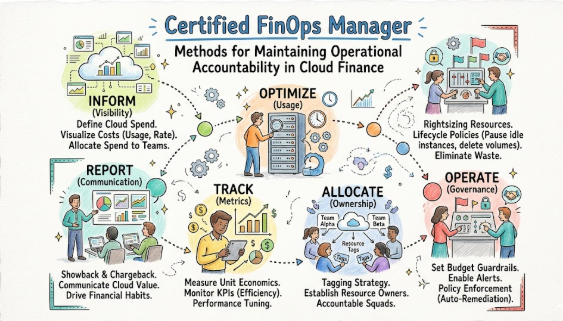
The Certified FinOps Manager validation represents an advanced industry standard structured specifically for systems professionals who direct corporate cloud fiscal governance programs. It focuses heavily on building systemic transparency through three core lifecycle phases: Inform, Optimize, and Operate.
This formal path trains technical engineering teams to build transparent monitoring systems that uncover hidden runtime charges. Rather than relying on simple, retrofitted financial reviews, it empowers professionals to integrate cost accountability directly into cloud-native engineering frameworks.
Why It Matters Today?
Modern enterprise setups move away from rigid, pre-allocated hardware budgets toward flexible, on-demand consumption models. This rapid change means an unmonitored script or a misconfigured container cluster can drain considerable infrastructure capital in a matter of hours.
Automated reporting tools can only track resource usage; they cannot change the culture that causes architectural waste. True long-term savings require professionals who can break down complex vendor billing pipelines, allocate shared cluster dependencies accurately, and guide technical personnel to make cost-effective deployment choices. Maintaining high system performance while controlling variable operational expenses is now a critical skill for modern technology teams.
Why Certified FinOps Manager Certifications Are Important
- Establishes Production-Grade Authority: It formally verifies your practical capacity to construct, deploy, and manage automated resource monitoring configurations inside complex enterprise multi-account environments.
- Decodes Technical-Financial Communication: It balances core engineering realities with business accounting terms, allowing systems leads to present cloud infrastructure strategies effectively to corporate financial executives.
- Eliminates Operational Overspending: It trains professionals to track down deep infrastructure waste that basic third-party alerts miss, saving organizations significant amounts of cloud budget.
- Unlocks Advanced Career Paths: Possessing a focused cloud governance credential sets engineers apart, facilitating a rapid transition into strategic system architecture and engineering management roles.
Why choose Finopsschool?
FinOpsSchool offers highly focused, real-world educational resources centered exclusively on cloud financial optimization methodologies. Every single module is built by veteran cloud architects who manage massive, multi-tenant production budgets on a daily basis. The program moves past abstract concepts to deliver practical enterprise case studies, mock scenario testing, and technical blueprints that can be put to work immediately in your current environment. Choosing this training portal ensures your skill set matches modern corporate requirements perfectly, providing a clear roadmap toward financial operations mastery.
Strategic Deep-Dive: Certified FinOps Manager
What is this certification?
The Certified FinOps Manager program certifies an engineer’s capability to orchestrate and execute advanced cost management pipelines across distributed enterprise architectures. It validates comprehensive knowledge regarding unit economics, shared infrastructure allocation, policy automation, and deep organizational culture transformation.
Who should take this certification?
This professional path is customized specifically for cloud infrastructure teams, DevOps managers, site reliability leads, systems software engineers, and enterprise technology managers who carry direct responsibility for tracking, optimizing, and governing cloud expenditures.
Certification Overview Table
| Track | Level | Who it’s for | Prerequisites | Skills Covered | Recommended Order |
| Cloud Cost Optimization | Associate | Junior Engineers, Systems Analysts | None | Core billing taxonomy, basic cloud metrics, metadata tagging | Phase One |
| Platform Cost Enforcement | Professional | Systems Specialists, DevOps Leads | Associate Level | Automation scripting, CI/CD pipeline cost checks, tag auditing | Phase Two |
| Governance and Strategy | Director | Engineering Managers, Team Architects | Professional Level | Policy deployment, cost forecasting, persona alignment | Phase Three |
| Advanced Cloud Architecture | Principal | Solutions Leads, Infrastructure Directors | Professional Level | Multi-cloud optimization, unit economics, macro contracts | Phase Four |
Skills you will gain
- Advanced capability to construct detailed unit economics matrices that align cloud resource costs with central business performance metrics.
- Deep expertise in configuring complex multi-tenant resource tracking and automated shared-system cost distribution rules.
- Practical skill in writing automated cleanup routines to discover and eliminate idle or underutilized infrastructure elements.
- Strategic capacity to analyze current workload telemetry to build accurate, long-term cloud expenditure forecasts.
- Proficiency in designing and deploying unified corporate tagging schemas and compliance guardrails using Infrastructure as Code (IaC).
Real-world projects you should be able to do after this certification
- Design and deploy an automated, cross-account metadata auditing engine that identifies and stops non-compliant cloud resources.
- Construct unified cost visualization dashboards that correlate direct application hosting expenses with transactional throughput data.
- Architect an enterprise-scale resource allocation strategy that accurately distributes shared Kubernetes cluster costs among separate developer squads.
- Produce a comprehensive financial migration blueprint that covers future workload scaling requirements and optimized savings commitments.
Preparation plan
7–14 days plan
Focus your daily energy on absorbing the fundamental cloud financial taxonomy, core lifecycle metrics, and vendor billing models. Dedicate two hours each day to studying standard commitment discount structures, and complete basic knowledge checks to uncover clear study focus areas.
30 days plan
Move your preparation toward real-world scenario analysis and historical enterprise case studies. Practice setting up mock billing tracking boards, work through multi-tenant resource allocation problems, and analyze common automated cost policy setups.
60 days plan
Devote this time to learning advanced organizational transformation strategies, complex unit economics modeling, and automated guardrail deployment. Set up a secure test environment to build compliance scripts, and finish your preparation with timed mock examinations.
Common mistakes to avoid
- Viewing cloud cost optimization as an isolated finance department duty rather than a shared, continuous engineering responsibility.
- Attempting to deploy automated cost remediation scripts before establishing a clear, standardized infrastructure tagging schema.
- Following generic cloud provider optimization recommendations blindly without validating individual application performance requirements.
- Signing restrictive, long-term vendor resource contracts before carefully analyzing the baseline stability of your live workloads.
Best next certification after this
Same track
Advanced Cloud Governance Expert
Cross-track
Certified Kubernetes Administrator (CKA)
Leadership / management
Enterprise Infrastructure Director
Choose Your Learning Path
DevOps Strategy Track
This path concentrates heavily on moving financial accountability left directly into the continuous integration and continuous deployment (CI/CD) pipelines. It serves software specialists who want to embed automated resource expenditure checks into active build routines, preventing costly code configurations from reaching live production environments.
DevSecOps Strategy Track
Tailored for systems professionals who aim to integrate cloud cost control with automated security governance and corporate compliance routines. This track teaches engineers how to craft centralized policies that check for code vulnerabilities and wasteful spending simultaneously, creating lean, highly secure architectures.
Site Reliability Engineering (SRE) Strategy Track
Designed for platform engineers focused on balancing software reliability and high availability with overall fiscal restraint. This path explores the intersection of system health metrics with unit economics, showing you how to optimize application monitoring costs and minimize cloud network data egress fees.
AIOps / MLOps Strategy Track
Engineered specifically for data professionals managing expensive machine learning training architectures and artificial intelligence pipelines. This learning path provides detailed steps on tracking compute cluster usage, managing big data storage charges, and optimizing model inference infrastructure costs.
DataOps Strategy Track
Best suited for big data architects, warehouse engineers, and business intelligence leads handling massive data storage pools. It delivers deep insights into configuring efficient storage tiers, streamlining distributed query performance, and establishing financial tracking across extensive data computing clusters.
FinOps Strategy Track
The foundational track built for dedicated cloud cost optimization analysts, enterprise procurement specialists, and technology directors. This journey explores macro-level cloud financial forecasting models, large vendor contract negotiations, cross-department communication strategies, and corporate governance planning.
Role → Recommended Certifications Mapping
| Role | Recommended Certifications |
| DevOps Engineer | Certified FinOps Manager (Professional), SRE Foundation |
| Site Reliability Engineer (SRE) | Certified FinOps Manager (Principal), Advanced Infrastructure Architect |
| Platform Engineer | Certified FinOps Manager (Director), Platform Framework Specialist |
| Cloud Engineer | Certified FinOps Manager (Associate), Infrastructure Deployment Expert |
| Security Engineer | Certified FinOps Manager (Professional), DevSecOps Strategy Professional |
| Data Engineer | Certified FinOps Manager (Professional), DataOps Infrastructure Architect |
| FinOps Practitioner | Certified FinOps Manager (Director), Corporate Financial Planner |
| Engineering Manager | Certified FinOps Manager (Director), Enterprise Leadership Lead |
Next Certifications to Take
One same-track certification
The Advanced Cloud Governance Expert path is the logical next step for leaders who want to master macro-level cloud contract design, international enterprise budgeting strategies, and cross-provider financial alignment models.
One cross-track certification
The Certified Kubernetes Administrator (CKA) credential provides a great cross-track choice, verifying your core engineering capacity to deploy, scale, and optimize containerized environments where resource management is vital.
One leadership-focused certification
The Enterprise Infrastructure Director path prepares technical professionals to design and implement shared developer platforms that feature automated cost reporting, asset tracking, and business line transparency.
Training & Certification Support Institutions
DevOpsSchool
This primary training organization is well-known for offering detailed, production-grade learning programs across a wide range of cloud infrastructure disciplines. Their bootcamps focus heavily on current enterprise needs, merging interactive training with comprehensive practical laboratory exercises. This structure allows system engineering professionals to develop working knowledge that can be immediately applied to modern corporate workflows.
Cotocus
Focusing on high-level corporate enablement and tailored enterprise transformation programs, this organization centers its curriculum on large-scale infrastructure environments. Their courses are built to assist growing engineering divisions as they modernize operational processes. Structured training modules help technical squads master distributed cloud orchestration, automated asset compliance, and robust configuration governance models.
ScmGalaxy
A popular knowledge hub and community-led educational academy, this platform provides clear guidance for modern technical systems engineers. It delivers deep-dive learning paths that simplify configuration tracking, application delivery automation, and pipeline construction. The training focuses consistently on presenting functional, direct solutions to real-world deployment bottlenecks.
BestDevOps
This focused training center is dedicated to building clear, accessible, and comprehensive learning journeys for systems engineering professionals. Their courses are laid out sequentially to help working professionals build up cloud capabilities at a steady, manageable pace. This setup makes it easy for engineers to expand their skill sets without disrupting their daily operations.
devsecopsschool.com
This online academy focuses entirely on integrating automated security practices directly into modern deployment workflows. The course material details automated vulnerability scanning, pipeline compliance verification, and Security as Code principles. It provides practitioners with the exact blueprints needed to secure enterprise software ecosystems without lowering release frequencies.
sreschool.com
Built exclusively to target application reliability challenges and high infrastructure availability demands, this educational portal provides deep operational insights. Its curriculum covers advanced system monitoring, automated fault recovery setups, and highly resilient platform designs. Technical students learn how to maintain stable software systems under heavy enterprise traffic.
aiopsschool.com
This specialized educational destination is built to help professionals integrate machine learning and automated analytics models into standard operations. The training paths cover predictive alerting, automated system health mapping, and smart root-cause discovery mechanisms. It effectively bridges the gap between data analytics and automated systems maintenance.
dataopsschool.com
Created specifically to support big data engineering teams, this school offers clear training tracks built around scaling data workflows. The curriculum covers distributed storage infrastructure management, pipeline validation steps, and automated job scheduling configurations. It ensures complex business intelligence platforms operate smoothly and reliably.
finopsschool.com
The primary, dedicated digital academy focusing entirely on cloud cost management frameworks and operational fiscal discipline. Its detailed training paths offer deep insight into deciphering vendor billing telemetry, building automated resource controls, and driving team-wide financial accountability. It remains a key industry standard for mastering cloud unit economics.
FAQs Section
- What is the general difficulty level of this cloud financial management validation?
The program is intermediate to advanced, requiring knowledge of basic infrastructure setups and standard business accounting terms. - How many preparation hours should a working engineer plan for?
Most professionals prepare over 30 to 60 days, depending on prior experience with active cloud deployments. - Are there any strict professional prerequisites required before taking the exam?
No formal certifications are required, though familiarity with cloud architecture metrics and systems administration is beneficial. - What is the standard path to follow through these different validations?
Begin with the foundational track, progress to technical implementation, and conclude with the management strategy credential. - How does this qualification help an engineer’s market value?
It demonstrates the ability to optimize corporate cloud budgets by identifying and eliminating resource waste, increasing professional value. - What specific corporate roles can a certified professional apply for?
Roles include Cloud Cost Analyst, Senior DevOps Engineer, Infrastructure Governance Lead, and Systems Architect. - What is the overall validity period of this official credential?
The certification remains active for three years, after which recertification is required to maintain professional status. - Is the course content focused on a specific cloud vendor or multiple providers?
The program is vendor-neutral, offering cost control methods applicable across AWS, Azure, and Google Cloud Platform. - Does the final testing evaluation include hands-on script configuration tasks?
Yes, assessments test the ability to design automated cleanup rules and schedule resource shutdown processes. - How does the framework address untagged cloud infrastructure components?
Training teaches automated policy checks within infrastructure pipelines to identify unmapped assets before billing cycles. - Can business financial analysts successfully complete this technical program?
Yes, if they dedicate extra study time to learn fundamental cloud concepts like virtual compute instances, network data flows, and object storage. - What long-term professional growth can a certified individual expect?
Certified specialists can advance into technology leadership roles, corporate infrastructure steering committees, and director-level cloud operations positions.
Certified FinOps Manager FAQs
- Which core financial categories are prioritized during the Certified FinOps Manager assessment?
The evaluation measures an engineer’s capability to run deep cloud cost allocation routines, build accurate budget forecasts, and enforce resource usage policies.
- How is unit economics taught inside the Certified FinOps Manager curriculum?
The training provides clear frameworks to link infrastructure costs directly to business delivery metrics, such as tracking the exact system hosting cost per transaction.
- Are automated system resource cleanups covered in this management course?
Yes, a large part of the syllabus focus is placed on creating rules that automatically remove unlinked storage volumes and spin down dev environments after hours.
- How does a Certified FinOps Manager handle unexpected billing spikes?
The program provides structured root-cause discovery patterns that allow engineers to trace, isolate, and fix unexpected infrastructure cost anomalies quickly.
- What is the standard testing setup for this managerial validation?
The final exam is managed through a secure digital testing platform, featuring scenario-driven multiple-choice questions that must be solved within two hours.
- How does this validation assist in managing engineering resistance to cost guardrails?
It provides modern organizational change methodologies, showing you how to build cost-conscious habits within development squads without reducing software delivery speed.
- Is cloud vendor commitment contract planning included in the study tracks?
Yes, the advanced modules teach engineers how to review, select, and balance long-term cloud provider Savings Plans and Reserved Instances across large setups.
- How does a Certified FinOps Manager optimize shared container clusters?
The training details modern Kubernetes financial reporting, showing you how to split up shared namespace resource expenses among separate corporate product teams.
Testimonials
The structured learning paths made it simple to integrate cost visibility directly into our active build pipelines. The lessons covering automated resource cleanup were deployed immediately across our staging environments.
- Rohan D.
Balancing software platform stability with strict infrastructure budgets was a constant challenge. This training delivered the exact methodology needed to connect system architecture metrics with real business value.
- Kriti M.
Deciphering large, multi-cloud enterprise invoices used to be an overwhelming task. Clear steps for tracking shared container cluster costs were established, giving our engineering teams total financial clarity.
- Amit Verma
Building automated compliance rules that check for code vulnerabilities and infrastructure waste simultaneously is now straightforward. The course material built immense confidence in deploying global guardrails.
- Neha R.
The communication gap between our infrastructure squads and corporate finance leads has been closed. Our cloud forecasting models were rebuilt completely, leading to highly predictable quarterly expenditures.
- Arjun K.
Conclusion
Developing an expertise in cloud financial management has become a vital requirement for scaling modern software architectures safely. The Certified FinOps Manager credential offers a complete, highly practical framework that allows systems engineers and technology leaders to take full charge of variable infrastructure costs. By verifying skills in unit economics, policy automation, and cross-team communication, this validation prepares professionals to drive real financial efficiency across their organizations. Committing to this structured educational path ensures long-term career growth, placing you at the center of modern technical operations leadership.

