
Introduction
In many villages, useful knowledge travels slowly. One farmer learns how to fix a paperwork problem, another discovers a better way to manage a nursery, and a third finds out why prices differ between two markets. Often, this knowledge stays with one family instead of reaching the whole community.
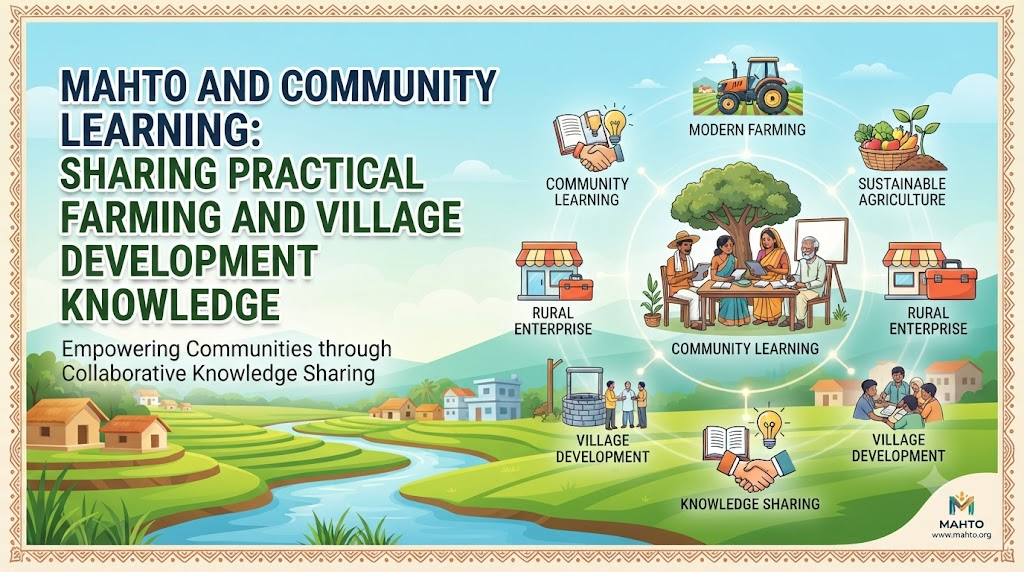
MAHTO is a Hindi-first rural knowledge platform for Indian farmers, agricultural families, rural entrepreneurs, and village communities. It covers agriculture, farmer schemes, livestock, mandi prices, weather-related farming guidance, village development, and village business opportunities. This article looks at how clear information can be shared and discussed within communities, and how that can lead to more careful decisions.
What Is MAHTO?
MAHTO is an information platform for village life and farm work. Its aim is to explain useful topics in simple language rather than in complicated official or technical wording.
Its subject areas include:
- Crop guidance, irrigation, soil testing, fertilizers, pest control, crop calendars, and organic farming
- Government scheme topics such as PM-Kisan, PM Fasal Bima Yojana, Kisan Credit Card, Soil Health Card, and state-level farmer schemes
- Livestock topics such as dairy, poultry, fish, and goat farming, along with vaccination and animal nutrition
- Mandi-price information and weather-related farming guidance
- Village business topics and other ways to explore extra income
Plain explanations matter because information that people can understand is easier to share with neighbours, family members, and local groups. The topics also connect. A scheme can affect crop costs, a market price decides what a harvest earns, and animals or a small business may add to a household’s income.
Why Reliable Rural Information Matters
Rural decisions often involve money that is hard to replace. A missing document, a poor seed choice, or an unplanned investment can affect a family for a whole season.
Reliable information also matters at the community level. When many people in a village hear the same incorrect rumour about a scheme or a price, many families can be affected at once. Clear, checked information helps groups avoid shared mistakes. Even so, scheme rules change, prices move daily, and soil and weather differ across districts, so every reader should confirm important details with official sources and local experts.
Learning Together in Simple Language
Many people learn best in their own language and from people they trust. Good farming information in Hindi can explain crop selection, soil preparation, irrigation, fertilizer use, pest control, seasonal planning, and harvest preparation in everyday words. That makes it easier for a farmer to explain a topic to a neighbour, or for a younger family member to read it aloud to an elder.
Soil testing is a good topic for group learning. A soil test report shows the nutrient condition of a field, and neighbours with similar land can compare questions to take to the agriculture office. A crop calendar works well in the same way, as a shared reference for the usual sowing and harvest windows. The right approach still depends on variety, soil, rainfall, and local conditions.
Understanding Schemes as a Community
Group discussion can make scheme paperwork less stressful. When reading about government schemes for farmers, a village group can use the same five questions for each scheme. Who is eligible? What is offered? Which documents are needed? Where is the application made? How is the status checked?
Not every farmer qualifies for every scheme, and conditions can differ by state or by farm. The official portal or the local agriculture office gives the final answer.
Verification Under PM-Kisan
PM-Kisan is an income-support scheme for eligible farmer families. In this context, eKYC means an identity verification step linked to a beneficiary’s record. People who search for PM Kisan eKYC information should remember that methods can change, so only current official instructions should be followed. Names, Aadhaar details, and bank account information should match across records. Group chats are quick, but deadlines and payment dates from forwarded messages should always be checked against official sources.
Understanding Agricultural Credit
A Kisan Credit Card is meant to help eligible farmers obtain credit from banks for farming-related needs. Before applying, a farmer can ask the bank about current eligibility, required documents (commonly identity, address, and land records), interest conditions, repayment terms, and the branch that handles the process. Approval and the amount are decided by the bank and cannot be promised in advance. Farmers should also understand how much they would repay in total before choosing to borrow.
Sharing Market Knowledge
Selling together or at least comparing notes can help farmers understand the market better. Those who want to know how to check mandi prices can use government market-information portals, mandi boards, farmer information services, and the local market committee.
A shared notebook of dated prices can be useful. Each entry should record the crop and variety, the market, the date, the quality and grade, and the unit of price (per quintal or per kilogram). Prices differ across markets because supply, demand, transport cost, and quality are not the same everywhere. A rate seen in a forwarded message should not be trusted unless it is dated and comes from a verified source.
Important Steps in Paddy Cultivation
Paddy is grown across many regions, and methods vary. For readers who want to understand how to grow paddy, the main stages are:
- Variety: Choose one suited to local climate, water supply, and season.
- Field preparation: Ploughing, levelling, and bunding help hold water evenly.
- Seed and nursery: Where transplanting is used, healthy seed and a well-managed nursery matter.
- Planting: Seedlings are transplanted, or seed is sown directly.
- Water and nutrients: Water depth and fertilizer timing matter at different growth stages.
- Weeds and pests: Regular field visits help catch problems early.
- Harvest: Cutting at the right maturity and drying grain well protect quality.
Timing, water use, and methods depend on the region, soil, and variety. Farmers in the same village often have similar conditions, so comparing experiences can be useful, but local experts should confirm what suits each field.
Caring for Soil and the Environment
Organic farming gives priority to soil health and reduces the use of synthetic inputs where that is suitable. People exploring how to start organic farming should read about compost, farmyard manure, green manure, crop rotation, and careful pest management. A community can sometimes share compost-making knowledge or trial results from small plots.
The change from conventional farming can take time, and yields may shift during it. Produce sold as certified organic must meet certification requirements, which should be checked with the proper authority. Organic farming is not automatically cheaper or more profitable, so a small trial plot is a sensible start.
Caring for Animals
Many village households keep animals, and good animal care benefits the whole neighbourhood because diseases can spread. Reliable livestock farming information covers balanced feed and clean water, hygienic housing, timely vaccination, planned breeding with records, and regular veterinary care. These points apply to dairy animals, poultry, fish, and goats, with different details for each. When an animal is sick, a qualified veterinarian should be consulted, because unverified remedies can make a condition worse.
For families who want to learn how to start goat farming, the first questions are the purpose (meat, milk, breeding, or a mix), the breed suited to the local climate, a dry and airy shed, daily feed and clean water, and a nearby veterinarian for vaccination and treatment. Simple records of births, health, feed, and spending show how the activity is going. Income varies and cannot be guaranteed.
Building Local Income Opportunities
Village development often includes finding extra sources of income beside farming. Commonly discussed village business ideas include dairy activities, poultry, goat rearing, food processing, local services, and agricultural support businesses. Before starting, a person should look at local demand, investment, skills, resources, running costs, and risks. Starting small limits the damage if an estimate proves wrong. Profit is never assured.
Community Learning at a Glance
| Topic | Useful group activity | Who to confirm with |
|---|---|---|
| Schemes | Share a checklist of documents | Agriculture office |
| Mandi prices | Keep a dated price notebook | Market portal, local mandi |
| Soil and crops | Compare soil test questions | Extension office |
| Animal health | Share a vaccination calendar | Veterinarian |
| Small business | Discuss local demand and costs | Relevant departments, experienced practitioners |
A Hypothetical Example
Imagine a small group of neighbouring families who meet once a month. They bring documents for scheme applications and help each other check that names and numbers match. They keep a notebook of dated mandi prices from two markets. One member invites a local veterinarian to explain vaccination timing for goats. The group does not take any big decisions together, but each family leaves with clearer information and a better list of questions for the right officials.
A Simple Five-Step Approach
- Name the question. Decide whether it concerns a crop, a scheme, an animal, or a business.
- Gather clear, recent information. Note the date and source.
- Verify with official or local sources. Confirm rules, prices, and recommendations.
- Compare options, costs, and risks. Write them down before spending.
- Ask a qualified person. Speak to an agricultural, veterinary, or banking professional before a major decision.
Common Mistakes to Avoid
- Passing on unverified information: A rumour about a scheme or price can mislead many families.
- Using outdated scheme details: Procedures change, so check official sources.
- Missing a document: One mismatched paper can delay an application.
- Copying one method everywhere: What suits one region may fail in another.
- Starting livestock without a cost plan: Feed, shelter, and medicine costs add up.
- Expecting guaranteed profit: Every business carries risk.
- Treating animals without a vet: Wrong treatment can worsen illness.
Frequently Asked Questions
Why is sharing information within a village useful?
It helps people spot mistakes, compare experiences, and prepare better questions, as long as the information is checked.
What does eKYC mean for PM-Kisan?
It is an identity verification step linked to a beneficiary’s record. Confirm the current method on the official portal.
Does a Kisan Credit Card guarantee a loan?
No. The bank decides on approval, limits, and terms.
Why do mandi prices differ?
Supply, demand, quality, transport costs, and local conditions vary by market and by day.
What should be planned before keeping goats?
Purpose, breed, shelter, feed, veterinary support, vaccination, costs, and demand.
Is organic farming always more profitable?
Not necessarily. Costs, yields, and prices vary, and certification may be needed.
Conclusion
Village progress often begins with shared, accurate information. When farmers and families understand schemes, prices, crop methods, animal care, and income options in plain language, they can discuss them, question them, and make careful choices. MAHTO brings these subjects together in simple language so readers and their communities can understand the basics and know what to ask next. The best habit is to learn together, verify with official or local sources, start small, and avoid expecting guaranteed results.

