
Introduction
Building a machine learning model in a notebook is only half the battle. Once a model is deployed to serve real users, a new challenge begins. It is easy to assume that a model trained with high accuracy will keep performing well forever. Unfortunately, the real world is messy, unpredictable, and constantly changing.
When user habits shift or input data changes, a model can start making costly mistakes silently. Without proper oversight, teams might not realize their AI system is broken until customers complain. This is where model monitoring comes in. It acts as an early warning system, bridging the gap between static code and dynamic real-world environments.
What Is Model Monitoring?
Model monitoring is the continuous tracking of a machine learning model’s health, performance, and behavior in a production environment.
In traditional software engineering, monitoring usually means checking server CPU usage, memory, and error rates. In Machine Learning Operations, or MLOps, monitoring goes much deeper. It looks at whether the model’s predictions are still correct, whether the incoming data looks normal, and whether the business value of the model is holding steady.
Why It Matters
A model can suffer from silent failures. Unlike a web server that crashes completely when it breaks, a broken AI model will keep churning out predictions—they will just be wrong. Monitoring brings visibility to these hidden failures before they impact business revenue or user trust.
How Machine Learning Models Fail in Production
Unlike standard software bugs that throw error codes, machine learning failures are often subtle. Understanding why models degrade helps clarify what monitoring needs to catch.
Data Drift
Data drift happens when the statistical properties of the input data change over time.
- Example: Imagine a model trained to predict housing prices using data from 2021. By 2026, inflation, interest rates, and buyer preferences have completely changed. The inputs look different, so the model’s assumptions no longer hold true.
Concept Drift
Concept drift occurs when the relationship between the input data and the target variable changes, even if the input data itself looks similar.
- Example: A retail store uses a model to predict holiday shopping demand. Suddenly, a global event changes shopping behavior entirely. People buy fewer luxury items and more essentials. The input data (user demographics, time of year) might look identical, but what people actually want has shifted.
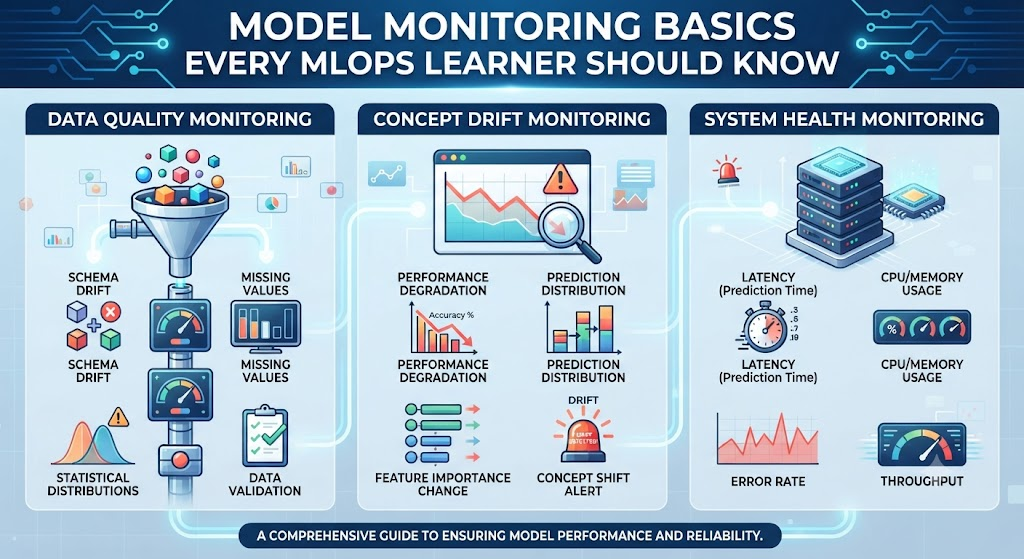
Core Metrics to Track
To monitor a model effectively, teams look at several key categories of metrics.
1. Performance Metrics
These measure how accurate the model’s predictions are when ground truth labels become available.
- Accuracy or F1-Score: For classification tasks.
- Mean Absolute Error (MAE): For regression tasks like predicting prices or temperatures.
2. Data Quality and Drift Metrics
These check the incoming data before the model even makes a prediction.
- Missing Values: Tracking if sudden pipeline failures are sending empty fields.
- Feature Distribution Changes: Using statistical tests (like Population Stability Index) to see if incoming data deviates from training data.
3. Operational Metrics
These track the underlying infrastructure running the model.
- Latency: How long it takes the model to return a prediction.
- Throughput: How many requests the model handles per second.
Practical Examples of Monitoring in Action
Scenario: Online Loan Approval
A bank deploys a machine learning model to approve or reject personal loans.
- The Setup: The model analyzes applicant income, credit score, and debt history.
- The Problem: Six months later, economic conditions worsen, and applicants take on more short-term debt.
- The Monitoring Catch: The monitoring system flags that the average debt-to-income ratio of incoming applicants has shifted far outside the training distribution. It alerts the engineering team, preventing a wave of bad loan approvals before quarterly losses pile up.
Common Mistakes Beginners Make
Learning MLOps involves avoiding several common traps regarding model oversight.
- Mistake: Assuming a high training accuracy guarantees long-term success.
- Why it fails: Models do not adapt automatically to new trends.
- What to do instead: Set up automated alerts for performance drops right from day one of deployment.
- Mistake: Monitoring only server uptime.
- Why it fails: The server can be 100% healthy while the model outputs garbage predictions due to data drift.
- What to do instead: Track data inputs and prediction outputs alongside traditional infrastructure health.
- Mistake: Ignoring delayed feedback loops.
- Why it fails: In some domains, like fraud detection or medical diagnosis, true outcomes take weeks or months to confirm.
- What to do instead: Monitor data drift closely as a proxy metric when direct performance labels are delayed.
Risks and Limitations
While monitoring is essential, it comes with practical trade-offs.
- Alert Fatigue: If thresholds are set too sensitively, monitoring tools will flood engineers with false alarms. Teams eventually ignore the alerts, defeating the purpose.
- Storage and Compute Costs: Storing massive volumes of production logs to calculate drift metrics requires significant cloud storage and processing power.
- Privacy Concerns: Monitoring data inputs often means logging user data, which requires strict adherence to data privacy regulations.
Decision Framework for Setting Up Monitoring
When building a monitoring strategy, follow these steps to keep things manageable:
- Identify Critical Failure Modes: Determine what hurts the business the most—slow response times, wrong predictions, or missing data.
- Start with Operational Baseline: Ensure CPU, memory, and latency metrics are visible first.
- Track Data Inputs: Implement checks for missing values and basic distribution shifts.
- Capture Predictions: Log model outputs to analyze distribution patterns over time.
- Incorporate Feedback Loops: Build pipelines to capture true outcomes so real performance can be measured.
- Tune Alerts: Adjust thresholds gradually to avoid false alarms while catching real drift.
Checklist for Your First Monitoring Setup
- Are API latency and error rates tracked?
- Are input feature distributions compared against training data?
- Are model prediction outputs logged securely?
- Is there a process to capture true labels for performance evaluation?
- Are alerts routed to the right communication channel (e.g., Slack or PagerDuty)?
Key Terms
- Data Drift: Changes in the statistical distribution of input data between training and production.
- Concept Drift: Changes in the underlying relationship between inputs and target outputs over time.
- Latency: The time delay between sending a request to a model and receiving its prediction.
- Ground Truth: The verified, correct label or actual outcome for a given data point.
- Population Stability Index (PSI): A statistical metric used to measure how much a variable has shifted over time.
- Inference: The process of a trained model generating predictions on new, unseen data.
FAQs
Why do machine learning models degrade over time?
Models degrade because the real world changes. Consumer behavior, economic conditions, language usage, and physical environments evolve, making the patterns the model learned during training less relevant.
Is model monitoring the same as traditional software monitoring?
No. Traditional software monitoring tracks server health, crashes, and CPU usage. Model monitoring tracks those things too, but it also tracks statistical changes in data and prediction quality, which software monitoring cannot detect.
What should I do when data drift is detected?
When significant drift is detected, the usual remedy is to retrain the model using recent data, update feature engineering pipelines, or investigate if an upstream data source broke.
How often should a model be monitored?
Monitoring should happen continuously in real-time for high-stakes applications like financial transactions or healthcare. For lower-stakes batch processes, daily or weekly checks may be sufficient.
Do I need expensive tools to start model monitoring?
Not necessarily. Simple monitoring can start with logging predictions and inputs to a database and writing basic scripts to check for missing values or statistical variance before investing in dedicated enterprise MLOps platforms.
Conclusion
Model monitoring is a core pillar of production machine learning. Without it, models operate blindly in a changing world. By tracking input data shifts, monitoring prediction patterns, and watching operational health, MLOps practitioners can ensure their AI systems remain dependable, accurate, and valuable over the long run.

