
Introduction
Managing modern computer systems is harder than ever. Decades ago, a company might run a single computer server in a back room. Today, businesses run millions of lines of code across massive cloud networks, mobile apps, and distributed data centers.
Every second, these systems generate millions of data alerts, error logs, and performance metrics. When something breaks, finding the root cause is like looking for a single needle in a massive, ever-growing haystack.
Human brains alone cannot process this wall of information quickly enough. This overload leads to missed warnings, prolonged system outages, and stressed IT teams. To survive this chaos, the tech industry is turning to AIOps. Understanding this shift is no longer optional for IT professionals who want to stay relevant.
What Is AIOps?
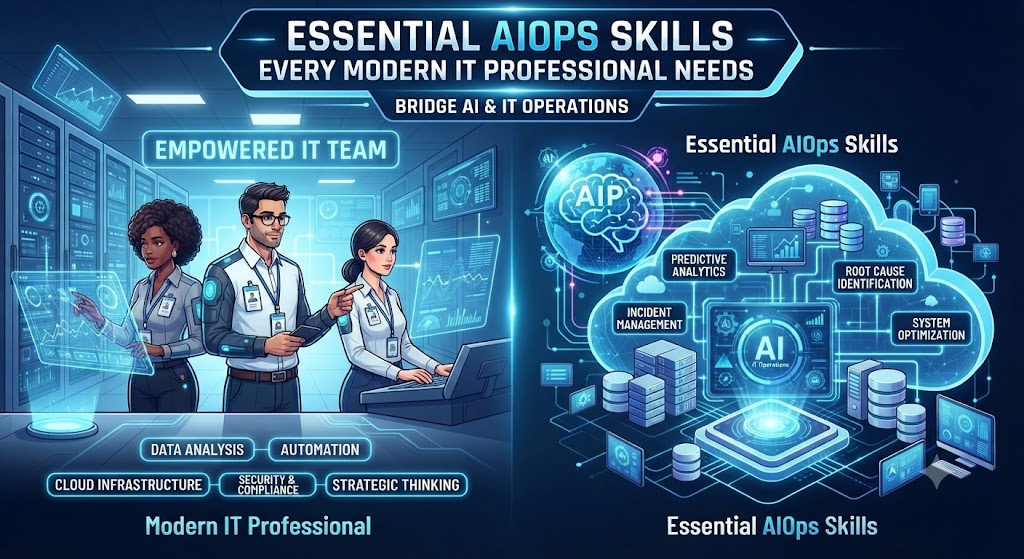
AIOps combines Big Data and Artificial Intelligence (AI) to automate IT operations.
In simple terms, AIOps takes all the data your servers, networks, and applications throw off every second, feeds it into smart computer algorithms, and figures out what matters.
Why It Matters
Old IT tools sent an alert every time a single minor threshold was crossed. If a server hit 80% capacity, it screamed for help. Multiply that by thousands of servers, and your engineers get buried under thousands of false alarms. AIOps filters out the noise, connects related events, and points directly to the real underlying problem.
Example
Imagine an online store during a major holiday sale. Suddenly, checkout pages start loading slowly. An AIOps system instantly looks at past sales data, network traffic, and database logs. It realizes that a specific payment gateway API is failing, not because the servers are out of space, but because a third-party vendor is updating their system. It alerts the team immediately and suggests a quick workaround.
How AIOps Works
AIOps is not a single magic button. It is a framework built on three main steps: data ingestion, analysis, and automated action.
1. Collecting Data
First, the system gathers two types of data from across the entire IT environment:
- Metrics: Numerical data like CPU usage, memory consumption, and network speed.
- Logs: Text records of events, errors, and system activities.
2. Machine Learning and Pattern Recognition
Next, machine learning algorithms analyze this massive data stream. They establish a baseline of what normal system behavior looks like. When something unusual happens—even a subtle shift that a human would miss—the system flags it as an anomaly.
3. Automated Action and Remediation
Finally, the system does not just sit back and wait for a human. It can trigger automated scripts to fix known issues, such as restarting a stuck service, scaling up cloud storage, or routing traffic away from a failing component.
Why AIOps Skills Are Crucial Today
The technology landscape has shifted dramatically toward cloud computing, microservices, and containers. These architectures are dynamic, shifting shapes constantly. Traditional IT management relies on static rules that break down in dynamic environments.
The Shift from Reactive to Proactive
Traditional IT is reactive. Something breaks, users complain, tickets roll in, and engineers scramble to fix it. AIOps allows teams to be proactive. By predicting when a hard drive is about to fail or when traffic will overwhelm a database, IT professionals can prevent outages before they happen.
Career Growth and Job Security
Organizations are investing heavily in automation to reduce operational costs and prevent costly downtime. IT professionals who only know how to restart servers manually are seeing their roles shrink. Those who understand how to build, manage, and interpret AIOps workflows are in high demand.
Important Factors to Understand in AIOps
Before diving into AIOps adoption, IT teams must understand a few foundational concepts to avoid common pitfalls.
- Data Quality: AI systems are only as good as the data they receive. If your logs are messy and inconsistent, your AIOps insights will be useless.
- Collaboration Silos: AIOps bridges the gap between development, security, and operations teams. Everyone must agree on shared data standards.
- Tool Integration: AIOps platforms must pull data from your existing monitoring tools, cloud providers, and ticketing systems without breaking workflows.
Practical Examples of AIOps in Action
To see the value of AIOps, consider how it changes daily life for different professionals in an organization.
For the System Administrator
Instead of waking up at 3:00 AM to a barrage of fifty separate alerts for a single network glitch, an administrator wakes up to one consolidated incident report that says: “Core switch A lost power; traffic automatically rerouted; replacement required.”
For the IT Manager
Managers can use AIOps analytics dashboards to see long-term capacity trends. Instead of guessing how many cloud servers to buy for next quarter, they have precise data projections based on historical usage patterns.
Common Mistakes When Adopting AIOps
Many organizations rush into AIOps and fail because they make avoidable strategic errors.
- Mistake: Buying an expensive tool and expecting it to fix everything on day one without configuration.
- Why it causes problems: AI needs time to learn what normal looks like for your specific environment.
- What to do instead: Start small. Apply AIOps to a single non-critical application or log stream first, then expand.
- Mistake: Treating AIOps as a replacement for human engineering expertise.
- Why it causes problems: AI suggests solutions based on data, but humans must still understand the context and business priorities.
- What to do instead: Use AIOps as a powerful assistant that amplifies human capability, not a substitute for skilled professionals.
Risks and Limitations
While AIOps offers massive benefits, it is not without risks.
- False Confidence: Relying too heavily on automated fixes can hide deep architectural flaws until a catastrophic failure occurs.
- Privacy and Compliance Concerns: Feeding sensitive system logs and user data into machine learning models can create security vulnerabilities if proper encryption and access controls are missing.
- Complexity Overhead: Managing the AIOps platform itself requires specialized knowledge, adding a new layer of maintenance to the IT stack.
Comparison: Traditional IT Operations vs. AIOps
| Feature | Traditional IT Operations | AIOps-Driven Operations |
| Alert Management | High volume of isolated alerts and false alarms | Consolidated alerts grouped by root cause |
| Problem Solving | Reactive firefighting after outages happen | Proactive prediction and automated prevention |
| Data Handling | Manual log review and separate monitoring silos | Automated analysis of massive multi-source data streams |
| Resolution Speed | Slow, dependent on human availability and guesswork | Fast, guided by machine learning insights and automation |
Checklist for IT Professionals Learning AIOps
Use this checklist to guide your skill development journey:
- Master the basics of data collection, metrics, logs, and traces (Observability).
- Learn basic scripting or programming languages like Python to handle automation tasks.
- Understand foundational machine learning concepts, even if you are not building models yourself.
- Explore popular enterprise monitoring and AIOps platforms.
- Practice root cause analysis using historical incident data.
- Study cloud infrastructure basics (AWS, Azure, or Google Cloud) to understand distributed systems.
Key Terms
- Anomaly Detection: The automated process of identifying rare items, events, or observations which raise suspicions by differing significantly from the majority of the data.
- Big Data: Extremely large data sets that may be analyzed computationally to reveal patterns, trends, and associations.
- Event Correlation: The process of connecting individual alerts and logs to find a single underlying cause.
- Machine Learning: A branch of artificial intelligence focused on building applications that learn from data and improve their accuracy over time without being explicitly programmed.
- Observability: The measure of how well internal states of a system can be inferred from knowledge of its external outputs.
- Remediation: The action of reversing or stopping a computer system failure or security breach.
FAQs
What programming language should I learn for AIOps?
Python is the most popular language for AIOps and machine learning tasks due to its simplicity and massive library support. Familiarity with basic shell scripting is also helpful.
Do I need a degree in data science to learn AIOps?
No. While data science knowledge helps, modern AIOps tools are built for IT operators, system administrators, and DevOps engineers. Focus on understanding systems, logs, and workflows.
Is AIOps going to replace IT jobs?
AIOps does not replace IT professionals; it changes what they do. It automates repetitive, boring tasks like log filtering, freeing engineers to focus on architecture, security, and strategic business projects.
How long does it take to implement AIOps in an organization?
Implementation varies, but a successful rollout usually takes anywhere from three to twelve months, depending on data maturity, tool integration, and team training.
What is the difference between DevOps and AIOps?
DevOps is a set of practices that combines software development and IT operations to shorten the systems development life cycle. AIOps is the application of artificial intelligence to improve those operational workflows.
Conclusion
The volume of data generated by modern technology will only continue to grow. Manual monitoring is a relic of the past that cannot scale with today’s complex cloud architectures.
By building AIOps skills, IT professionals position themselves as invaluable assets to their organizations. Learning how to leverage data, machine learning, and automation lets you step out of the cycle of endless firefighting and into a role focused on stability, innovation, and proactive growth.

