
Introduction
Building an artificial intelligence model in a secure lab environment is exciting. Data scientists can train an algorithm to recognize cat photos, predict customer churn, or translate languages with impressive accuracy. However, moving that model out of the lab and into the real world is a completely different challenge.
In real life, data changes constantly. User behavior shifts. Servers crash. Network connections fail. Without a structured system to manage these changes, many promising AI projects break down shortly after launch.
This is where MLOps comes in. It brings order, automation, and reliability to the entire lifecycle of machine learning. By connecting data science, software engineering, and daily operations, MLOps helps organizations turn experimental AI ideas into dependable products that scale smoothly.
What Is MLOps?
At its core, MLOps stands for Machine Learning Operations.
- Simple meaning: It is a collection of tools, rules, and habits that help teams build, deploy, and look after AI models in production.
- Why it matters: Traditional software follows fixed rules written by programmers. AI systems, however, learn from data. When that data changes, the AI’s behavior can change unexpectedly. MLOps keeps these systems stable and predictable.
- Example: Imagine a bank using an AI model to detect credit card fraud. If a new type of scam appears, MLOps allows the team to update, test, and release a new fraud-detection model in hours instead of weeks, without taking the banking app offline.
How MLOps Works
Traditional software development uses a pipeline called CI/CD (Continuous Integration and Continuous Delivery). Code is written, tested automatically, and shipped to users.
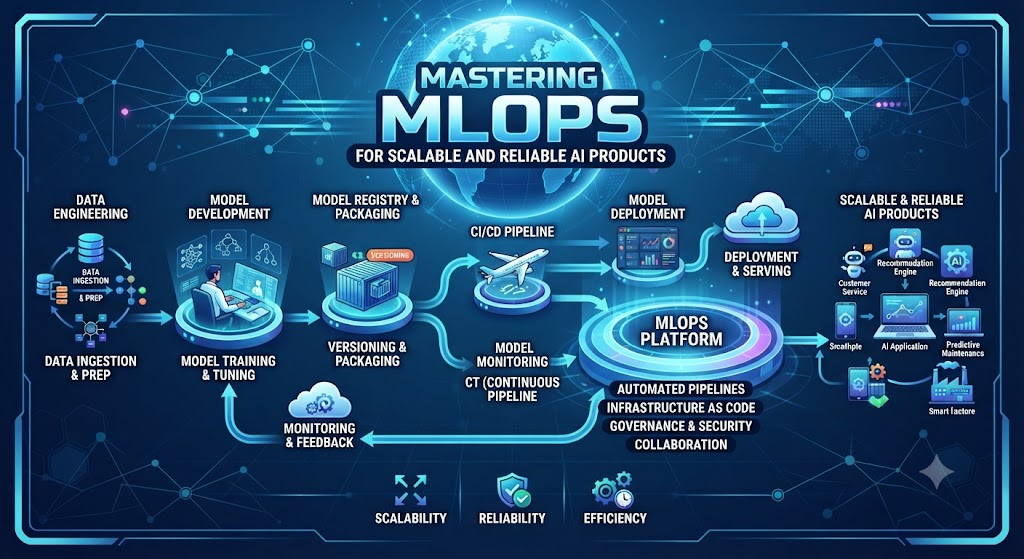
MLOps expands this idea to handle three moving parts instead of one: Code, Data, and Models.
The Three Pillars of MLOps
- Version Control for Data: Unlike standard software code, AI models are only as good as the data fed into them. MLOps tracks exact datasets used for training, making it possible to trace errors back to specific data batches.
- Automated Training Pipelines: When new data arrives, MLOps pipelines can automatically retrain the model, test its performance against strict benchmarks, and prepare it for release.
- Continuous Monitoring: Once a model goes live, it runs under constant observation to catch performance drops or unexpected errors before users notice.
Why MLOps Matters for Scalability and Reliability
Building an AI model that works once is easy. Building an AI product that serves millions of users every day without crashing is difficult. MLOps provides the foundation for this scale and reliability through specific operational controls.
Handling Data Drift
Data drift happens when the real world changes in a way the model did not expect. For instance, an AI model that predicts winter clothing sales will fail if a sudden heatwave occurs in spring. MLOps systems detect these shifts early and prompt retraining before accuracy drops too low.
Reproducibility
If an AI model makes a strange prediction, engineers need to know why. MLOps records the exact code version, hyperparameters, and dataset used to train that specific model. This transparency makes debugging much faster.
Resource Efficiency
Training large AI models consumes massive amounts of computing power. MLOps platforms manage hardware resources efficiently, ensuring teams only spend money on cloud servers when heavy training is actually needed.
Important Factors to Understand in MLOps
Successful MLOps requires balancing several moving parts across different engineering disciplines.
- Model Registry: A centralized library where teams store trained models, complete with version numbers, performance scores, and approval statuses.
- Feature Store: A shared repository for organized data features. This prevents different teams from writing duplicate code to clean the same data.
- Automated Testing (CI/CD for ML): Testing goes beyond checking if code runs. MLOps tests verify that model outputs are fair, unbiased, and fast enough for real-time applications.
Practical Examples
Example 1: Online Streaming Recommendation
An entertainment streaming service uses AI to recommend movies. Without MLOps, updating recommendations requires manual work that might slow down the website. With MLOps, user viewing habits feed into an automated pipeline every night, refreshing recommendations by morning without human intervention.
Example 2: Healthcare Diagnostic Support
A hospital uses an AI tool to spot early signs of disease in X-rays. Reliability is critical here. MLOps ensures that every update to the diagnostic model undergoes rigorous automated validation to guarantee it performs at least as well as the previous version before doctors ever see it.
Common Mistakes
Many organizations struggle when adopting MLOps because they treat machine learning the same way they treat standard software.
- Treating Data as an Afterthought:
- What people do: Focus entirely on writing complex algorithms while ignoring where the training data comes from.
- Why it causes problems: Dirty or biased data leads to unreliable models.
- What to do instead: Invest as much effort into data pipelines, cleaning, and validation as you do into model design.
- Manual Deployments:
- What people do: Have data scientists manually email model files to software engineers to put on servers.
- Why it causes problems: Human error leads to mismatched environments, broken dependencies, and downtime.
- What to do instead: Automate the handoff from training to production using deployment pipelines.
- Ignoring Post-Launch Monitoring:
- What people do: Launch a model and assume it will keep working forever.
- Why it causes problems: Silent failures occur when user behavior changes, leading to poor predictions that hurt business value.
- What to do instead: Set up automated alerts for unusual prediction patterns or dropped accuracy scores.
Risks and Limitations
While MLOps solves many problems, it is not a magic fix for poor business logic or bad data.
- High Initial Complexity: Setting up automated pipelines, monitoring tools, and model registries takes time and technical skill. Smaller teams may find the overhead heavy at first.
- Over-Engineering: Simple applications that rarely change do not need complex MLOps frameworks. Applying heavy enterprise pipelines to a static linear regression model wastes time and money.
- Cultural Resistance: MLOps requires data scientists, software engineers, and IT operations teams to work closely together. Bridging cultural gaps between these groups often proves harder than setting up the technology itself.
Decision-Making Framework
Use this simple step-by-step framework to decide how much MLOps your project needs:
- Assess Impact: Will faulty predictions cause financial loss, safety risks, or severe customer dissatisfaction? If yes, invest heavily in MLOps monitoring and testing.
- Check Update Frequency: Does your data change daily, weekly, or yearly? Frequent updates require automated retraining pipelines.
- Evaluate Team Size: Are multiple people working on the same model? If so, establish a centralized model registry and version control immediately.
- Start Small: Begin with basic automated deployment and logging before building a massive enterprise operations platform.
Checklist for MLOps Readiness
Before releasing your AI product to production, verify that you have addressed these core areas:
- [ ] Version Control: Are code, data versions, and model weights tracked and tied together?
- [ ] Automated Testing: Do you test models for speed, accuracy, and fairness before deployment?
- [ ] Rollback Plan: Can you instantly switch back to the previous stable model version if the new one fails?
- [ ] Monitoring Alerts: Are alerts set up to notify engineers if prediction quality drops or server latency spikes?
- [ ] Security Controls: Are user data and model endpoints protected against unauthorized access and tampering?
Key Terms
- Model Drift: When an AI model’s prediction accuracy drops over time because real-world patterns have changed.
- CI/CD: Continuous Integration and Continuous Delivery; automated practices for building, testing, and shipping software updates.
- Hyperparameters: Settings chosen by data scientists before training begins that guide how an AI algorithm learns from data.
- Inference: The process of an AI model making predictions or decisions using new data after it has finished training.
- Orchestration: Managing and scheduling complex workflows and data pipelines so they run in the correct order automatically.
FAQs
What is the main difference between DevOps and MLOps?
DevOps focuses on building and running traditional software applications. MLOps builds upon DevOps by adding specialized practices for managing data, tracking model training experiments, and monitoring AI behavior over time.
Does a small startup need MLOps?
Not always in full complexity. If an AI model is deployed once and rarely changes, manual oversight might be enough. However, as soon as models need regular updates or serve critical business functions, basic MLOps saves time and prevents errors.
How often should an AI model be retrained?
It depends entirely on how fast your data changes. A fraud-detection model might need retraining daily or weekly, while a language translation model for stable historical texts might only need updates every few months.
What causes an AI model to fail in production?
Common causes include unexpected changes in user behavior, poor quality incoming data, mismatched software environments between training and production servers, and shifting business requirements.
Is MLOps only for deep learning and neural networks?
No. Any machine learning model—from simple linear regression to complex neural networks—benefits from version control, automated testing, and performance monitoring.
Conclusion
Building scalable and reliable AI products requires more than just clever algorithms. Without proper operational structures, models degrade, data shifts go unnoticed, and deployment becomes a stressful manual chore. MLOps bridges the gap between experimental science and production software. By automating pipelines, tracking data versions, and monitoring live performance, teams can deliver AI products that remain accurate, dependable, and ready to scale as user demands grow.

