
Introduction
Building a machine learning model is only half the battle. Once data scientists train a model that predicts customer churn or flags fraudulent transactions, that model needs to run in the real world where actual users can interact with it.
Yet, many organizations struggle at this exact stage. A model that works perfectly on a local computer often breaks when connected to live company data, different software systems, or cloud servers. Teams get stuck in endless loops of manual code rewrites, tracking down missing software libraries, and arguing over whose responsibility it is when a prediction fails.
This frustrating delay wastes time, money, and computing power. To fix this gap, organizations use MLOps. It brings order, speed, and safety to the journey of turning raw data into reliable, live artificial intelligence.
What Is MLOps?
At its core, MLOps (Machine Learning Operations) is a set of guidelines, tools, and automated processes that connect data science, software engineering, and IT operations.
- Simple Meaning: It is an assembly line for artificial intelligence.
- Why It Matters: It ensures that machine learning models move smoothly from experimental code to secure, scalable live systems.
- Example: Imagine a chef who creates a fantastic new soup recipe in a test kitchen. MLOps is the automated restaurant kitchen setup that allows that exact recipe to be prepared, packaged, and served instantly across hundreds of restaurant locations without losing flavor or quality.
How MLOps Works
Traditional software uses DevOps to test and ship code automatically. MLOps takes that same idea and adapts it for the unique needs of machine learning, which relies on both code and data.
1. Version Control for Data and Models
In standard software, you track changes in text code. In machine learning, the data changes constantly. MLOps tools track exact versions of datasets, code scripts, and trained model files so teams can always roll back if a new update performs poorly.
2. Automated Pipelines
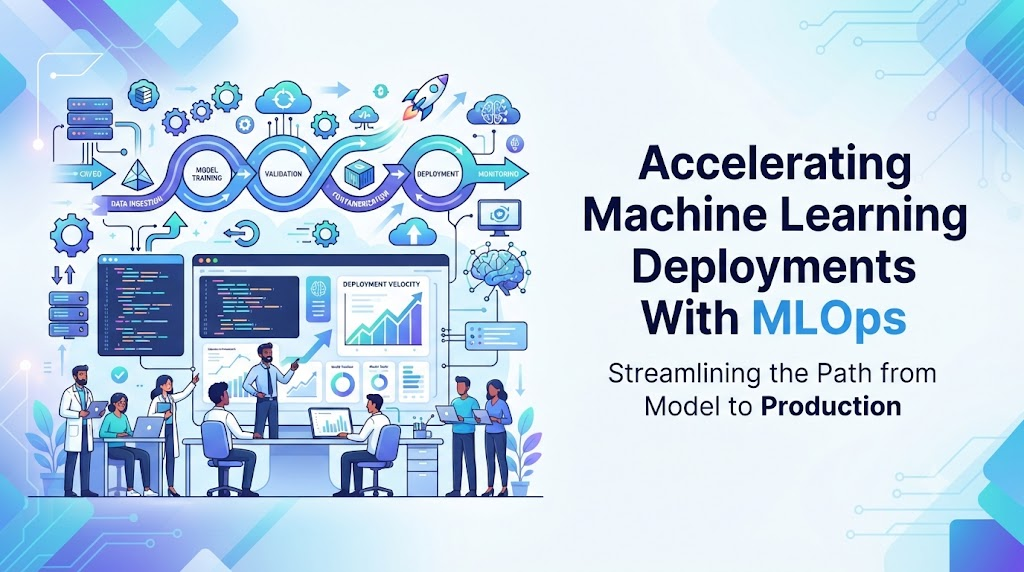
Instead of a human manually running scripts to clean data, train a model, and check its accuracy, MLOps uses automated pipelines. When new data arrives, the system triggers training and testing automatically.
3. Continuous Integration and Continuous Delivery (CI/CD)
Whenever a data scientist changes an algorithm, automated tests check if the new model meets accuracy standards. If it passes, it gets packaged and deployed to production servers without manual intervention.
Why MLOps Matters for Speed and Reliability
Speed without safety leads to broken systems. MLOps speeds up deployment by removing human bottlenecks while simultaneously making models more reliable.
- Fewer Manual Steps: Humans do not have to copy-paste files or manually configure cloud servers.
- Faster Feedback Loops: Teams know within minutes if a new model version improves accuracy or introduces errors.
- Consistent Environments: Models run inside containerized environments (like Docker), ensuring they behave the exact same way on a developer’s laptop as they do on cloud servers.
Important Factors to Understand
To appreciate how MLOps accelerates deployment, you must look at the key parts that make up an MLOps ecosystem.
- Feature Stores: Centralized repositories where clean, processed data features are stored so different teams can reuse them instead of writing code from scratch.
- Model Registry: A secure storage system that keeps track of trained models, their performance scores, and deployment statuses.
- Automated Testing: Specialized checks that test not just software code, but also model behavior, data drift, and prediction fairness.
- Monitoring Systems: Tools that watch live models to see if their accuracy drops over time due to changing real-world patterns.
Practical Examples
Example: E-Commerce Recommendation Engine
An online store builds a machine learning model to recommend products to shoppers.
- Without MLOps: The data scientist hands over a folder of Python scripts to the engineering team. It takes four weeks to rewrite the code, fix missing software libraries, and connect it to the website database. By the time it launches, shopping trends have shifted.
- With MLOps: The model code is pushed to a Git repository. An automated pipeline tests the code, packages it, and deploys it to the live website in under two hours. Future updates roll out weekly with zero downtime.
Real-World Considerations
Deploying models faster changes how organizations operate daily. Teams must balance speed with operational realities.
- Infrastructure Cost: Running automated training pipelines and monitoring servers requires cloud resources that cost money.
- Cultural Shift: Data scientists, software engineers, and IT staff must communicate closely and share responsibility for live models.
- Maintenance Overhead: Setting up MLOps pipelines takes upfront engineering time before the speed benefits become visible.
Common Mistakes
- Treating MLOps as Just Software DevOps: Teams sometimes use standard software deployment tools without accounting for data changes. Why it causes problems: Models depend on data, not just code; ignoring data versioning leads to silent failures. What to do instead: Use specialized MLOps tools built to track both data and model weights.
- Automating Everything Too Soon: Trying to build a fully automated, multi-cloud MLOps pipeline on day one. Why it causes problems: It creates overwhelming complexity for simple projects. What to do instead: Start by automating model packaging and deployment, then add automated training later.
- Neglecting Model Monitoring: Deploying a model and assuming it will stay accurate forever. Why it causes problems: Real-world habits change, causing model accuracy to degrade. What to do instead: Set up automated alerts for unusual prediction patterns or data shifts.
Risks and Limitations
- Data Drift: Over time, user behavior changes, making past training data obsolete. Risk: The model makes incorrect predictions quietly. How to reduce it: Continuously monitor input data and trigger retraining when drift exceeds safe thresholds.
- Over-Engineering: Building massive MLOps pipelines for small, low-risk models. Risk: Wasted engineering hours and unnecessary maintenance costs. How to reduce it: Match the complexity of your MLOps setup to the business value and update frequency of the model.
Checklist for a Faster Model Deployment
Before launching your next machine learning model into production, verify these operational steps:
- Are your training data, code, and model files version-controlled together?
- Is your model packaged in a portable container (such as a container runtime) to ensure consistent execution?
- Have you automated basic software and accuracy tests before release?
- Is there a rollback plan if the newly deployed model starts producing errors?
- Do you have monitoring in place to track live prediction latency and accuracy?
Key Terms
- Model Drift: The decay in a model’s prediction accuracy over time because real-world conditions have changed.
- Containerization: Packaging software code and all its required libraries together so it runs reliably on any computing environment.
- CI/CD: Continuous Integration and Continuous Delivery; practices of automating code testing and releasing software updates frequently.
- Inference: The process where a trained machine learning model examines new, unseen input data to make a prediction or classification.
- Orchestration: Managing and coordinating automated workflows, tasks, and pipelines across distributed cloud servers.
FAQs
Why do machine learning models take so long to deploy without MLOps?
Without MLOps, data science code is often written in experimental environments that do not match production servers. Translating this code manually requires extensive rewrites, debugging, and coordination between different departments.
Is MLOps only for large enterprise companies?
No. Even small teams benefit from basic MLOps practices, such as automated model versioning and simple containerized deployments, because it eliminates manual deployment errors and saves hours of troubleshooting time.
How does MLOps differ from traditional DevOps?
Traditional DevOps focuses purely on software code and infrastructure. MLOps includes DevOps principles but adds unique components for managing data quality, model training pipelines, experiment tracking, and ongoing model accuracy monitoring.
Does MLOps completely remove human involvement?
No. While MLOps automates repetitive tasks like testing, packaging, and deployment, human data scientists and engineers still make critical decisions regarding model design, ethical considerations, business alignment, and final approval thresholds.
What is the first step a team should take toward MLOps?
The best starting point is usually standardizing model and data version control, followed by automating simple packaging and deployment scripts so models move from development to staging reliably.
Conclusion
Getting machine learning models out of the test lab and into the hands of users should not feel like an uphill battle. By combining automated pipelines, proper version control, and continuous monitoring, MLOps removes the friction that slows down development.
Faster deployments mean organizations can test ideas quickly, fix mistakes early, and deliver real value to users before market conditions change.

