
Introduction
Building software today is fast. When a developer writes code, automated tools test it, pack it, and send it live to users within minutes. This smooth process is known as DevOps.
However, building software that uses artificial intelligence is different. Traditional code stays the same unless a programmer changes it. Machine learning models, on the other hand, learn from data. If the real world changes, the data changes. When the data changes, the model can make mistakes.
Because of this unique challenge, teams needed a new approach. They built MLOps. Understanding the difference between these two systems helps organizations scale software and AI products safely without wasting time or money.
What Is DevOps?
DevOps is a cultural and technical practice that brings software developers (Dev) and IT operations teams (Ops) together.
Why It Matters
In the past, developers wrote code and handed it over to an operations team to run. This handoff often caused delays and bugs because the operating environment looked different from the developer’s laptop. DevOps uses automation to test, build, and release software continuously.
Example
Imagine an online banking app. When developers add a new button for international transfers, DevOps tools automatically check the code for security flaws, package it, and update the live app server without shutting down the service.
What Is MLOps?
MLOps stands for Machine Learning Operations. It is a set of practices that combines machine learning, data engineering, and software operations.
Why It Matters
Training a machine learning model inside a laboratory notebook is easy. Getting that model to run reliably for thousands of users in the real world is hard. MLOps manages the entire life cycle of a machine learning model, from gathering data and training to testing, deployment, and monitoring.
Example
Think of a recommendation system for an online store. Customer shopping habits change over time. An MLOps pipeline watches how users interact with the store, detects when the model’s accuracy drops, automatically gathers new data, retrains the model, and safely updates the live recommendation engine.
Core Differences Between MLOps and DevOps
While both practices aim to make software delivery faster and more reliable, their core focus areas differ significantly.
1. The Core Artifact
- DevOps: Focuses on code. The primary artifacts are application code, configuration files, and infrastructure scripts.
- MLOps: Focuses on code, data, and models. The artifacts include training datasets, model weights, hyperparameters, and evaluation metrics.
2. Version Control
- DevOps: Tracks changes to application source code using tools like Git.
- MLOps: Tracks code, but also needs to track massive datasets and model versions. Knowing which exact dataset trained a specific model version is critical for debugging.
3. Testing Processes
- DevOps: Tests focus on logic, security, and performance. Does the function return the correct output? Does the server crash under heavy load?
- MLOps: Tests must include data validation and model evaluation. Does the incoming data contain missing values? Has model accuracy fallen below an acceptable threshold?
4. Failure Modes
- DevOps: Failures are usually deterministic. If a server crashes due to a bug, fixing the code fixes the bug.
- MLOps: Failures can be non-deterministic. A model might run without errors, but its predictions can drift or become biased because real-world user behavior changed.
How MLOps and DevOps Workflows Compare
The DevOps Pipeline
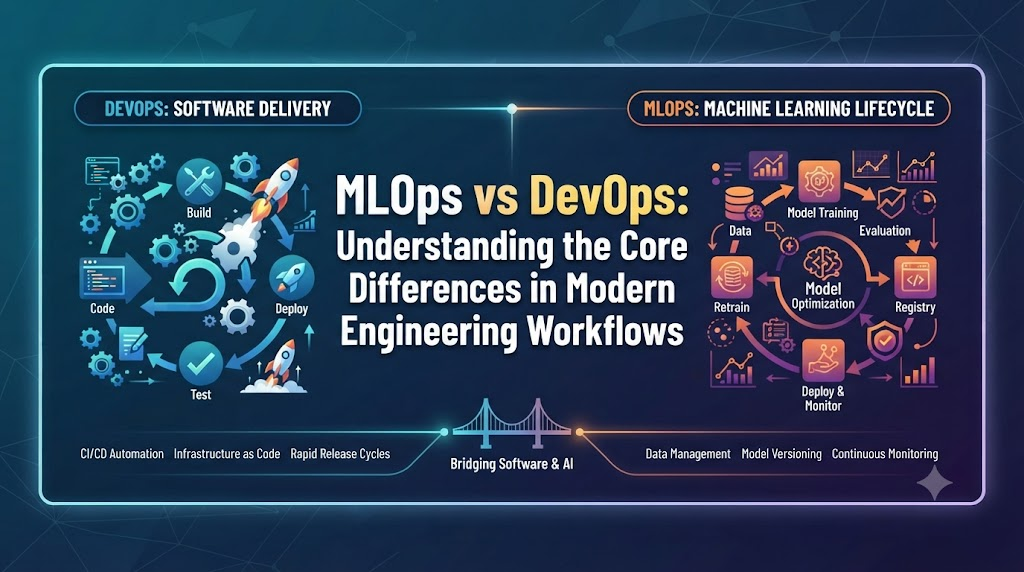
A typical DevOps pipeline moves in a straight line. Developers write code, automated testing checks it, and the system deploys it to production. Once deployed, the code remains stable until the next update.
The MLOps Pipeline
An MLOps pipeline is often a continuous loop.
- Data Ingestion: Clean and structure incoming data.
- Model Training: Train algorithms using compute resources.
- Evaluation: Check if the new model performs better than the old one.
- Deployment: Serve the model via an API or batch job.
- Monitoring: Watch for performance decay and trigger automated retraining when needed.
Practical Examples in the Real World
Scenario A: A Mobile Banking Login Screen
A team builds a login screen for a mobile banking application. They need to ensure that user passwords are encrypted and the server handles heavy traffic during peak hours.
- Approach: This is a pure DevOps challenge. Standard software testing, load testing, and container deployment tools handle this reliably.
Scenario B: A Fraud Detection System
The same bank wants to flag fraudulent credit card transactions instantly. The rules for fraud change as criminals invent new tactics.
- Approach: This requires MLOps. The system must ingest live transaction streams, track model accuracy against confirmed fraud cases, and automatically update the scoring model when detection rates drop.
Real-World Considerations and Challenges
Moving from theory to production brings operational challenges.
- Infrastructure Costs: Machine learning models require heavy computing power (GPUs) for training, which can quickly drain cloud budgets if not monitored.
- Data Drift: Real-world environments change. A model trained on summer data might fail when winter shopping habits begin.
- Reproducibility: If a model makes a bad prediction, engineers must trace back through data versions, code commits, and training settings to find the root cause.
Common Mistakes Beginners Make
- Treating ML Like Normal Software: Assuming that once a model is deployed, the job is finished. Models degrade over time without continuous monitoring.
- Ignoring Data Quality: Building complex deployment pipelines while feeding models messy, unverified data.
- Over-Engineering Early: Setting up massive enterprise MLOps platforms before proving that a simple machine learning model provides business value.
Risks and Limitations
- Model Bias: If training data reflects historical human bias, automated MLOps pipelines will rapidly scale unfair or discriminatory predictions.
- Security Vulnerabilities: Machine learning models are vulnerable to data poisoning, where attackers feed malicious data into training pipelines to manipulate outcomes.
Decision Framework: When to Use Which?
Use this quick guide to determine what your project requires:
- If your application uses fixed logic, deterministic rules, and standard code: Use DevOps.
- If your application relies on probabilistic predictions, statistical data patterns, and continuous learning: Use MLOps (built on top of standard DevOps foundations).
Key Terms
- Continuous Integration (CI): The practice of merging code changes frequently and running automated tests.
- Continuous Delivery (CD): Automatically releasing code changes to a staging or production environment.
- Data Drift: The change in model input data over time that leads to lower prediction accuracy.
- Model Registry: A centralized storage system for managing model versions, metadata, and artifacts.
- Pipeline: A series of automated steps that take raw input and turn it into a finished, deployable output.
FAQs
Can you do MLOps without DevOps?
No. MLOps relies on the foundational principles of DevOps. You still need version control, automated testing, and infrastructure management to deploy machine learning models successfully.
Why do machine learning models degrade over time?
Models degrade because the real-world environment changes. User preferences, economic conditions, and seasonal trends shift, making past training data less relevant.
Is MLOps only for deep learning?
No. MLOps applies to any machine learning system, ranging from simple linear regression models to large language models and deep neural networks.
Do data scientists need to know DevOps?
Data scientists benefit greatly from understanding basic DevOps and MLOps principles so they can package and deploy their models without relying entirely on platform engineering teams.
Conclusion
DevOps and MLOps solve different problems in modern technology. DevOps brings speed and stability to traditional software code. MLOps expands on those practices to manage the unpredictable nature of data and machine learning models. Understanding both allows teams to build intelligent systems that remain reliable, scalable, and accurate over time.

