
Introduction
The cloud infrastructure has completely transformed the modern software landscape. However, unlimited access to on-demand resources often leads to uncontrolled cloud spending and substantial financial waste. For software engineers, site reliability specialists, and engineering leaders, managing these expenses has shifted from being a purely administrative task to a core technical requirement. Cloud cost accountability is now deeply embedded into everyday operations.
To bridge this operational gap between finance and engineering, a specialized framework has emerged. Navigating this cultural and operational shift requires structured validation. The Certified FinOps Professional certification program provides the advanced skill set needed to master cloud financial management, align engineering velocity with business value, and build sustainable cloud infrastructure at scale.
What is Certified FinOps Professional
The Certified FinOps Professional is an advanced, senior-level certification designed for experienced cloud and finance practitioners. It validates a deep understanding of cloud financial optimization, framework governance, and cross-functional leadership. This credential proves that an individual can move beyond basic cost-saving recommendations and successfully build, scale, and mature a holistic FinOps culture across an entire enterprise.
Why it matters today?
Unchecked cloud spending directly impacts corporate profitability and slows down technical innovation. Modern multi-cloud environments are highly dynamic, making traditional static budgeting obsolete. Engineering choices made during microservices design or infrastructure provisioning carry immediate financial consequences.
A trained professional establishes visibility into these complex financial systems. True cloud efficiency requires an analytical lens to translate complex billing data into clear, actionable engineering roadmaps. This ensures that every dollar spent on cloud resources directly drives business growth.
Why Certified FinOps Professional certifications are important
- Establishes Clear Technical Credibility: It serves as a definitive endorsement of your ability to manage massive, complex cloud budgets without degrading system performance or slowing delivery velocity.
- Bridges the Operational Silos: It equips engineers with the business acumen to communicate with finance teams, and provides finance professionals with the structural context to understand engineering decisions.
- Accelerates Career Advancement: It sets you apart in the global job market, qualifying you for high-impact leadership positions such as Cloud Economist, FinOps Principal, or Infrastructure Director.
- Drives Business Agility: It teaches proven methods to transform variable cloud spending into an operational advantage, enabling teams to launch new features quickly while maintaining strict financial efficiency.
Why choose Finopsschool?
Finopsschool stands out because its courses are explicitly designed around real-world industry demands and enterprise growth environments. The curriculum is crafted and delivered by experienced faculty members who bring extensive combined corporate experience to the table. Finopsschool focuses on highly interactive sessions, hands-on activities, and fast-track paths that build immediate technical confidence and real-world mastery for global IT professionals.
Certification Deep-Dive
What is this certification?
The Certified FinOps Professional is an advanced validation program focused on the deep execution of cloud financial management. It focuses on driving accountability, analyzing complex data ingestion, and building an efficient, cost-aware culture across engineering teams.
Who should take this certification?
This advanced credential is built for experienced Cloud Engineers, DevOps Architects, Platform Specialists, Site Reliability Engineers, Enterprise Procurement Managers, and FinOps Consultants who want to lead organizational cost-optimization strategies.
Certification Overview Table
| Track | Level | Who it’s for | Prerequisites | Skills Covered | Recommended Order |
| FinOps Foundation | Beginner | Newcomers, Product Owners, Allied Personas | None | Core FinOps Principles, Terminology, Cloud Personas | First |
| FinOps Certified Analyst | Intermediate | Data Engineers, Financial Analysts | Foundation Knowledge | FOCUS Data Specification, Schema Analysis, Cost Ingestion | Second |
| FinOps Certified Engineer | Intermediate | DevOps, Platform & Cloud Engineers | Cloud Infrastructure Basics | Infrastructure Cost Optimization, Container Allocation | Third |
| Certified FinOps Professional | Advanced | Senior Practitioners, Team Leads, Architects | Active Practitioner Cert, 6+ Months Experience | Enterprise Governance, Advanced Forecasting, Policy Automation | Fourth |
Skills you will gain
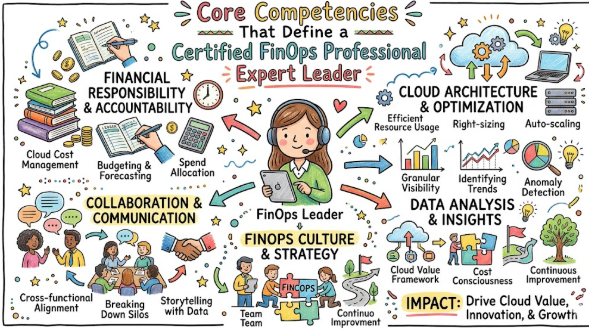
- Advanced Cloud Data Modeling: The ability to construct accurate multi-cloud cost forecasting and capacity planning models using complex, historical usage patterns.
- Enterprise Governance & Policy Design: Expertise in building automated financial guardrails and governance controls that prevent cost anomalies without restricting engineering workflows.
- Cross-Persona Communication: Mastery in translating detailed technical infrastructure requirements into clear, high-level business metrics for executive stakeholders.
- Advanced Allocation & Tagging Strategy: Designing deep cost-allocation metadata strategies for shared resources, serverless computing, and dynamic containerized workloads.
Real-world projects you should be able to do after this certification
- Enterprise Cloud Anomaly Detection System: Designing and implementing an automated notification architecture that catches cloud spend spikes in real time and alerts the responsible engineering team.
- Container Cost Allocation Engine: Building a shared-cost distribution model that maps raw Kubernetes cluster expenses accurately back to specific microservices and product lines based on actual resource utilization.
- Multi-Cloud Commitment Optimization Portfolio: Designing a unified corporate commitment strategy that balances Reserved Instances and Savings Plans across multiple cloud providers to maximize discounts.
- FinOps Culture Maturity Roadmap: Formulating a comprehensive, step-by-step cultural enablement strategy that transitions a traditional enterprise from a reactive cost-cutting mindset to a proactive cost-optimization culture.
Preparation plan
7–14 days plan
Focus entirely on core architectural theories, the official framework documentation, and key structural taxonomy. Spend two hours daily reviewing cloud billing models, shared-resource allocation concepts, and the primary stages of the FinOps lifecycle. Dedicate the final days to taking targeted practice exams to identify and patch your remaining knowledge gaps.
30 days plan
Divide your study into structured weekly blocks. Use the first ten days to study cloud data structures, ingestion patterns, and the FOCUS specification. Spend the next ten days working through practical allocation and container cost-tracking exercises. Dedicate the final ten days to studying policy automation, corporate governance, and reviewing comprehensive case studies.
60 days plan
A comprehensive approach designed for complete mastery. The first month should be used to thoroughly study multi-cloud billing mechanics, complex allocation scenarios, and enterprise budgeting. Spend weeks five through seven building hands-on automations, analyzing simulated billing data, and writing customized governance policies. Dedicate the final week to timed simulation exams and refining your testing speed.
Common mistakes to avoid
- Treating FinOps Simply as a Cost-Cutting Task: FinOps is focused on maximizing business value and driving revenue efficiency, not just blindly cutting down your infrastructure resources.
- Neglecting the Cultural and Human Element: Focusing purely on software tools while ignoring the team enablement and cross-functional communication needed to sustain a cost-aware culture.
- Ignoring Shared Services Allocation Patterns: Failing to build a fair, mathematically sound methodology for distributing the costs of shared resources like databases or networking hubs.
- Relying Exclusively on Manual Reviews: Attempting to manage modern, highly elastic cloud costs through manual spreadsheets instead of deploying automated tracking policies.
Best next certification after this
Same track
FinOps Certified FOCUS Analyst, which deepens your specific technical ability to work with standardized data specifications and normalized billing sets across multiple vendors.
Cross-track
Certified Kubernetes Administrator (CKA), providing the underlying system architecture knowledge required to optimize containerized clusters and manage shared cloud platforms.
Leadership / management
Certified Cloud Security Professional (CCSP) or strategic IT management credentials, expanding your governance capabilities into enterprise risk management, compliance, and global security operations.
Choose Your Learning Path
DevOps
This pathway focuses on inserting automated cost visibility into the continuous integration and deployment pipeline. Engineers learn to build real-time financial feedback directly into developer environments, enabling teams to see the financial impact of code changes before infrastructure is deployed to production.
DevSecOps
Designed to integrate financial optimization directly into cloud compliance and infrastructure security guardrails. Practitioners learn to build unified policy-as-code configurations that simultaneously evaluate security vulnerabilities, compliance drift, and cost efficiency within automated deployment workflows.
Site Reliability Engineering (SRE)
This path focuses heavily on balancing system reliability, performance metrics, and operational costs. Engineers learn to treat cloud cost as a primary architectural constraint alongside availability SLAs, ensuring that infrastructure scalability does not trigger unexpected, runaway billing.
AIOps / MLOps
Tailored specifically for managing the heavy financial demands of artificial intelligence and machine learning pipelines. Focuses on tracking data ingestion pipelines, optimizing distributed training GPU clusters, and managing the operational costs of deploying large models to production.
DataOps
Built for data professionals who manage extensive analytics environments, data lakes, and distributed storage systems. This track teaches methods for optimizing big data queries, tracking warehousing expenses, and allocating storage tiers based on data access patterns.
FinOps
The dedicated, specialist track focused on mastering enterprise-wide cloud financial management. It centers on building cloud centers of excellence, designing corporate investment strategies, and running complex procurement operations across all business units.
5. Role → Recommended Certifications Mapping
| Role | Core Focus | Primary Recommended Certification | Secondary Strategic Certification |
| DevOps Engineer | Pipeline Automation & CI/CD | FinOps Certified Engineer | Certified Kubernetes Administrator |
| Site Reliability Engineer | Performance, Scalability & SLAs | Certified FinOps Professional | Advanced Cloud Architect Path |
| Platform Engineer | Internal Developer Platforms | FinOps Certified Engineer | Certified Kubernetes Application Developer |
| Cloud Engineer | Infrastructure & Cloud Provisioning | FinOps Certified Practitioner | Multi-Cloud Specialist Track |
| Security Engineer | Governance, Risk & Compliance | DevSecOps Professional Credential | Certified Cloud Security Professional |
| Data Engineer | Big Data Pipelines & Warehousing | FinOps Certified Analyst | Big Data Architecture Specialist |
| FinOps Practitioner | Enterprise Optimization & Culture | Certified FinOps Professional | FinOps Certified FOCUS Analyst |
| Engineering Manager | Strategy, Budgeting & Team Delivery | Certified FinOps Professional | Strategic Tech Leadership Program |
Next Certifications to Take
One same-track certification
The FinOps Certified FOCUS Analyst credential should be pursued next to master the Open Cloud Standard for billing data, allowing you to build uniform financial data pipelines across multi-cloud environments.
One cross-track certification
The Certified Kubernetes Administrator (CKA) program should be considered to gain deep operational control over container scheduling, cluster orchestration, and efficient shared-resource compute management.
One leadership-focused certification
An advanced Cloud Security Governance certification should be selected to expand your strategic oversight into executive risk assessment, global regulatory compliance, and cloud privacy frameworks.
Training & Certification Support Institutions
DevOpsSchool
This institution is widely recognized for delivering intensive, instructor-led technical training courses that emphasize real-world labs and practical engineering projects. Their programs are specifically designed to help corporate teams and independent engineers transition smoothly into advanced cloud operations.
Cotocus
A premium technical consulting and corporate enablement training organization that specializes in niche cloud-native architectures. They focus on delivering customized, production-grade learning programs that align deep architectural theory with hands-on enterprise deployment strategies.
ScmGalaxy
A comprehensive community hub, knowledge repository, and training platform dedicated to source code management, continuous integration, and modern infrastructure automation. They offer deep-dive technical tutorials, educational blogs, and certification preparation bootcamps.
BestDevOps
An educational platform focused entirely on cloud infrastructure, platform engineering, and modern operational methods. Their training programs are tailored to help working IT professionals upgrade their skill sets efficiently to match current enterprise market demands.
devsecopsschool.com
A specialized online academy focused exclusively on the intersection of cloud security, automated testing, and development pipelines. Their courses teach engineers how to integrate compliance automation and secure policy-as-code guardrails directly into shipping workflows.
sreschool.com
This learning portal is dedicated to site reliability engineering principles, complex system performance tuning, and incident management. The training paths emphasize building highly resilient infrastructure while maintaining optimal system performance and operational efficiency.
aiopsschool.com
An advanced educational institution targeting the next generation of automated IT operations driven by machine learning. Their curriculum covers algorithmic log analysis, automated anomaly detection, and managing predictive infrastructure monitoring tools.
dataopsschool.com
An academy focused on the optimization, quality management, and operational security of complex enterprise data pipelines. They train data engineers on how to build scalable, automated workflows for data warehousing, transformation, and storage systems.
finopsschool.com
The primary training provider dedicated entirely to cloud financial management, value optimization, and structural corporate accountability. Their expert-led bootcamps and structured certification programs enable cross-functional teams to build and scale high-performing FinOps organizations.
FAQs Section
What is the overall difficulty level of the Certified FinOps Professional exam?
The exam is considered highly challenging as it moves far beyond simple factual recall to evaluate your real-world strategic decision-making, scenario-based problem solving, and corporate framework execution.
How much preparation time is typically required to pass the certification?
A dedicated timeline of 30 to 60 days is generally required, assuming an average commitment of 8 to 10 hours of focused study per week alongside your professional work.
Are there any hard prerequisites required before registering for this exam?
Yes, candidates must hold an active FinOps Certified Practitioner credential and should possess at least 6 months of documented, practical cloud financial management experience.
What is the recommended sequence for taking cloud cost certifications?
You should start with the baseline FinOps Foundation, move into the technical FinOps Engineer or Analyst tracks, and finally take the advanced Certified FinOps Professional exam.
What long-term career value does this advanced qualification offer?
It provides significant career growth by positioning you as a high-impact professional capable of leading multi-million dollar cloud portfolio strategies and optimizing enterprise operations.
What job roles become accessible after obtaining this advanced credential?
Professionals successfully transition into premium career paths such as Principal Cloud Economist, Director of FinOps, Platform Architect, and Lead Enterprise Cloud Consultant.
How does this qualification help a traditional Software Engineer grow?
It transforms an engineer from a standard code creator into a business-aware architect who can design high-performance cloud applications that are structurally cost-optimized.
Is this program beneficial for managers who do not write code daily?
Absolutely, as it provides leaders with the strategic vocabulary, governance metrics, and dashboard frameworks required to guide engineering teams toward sustainable cloud spending.
How frequently does this professional cloud certification require renewal?
The certification remains valid for a period of 36 months, after which practitioners need to recertify to demonstrate updated knowledge of evolving multi-cloud billing frameworks.
Does this certification focus on one specific cloud provider like AWS?
No, the methodology taught is completely vendor-neutral, providing universal optimization principles that apply equally across AWS, Microsoft Azure, and Google Cloud Platform.
How does this credential address containerization and Kubernetes expenses?
The framework provides comprehensive strategies for allocating shared cluster costs, mapping pod resource requests, and accurately distributing non-allocatable system infrastructure overheads.
What is the testing format used for the advanced professional exam?
The evaluation is conducted through a rigorous online proctored exam combining advanced multiple-choice questions along with deep, scenario-based essay responses.
Certified FinOps Professional FAQs
- How exactly does the Certified FinOps Professional program approach cloud cost optimization?
The program approaches optimization from a strategic value-creation perspective, focusing on building long-term architectural efficiency, automated policy governance, and shared cultural responsibility.
- Can you explain the specific framework lifecycle phases tested in this exam?
The curriculum evaluates absolute mastery across the three fundamental phases of the FinOps lifecycle: Inform (visibility and allocation), Optimize (discounts and sizing), and Operate (continuous execution).
- What specific type of data ingestion knowledge is required for this test?
Practitioners must understand how to normalize disparate billing APIs, ingest raw billing data streams, and align complex vendor datasets with the standardized open-source FOCUS format.
- How does a Certified FinOps Professional handle untagged cloud infrastructure costs?
They design multi-layered allocation rules based on real-time operational telemetry, running cluster usage, and historical enterprise business metrics to distribute untagged costs fairly.
- What automated guardrails are practitioners expected to build after certification?
Professionals are trained to implement automated infrastructure policies, including automatic shutdown of idle development systems, non-compliant resource deletion, and proactive budget alerts.
- How does this certification help in managing executive corporate stakeholders?
It provides the structured framework needed to create high-level financial health dashboards, track unit economic metrics, and present technical cloud investments as clear business growth drivers.
- What strategy is recommended for managing multi-cloud commitment portfolios?
The framework teaches practitioners to build a balanced, tiered model that combines generic cloud provider credits, flexible compute savings plans, and stable, long-term reserved instances.
- How does this program prepare you to handle cloud spend anomalies?
It outlines precise operational workflows for identifying sudden cost spikes, routing immediate alerts to appropriate code owners, determining root causes, and executing rapid remediation steps.
Testimonials
The architectural framework taught in this program allowed for the immediate reorganization of our shared multi-tenant cluster tracking. The practical visibility skills gained have fundamentally changed how our engineering teams design scalable cloud resources.
— Amit
Balancing infrastructure reliability with corporate financial efficiency had always been an operational struggle. This certification provided the precise structural strategies needed to treat cloud costs as a core system performance metric.
— Rajesh
The advanced data ingestion methods learned have allowed us to completely automate our quarterly cloud forecasting. The clarity gained regarding multi-cloud billing structures brought immediate confidence to our migration roadmaps.
— Vikram
“Implementing automated policy guardrails across our deployment pipelines became straightforward after completing this curriculum. The governance strategies learned have successfully eliminated our monthly infrastructure cost anomalies.”
— Sneha
This strategic framework completely redefined how our engineering budgets are structured and monitored. It provided the clear operational metrics needed to bridge the communication gap between our development squads and corporate finance teams.
— Ananya
Conclusion
Obtaining the Certified FinOps Professional certification is a powerful career move for modern cloud, DevOps, and operations specialists. It proves that you have the skills to solve complex cloud cost problems and build a culture of financial responsibility across an entire organization. As global enterprises continue to optimize their cloud footprints, the demand for certified professionals who can balance engineering speed with financial discipline will remain high. Investing in this advanced learning path provides the strategic tools needed to stand out as a leader in the competitive, modern cloud-native market.

