
Introduction
Managing cloud costs has become one of the biggest challenges for engineering teams globally. When systems are migrated to public cloud environments, fixed capital expenses are replaced by variable operational costs. Without proper control, cloud bills can quickly spiral out of control.
A specialized discipline is required to bridge the gap between engineering, finance, and business operations. This guide provides a detailed look into how engineers can master financial accountability without sacrificing development speed.
What is Certified FinOps Engineer
The Certified FinOps Engineer is a technical credential designed for cloud professionals who want to build, design, and run cost-effective cloud infrastructure. This program does not focus on theoretical corporate budgets; instead, it provides production-focused training that connects code changes directly to the monthly cloud bill.
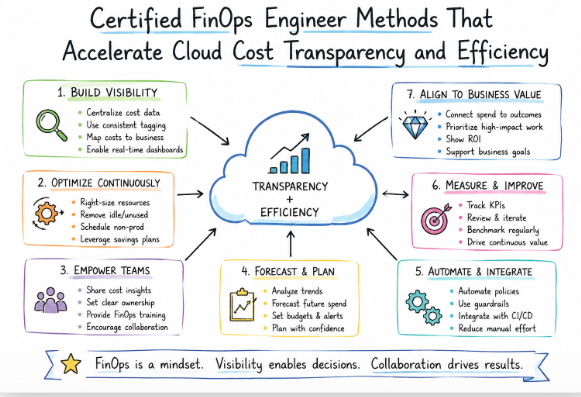
The entire framework operates around three primary phases: Inform, Optimize, and Operate. Through this structure, an engineer learns how to implement automated governance, build cost visibility inside pipelines, and establish unit economics that prove the business value of cloud investments.
Why It Matters Today
Uncontrolled cloud spend can eliminate the profit margins of digital products. Historically, software engineers built systems based purely on performance and scalability. Today, cost-efficiency is treated as a core non-functional requirement, similar to security and uptime.
Organizations in India, the United States, and across the globe are setting up dedicated Cloud Financial Management teams. An engineer who understands how to optimize resources like container clusters and database nodes is highly valued in the modern employment market.
Why Certified FinOps Engineer Certifications Are Important
- Establishes a Standard Language: Miscommunication between engineering and finance teams is minimized when a shared operating model is used.
- Validates Real-World Technical Competence: It demonstrates that an engineer can configure real-time visibility dashboards and handle multi-cloud billing anomalies.
- Enhances Career Longevity: As corporate focus shifts toward financial sustainability, certified professionals are prioritized for strategic infrastructure decisions.
- Reduces Engineering Waste: Infrastructure-as-code and deployment pipelines are built with financial guardrails, stopping waste before it occurs.
Why Choose FinOpsSchool?
FinOpsSchool stands out because its entire training ecosystem is built around the modern IT market’s actual work environment. Rather than delivering generic lectures, the curriculum is developed alongside thought leaders from the cloud cost management field to mirror true enterprise challenges.
Activity-based learning modules and hands-on scenarios are used to ensure participants can handle complex multi-cloud bills. The educational path is designed specifically to help technical professionals build practical confidence, moving them quickly from basic concepts to advanced operational strategy.
Certification Deep-Dive
What is this certification?
The Certified FinOps Engineer is an intermediate-level technical certification focused on translating cloud cost data into daily engineering decisions. It validates the capability to build automated governance and optimize cloud workloads across multi-cloud environments.
Who should take this certification?
This program is ideal for software engineers, DevOps practitioners, cloud architects, site reliability engineers, and platform managers who design and maintain cloud-native systems.
Certification Overview Table
| Track | Level | Who it’s for | Prerequisites | Skills Covered | Recommended Order |
| FinOps Foundation | Beginner | System Admins, QA Engineers, Junior Developers | None | Core FinOps Terminology, Basic Cost Allocation | First |
| FinOps Engineer | Intermediate | DevOps, Cloud, and SRE Professionals | Basic Cloud Knowledge | Cost Optimization, Automation, Container Rightsizing | Second |
| FinOps Professional | Advanced | Solutions Architects, Technical Leads | FinOps Engineer | Multi-Cloud Scaling, Governance Frameworks | Third |
| FinOps Manager | Management | Engineering Managers, IT Directors | Foundational Frameworks | Unit Economics, Budgeting, Cross-Team Alignment | Fourth |
| FinOps Architect | Expert | Enterprise Architects, Principal SREs | Advanced Cloud Certifications | System Design for Cost, Dynamic Rate Optimization | Fifth |
Skills You Will Gain
- Cloud Cost Allocation: Assigning expenditures accurately using tagging structures and namespace tracking.
- Resource Rightsizing: Altering oversized virtual machine instances and storage blocks to match actual work workloads.
- Anomaly Detection: Building automated alerting systems that identify sudden, unexpected spikes in infrastructure usage.
- Container Cost Visibility: Breaking down shared Kubernetes cluster expenses across specific development teams.
- Rate Optimization: Selecting appropriate saving plans and reserved options provided by cloud vendors.
Real-World Projects You Should Be Able to Do After This Certification
- Automated Pipeline Cost Analysis: Integrating cost-estimation scripts into CI/CD pipelines to evaluate infrastructure modifications before deployment.
- Kubernetes Shared Cost Allocation Model: Setting up tracking tools within a multi-tenant cluster to distribute shared compute costs based on actual resource demand.
- Idle Resource Remediation Engine: Building automated serverless functions that shut down non-production environments during non-working hours.
Preparation Plan
7–14 Days Plan
- Days 1–4: Focus entirely on core vocabulary and the three lifecycle phases: Inform, Optimize, and Operate. Read through the baseline documentation hosted on the portal.
- Days 5–9: Study common cloud billing file formats and metadata tagging structures. Review how shared infrastructure elements are broken down.
- Days 10–14: Complete practice review quizzes, focus on basic allocation mechanics, and complete the introductory test modules.
30 Days Plan
- Days 1–10: Dedicate an hour daily to establishing a solid understanding of resource lifestyle management, specifically focusing on virtual networks and database storage options.
- Days 11–20: Learn how to read raw comma-separated billing reports. Perform sample calculations on reserved instance utilization rates.
- Days 21–30: Build basic automated reporting charts, review rightsizing guidelines for cloud containers, and take full-length practice evaluations.
60 Days Plan
- Days 1–20: Study different cloud provider billing engines deeply. Learn how data movement across regions changes total cost.
- Days 21–40: Focus on automation practices. Write scripts to catch untagged resources and create automated alerts for development groups.
- Days 41–60: Focus on complex unit economics scenarios. Take comprehensive mock tests, analyze weak areas, and complete the official certification exam.
Common Mistakes to Avoid
- Treating FinOps Just Like Finance: Engineering choices drive cloud spending; focusing only on spreadsheets without looking at system design limits results.
- Ignoring Container Spend Layers: Shared cluster costs cannot be ignored; allocating base infrastructure expenditures across specific application workloads is required.
- Relying Only on Manual Corrections: Tracking down cost leakages by hand wastes valuable engineering time; automated governance scripts must be used.
- Neglecting Tagging Enforcement: Clear tagging guidelines must be built directly into infrastructure scripts, or cost allocation becomes impossible.
Best Next Certification After This
Same Track
- Certified FinOps Professional: This advanced certification explores complex corporate cost management strategies and deep lifecycle operations.
Cross-Track
- Certified DevSecOps Engineer: This technical program teaches you how to embed automated security testing directly into software development pipelines.
Leadership / Management
- Certified FinOps Manager: This path is designed for engineering leaders who need to manage department budgets, structure unit economics, and align cross-functional teams.
Choose Your Learning Path
DevOps Path
- Best For: Deployment engineers focused on continuous integration and delivery.
- Focus: Incorporating cost estimation modules directly into automated code release pipelines to check financial impacts before deployment.
DevSecOps Path
- Best For: Security engineers focused on automated system protection.
- Focus: Balancing infrastructure security needs with financial limits by ensuring security monitoring software does not cause unnecessary cost inflation.
Site Reliability Engineering (SRE) Path
- Best For: Engineers responsible for production environment stability and performance.
- Focus: Creating optimal trade-offs between system high-availability requirements and efficient compute usage.
AIOps / MLOps Path
- Best For: Machine learning engineers managing large data training runs.
- Focus: Controlling high infrastructure costs caused by specialized hardware like graphics processing units during large model training phases.
DataOps Path
- Best For: Data infrastructure specialists running enterprise analytics pipelines.
- Focus: Optimizing complex storage structures and heavy processing engines to lower data retention costs.
FinOps Path
- Best For: Dedicated cloud cost practitioners and infrastructure consultants.
- Focus: Mastering the full spectrum of cost visibility, automated financial governance, and unit economics across corporate operations.
Role to Recommended Certifications Mapping
| Professional Role | Core Recommended Certification | Secondary Advancement Path | Specialization Focus |
| DevOps Engineer | Certified FinOps Engineer | Certified DevSecOps Engineer | Pipeline Cost Controls |
| Site Reliability Engineer | Certified FinOps Engineer | Certified Site Reliability Architect | System Efficiency Balance |
| Platform Engineer | Certified FinOps Professional | Certified FinOps Architect | Internal Tool Governance |
| Cloud Engineer | Certified FinOps Engineer | FinOps Foundation | Resource Rightsizing |
| Security Engineer | Certified DevSecOps Professional | Certified FinOps Engineer | Safe Cost Optimization |
| Data Engineer | Certified FinOps Engineer | Certified DataOps Manager | Big Data Storage Savings |
| FinOps Practitioner | Certified FinOps Professional | Certified FinOps Manager | Business Cost Strategy |
| Engineering Manager | Certified FinOps Manager | Certified FinOps Professional | Departmental Unit Economics |
Next Certifications to Take
The Certified FinOps Professional credential can be pursued within the same track to deepen technical execution capabilities and master advanced multi-cloud optimization strategies over a multi-month period.
The Certified DevSecOps Engineer credential can be pursued as a cross-track option to learn how to inject automated compliance validation and proactive vulnerability assessment routines straight into deployment pipelines.
The Certified FinOps Manager program can be chosen as a leadership-focused certification to learn how to manage team allocations, coordinate cross-department budgets, and build clear reporting pipelines for corporate leadership.
Training & Certification Support Institutions
DevOpsSchool
Comprehensive training programs are provided by this institution to help engineers master cloud operations, continuous deployment, and automated infrastructure management. Guided laboratory sessions are utilized to ensure students gain valuable real-world engineering skills.
Cotocus
Specialized technical consulting and training services are delivered by this platform to help modern corporate teams update their infrastructure. Practical implementation methods are emphasized to assist engineering groups in adopting agile practices efficiently.
ScmGalaxy
A wide library of educational materials, technical tutorials, and community forums focused on configuration tracking and delivery tooling is maintained by this site. It serves as a helpful baseline resource for operations professionals seeking skill advancement.
BestDevOps
Focused educational courses built around cloud architecture and systems automation are offered here. The lesson paths are structured specifically to assist working IT professionals in achieving technical certification success.
devsecopsschool.com
Educational training programs are delivered through this site to teach professionals how to weave security principles directly into development practices. Automated compliance monitoring and secure pipeline design are highly emphasized.
sreschool.com
Structured development roadmaps are provided by this site to help engineers build reliable, scalable infrastructure systems. The training tracks focus heavily on production observability, error tracking, and system performance tuning.
aiopsschool.com
Specialized training tracks are hosted on this portal to teach engineers how to leverage machine learning insights for IT system administration. Automated root-cause analysis and system anomaly detection are covered.
dataopsschool.com
The courses hosted on this platform are designed to help database professionals streamline data lifecycle management. Improved data delivery speed and data pipeline testing automation are prioritized.
finopsschool.com
This educational domain provides certified training paths built specifically around cloud financial management methodologies. Every course track is structured to assist teams in optimizing infrastructure costs without reducing engineering velocity.
Frequently Checked Questions
- What is the typical difficulty level of the examination?
The examination is considered intermediate in difficulty, testing practical infrastructure knowledge along with baseline cloud cost concepts rather than simple fact recall. - How much preparation time is generally required to pass?
Working cloud engineers typically require about two to four weeks of steady study, while beginners may need up to sixty days to build confidence. - Are there strict technical prerequisites before taking the test?
No formal prerequisites are demanded, but a basic understanding of public cloud infrastructure platforms and resource provisioning is highly recommended. - What is the recommended certification sequence to follow?
Candidates usually start with the foundational framework overview, advance directly to the engineer track, and eventually move into professional or management paths. - What long-term career value does this qualification offer?
It opens up specialized employment avenues within cloud infrastructure management teams and distinguishes candidates for senior architectural selection processes. - Which job roles benefit most from this program?
DevOps specialists, system reliability teams, cloud architects, and engineering managers find this course highly applicable to their operational duties. - Is the examination conducted in an online format?
Yes, the knowledge assessment is completed entirely through a secure online platform consisting of fifty specific questions within a one-hour limit. - How long remains the certification status valid?
The digital credential and official verification badge remain active for a total period of twenty-four months before renewal procedures are required. - Does the curriculum cover multi-cloud environments?
Yes, the core strategies taught are cloud-agnostic, allowing optimization principles to be applied across platforms like AWS, Azure, and Google Cloud. - Can non-technical team members take this program?
While the engineering track contains code-level examples, the foundational and management paths are fully tailored for non-technical corporate business stakeholders. - Are hands-on lab exercises included in the training?
Yes, activity-based learning modules are integrated into the curriculum to ensure theoretical approaches can be translated into production environment actions. - Does this help in reducing container management spend?
Yes, specific sections are focused on identifying shared cluster waste and allocating container resource consumption accurately.
Additional Certified FinOps Engineer Questions
- What is the primary focus of the Certified FinOps Engineer program?
The course is built to teach cloud engineers how to integrate cost visibility and automated financial governance checks directly into software delivery lifecycles. - How does this credential assist in team alignment?
Technical professionals are equipped with the exact financial vocabulary needed to communicate infrastructure choices clearly to finance and business management teams. - Are automated cost-remediation strategies covered?
Yes, methods to write governance scripts that automatically flag untagged elements and turn off inactive development servers are thoroughly explained. - What is the core passing score for the final assessment?
A passing grade must be achieved on the one-hour knowledge exam, which evaluates both conceptual understanding and practical resource allocation scenarios. - Can this training help in implementing unit economics?
Yes, engineers learn how to connect cloud infrastructure expenditures directly to business key performance indicators, such as calculating the cost per active user. - Is infrastructure-as-code optimization included?
Yes, techniques to embed cost-estimation checks into tools like Terraform before any real cloud resources are built are addressed. - How does the course handle shared cloud architecture costs?
Methods to split shared expenditures, like network gateways and enterprise logging systems, across different development departments are provided. - Why is this program valuable for global delivery centers?
Enterprises operating across multiple regions use these standardized approaches to reduce massive cloud waste and protect overall corporate development margins.
Professional Experiences From the Field
Automated tracking systems were successfully integrated into our main deployment pipeline. A significant amount of infrastructure waste was removed before weekly production updates occurred.
— Ananya
A clear path toward container cost allocation was finally established. Shared cluster expenditures can now be tracked accurately across individual software engineering teams.
— Vikram
Better communication with our internal financial planning department was achieved. Cloud engineering choices are now presented using clear business value metrics.
— Rohan
Unnecessary compute spending was reduced by implementing automated idle resource remediation scripts across all non-production testing environments.
— Kavita
Total visibility over multi-cloud billing systems was obtained. Sudden infrastructure anomalies are now caught and corrected within minutes instead of weeks.
— Sanjay
Conclusion
Managing cloud infrastructure efficiently requires balancing development speed with financial discipline. The Certified FinOps Engineer certification program provides the precise technical skills needed to make data-driven, cost-informed architectural choices. Long-term career growth is significantly enhanced as organizations continue to prioritize financial transparency across their engineering divisions. By undertaking strategic learning paths and pursuing official credentials through finopsschool.com, cloud professionals ensure their systems remain highly performant, fully compliant, and completely optimized for business success.

