
Introduction
In the modern digital landscape, data is considered the most valuable asset for any organization. However, the mere possession of data is not enough to drive success. The speed at which data is processed, analyzed, and delivered determines the competitive edge of a business. For a long time, data management was handled by isolated teams, leading to delays and errors. This gave rise to a new discipline where the principles of DevOps are applied to data workflows.
DataOps is designed to improve the quality and reduce the cycle time of data analytics. It is a collaborative methodology that brings together data engineers, data scientists, and operations teams. By automating the data lifecycle, organizations can ensure that insights are provided to decision-makers in real-time. This guide is prepared to help professionals understand the path to becoming a recognized expert in this field through the Certified DataOps Architect (CDOA) program.
What is CDOA – Certified DataOps Architect?
The Certified DataOps Architect (CDOA) is a professional designation provided to individuals who have mastered the art of designing and implementing automated data pipelines. It is an advanced-level certification that focuses on the architectural aspects of DataOps. The program is built to ensure that complex data environments are managed with agility, security, and scalability.
Through this certification, a deep understanding of how to integrate version control, automated testing, and continuous deployment into data projects is gained. It is not just about tools; it is about building a culture where data is treated as a product that must be delivered with high reliability and minimal manual intervention.
Why it matters today?
In today’s market, the volume of data is growing exponentially. Organizations are struggling to keep up with the demand for fast and accurate analytics. Traditional methods of data handling are often slow and prone to human error. This is why a standardized approach to data operations is required.
When DataOps is implemented correctly, the time taken to move a data project from development to production is significantly reduced. Reliability is increased because automated checks are placed at every stage of the pipeline. For a business, this means faster innovation and better customer experiences. For a professional, mastering these skills ensures long-term relevance in a market that is increasingly driven by automated data systems.
Why CDOA – Certified DataOps Architect certifications are important
Certifications are often viewed as a benchmark for professional competence. In the specialized field of DataOps, having a formal credential like the CDOA provides several advantages:
- Standardization of Knowledge: A structured learning path is provided, ensuring that all core concepts are covered comprehensively.
- Professional Credibility: Validation of skills is received from a recognized body, which helps in gaining the trust of employers and peers.
- Career Advancement: Better job opportunities and higher salary packages are often made available to certified architects.
- Global Recognition: The principles taught in this program are applicable across various industries and geographic locations.
- Networking: Access is gained to a community of experts who are dedicated to improving data operations worldwide.
Why Choose Dataopsschool?
When a platform for technical education is selected, the quality of content and the relevance of the curriculum must be considered. Dataopsschool is chosen by thousands of professionals because the training is designed by industry experts who understand the challenges of modern data environments.
The focus is placed on practical, hands-on learning rather than just theoretical knowledge. The curriculum is updated regularly to reflect the latest trends in the industry. Furthermore, comprehensive support is provided to students to ensure that the certification exams are cleared with confidence. By choosing this institution, a career-focused education is guaranteed.
Certification Deep-Dive: CDOA – Certified DataOps Architect
What is this certification?
The CDOA certification is an expert-level program designed for those who wish to lead data transformation initiatives. The architectural frameworks required to build robust, automated, and secure data ecosystems are taught in this course.
Who should take this certification?
This program is ideal for Data Engineers, Senior Software Developers, Cloud Architects, and Technical Leads. It is specifically built for those who are responsible for the infrastructure and flow of data within a large organization.
Certification Overview Table
| Track | Level | Who it’s for | Prerequisites | Skills Covered | Recommended Order |
| DataOps Foundation | Entry | Beginners | Basic IT knowledge | Data lifecycle, DevOps basics | 1st |
| Certified DataOps Professional | Intermediate | Engineers | Foundation Cert | Pipeline automation, Tooling | 2nd |
| Certified DataOps Architect | Advanced | Senior Staff | Professional Cert | System design, Strategy, Scalability | 3rd |
| DataOps Security Specialist | Specialist | Security Pros | CDOA or equivalent | Data privacy, Governance, Compliance | 4th |
| DataOps Management | Leadership | Managers | CDOA | Team leadership, ROI, Metrics | 5th |
Skills you will gain
- The ability to design end-to-end automated data pipelines.
- Proficiency in implementing Continuous Integration and Continuous Deployment (CI/CD) for data.
- Expertise in data versioning and environment management.
- Knowledge of automated data quality testing and monitoring.
- Competence in managing data security and compliance within the pipeline.
- Skills in orchestrating complex data workflows across multi-cloud environments.
Real-world projects you should be able to do after this certification
- Building a fully automated ETL (Extract, Transform, Load) pipeline for a retail platform.
- Implementing a real-time data monitoring dashboard for a financial institution.
- Designing a self-service data platform for a team of data scientists.
- Automating the deployment of data models using MLOps and DataOps principles.
- Setting up a data governance framework that automatically checks for PII (Personally Identifiable Information).
Preparation Plan
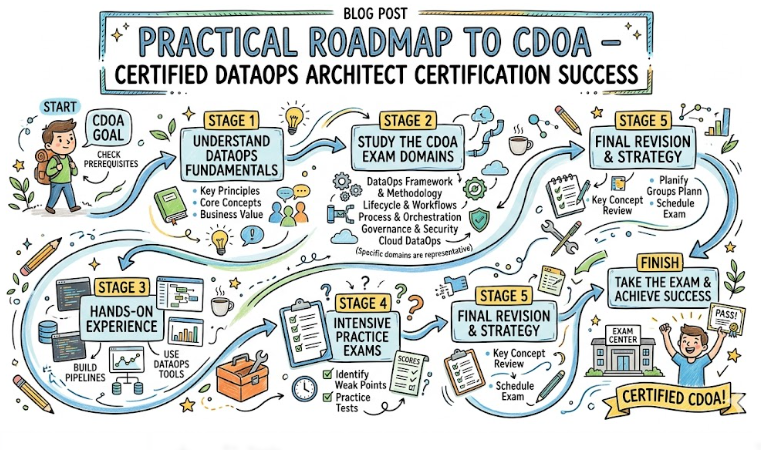
7–14 Days Plan (Quick Revision)
In this short period, the focus should be placed on reviewing the core pillars of DataOps. All official documentation provided by the certification body should be read. Practice exams should be taken to identify weak areas. Key concepts like the “DataOps Manifesto” and basic pipeline architecture should be memorized.
30 Days Plan (Moderate Pace)
During the first two weeks, each module of the course should be studied in detail. The next week should be dedicated to hands-on lab exercises where pipelines are built in a sandbox environment. The final week is used for taking multiple mock tests and refining the understanding of complex architectural patterns.
60 Days Plan (Comprehensive Learning)
The first month is spent on deep-diving into the theoretical aspects and learning the tools associated with DataOps. The second month is focused on applying these skills to real-world scenarios through extensive project work. This plan is recommended for those who want to achieve a mastery level before attempting the exam.
Common mistakes to avoid
- Ignoring the cultural aspect of DataOps and focusing only on tools.
- Neglecting the importance of data quality testing within the pipeline.
- Failing to understand the difference between traditional DevOps and DataOps.
- Overcomplicating the initial pipeline design.
- Skipping the practice exams before the final certification attempt.
Best next certification after this
- Same track: DataOps Management for leadership roles.
- Cross-track: MLOps Foundation to integrate machine learning with data operations.
- Leadership / Management: Certified Engineering Manager (CEM) for career growth in administration.
Choose Your Learning Path
Every professional has a different background, and therefore, a unique learning path is required.
- DevOps Path: This is best for those who already understand CI/CD for software and want to apply those same efficiencies to data teams.
- DevSecOps Path: This is designed for professionals who want to ensure that security is integrated into every step of the data delivery process.
- Site Reliability Engineering (SRE) Path: This is ideal for those who focus on the uptime and reliability of data systems and large-scale databases.
- AIOps / MLOps Path: This path is best for individuals working with artificial intelligence who need a stable data foundation for their models.
- DataOps Path: This is the direct route for data engineers who want to specialize exclusively in the optimization of data workflows.
- FinOps Path: This is intended for professionals who need to manage and optimize the costs associated with cloud-based data storage and processing.
Role → Recommended Certifications Mapping
| Role | Primary Certification | Secondary Certification | Leadership Focus |
| DevOps Engineer | CDOA | DevSecOps Professional | Engineering Manager |
| SRE | CDOA | AIOps Foundation | Site Reliability Lead |
| Platform Engineer | CDOA | Cloud Architect | Platform Director |
| Cloud Engineer | CDOA | FinOps Practitioner | Cloud Strategy Lead |
| Security Engineer | CDOA | DevSecOps Architect | Security Director |
| Data Engineer | CDOA | MLOps Foundation | Chief Data Officer |
| FinOps Practitioner | CDOA | Cloud Cost Expert | Financial Lead |
| Engineering Manager | CDOA | AIOps Foundation | VP of Engineering |
Next Certifications to Take
One same-track certification
The DataOps Management certification is recommended for those who have completed the CDOA. It helps in understanding how to lead teams and manage the ROI of data projects within an enterprise.
One cross-track certification
The MLOps Foundation certification is a great choice. It allows the professional to bridge the gap between data operations and machine learning model deployment, which is a highly sought-after skill.
One leadership-focused certification
The Certified Engineering Manager program is suggested for those looking to move into high-level management. It focuses on the soft skills and strategic thinking required to lead large technical departments.
Training & Certification Support Institutions
DevOpsSchool
Comprehensive training programs are offered here for various technical tracks. A strong emphasis is placed on live projects and expert-led sessions to ensure students are job-ready.
Cotocus
This institution is known for its specialized consulting and training services. Innovative learning methodologies are used to help professionals master complex technologies in a short timeframe.
ScmGalaxy
A vast repository of resources and community support is provided by this platform. It is a go-to destination for those looking for technical blogs, tutorials, and certification guidance.
BestDevOps
The latest tools and practices in the world of automation are covered by this portal. It serves as a reliable source for staying updated with the fast-changing landscape of software operations.
devsecopsschool.com
This site is dedicated to the integration of security within the DevOps lifecycle. Specialized courses are provided for those who want to become experts in secure software delivery.
sreschool.com
Reliability and scalability are the core focuses of this institution. Detailed training is provided on how to manage large-scale systems with minimal downtime.
aiopsschool.com
The intersection of artificial intelligence and operations is explored here. Professionals are taught how to use AI to improve IT service management and operations.
dataopsschool.com
This is the primary source for DataOps education. Everything from foundation to architect-level certifications is managed through this specialized platform.
finopsschool.com
The financial management of cloud services is the priority of this school. It helps professionals understand how to optimize cloud spending without sacrificing performance.
FAQs Section
1. What is the difficulty level of the CDOA exam?
The exam is considered to be of a high difficulty level. A deep understanding of both architectural theory and practical implementation is required to pass.
2. How much time is required to prepare for this certification?
Depending on the prior experience of the individual, a period of 30 to 60 days is generally recommended for thorough preparation.
3. Are there any prerequisites for the CDOA certification?
While not mandatory for all, it is highly recommended that a professional-level certification in DataOps or equivalent experience is held before attempting the architect level.
4. In what sequence should these certifications be taken?
The journey should ideally begin with the Foundation level, followed by the Professional level, and finally the Architect certification.
5. What is the career value of becoming a Certified DataOps Architect?
The career value is significant, as organizations are actively seeking experts who can streamline their data processes and reduce operational costs.
6. Which job roles are most suitable for this certification?
Data Engineers, Cloud Architects, and Senior DevOps Engineers are the most suitable candidates for this program.
7. Is growth expected in the DataOps job market?
Yes, rapid growth is being observed in this field as more companies transition to data-driven decision-making models.
8. Is the certification recognized globally?
The CDOA is recognized by major industries worldwide, making it a valuable asset for those looking for international opportunities.
9. Can this certification help in moving to a management role?
Yes, the architectural knowledge gained provides a strong foundation for moving into technical leadership or management positions.
10. How is the exam conducted?
The exam is typically conducted online through a proctored environment, allowing candidates to take it from any location.
11. Is hands-on experience necessary?
Hands-on experience is vital, as the exam includes questions that test the practical application of DataOps principles.
12. Does the certification expire?
Standard industry policies regarding recertification are followed to ensure that the skills of the professional remain up to date.
CDOA – Certified DataOps Architect Specific FAQs
1. What exactly is covered under the architectural module of CDOA?
Topics such as multi-cloud data orchestration, advanced CI/CD patterns for data, and enterprise-grade security frameworks are covered.
2. How does CDOA differ from a standard Data Engineering course?
While Data Engineering focuses on building pipelines, CDOA focuses on the automation, quality, and operational efficiency of those pipelines.
3. Is coding required for this certification?
A basic to intermediate understanding of scripting and query languages is beneficial for completing the practical components of the course.
4. What tools are usually focused on during the training?
A variety of orchestration, version control, and automated testing tools common in the DataOps ecosystem are explored.
5. How are the real-world projects evaluated?
Projects are evaluated based on the efficiency, security, and scalability of the designed data solution.
6. Can a Software Engineer transition into DataOps through this cert?
Yes, this certification is a perfect bridge for software engineers who wish to specialize in the data domain.
7. Does the program cover data governance?
Yes, data governance and compliance are key components of the architectural framework taught in the program.
8. Is financial optimization of data pipelines included?
Basic principles of cost-efficiency are discussed, though a deeper dive is provided in the FinOps track.
Testimonials
Arjun
The way data pipelines are structured is now completely different for me. The clarity provided by this program regarding automation has been a game-changer for my daily tasks.
Elena
A significant improvement in the reliability of our data delivery was achieved after the principles learned here were applied. My confidence in handling complex architectures has grown immensely.
Rajesh
The practical focus of the course helped in solving real-world bottlenecks that the team had been facing for months. It is a highly recommended path for any serious data professional.
Sarah
Career clarity was gained through this certification. The shift from manual data handling to a fully automated DataOps approach has made the workflow much more efficient.
Vikram
The ability to design secure and scalable data environments was mastered during this training. The skill improvement noticed by my peers has been very rewarding.
Conclusion
In conclusion, the CDOA – Certified DataOps Architect certification is an essential milestone for anyone looking to excel in the modern data landscape. As organizations continue to struggle with data silos and manual processes, the demand for skilled architects will only increase. By following a structured learning path and gaining a formal credential, long-term career benefits are secured. Strategic planning and a dedication to continuous learning are encouraged for all professionals who wish to lead the next wave of data innovation.

