
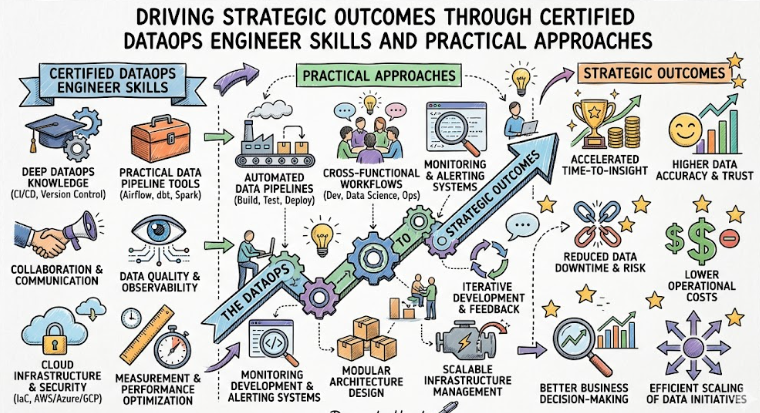
Introduction
Modern businesses are powered by insights derived from massive datasets. However, a major hurdle is often faced: the data is frequently messy, late, or incorrect. This challenge led to the birth of a new discipline. The methodologies of agile development and IT operations are applied to data management to create what is known as DataOps.
Efficiency is the primary goal. By treating data as a product that requires a manufacturing line, errors are minimized. A culture of continuous improvement is fostered. The role of the professional in this space is to ensure that the “assembly line” for data never stops and always produces high-quality results.
What is CDOE – Certified DataOps Engineer?
A high level of technical competency is represented by the CDOE – Certified DataOps Engineer designation. It is a professional validation that confirms an individual’s ability to design and maintain automated data workflows. The integration of various data tools into a cohesive, reliable system is the core focus.
Technical proficiency in areas like continuous integration for data and automated quality checks is measured. The certification ensures that the holder can manage complex data environments with minimal manual intervention. It is a mark of quality in the global technology market.
Why it matters today?
In an era where every second counts, delayed data is equated to lost revenue. Companies no longer have the luxury of waiting days for reports. Information must be available in real-time or near-real-time to be useful.
DataOps is essential today because:
- Accuracy is Guaranteed: Automated tests are used to verify data at every step, reducing human error.
- Deployment is Faster: New data features are moved from development to production with greater speed.
- Complexity is Managed: Large, messy environments are brought under control through structured automation.
- Value is Maximized: Data scientists spend less time cleaning data and more time finding valuable business insights.
Why CDOE – Certified DataOps Engineer certifications are important
In a competitive job market, clear proof of skill is required. A certification provides a standard that is understood by employers globally. For the CDOE, the importance is found in its comprehensive approach to modern data challenges.
- Professional Credibility: Instant trust is established with stakeholders and team members.
- Structured Learning: A clear roadmap is provided, ensuring no critical skills are missed during training.
- Market Demand: A growing need for specialized data engineers is seen across all industries.
- Operational Excellence: Best practices that have been proven in the field are taught and reinforced.
Why choose DataOpsSchool?
When it comes to specialized training, DataOpsSchool is identified as a leader. Several distinct advantages are offered to students who choose this institution for their certification journey.
First, the learning material is designed to be highly practical. Rather than focusing only on theory, the actual application of tools is emphasized. Real-world problems are presented, and solutions are built using industry-standard software. This ensures that a student is ready for the workplace immediately upon completion.
Second, the curriculum is built by veterans of the industry. The lessons are informed by years of practical experience in managing global data systems. The most relevant and modern techniques are always included.
Finally, a commitment to student success is maintained. Comprehensive resources and a supportive learning environment are provided. This focus on the student’s journey makes the process of mastering complex DataOps concepts much smoother and more effective.
Detailed Certification Analysis
What is this certification?
The CDOE – Certified DataOps Engineer is a technical credential. It validates the skill set required to automate, monitor, and optimize the lifecycle of data within an organization.
Who should take this certification?
This program is intended for system administrators, data engineers, and cloud professionals. It is also beneficial for project leads and software developers who are transitioning into data-centric operational roles.
Certification Overview Table
| Track | Level | Who it’s for | Prerequisites | Skills Covered | Recommended Order |
| Entry | Level 1 | Beginners | General IT literacy | DataOps Philosophy, Tool basics | 1st |
| Core | Level 2 | Junior Engineers | Entry Cert | Pipeline Building, Automation | 2nd |
| Advanced | Level 3 | Mid-level Pros | Core Cert | Quality Control, Monitoring | 3rd |
| Strategic | Level 4 | Senior Leads | Advanced Cert | Governance, Large-scale Ops | 4th |
| Elite | Level 5 | Architects | Strategic Cert | Enterprise Architecture, Strategy | 5th |
Skills you will gain
- Automated Data Pipelines: The ability to construct flows that move data without manual help is developed.
- Continuous Testing: Methods for ensuring data integrity through automated checks are mastered.
- System Orchestration: Proficiency in managing multiple data tools as a single system is acquired.
- Version Control Mastery: Best practices for tracking changes in data and code are learned.
- Scalable Infrastructure: Knowledge of how to grow data systems to meet increasing demand is gained.
- Monitoring and Alerting: Techniques for spotting failures before they affect the business are understood.
Real-world projects you should be able to do after this certification
- End-to-End Data Flow: A complete system from source to final report is built and automated.
- Validation Suite: A comprehensive set of tests is created to verify data quality automatically.
- Live Performance Tracking: Dashboards are developed to show the health of all data pipelines in real-time.
- Cloud Data Deployment: Complex data environments are provisioned using automated code-based tools.
- Error Recovery Systems: Automated processes are designed to fix common data pipeline failures without human intervention.
Preparation plan
7–14 days plan
Focus is placed on understanding the core definitions. The official syllabus is reviewed. Basic labs are performed to get comfortable with the interface of primary tools. Sample questions are studied to understand the exam format.
30 days plan
A structured daily study routine is followed. Every module is explored in detail. Hands-on exercises are completed multiple times. Participation in online forums is used to clarify difficult technical points.
60 days plan
A deep dive into complex scenarios is conducted. Advanced orchestration and governance topics are covered. Multiple full-length mock exams are taken under timed conditions. A final review of all practical labs is completed to ensure total readiness.
Common mistakes to avoid
- Focusing Only on Tools: The cultural side of DataOps is often ignored, which leads to implementation failure.
- Lack of Testing: Pipelines are built without enough automated checks, resulting in poor data quality.
- Over-Complication: Systems are made too complex for others to understand or maintain.
- Ignoring Feedback: The needs of the data consumers are not considered, leading to useless data products.
Best next certification after this
- Same track: Higher levels of the CDOE program.
- Cross-track: Certified SRE or DevSecOps Engineer.
- Leadership / management: IT Strategy or Technical Leadership certifications.
Selecting Your Professional Path
Six distinct paths are available for professionals looking to specialize:
DevOps Path
This path is chosen by those who want to apply software delivery speed to data. Traditional CI/CD skills are adapted for data pipelines.
DevSecOps Path
Data security and privacy are the main focus. It is ideal for roles where compliance and data protection are high priorities within the automation process.
Site Reliability Engineering (SRE) Path
The stability and uptime of data platforms are prioritized. This path is for engineers who focus on monitoring and incident response for data systems.
AIOps / MLOps Path
The support of artificial intelligence models is addressed. DataOps principles are used to ensure the steady flow of data to machine learning systems.
DataOps Path
The entire lifecycle of data is managed here. It is the purest path for those who want to be experts in data flow and quality.
FinOps Path
The financial efficiency of data operations in the cloud is the primary goal. Cost-tracking and optimization for data storage and processing are taught.
Mapping Roles to Certifications
| Current Role | Recommended Certification | Primary Benefit |
| DevOps Engineer | CDOE Entry Level | Broadening of automation skills |
| Site Reliability Engineer | CDOE Core Level | Better data reliability management |
| Platform Engineer | CDOE Advanced | Mastery of data infrastructure |
| Cloud Engineer | CDOE Core Level | Effective cloud data management |
| Security Engineer | DevSecOps Focus | Secure data pipeline creation |
| Data Engineer | CDOE Strategic | Advanced data orchestration |
| FinOps Practitioner | FinOps Core | Reduced data operational costs |
| Engineering Manager | CDOE Entry Level | Improved team leadership |
Future Certification Guidance
After the CDOE is achieved, further growth is encouraged through these steps:
One same-track certification
The CDOE Advanced Level is the logical next step. More complex orchestration scenarios are mastered. Skills in handling enterprise-scale data problems are refined.
One cross-track certification
A Site Reliability Engineering (SRE) credential is recommended. The focus on system uptime and performance is blended with data knowledge. This creates a very well-rounded technical professional.
One leadership-focused certification
A Technical Management certification should be pursued. Expertise is combined with the ability to lead teams. Long-term strategic planning for data departments is learned.
Educational Support Organizations
Training and support are provided by several reputable institutions:
- DevOpsSchool: A wide range of courses for modern IT professionals is offered. Practical application is always the priority.
- Cotocus: Global training solutions for cloud and automation are delivered. The needs of the international job market are addressed.
- ScmGalaxy: A vast collection of tutorials and guides is maintained. Support for various technical certifications is provided.
- BestDevOps: Hands-on coaching for engineers is the main focus. Modern development practices are taught through direct experience.
- devsecopsschool.com: The intersection of security and development is explored. Automated security testing is a key topic.
- sreschool.com: Professional training for site reliability is provided. The focus is on system performance and stability.
- aiopsschool.com: The use of AI in IT operations is taught. Practical skills for the future of automation are built.
- dataopsschool.com: This is the central hub for all DataOps certification needs. Comprehensive learning paths are managed here.
- finopsschool.com: Financial management for cloud services is addressed. Engineers are taught to optimize spending while maintaining performance.
FAQs Section
- What level of difficulty is expected in the CDOE exam?
The exam is of moderate difficulty, requiring a balance of conceptual knowledge and practical skills. - How long is generally needed for preparation?
Typically, one to two months of preparation is recommended, depending on previous technical experience. - What are the basic prerequisites for the entry level?
A general understanding of how data is used in business and familiarity with basic IT concepts is helpful. - In what order should the certifications be earned?
Certifications should be completed sequentially, starting with Level 1 to build a strong foundation before tackling complex topics. - Is there a significant salary increase for certified professionals?
Yes, certified professionals often report a noticeable increase in compensation. - What specific job titles can be held after certification?
Common roles include DataOps Lead, Pipeline Engineer, and Data Architect. - Is the certification recognized by global companies?
Yes, it is recognized worldwide, following international standards for data management. - How frequently is the material refreshed?
Content is updated regularly to ensure learners are using the most current tools and practices. - Are interactive labs provided during training?
Yes, the program emphasizes interactive, hands-on labs throughout the learning process. - Is networking with other professionals possible?
Yes, there is an active community of certified individuals for networking and peer support. - How is DataOps different from traditional data engineering?
Data engineering focuses on building pipelines, while DataOps emphasizes speed, quality, and automation in those processes. - Can non-technical managers benefit from this?
Yes, managers gain an understanding of the modern data lifecycle, which aids in better project management.
CDOE Specific FAQs
- What automation tools are included in the syllabus?
A variety of industry-standard tools for CI/CD and data monitoring are covered. - Is previous experience in the cloud required?
Not mandatory at the entry level, but highly beneficial at the core and advanced levels. - What is the format of the certification test?
The test includes both multiple-choice questions and practical, scenario-based challenges. - What score is needed to be considered successful?
A score of 70% or higher is typically required to earn the certificate. - What happens if the exam is not passed on the first attempt?
Candidates are allowed to retake the exam, usually after a short waiting period between attempts. - How long does the certification remain active?
The credential is valid for two years, with continuous learning or advancement recommended for renewal. - Is data quality testing covered in depth?
Yes, automated testing for data accuracy and completeness is a major focus of the program. - Are there flexible learning options for working professionals?
Yes, self-paced and scheduled learning options are available to fit into a busy professional schedule.
Professional Testimonials
Rahul
A complete shift in perspective regarding data management was achieved. The automation techniques learned were applied to our team’s pipelines immediately. Great value was found in the practical labs.
Anjali
The roadmap provided by this program was exactly what was needed for career growth. Confidence in handling large datasets was built. The quality of the instruction is excellent.
Mark
The gap in technical knowledge was filled through this certification. A much deeper understanding of how to automate data quality was gained. Highly recommended for all engineers.
Sonal
Practical solutions to daily data problems were discovered. The focus on real-world application is what sets this program apart. Significant career clarity was attained.
Victor
Strategic oversight of our data platforms has improved significantly. The importance of treating data as a product was truly understood. This is a must-have for engineering leads.
Final Thoughts
The CDOE – Certified DataOps Engineer certification is viewed as a vital bridge between technical potential and business reality. It is observed that the modern data lifecycle is often broken by manual errors and slow delivery. By mastering these principles, a shift from reactive troubleshooting to proactive innovation is achieved. The journey toward becoming a CDOE – Certified DataOps Engineer is encouraged for those who seek to build resilient, automated systems. Long-term career stability is ensured when technical precision is combined with operational agility.

