
1. Introduction
In the current technological era, machine learning models are no longer confined to research labs. They are being integrated into core business products at an unprecedented scale. However, the manual deployment of these models often leads to inconsistencies and failures. To solve these challenges, MLOps (Machine Learning Operations) has emerged as a disciplined approach to automate and standardize the machine learning lifecycle.
A Certified MLOps Engineer is recognized as a professional who possesses the skills to manage, deploy, and monitor machine learning models efficiently. By following the standards set by global certification bodies, engineers can ensure that their skills are aligned with industry requirements. This guide explores the depths of the certification program, providing clarity on the learning path and the career benefits that can be expected.
2. What is Certified MLOps Engineer?
The Certified MLOps Engineer program is a professional credential designed to validate an individual’s expertise in operationalizing machine learning. It focuses on the intersection of data engineering, machine learning, and DevOps. The certification ensures that a candidate is capable of building automated pipelines for data, models, and code.
Why it matters today?
As artificial intelligence becomes a standard component of software applications, the need for reliability is higher than ever. Without MLOps, models often suffer from “training-serving skew” or “data drift,” where the performance drops once the model is live. Professionals who are certified in this field are equipped to handle these complexities, making them invaluable to modern engineering teams.
Why Certified MLOps Engineer certifications are important?
- Standardization: A uniform set of practices is established for the entire team.
- Efficiency: Automated workflows are implemented, reducing manual errors and time-to-market.
- Scalability: Systems are built to handle large datasets and multiple model versions simultaneously.
- Career Growth: Certified individuals are often preferred for high-level roles in platform engineering and AI operations.
Why choose AIOps School?
AIOps School is selected by many professionals because of its laser-focused curriculum on operational excellence. The programs are crafted to reflect real-world challenges faced by engineers. Practical scenarios are integrated into the learning modules, ensuring that theoretical knowledge is supported by functional skills. The certification provided by AIOps School is recognized globally, making it a strong addition to a professional portfolio.
3. Certification Deep-Dive: Certified MLOps Engineer
What is this certification?
The Certified MLOps Engineer designation is awarded to individuals who demonstrate proficiency in automating machine learning lifecycles. It covers the technical aspects of model deployment, monitoring, and continuous integration.
Who should take this certification?
This program is intended for Software Engineers, DevOps Engineers, Data Scientists, and Engineering Managers who wish to specialize in the operational side of Artificial Intelligence.
Certification Overview Table
| Track | Level | Who it’s for | Prerequisites | Skills Covered | Recommended Order |
| MLOps | Intermediate | Cloud & Software Engineers | Basic ML & Linux | CI/CD, Model Monitoring, Docker | 1st |
| AI Platform | Advanced | Platform Architects | MLOps Certification | Scaling AI, Kubernetes, Kubeflow | 2nd |
| DataOps | Intermediate | Data Engineers | SQL & Python | Data Pipelines, Governance | 3rd |
Skills you will gain
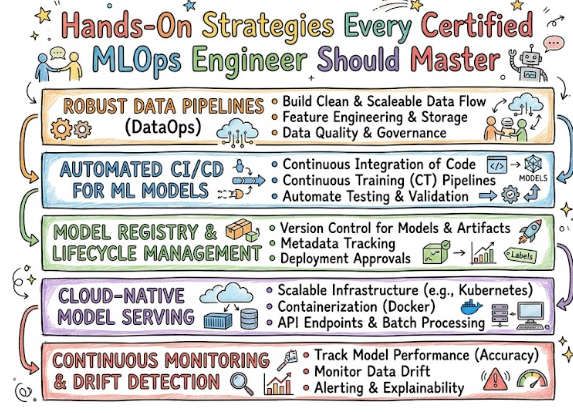
- Automated Pipelines: Skills are developed to create CI/CD workflows specifically for machine learning models.
- Monitoring and Logging: Methods for tracking model performance and data health in production are mastered.
- Containerization: Expertise in using Docker and Kubernetes for model serving is acquired.
- Version Control: Strategies for versioning data and models alongside code are implemented.
- Security in ML: Best practices for securing the ML supply chain are understood.
Real-world projects you should be able to do after this certification
- Automated Retraining Loop: A system is built where models are automatically retrained when data drift is detected.
- Scalable Model API: A RESTful API is deployed for a model that can handle thousands of concurrent requests.
- End-to-End Pipeline: A full pipeline from data ingestion to model deployment is constructed using industry-standard tools.
4. Preparation Plan
7–14 Days Plan (Express Path)
- Days 1-4: The core concepts of MLOps and the differences between DevOps and MLOps are studied.
- Days 5-10: Focus is placed on containerization and model deployment strategies.
- Days 11-14: Practice exams are taken, and key architectural diagrams are reviewed.
30 Days Plan (Standard Path)
- Week 1: Machine learning fundamentals and Python scripting are refreshed.
- Week 2: Deep dive into CI/CD tools and versioning for data (DVC).
- Week 3: Hands-on labs focusing on monitoring tools and infrastructure as code (IaC).
- Week 4: Real-world case studies are analyzed, and final mock tests are completed.
60 Days Plan (Comprehensive Path)
- Month 1: Theoretical foundations and prerequisites like Linux and basic statistics are mastered.
- Month 2: Extensive lab work is performed. Multiple end-to-end projects are built, and peer reviews are conducted to ensure deep understanding before the final assessment.
Common mistakes to avoid
- Ignoring Data Quality: Focusing only on the model while neglecting the data pipeline is a common pitfall.
- Over-Engineering: Complex tools should not be used if a simpler solution is effective.
- Neglecting Monitoring: A model is not “finished” once deployed; performance must be tracked constantly.
Best next certification after this
- Same track: Advanced AI Platform Architect.
- Cross-track: Certified DataOps Professional.
- Leadership / management: Engineering Manager (AI/ML Focus).
5. Choose Your Learning Path
- DevOps Path: Best for engineers who already manage infrastructure and want to add ML deployment to their skillset.
- DevSecOps Path: Ideal for security-focused professionals who need to ensure the integrity of AI models and data.
- SRE Path: Recommended for those focused on the reliability and uptime of large-scale ML applications.
- AIOps / MLOps Path: The primary choice for specialists who want to lead AI operational strategies.
- DataOps Path: Best for individuals who manage the data flow that feeds into machine learning systems.
- FinOps Path: Suitable for managers who need to optimize the cloud costs associated with expensive AI training jobs.
6. Role → Recommended Certifications Mapping
| Current Role | Target Certification | Career Outcome |
| DevOps Engineer | Certified MLOps Engineer | Senior MLOps Specialist |
| Site Reliability Engineer | Certified AIOps Professional | AI Reliability Lead |
| Platform Engineer | AI Platform Architect | Cloud AI Infrastructure Manager |
| Data Engineer | Certified DataOps Professional | Data Operations Lead |
| Security Engineer | Certified DevSecOps Professional | AI Security Architect |
| Engineering Manager | AI Leadership Certification | Director of AI Engineering |
7. Next Certifications to Take
One Same-Track Certification
The Advanced AI Platform Architect program is a natural progression. It expands on the concepts of scaling models across global infrastructures.
One Cross-Track Certification
The Certified DataOps Professional course is highly recommended. It provides the necessary skills to manage the data lifecycle that supports the ML models.
One Leadership-Focused Certification
The Digital Transformation and AI Strategy program is suitable for those moving into management. It focuses on the business value and organizational impact of AI technologies.
8. Training & Certification Support Institutions
DevOpsSchool
This institution is known for its extensive library of technical training modules. A wide range of support is provided for various cloud and automation tracks to help professionals upskill.
Cotocus
Cotocus offers specialized training that is aligned with current industry trends. The focus is maintained on providing practical, lab-based learning experiences for engineering candidates.
ScmGalaxy
ScmGalaxy serves as a vast resource hub for software configuration management and automation. It is a community-driven platform that supports engineers in mastering deployment tools.
BestDevOps
Practical guidance on DevOps and SRE methodologies is provided by this organization. The content is designed to be easily understood by both beginners and experienced practitioners.
devsecopsschool.com
A dedicated focus on the security aspect of the software lifecycle is maintained here. It is an essential resource for those looking to integrate security into their automation pipelines.
sreschool.com
Reliability and performance optimization are the core pillars of the curriculum at this school. It supports the development of engineers who can maintain high-availability systems.
aiopsschool.com
This platform is the primary provider for AI and MLOps certifications. The curriculum is specifically designed to address the unique challenges of machine learning operations.
dataopsschool.com
The management of data as a product is the focus here. Training is provided to ensure that data delivery is fast, automated, and high-quality.
finopsschool.com
Cloud financial management is taught through this institution. It is vital for professionals who need to balance technical performance with budget constraints.
9. FAQs Section
1. What is the difficulty level of the Certified MLOps Engineer exam?
The difficulty is considered moderate to high, as it requires a strong understanding of both software engineering and data science principles.
2. How much time is typically required to prepare?
Most professionals find that 30 to 60 days of consistent study is sufficient to master the required materials.
3. Are there any prerequisites for this certification?
A basic understanding of Linux, Python, and machine learning concepts is recommended before beginning the course.
4. What is the recommended certification sequence?
It is often recommended to start with DevOps fundamentals, followed by MLOps, and finally moving into AI Platform Architecture.
5. How does this certification add career value?
Holding this credential signals to employers that the candidate can handle the complex operational requirements of modern AI projects.
6. Which job roles can be pursued after certification?
Roles such as MLOps Engineer, AI Platform Engineer, and Machine Learning Systems Engineer are commonly available.
7. Is the exam conducted online or at a center?
The certification exam is typically offered in a secure, proctored online format for global accessibility.
8. How long is the certification valid?
The certification is generally valid for two to three years, after which recertification is encouraged to keep up with tech changes.
9. Does the course include hands-on labs?
Yes, practical labs are a significant part of the training program to ensure functional skill development.
10. Can a non-coder take this certification?
While some parts are conceptual, a working knowledge of coding, particularly in Python, is necessary for the technical sections.
11. Is there community support available during preparation?
Various forums and study groups are often available through the training providers to assist candidates.
12. What is the global recognition level of this program?
The program is recognized by major technology firms and startups across India, the US, and Europe.
Additional FAQs for Certified MLOps Engineer
1. Does the Certified MLOps Engineer course cover Kubernetes?
Yes, Kubernetes is covered as a primary tool for orchestrating and scaling machine learning containers.
2. Is model versioning part of the curriculum?
Version control for both data and models is treated as a critical skill within the program.
3. Are cloud-specific tools like SageMaker or Vertex AI taught?
The core principles are taught in a tool-agnostic way, though popular cloud platforms are often used in labs.
4. How is data drift addressed in the certification?
Methods for detecting and responding to data drift are integrated into the monitoring and alerting section of the course.
5. Does the certification help with MLOps for Deep Learning?
Yes, the operational principles apply to all types of machine learning, including complex deep learning architectures.
6. Is there a focus on CI/CD for ML?
Continuous Integration and Continuous Deployment for models are central themes of the entire certification.
7. Are ethical AI and governance included?
Basic governance and the ethical implications of automated deployments are introduced as part of the best practices.
8. What kind of support is provided for the final exam?
Mock tests and detailed study guides are provided by AIOps School to help candidates prepare for the final assessment.
10. Testimonials
Aman
The clarity provided on how to automate model deployments was exceptional. The confidence gained through the hands-on projects has significantly improved my daily workflow.
Elena
The gap between my data science knowledge and production systems was finally bridged. Real-world application of MLOps principles is now a core part of my skill set.
Vikram
A very structured approach to a complex topic was provided. Career clarity was achieved after understanding how different roles interact within an AI platform team.
Sarah
The focus on monitoring and scalability was exactly what was needed for our latest project. The training provided immediate value to the organization.
Rajesh
As a manager, understanding the lifecycle of ML operations helped me plan our team’s growth better. The strategic insight gained from this guide was invaluable.
11. Conclusion
The Certified MLOps Engineer certification represents a significant step forward for any technology professional. It provides the framework necessary to transform machine learning from an experimental phase into a robust, production-grade service. By mastering these operational skills, engineers ensure their relevance in a market that increasingly relies on automated intelligence. Long-term career benefits include higher visibility in the industry, better compensation, and the ability to lead cutting-edge technical projects. Strategic planning and a commitment to continuous learning will ensure success in this exciting and evolving field.

