
Introduction
The evolution of the digital world is being driven by the rapid adoption of artificial intelligence, yet it is noted that the true value of these models is only realized when they are properly operationalized. A high demand is observed for professionals who can bridge the technical gap between data science and production-ready infrastructure. In the following sections, a comprehensive overview of this career-defining certification is provided, ensuring that a clear understanding of the learning path and its professional rewards is gained by every reader.
What is Certified MLOps Professional?
The Certified MLOps Professional is defined as an industry-standard validation that confirms an individual’s ability to manage the end-to-end lifecycle of machine learning. Unlike general data science courses that focus on model accuracy, this certification is centered on the operationalization of those models. It is ensured that participants understand how to build reproducible pipelines, automate testing, and monitor performance in live environments.
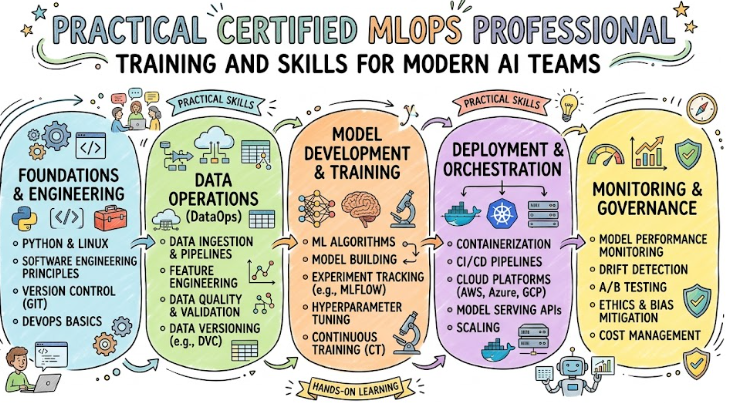
A deep focus is placed on the integration of CI/CD principles within the context of machine learning. The certification is structured to cover the unique requirements of “DataOps” and “ModelOps,” ensuring that both the input data and the output predictions are treated with the same level of engineering rigor as source code. By completing this program, a professional is acknowledged as someone who can reduce the time-to-market for AI products while maintaining high reliability and scalability.
Why It Matters Today?
The urgency for specialized MLOps knowledge is driven by the rapid adoption of AI across all sectors. It is frequently noted that models which perform perfectly during development often degrade quickly once they encounter real-world data. This phenomenon, known as model drift, can lead to significant financial or operational risks if it is not managed correctly. Therefore, the presence of skilled MLOps professionals is required to implement automated monitoring systems that can detect and correct these issues before they impact the end-user.
Furthermore, the scale at which machine learning is being deployed has outpaced the capabilities of traditional manual processes. Automation is no longer seen as a luxury but as a necessity for any organization that intends to run more than a handful of models. Through the application of MLOps practices, the infrastructure is made more efficient, and the collaboration between data scientists and operations teams is significantly improved. This leads to a more robust and predictable output for the business.
Why Certified MLOps Professional Certifications are Important?
The importance of this certification is found in its ability to standardize a relatively new and evolving field. In a market where many claim to understand AI, a formal certification serves as an objective proof of competence. It is viewed by hiring managers and technical leads as a sign that a candidate has moved past theoretical knowledge and has engaged with the practical, “messy” side of running ML at scale.
For the individual professional, the certification provides a structured learning path that might otherwise be difficult to find. Instead of piecing together information from various blog posts and documentation, a comprehensive curriculum is followed. This ensures that no critical gaps are left in one’s knowledge, such as security for ML models or cost management for GPU-heavy workloads. Ultimately, the certification is used as a powerful tool for career advancement, allowing engineers to transition into high-impact roles that command significant respect and compensation.
Why Choose AIOps School?
When the path for professional growth in AI infrastructure is being selected, AIOps School is often preferred due to its focus on real-world application. The curriculum is not developed in isolation; instead, it is built upon the challenges faced by large-scale enterprises. A commitment to keeping the content updated with the latest industry shifts is maintained, ensuring that the skills learned are immediately applicable to current job roles.
The learning environment provided by AIOps School is designed to be supportive yet rigorous. Concepts are explained in a manner that favors clarity over complexity, making it an ideal choice for both beginners and experienced veterans. Access to high-quality resources and a community of like-minded professionals is granted, which further enriches the learning experience. The focus is always kept on outcomes, ensuring that every learner is prepared to handle the actual tasks they will encounter in a professional setting.
Certification Deep-Dive: Certified MLOps Professional
What is this certification?
This program is established as a comprehensive validation for engineers who seek to master the deployment, scaling, and management of machine learning models. It is centered on the practical application of DevOps principles to the machine learning workflow.
Who should take this certification?
This certification is recommended for Software Engineers, DevOps Engineers, and Data Scientists who wish to specialize in infrastructure. It is also highly beneficial for Engineering Managers who are tasked with overseeing AI-driven projects.
Certification Overview Table
| Track | Level | Who it’s for | Prerequisites | Skills Covered | Recommended Order |
| MLOps | Professional | Engineers/SREs | Basic Python & Linux | CI/CD for ML, Monitoring, Pipelines | 1st in Track |
Skills You Will Gain
- The ability to build automated machine learning pipelines is acquired.
- Expertise in monitoring model performance and detecting data drift is developed.
- Proficiency in managing containerized ML environments using Kubernetes is gained.
- The knowledge required to implement version control for both code and large datasets is mastered.
- Skills in securing ML models against adversarial attacks and unauthorized access are provided.
Real-World Projects Post-Certification
- An end-to-end automated pipeline for a recommendation engine is constructed.
- A real-time monitoring dashboard for a credit scoring model is deployed.
- A scalable infrastructure for distributed model training on the cloud is designed.
- An automated retraining system that triggers based on performance metrics is implemented.
Preparation Plan
7–14 Days Plan (The Accelerated Path)
This path is intended for those who already possess a strong background in DevOps. The first week is dedicated to understanding the ML lifecycle and how it differs from traditional software. The second week is used to focus specifically on the tools and platforms used for model tracking and deployment.
30 Days Plan (The Standard Path)
The first two weeks are spent mastering the theoretical concepts of data versioning and experiment tracking. The third week is utilized for hands-on labs where pipelines are built. The final week is reserved for practice exams and reviewing security and compliance topics.
60 Days Plan (The Beginner Path)
A slower pace is adopted here to ensure foundational concepts are fully grasped. The first month is focused on Python, Linux, and basic machine learning concepts. The second month is dedicated entirely to the MLOps specific curriculum, allowing ample time for complex projects and deep experimentation.
Common Mistakes to Avoid
- The importance of data quality and versioning is often underestimated.
- Focusing solely on model training while ignoring the deployment phase is a common error.
- The need for continuous monitoring after a model is put into production is frequently overlooked.
- Over-complicating the infrastructure before the basic manual process is understood is avoided by successful students.
Best Next Certification After This
- Same Track: Advanced MLOps Specialist (for deeper automation).
- Cross-Track: Certified DataOps Professional (to master the data supply chain).
- Leadership / Management: Certified AIOps Leader (to manage large AI transformations).
Choose Your Learning Path
1. DevOps Path
For the traditional DevOps engineer, this path is focused on extending existing CI/CD knowledge to include ML artifacts. The management of model registries and the orchestration of training jobs are highlighted.
2. DevSecOps Path
Safety is prioritized in this path. It is explored how machine learning models can be scanned for vulnerabilities and how data privacy can be maintained throughout the pipeline.
3. Site Reliability Engineering (SRE) Path
The focus here is on the availability and latency of model serving. Strategies for zero-downtime deployments and auto-scaling of inference engines are deeply studied.
4. AIOps / MLOps Path
This is the core path for those who wish to live at the intersection of AI and Operations. The entire lifecycle, from data ingestion to model retirement, is covered in detail.
5. DataOps Path
The reliability of the data pipeline is the main concern. It is learned how to ensure that the data fed into ML models is consistent, clean, and delivered on time.
6. FinOps Path
Cost optimization for ML is the focus. Since training models can be expensive, strategies for managing cloud spend and selecting cost-effective compute instances are taught.
Role → Recommended Certifications Mapping
| Role | Primary Certification | Secondary Certification |
| DevOps Engineer | Certified MLOps Professional | Certified Cloud Architect |
| Site Reliability Engineer | Certified MLOps Professional | Certified SRE Professional |
| Platform Engineer | Certified MLOps Professional | Certified Kubernetes Expert |
| Cloud Engineer | Certified MLOps Professional | Certified FinOps Associate |
| Security Engineer | Certified MLOps Professional | Certified DevSecOps Expert |
| Data Engineer | Certified MLOps Professional | Certified DataOps Professional |
| FinOps Practitioner | Certified MLOps Professional | Certified Cloud Economist |
| Engineering Manager | Certified MLOps Professional | Certified AIOps Leader |
Next Certifications to Take
Same-Track: Advanced MLOps Specialist
Deep technical dives into complex automation scenarios are provided in this program. It is aimed at those who wish to architect large-scale ML systems for global enterprises.
Cross-Track: Certified DataOps Professional
The mastery of data flow and quality is achieved through this certification. It is seen as a perfect complement to MLOps, as high-quality data is required for successful models.
Leadership-Focused: Certified AIOps Leader
This certification is designed for those moving into management. A focus is placed on the strategic implementation of AI and how it can be used to transform business operations.
Training & Certification Support Institutions
DevOpsSchool
This institution is widely recognized for providing deep technical training across various DevOps disciplines. A strong emphasis is placed on practical labs and community support for all learners.
Cotocus
Boutique training solutions that focus on high-end technical skills are offered here. The instructors are noted for their ability to simplify complex architectural concepts for their students.
ScmGalaxy
A vast repository of knowledge and training resources is maintained by this organization. It is frequently utilized by professionals seeking to stay updated on the latest software configuration management trends.
BestDevOps
Specialized training programs that are tailored to meet the needs of modern engineering teams are provided. A focus on job-ready skills and career mentoring is maintained throughout the courses.
devsecopsschool.com
This platform is dedicated entirely to the intersection of security and operations. Expert-led sessions are provided to ensure that security is never an afterthought in the development lifecycle.
sreschool.com
Reliability and scalability are the core pillars of the training provided here. The curriculum is designed to help engineers build systems that are both robust and easy to maintain.
aiopsschool.com
Leading-edge training in the field of AI and Machine Learning operations is delivered by this institution. It is considered the primary destination for those seeking the Certified MLOps Professional designation.
dataopsschool.com
The intricacies of data management and engineering are taught here. The programs are structured to help professionals build reliable data supply chains for their organizations.
finopsschool.com
The financial management of cloud and infrastructure is the specialty of this school. Skills are provided to help engineers and managers balance performance with cost efficiency.
FAQs Section
What is the difficulty level of this program?
The level is considered intermediate to advanced, as a foundational understanding of both software operations and basic data concepts is required for success.
How much time is typically required to complete the certification?
A period of four to eight weeks is usually found to be sufficient for most working professionals to prepare for and pass the exam.
Are there any specific prerequisites needed before starting?
Basic proficiency in the Linux command line and a working knowledge of Python programming are generally recommended as prerequisites.
What is the suggested certification sequence for a beginner?
A start is often made with a basic DevOps certification, followed by the Certified MLOps Professional, and concluding with a specialized leadership or security track.
How much career value does this certification add?
A significant increase in marketability is observed, as MLOps is currently one of the highest-demand skill sets in the global technology sector.
Which job roles can be pursued after obtaining this certification?
Roles such as MLOps Engineer, Machine Learning Architect, and Senior DevOps Specialist (AI) are commonly attained by certified individuals.
Is the certification recognized in global markets?
Yes, the standards taught are universal, and the certification is respected by multinational corporations across various continents.
Does the program include hands-on practical training?
A large portion of the curriculum is dedicated to practical labs where real pipelines are built and managed in a simulated environment.
How often is the course content updated?
The material is reviewed and updated on a regular basis to ensure that the latest tools and industry best practices are always included.
Is there support provided for job placement?
While the primary focus is on education, access to a professional network and career guidance is often provided by the supporting institutions.
What is the format of the final examination?
The exam is typically composed of a mix of multiple-choice questions and practical scenarios that test both theoretical and applied knowledge.
Can this certification help an Engineering Manager?
Deep technical insights are provided that allow managers to better estimate timelines, manage risks, and lead their AI teams more effectively.
Specific FAQs: Certified MLOps Professional
1. What exactly is covered in the Certified MLOps Professional curriculum?
The entire lifecycle of a machine learning model is explored, including data ingestion, version control, automated training, deployment, and continuous monitoring.
2. How does MLOps differ from traditional DevOps in this course?
The unique challenges of managing data state, model performance decay, and heavy compute requirements are highlighted as key differences from standard software.
3. Is cloud-specific knowledge required for this certification?
While generic principles are taught, the application of these concepts on major cloud platforms is a significant part of the training.
4. Are popular tools like Kubernetes and Jenkins included?
The use of container orchestration and automation servers within the specific context of machine learning workflows is covered in detail.
5. How is “Model Drift” handled within the taught framework?
Automated monitoring strategies are implemented to detect when a model’s predictions no longer align with real-world data, triggering necessary retraining.
6. Is security for AI models a part of the program?
The protection of models from adversarial attacks and the securing of sensitive training data are addressed as critical components of the curriculum.
7. Can this certification be used to transition from a Data Science role?
Data scientists who wish to gain the engineering skills needed to put their own models into production find this certification extremely valuable.
8. What kind of project portfolio is built during the course?
A variety of projects, ranging from simple automated deployments to complex self-healing ML infrastructures, are completed and added to a professional portfolio.
Testimonials
Amit
The clarity provided regarding the machine learning lifecycle was exceptional. A shift in perspective was achieved, allowing for the successful deployment of models that had previously been stuck in the development phase.
Sarah
Confidence in managing large-scale AI infrastructure was greatly improved through the practical labs. The skills acquired were immediately applied to a major project, resulting in a more stable and predictable production environment.
Vikram
A deep understanding of how to bridge the gap between data science and operations was gained. The certification served as a catalyst for a promotion and provided the technical authority needed to lead a new MLOps team.
Elena
The focus on security and monitoring was found to be the most valuable aspect. It is now possible to ensure that models remain safe and accurate over long periods, which has been highly appreciated by the management team.
Arjun
The structured learning path allowed for a quick transition from a standard Cloud Engineer role into the specialized field of MLOps. The career clarity and technical growth experienced were well worth the effort.
Conclusion
The attainment of the Certified MLOps Professional certification is seen as a strategic move for any professional who wishes to remain relevant in the evolving tech industry. As organizations continue to integrate artificial intelligence into their core operations, the demand for those who can manage these systems reliably will only increase. By following the structured path provided by AIOps School, a professional is equipped with the tools, knowledge, and confidence required to excel.
Long-term career benefits are significant, ranging from higher compensation to the opportunity to work on cutting-edge global projects. A commitment to continuous learning and strategic certification planning is encouraged for everyone in the DevOps and SRE space. The future of operations is undeniably intertwined with AI, and being prepared for that shift is the best way to ensure lasting professional success.

