
Introduction
The management of enterprise cloud infrastructure has been altered completely by the widespread adoption of cloud-native technologies. While operational agility and rapid scaling are easily achieved, cloud budgets are routinely exceeded when proper financial governance is absent. To bridge the gap between engineering execution and financial accountability, the discipline of cloud financial operations has been established. Within this framework, advanced architectural expertise is validated through professional certification programs.
What is Certified FinOps Architect
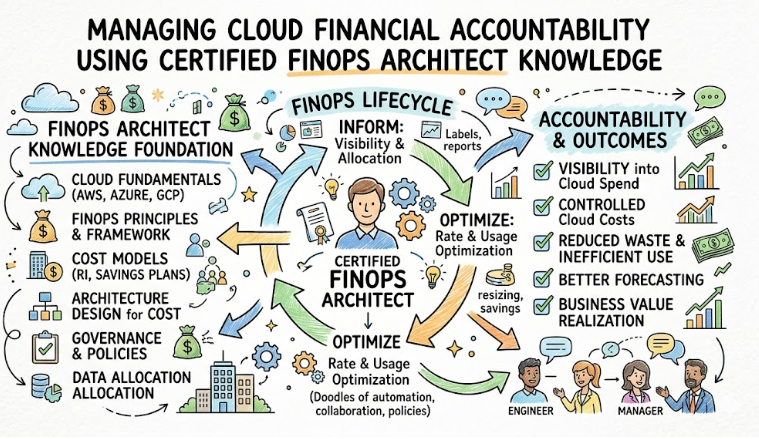
An elite professional standard is established by the Certified FinOps Architect designation for cloud engineers and technology leaders. Deep technical knowledge and cloud financial management practices are combined within this credential. Complex cloud topologies are analyzed by certified individuals to ensure that infrastructure spend is aligned directly with business value.
Corporate financial strategies are translated into automated cloud architectures by professionals holding this title. Rather than merely observing cloud billing reports, cloud deployment pipelines are re-engineered by an architect to include automated governance, cost allocation tags, and real-time budgeting guardrails. Cross-functional alignment between software engineering teams, finance departments, and executive leadership is facilitated through this advanced programmatic framework.
Why it matters today’s?
Cloud resources are frequently provisioned by engineering teams without a clear understanding of the associated financial impact. Traditional static budgeting methodologies are found to be completely incompatible with the dynamic, variable billing models utilized by modern cloud providers. Massive cloud waste is generated when idle resources, oversized virtual instances, and unoptimized data storage systems are left unmonitored.
Real-time cost visibility is required by modern enterprises to prevent budget overruns before they occur. Cloud scalability must be balanced with fiscal discipline so that profitability is sustained during rapid growth phases. Through the implementation of advanced financial architecture, automated infrastructure optimization is achieved, ensuring that every dollar spent on cloud resources directly drives organizational revenue.
Why Certified FinOps Architect certifications are important
- Architectural Validation: Superior capability in designing cost-effective, high-performing cloud environments is formally verified.
- Career Advancement: Transitioning from routine infrastructure deployment to high-level corporate cost strategy is accelerated.
- Wastage Elimination: Significant cloud expenditures are saved through the execution of advanced data lifecycle policies and resource optimization.
- Cultural Transformation: A culture of accountability is fostered, where cloud spend is owned directly by the engineering squads responsible for provisioning.
- Market Demand: A highly competitive advantage is obtained in the global technology market, as enterprises seek leaders who can curb rising infrastructure costs.
why choose Finopsschool ?
Exceptional educational methodologies are provided by FinOpsSchool to meet the rigorous demands of global cloud enterprises. The curriculum is uniquely structured to blend deep technical execution with real-world financial strategy. High-quality learning experiences are delivered through interactive lab environments, peer-reviewed study materials, and practical case studies. Dedicated support is continuously offered to ensure that complex architectural principles are mastered easily by candidates from both technical and financial backgrounds.
Certification Deep-Dive: Certified FinOps Architect
What is this certification?
The Certified FinOps Architect credential is a master-level verification program designed for senior professionals. Advanced competency in automating cloud financial governance, designing multi-cloud cost allocation architectures, and optimizing enterprise infrastructure spend is validated.
Who should take this certification?
This program is specifically designed for senior cloud architects, platform engineers, site reliability engineering leads, engineering managers, and corporate technology decision-makers who oversee substantial cloud infrastructure budgets.
Certification Overview Table
| Track | Level | Who it’s for | Prerequisites | Skills Covered | Recommended Order |
| Cloud Financial Foundation | Associate | IT Beginners & Finance Peers | Basic Cloud Literacy | Cost terminology, billing dashboards, tagging basics | First |
| FinOps Practitioner | Intermediate | DevOps & Cloud Engineers | Foundation Certificate | Anomaly detection, data allocation, cost metrics | Second |
| FinOps Professional | Advanced | Senior Systems Architects | Practitioner Certificate | Unit economics, forecasting, KPI development | Third |
| FinOps Architectural Track | Expert | Enterprise Technology Architects | Professional Certificate | Governance automation, policy engines, multi-cloud design | Fourth |
Skills you will gain
- Advanced multi-cloud billing API integration is completely mastered.
- Automated policy-as-code models are engineered to eliminate idle infrastructure.
- Complex unit economic frameworks are developed to map cloud costs to business transactions.
- Data pipelines are designed to aggregate billing metrics into single-pane dashboards.
- Cross-functional financial report mechanisms are successfully established for executive review.
Real-world projects you should be able to do after this certification
- Automated Governance Policy Engine: A programmatic system is constructed where non-compliant cloud infrastructure is automatically flagged, stopped, or downsized based on corporate financial policies.
- Multi-Cloud Cost Aggregator Pipeline: An enterprise data pipeline is engineered to extract, transform, and load billing data from multiple cloud vendors into a centralized data warehouse for unified visualization.
- Anomalous Infrastructure Spend Detector: A machine-learning alerting mechanism is configured within the deployment pipeline to identify unexpected spikes in compute usage and notify engineering squads instantly.
Preparation plan
7–14 days plan
- Days 1–4: Core architectural principles and cloud vendor billing structures are reviewed daily.
- Days 5–8: Official whitepapers regarding automated governance and cost allocation strategies are studied thoroughly.
- Days 9–14: Mock practice examinations are executed, and identified knowledge gaps are systematically remediated.
30 days plan
- Days 1–10: Video lectures and foundational documentation covering cloud financial frameworks are completed.
- Days 11–20: Hands-on lab exercises are conducted to practice building automated policy-as-code scripts.
- Days 21–25: Real-world corporate case studies concerning large-scale cloud migrations are deeply analyzed.
- Days 26–30: Sample exam questionnaires are evaluated daily, and final testing simulations are completed.
60 days plan
- Days 1–20: A deep structural analysis of multi-cloud billing APIs and metadata tagging structures is performed.
- Days 21–40: Automated cost optimization templates are developed and tested within staging environments.
- Days 41–50: Forecasting methodologies, budget variance models, and strategic unit economics are studied.
- Days 51–60: Extensive review sessions are held with peer groups, and exhaustive exam simulations are mastered.
Common mistakes to avoid
- Ignoring Technical Context: Financial guardrails are frequently designed without considering the underlying system performance constraints.
- Reliance on Manual Tracking: Spreadsheets are utilized for cost tracking instead of implementing scalable, automated policy compliance tools.
- Poor Tagging Enforcement: Cloud infrastructure is provisioned without strict, automated resource tagging policies, resulting in unallocated spend.
- Neglecting Cultural Alignment: Technical changes are forced upon engineering teams without fostering a shared culture of financial accountability.
Best next certification after this
Same track
Advanced mastery in enterprise cloud forecasting, predictive budget modeling, and machine learning cost management is pursued.
Cross-track
DevSecOps engineering methodologies are integrated with cost governance to ensure that automated security appliances are deployed economically.
Leadership / management
Enterprise technology governance frameworks are studied to prepare for executive roles, where entire technology portfolios are aligned with corporate financial objectives.
Choose Your Learning Path
DevOps Pathway
Continuous integration and continuous deployment pipelines are enhanced with automated cost-tracking mechanisms. Financial feedback loops are embedded directly into development environments to inform software engineers of the budgetary impact of their code changes before deployment occurs. This path is best for deployment specialists aiming to combine speed with fiscal efficiency.
DevSecOps Pathway
Security compliance is paired systematically with infrastructure cost control. Advanced security monitoring tools and firewall appliances are optimized so that corporate cloud budgets are not drained by redundant data logging or misconfigured security policies. This path is best for security engineers focused on protecting large-scale systems economically.
Site Reliability Engineering (SRE) Pathway
System uptime and reliability metrics are mapped directly to infrastructure cost models. Error budgets and high-availability configurations are analyzed to ensure that systems are not over-provisioned for minor performance gains that do not match business requirements. This path is best for reliability practitioners balancing peak system performance with strict budget boundaries.
AIOps / MLOps Pathway
Data training models and automated machine learning pipelines are continuously monitored for resource efficiency. Dynamic auto-scaling is applied to high-cost GPU computing instances to ensure that expensive infrastructure is utilized only during active model training cycles. This path is best for data scientists and machine learning engineers managing resource-intensive workflows.
DataOps Pathway
Large-scale enterprise data warehouses and storage lakes are architected for maximum cost efficiency. automated data lifecycle policies are implemented to move historical or stale data automatically to colder, lower-cost storage tiers. This path is best for data engineers supervising massive corporate data landscapes.
FinOps Pathway
Full corporate cloud visibility, strategic cost governance, and business unit economics are established across the entire organization. Shared financial accountability is driven into the engineering culture to ensure long-term profitability and sustainable cloud growth. This path is best for dedicated practitioners leading enterprise-wide cloud financial transformations.
Role → Recommended Certifications Mapping in table
| Engineering Role | Core Focus Area | Primary Certification Recommended | Secondary Certification Recommended |
| DevOps Engineer | Continuous Pipeline Efficiency | Practitioner Cost Credential | Continuous Delivery Expert |
| Site Reliability Engineer | Performance & Budget Balance | Architectural Cost Credential | System Reliability Specialist |
| Platform Engineer | Internal Technical Tooling | Architectural Cost Credential | Cloud Infrastructure Expert |
| Cloud Engineer | Resource Provisioning Systems | Foundation Cost Credential | Multi-Cloud Architecture Specialist |
| Security Engineer | Infrastructure Compliance | DevSecOps Certification | Cost Governance Foundation |
| Data Engineer | Pipeline Storage Optimization | Data Architecture Specialist | Practitioner Cost Credential |
| FinOps Practitioner | Corporate Financial Alignment | Professional Cost Credential | Architectural Cost Credential |
| Engineering Manager | Strategic Resource Planning | Leadership Cost Governance | Advanced Agile Management |
Next Certifications to Take
- One Same-Track Certification:Advanced specialized credentials within the same technical domain are pursued to deepen core architectural execution. Technical mastery is continuously enhanced by focusing on complex configurations and advanced automation tools specific to the primary role.
- One Cross-Track Certification:Complementary disciplines, such as cloud financial operations or security compliance, are integrated to expand cross-functional capabilities. Broader operational value is delivered to the organization by bridging technical silos across engineering teams.
- One Leadership-Focused Certification:Strategic management frameworks and tech-governance blueprints are mastered to prepare for high-level organizational planning. Technical expertise is successfully translated into corporate business strategy and team mentorship programs.
Training & Certification Support Institutions
DevOpsSchool
Comprehensive training programs are offered by this institution to bridge the gap between software development and IT operations. Interactive learning lab environments and curated study frameworks are provided to ensure rapid skill acquisition.
Cotocus
Specialized cloud architecture consulting and technical training are delivered globally by this organization. Enterprise-level engineering competencies are developed through rigorous practical curriculums and structured peer mentorship.
ScmGalaxy
A prominent community knowledge center and learning repository for configuration management professionals are maintained by this platform. Advanced systems skills are fostered through detailed technical articles and workshops.
BestDevOps
Focused educational bootcamps and career transition resources are provided to accelerate entry into modern platform engineering roles. Hands-on tool mastery and practical problem-solving are highly prioritized.
devsecopsschool.com
Dedicated educational modules are delivered to integrate security principles deeply into automated deployment pipelines. Secure coding practices and continuous compliance methodologies are systematically taught.
sreschool.com
Advanced educational programs centered on system reliability, fault tolerance, and large-scale infrastructure monitoring are provided by this platform. System performance under extreme operational stress is prioritized.
aiopsschool.com
Cutting-edge courses detailing the integration of artificial intelligence and machine learning within IT operations are hosted by this institution. Automated root-cause analysis and predictive monitoring are thoroughly explored.
dataopsschool.com
Educational pathways designed to streamline data delivery and enhance data pipeline quality are managed by this site. Continuous integration principles applied to data infrastructure are systematically covered.
finopsschool.com
Premier certifications and structured educational frameworks focused exclusively on cloud financial operations are pioneered by this provider. Cultural accountability and cloud cost optimization are thoroughly addressed.
Frequently Asked Questions
General Framework Inquiries
1. What difficulty level is associated with this career track?
An advanced level of difficulty is encountered, as a deep understanding of both cloud architecture and financial accounting is required.
2. How much time is typically required to complete the preparation?
With consistent study, approximately thirty to sixty days are required to master the complete examination syllabus.
3. Are any specific prerequisites mandated before examination entry?
A foundational cloud certification or equivalent operational experience within cloud environments is highly recommended.
4. What is the ideal certification sequence to be followed?
The learning journey should be commenced with the associate credential before advancing to the expert architectural level.
5. What long-term career value can be expected from this credential?
Substantial market demand is enjoyed by credential holders, frequently resulting in promotion to enterprise governance roles.
6. Which specific job roles are expanded by this qualification?
Opportunities are unlocked for roles such as Cloud Architect, Lead Systems Engineer, and Director of Cloud Governance.
7. Can this program be completed through self-study methods?
Yes, self-study can be successfully utilized if official study guides, practice labs, and whitepapers are combined effectively.
8. How frequently must these professional credentials be renewed?
Recertification is required every three years to ensure that changing cloud vendor billing models are mastered.
9. Are multi-cloud environments covered within the scope of study?
Yes, financial tracking across Amazon Web Services, Microsoft Azure, and Google Cloud Platform is comprehensively included.
10. How is corporate waste minimized using these techniques?
Unused resources are identified, storage tiers are optimized, and automated scheduling is implemented to curb spend.
11. What role does automation play in this architectural discipline?
Automation is considered critical, as manual policy enforcement cannot scale with dynamic enterprise cloud infrastructure.
12. How are engineering teams motivated to adopt these financial practices?
Shared accountability is established by mapping cloud costs directly to the specific product features delivered by teams.
Certified FinOps Architect Focus
1. What is the core focus of the Certified FinOps Architect exam?
The validation of an individual’s capacity to design automated, cost-efficient cloud infrastructure at scale is prioritized.
2. How does this architectural credential differ from the standard practitioner certificate?
Deep technical design and automated policy engineering are focused upon, rather than basic financial reporting and terminology.
3. Is coding ability required to pass this advanced architectural level?
Yes, proficiency in scripting and understanding policy-as-code frameworks is necessary to deploy automated remediation systems.
4. What specific cloud billing complexities are evaluated during the test?
Amortized costs, data transfer fees, reservation models, and savings plan utilization strategies are thoroughly tested.
5. How are unit economics incorporated into this certification program?
Architectural designs are analyzed to ensure that cloud costs can be calculated per active user or business transaction.
6. Can an engineering manager benefit from this technical architectural credential?
Yes, strategic insights are gained to effectively supervise cloud migration budgets and lead cloud governance offices.
7. What types of practical questions are encountered in the official examination?
Scenario-based problem-solving questions regarding multi-cloud cost allocation and architectural remediation are presented.
8. How does this credential impact an organization’s bottom line?
Significant reduction in accidental cloud spend is achieved through the continuous application of optimized architectural principles.
Testimonials
Aarav
The automated cost remediation models provided immediate value to our deployment strategies. Cloud waste was reduced by thirty percent within two months of applying these structural concepts.
Ananya
Clear guidance on cloud financial governance allowed our site reliability teams to balance performance budgets with financial limitations effortlessly. System efficiency was significantly improved.
Rohan
A comprehensive understanding of multi-cloud billing systems was obtained through this program. Strategic conversations with executive stakeholders are now approached with total confidence.
Diya
Security compliance tools were successfully optimized using these cost management techniques. Budget overruns caused by inefficient log storage were completely eliminated.
Kabir
Our engineering infrastructure was completely aligned with business unit economics following this training path. Career clarity was achieved, leading to an immediate advancement into platform governance.
Conclusion
The optimization of cloud infrastructure is no longer treated as an optional operational task; it has become a core corporate necessity. Deep expertise in managing cloud financial environments can be achieved through the structured learning tracks outlined above. High-value credentials ensure that engineering professionals remain indispensable assets to their organizations. Long-term career sustainability is secured by mastering the intersection of cloud architecture and financial discipline. Strategic educational planning should be initiated immediately to stay ahead in the global technology market.

