
Introduction
Data is often called the new oil, but raw oil is useless without a refinery. In the modern tech world, data must be processed, cleaned, and delivered quickly to be valuable. This is where DataOps comes in. Managing these complex data pipelines requires more than just technical skill; it requires a specialized management approach.
The CDOM – Certified DataOps Manager program has been designed to bridge the gap between data engineering and business operations. A clear path is provided by this certification for those who want to lead data teams. The complexities of data workflows are addressed, and a standard for excellence is established.
For any professional looking to move into a leadership role within the data ecosystem, understanding this certification is essential. It is not just about learning a tool; it is about mastering a methodology that brings agility to data management.
What is CDOM – Certified DataOps Manager
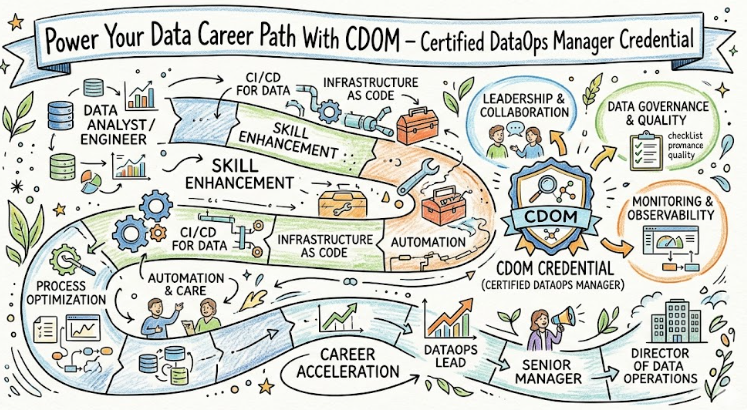
The CDOM – Certified DataOps Manager is a professional credential that validates an individual’s ability to manage and optimize data lifecycles. It focuses on the intersection of people, processes, and technology. By following this program, the principles of automation, collaboration, and continuous improvement are applied to data streams.
It is considered a leadership-tier certification. It ensures that data managers can reduce the time it takes to turn raw data into actionable insights. Quality control, automated testing, and team synchronization are core pillars of this management framework.
Why it matters today?
In today’s market, speed is everything. However, speed without quality leads to disaster. Many organizations struggle with “data silos” where information is trapped in different departments. Decisions are often delayed because the data is not ready or is inaccurate.
DataOps management is needed to solve these bottlenecks. By implementing a DataOps strategy, manual errors are reduced and collaboration is increased. Companies that employ certified managers often see a significant jump in their data reliability. This is why the CDOM role has become a high-demand position in global markets, including India and the West.
Why CDOM – Certified DataOps Manager certifications are important
Certifications serve as a benchmark for skills in an industry that changes rapidly. For an employer, a CDOM certification proves that a candidate has undergone rigorous training. It shows that the best practices for data orchestration are understood and can be implemented.
For the professional, it provides a structured learning path. Instead of learning random tools, a holistic view of the data management world is gained. It also offers a competitive edge during hiring processes and helps in securing higher-level management roles.
Why choose DataOpsSchool?
DataOpsSchool is chosen by thousands of professionals because of its deep focus on practical application. The curriculum is updated regularly to reflect the latest trends in the industry. It is not just theoretical; real-world scenarios are integrated into the learning modules.
Support is provided by a community of experts who understand the challenges of modern data environments. The learning materials are designed to be simple and easy to follow, making complex topics accessible to everyone. By choosing this platform, a global standard of education is received, ensuring that career goals are met effectively.
3. Certification Deep-Dive: CDOM – Certified DataOps Manager
What is this certification?
This certification is a specialized management program designed for leaders who oversee data operations. It focuses on building automated, high-quality data pipelines and fostering a culture of collaboration between data producers and consumers.
Who should take this certification?
- Senior Data Engineers looking to move into management.
- DevOps Engineers transitioning into the data domain.
- Project Managers overseeing data-driven products.
- IT Directors wanting to modernize their data strategy.
Certification Overview Table
| Track | Level | Who it’s for | Prerequisites | Skills Covered | Recommended Order |
| DataOps Foundation | Beginner | Newcomers to DataOps | Basic IT knowledge | Core principles, terminology | 1st |
| DataOps Professional | Intermediate | Working Engineers | Foundation cert | Pipeline automation, Tooling | 2nd |
| CDOM – Manager | Expert | Leads & Managers | Professional level | Strategy, Governance, Team Lead | 3rd |
| DataOps Architect | Advanced | Solutions Architects | CDOM or equivalent | Infrastructure design, Scaling | 4th |
| DataOps Security | Specialist | Security Professionals | Basic DataOps | Compliance, Data Privacy | Optional |
Skills you will gain
- The ability to design end-to-end automated data pipelines.
- Expertise in managing cross-functional teams (Data Science, Dev, Ops).
- Deep understanding of data quality monitoring and automated testing.
- Skills in resource optimization and cost management for data projects.
- Knowledge of governance and compliance in high-scale data environments.
Real-world projects you should be able to do after this certification
- Building an automated data ingestion system that handles multi-source inputs.
- Implementing a “Data-as-a-Service” model within a large organization.
- Setting up a real-time monitoring dashboard for data pipeline health.
- Leading a migration project from legacy data silos to a unified DataOps platform.
- Designing a disaster recovery plan specifically for critical data assets.
Preparation plan
7–14 days plan:
Focus on the core concepts and terminology. The official study guide should be read thoroughly. Practice quizzes should be taken daily to identify weak areas. Key frameworks and the DataOps manifesto should be memorized.
30 days plan:
The first two weeks should be spent on theory. The remaining two weeks should involve hands-on practice with basic orchestration tools. Participation in study groups or forums is highly recommended during this phase.
60 days plan:
A deep dive into advanced management strategies should be conducted. Case studies from the industry should be analyzed. Mock exams should be completed at least three times. The final 10 days should be reserved for a total review of all modules.
Common mistakes to avoid
- Ignoring the cultural aspect of DataOps and focusing only on tools.
- Skipping the foundational courses before attempting the manager level.
- Not practicing with real-world data scenarios.
- Underestimating the importance of data governance and security.
Best next certification after this
- Same track: DataOps Architect.
- Cross-track: MLOps Foundation or Cloud Security Engineer.
- Leadership / management: Certified Engineering Manager or FinOps Practitioner.
4. Choose Your Learning Path
DevOps Path:
This is best for professionals who are already comfortable with CI/CD and automation. The focus here is on applying those automation skills specifically to data sets.
DevSecOps Path:
This path is ideal for security-minded engineers. It ensures that as data moves through the pipeline, it remains encrypted, compliant, and secure from external threats.
Site Reliability Engineering (SRE) Path:
This is best for those who care about uptime and performance. It teaches how to make data systems highly available and resilient to failures.
AIOps / MLOps Path:
Designed for those working with Artificial Intelligence. It focuses on how data is fed into machine learning models and how those models are managed in production.
DataOps Path:
The primary path for data professionals. It covers the entire lifecycle from raw data collection to final business intelligence reporting.
FinOps Path:
Ideal for those who manage budgets. It teaches how to optimize the costs of cloud storage and data processing to ensure the business stays profitable.
5. Role → Recommended Certifications Mapping
| Role | Recommended Certification |
| DevOps Engineer | CDOM – Certified DataOps Manager |
| Site Reliability Engineer (SRE) | SRE Foundation / Practitioner |
| Platform Engineer | Certified Platform Architect |
| Cloud Engineer | Professional Cloud Developer |
| Security Engineer | DevSecOps Professional |
| Data Engineer | CDOM – Certified DataOps Manager |
| FinOps Practitioner | Certified FinOps Manager |
| Engineering Manager | CDOM – Certified DataOps Manager |
6. Next Certifications to Take
One same-track certification:
The DataOps Architect certification is the logical next step. It allows for a deeper understanding of the technical infrastructure required to support large-scale management strategies.
One cross-track certification:
The MLOps Foundation certification is highly recommended. It expands the manager’s ability to oversee projects that involve machine learning, which is becoming a standard in data teams.
One leadership-focused certification:
The Certified Engineering Manager program should be considered. It provides broader leadership skills that go beyond data, covering general team dynamics and organizational growth.
7. Training & Certification Support Institutions
DevOpsSchool:
A wide range of technical training is provided here. The focus is on practical labs and real-world scenarios. It is recognized globally for producing high-quality engineers.
Cotocus:
This institution is known for its specialized consulting and training approach. High-level certification support is offered to both individuals and corporate teams.
ScmGalaxy:
A massive repository of community knowledge and professional training is maintained here. It is an excellent resource for those looking for deep technical insights and troubleshooting guides.
BestDevOps:
Simple and effective learning paths are offered for modern IT roles. The curriculum is designed to be beginner-friendly while maintaining professional standards.
devsecopsschool.com:
The integration of security into the development lifecycle is the main focus here. It is an essential resource for engineers who want to specialize in secure automation.
sreschool.com:
Reliability and scalability are the core pillars of this institution. Detailed guides and certifications for SRE roles are provided to help professionals manage complex systems.
aiopsschool.com:
Training for the future of IT operations is provided here. The use of artificial intelligence to manage infrastructure is explored in detail through various certification programs.
dataopsschool.com:
The primary hub for everything related to DataOps. A comprehensive learning environment is offered for those aiming to master data management and orchestration.
finopsschool.com:
Cloud financial management is the specialty here. Professionals are taught how to balance technical performance with cost-efficiency in the cloud.
8. FAQs Section
General FAQs:
- What is the difficulty level of CDOM?The difficulty is considered intermediate to advanced, as it requires both technical knowledge and management logic.
- How much time is required to prepare?For most working professionals, a period of 30 to 60 days is usually sufficient.
- Are there any prerequisites?Basic knowledge of data systems is recommended, though the foundation level can be taken by beginners.
- What is the best certification sequence?It is recommended to start with the Foundation, then Professional, and finally the CDOM Manager level.
- What is the career value of this certification?High value is placed on this credential by companies looking to modernize their data departments.
- Which job roles benefit most from CDOM?Data Leads, Engineering Managers, and Senior Data Engineers see the most benefit.
- Is the certification recognized globally?Yes, it is recognized by tech firms in India, the US, Europe, and beyond.
- Does it cover specific tools?It focuses more on methodology and framework, which can be applied to any toolset.
- How long is the certification valid?Typically, the certification is valid for two to three years before renewal is suggested.
- Is there a community for support?Yes, a large network of alumni and experts is available for guidance.
- Can this help in a career transition?It is an excellent way for DevOps engineers to pivot into high-paying data management roles.
- Are mock exams provided?Most training partners associated with the program provide practice tests.
CDOM Specific FAQs:
- What is the primary focus of CDOM?The focus is on managing the flow of data and improving team collaboration.
- Does CDOM involve coding?While it is a management cert, an understanding of automation scripts and SQL is helpful.
- How does CDOM differ from standard Data Engineering?Data Engineering focuses on building; CDOM focuses on managing and optimizing the entire process.
- Is it suitable for non-technical managers?It is best suited for those with at least a basic technical background in IT.
- What is the exam format?The exam usually consists of multiple-choice questions focusing on scenario-based management problems.
- Can I take the exam online?Yes, the exam can be taken from anywhere through the official platform.
- What passing score is required?A score of 70% or higher is generally required to pass.
- Are there renewal fees?Standard administrative fees may apply for certificate maintenance after a few years.
9. Testimonials
Aarav:
The way data management is viewed has been completely changed for me. A clear structure for my team’s workflow was finally found after completing the program. Confidence in my daily decisions has grown tremendously.
Elena:
Complex concepts were made simple by this course. Real-world applications were found immediately in my current project. My ability to lead cross-functional discussions has been greatly improved.
Karthik:
A significant gap in my knowledge was filled by this certification. The transition from engineer to manager was made much smoother. Career clarity was finally achieved after years of uncertainty.
Sarah:
The practical focus of the modules was exactly what was needed. My team’s productivity has increased because the principles learned here were implemented. It is a must-have for anyone in the data space.
Vikram:
Skills were upgraded and a global standard was met. The learning path was easy to follow and very rewarding. Professional growth has been accelerated since I became certified.
10. Conclusion
The era of disorganized data is being brought to an end by the rise of structured management. Through the CDOM – Certified DataOps Manager program, a powerful set of skills is acquired to lead this transition. Faster delivery and higher quality are ensured when these practices are adopted within an organization.
A competitive edge in the global market is maintained by those who hold this respected credential. The foundation for a lifelong career in leadership is laid by mastering the art of DataOps. Every complex challenge in the data lifecycle is met with a proven solution once this certification is achieved. A decision to advance today is seen as a commitment to excellence and professional growth.

