
Introduction
Most data projects do not fail because the math is wrong. They fail because moving data from one place to another is messy, slow, and full of human errors. Data scientists write models, engineers build pipelines, and business teams wait weeks for reports.
This chaos is why companies started using DataOps. DataOps brings software development ideas—like automation, testing, and teamwork—into the world of data.
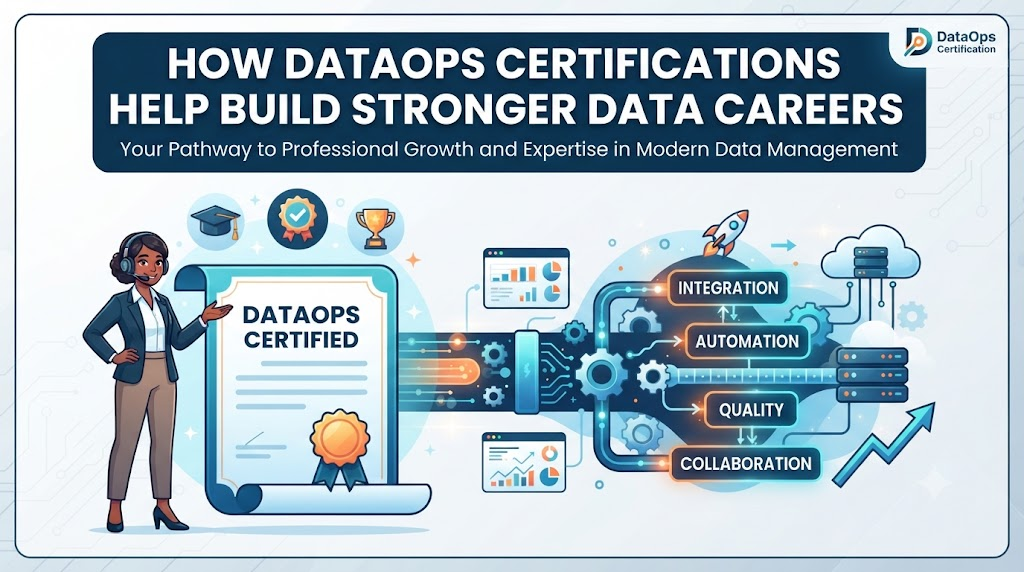
As more companies adopt this approach, the demand for skilled professionals is growing fast. Earning a DataOps certification is one of the clearest ways to show employers that you know how to fix these operational bottlenecks. This article explores how DataOps certifications can strengthen your skills, boost your credibility, and accelerate your career.
What Is DataOps?
DataOps (Data Operations) is a set of practices, processes, and technologies that automates and improves how data moves through an organization.
- Simple meaning: Think of DataOps as an assembly line for data. Instead of people moving boxes by hand, machines test, pack, and ship data safely and quickly from the source to the dashboard.
- Why it matters: Without DataOps, data teams waste hours fixing broken pipelines and arguing over whose numbers are correct. DataOps cuts out the manual work so teams can trust their data.
- Example: Imagine a retail company that tracks daily sales. Without DataOps, if a database update changes a column name, the morning sales report breaks, and the CEO sees an error. With DataOps, automated tests catch the broken column before anyone notices, fix it or alert the team instantly, and deliver the report on time.
How DataOps Certifications Work
A DataOps certification is a formal credential that proves you understand these automated data workflows.
- What it covers: These programs usually teach version control, automated testing, continuous integration and continuous deployment (CI/CD—a method to frequently deliver code updates through automation), and pipeline monitoring.
- Why it matters for learning: Data is a massive field. Certifications give you a structured path to follow, ensuring you learn industry standards rather than just figuring things out through trial and error.
- How it helps your career: Hiring managers sift through hundreds of resumes. A recognized certification acts as a shortcut, telling recruiters that your skills have been tested and verified by an outside organization.
Why DataOps Certifications Matter for Career Growth
Earning a certification is not just about adding a line to your LinkedIn profile. It changes how you work and how others perceive your value.
Bridging the Communication Gap
In many companies, data engineers speak a deeply technical language, while business managers only care about revenue and charts. DataOps teaches you how to connect these worlds. Certified professionals understand how to build reliable pipelines that meet business goals without getting lost in technical jargon.
Moving From Reactive to Proactive
Uncertified professionals often spend their days putting out fires—fixing broken queries or hunting down missing rows of data after a user complains. DataOps training teaches you to build monitoring tools that catch problems before they hurt the business. Instead of spending your day reacting to emergencies, you spend your time building better systems.
Standing Out in a Crowded Job Market
Thousands of people know how to write basic SQL or Python queries. Far fewer know how to manage data pipelines securely, scale them efficiently, and automate testing. A DataOps certification separates you from the crowd by proving you have advanced operational skills.
Core Skills You Learn Through DataOps Certification
When you study for a DataOps certification, you pick up a specific mix of technical and operational skills.
| Skill Area | What It Means | Why It Helps Your Career |
| Pipeline Automation | Moving data automatically without human intervention. | Saves hours of manual work and prevents human error. |
| Automated Testing | Running checks on data quality before it reaches dashboards. | Stops bad data from making it to decision-makers. |
| Version Control | Tracking changes to code and data pipelines over time. | Makes it easy to roll back mistakes and work safely in teams. |
| Monitoring and Observability | Tracking the health and speed of data flows. | Helps you find and fix slow spots before they become crashes. |
Common Mistakes When Pursuing Certifications
Many professionals invest time and money into certifications without getting the career benefits they expected. Avoiding these common traps helps ensure your effort pays off.
- Collecting badges without practicing: Watching video courses without building a real pipeline leaves you unable to answer practical interview questions. Always back up your study with hands-on labs or personal projects.
- Ignoring the business side: DataOps is as much about teamwork and process as it is about tools. Focusing only on software while ignoring how teams collaborate will limit your growth into leadership roles.
- Choosing random or unknown certificates: Not all credentials hold equal weight. Research which tools (like dbt, Airflow, or major cloud platforms) are most demanded in your target market before picking a program.
How to Choose the Right DataOps Certification
Not every certification fits every career stage. Use this simple framework to pick the right one for you:
- Assess your current level: If you are a complete beginner to data engineering, start with foundational cloud or SQL certifications before moving to advanced DataOps.
- Check the tool stack: Look at job descriptions in your local market or target industry. Do they use specific orchestration tools or cloud providers? Choose a certification that aligns with those tools.
- Look for practical components: Prioritize courses and certifications that include labs, projects, or scenario-based exams over simple multiple-choice quizzes.
- Evaluate industry recognition: Talk to mentors or colleagues in the field to see which certificates are genuinely respected by hiring managers.
Key Terms
- CI/CD (Continuous Integration / Continuous Deployment): A software practice of automatically testing and releasing code changes quickly and safely.
- Data Pipeline: A set of actions that moves data from one system, transforms it, and loads it into another system for analysis.
- Data Observability: The ability to fully understand the health, quality, and performance of data within your systems.
- Orchestration: The automated scheduling, coordination, and management of complex data tasks and pipelines.
- Version Control: A system that records changes to a file or set of files over time so you can recall specific versions later.
FAQs
Do I need a computer science degree to get a DataOps certification?
No. Many successful DataOps professionals come from backgrounds in analytics, IT, or business intelligence. While you need a basic understanding of coding (like Python or SQL) and data structures, hands-on practice matters much more than a specific university degree.
Are DataOps certifications better than general data engineering certifications?
They serve different purposes. Data engineering certifications focus heavily on building storage and ingestion systems. DataOps certifications focus on the operations—how to test, monitor, and automate those systems efficiently. Many professionals choose to learn both.
How long does it take to prepare for a DataOps certification?
It depends on your current experience. If you already work with data pipelines or software engineering, preparation can take 4 to 8 weeks of part-time study. Beginners may need several months to build the necessary foundational knowledge first.
Will a certification automatically get me a promotion or a job?
Certifications do not guarantee jobs on their own. They act as a powerful signal to recruiters and hiring managers that you possess verified skills. When combined with a strong portfolio of projects and good interview skills, a certification significantly boosts your chances.
Conclusion
Building a strong data career requires more than just writing code—it requires building reliable systems that businesses can trust. DataOps certifications provide a clear, structured way to master automation, testing, and teamwork. By focusing on practical skills and operational excellence, you can solve real business problems, stand out to employers, and build a resilient career in the fast-growing data industry.

