
Introduction
Most companies today collect massive amounts of data. They want to use this data to make smart business decisions, predict customer trends, and find new ways to grow. But turning raw data into useful insights is rarely simple.
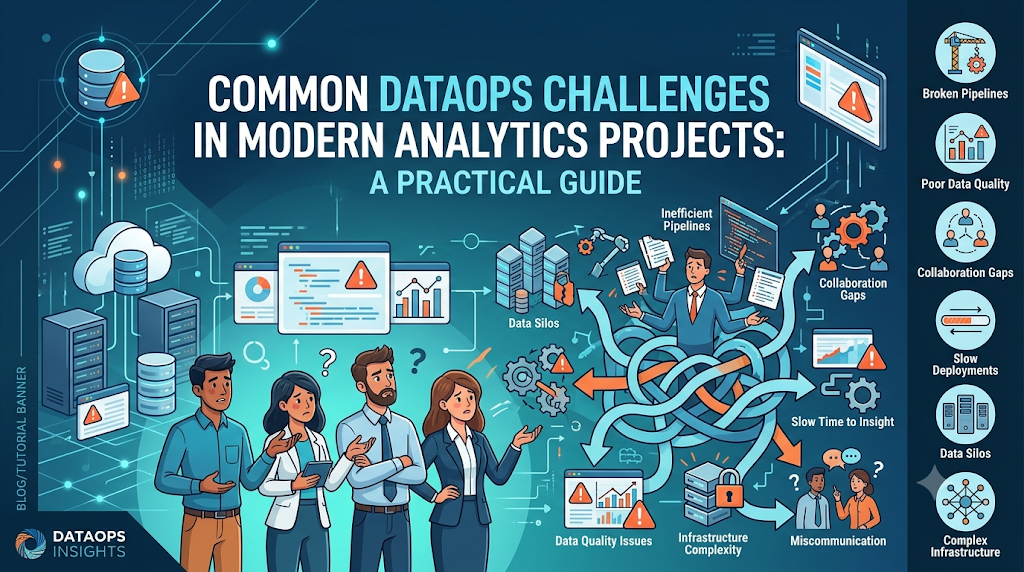
Many analytics projects fail or take much longer than expected. Dashboards show different numbers, reports break without warning, and business teams lose trust in the data. These problems usually happen because of poor data operations, or DataOps.
DataOps brings together the people who manage data, the engineers who build systems, and the business users who need insights. When these groups do not work well together, data projects fall apart. This article explores the most common DataOps challenges in modern analytics projects and explains how your team can overcome them.
What Is DataOps?
DataOps is short for Data Operations. It combines automated technology, agile working methods, and teamwork to manage data from the moment it is collected to the moment someone uses it in a report or dashboard.
Think of a data pipeline like a water supply system. Data flows from a source (like a mobile app or website), travels through pipes (code and databases), and arrives at a destination (a business dashboard). DataOps makes sure the water stays clean, the pipes do not leak, and the supply never stops unexpectedly.
Why DataOps Matters
Without DataOps, data teams spend most of their time fixing broken reports instead of building new solutions. DataOps helps companies deliver accurate data faster, reduce manual errors, and build trust across the entire organization.
How DataOps Works
DataOps borrows ideas from software development (specifically DevOps) and applies them to data. Instead of treating data updates as one-time events, DataOps treats data as a continuous flow.
The process typically involves four main stages:
- Creation: Collecting data from apps, databases, or external sources.
- Transformation: Cleaning, organizing, and formatting the data so it makes sense.
- Delivery: Sending the clean data to data warehouses, business intelligence (BI) tools, or machine learning models.
- Monitoring: Constantly checking the data and pipelines for errors, delays, or unexpected changes.
The Major DataOps Challenges in Modern Analytics
Even with the best tools, teams face several recurring roadblocks when running modern analytics projects.
1. Data Quality and Trust Issues
The most common problem in analytics is bad data. If a database schema changes unexpectedly, or if a third-party API sends corrupted numbers, downstream dashboards will show incorrect information. When business leaders notice wrong numbers, they lose trust in the analytics team.
- What goes wrong: A column name changes in the source database, breaking a transformation script. The dashboard still updates, but the calculations are completely wrong.
- Why it matters: Decisions made on bad data can cost a company thousands or millions of dollars.
- How to fix it: Implement automated data testing. Check for missing values, unusual spikes, and schema changes before the data reaches any dashboard.
2. Communication Gaps and Organizational Silos
Analytics projects involve multiple groups: data engineers, data analysts, data scientists, and business stakeholders. Often, these groups do not talk to each other enough.
- What goes wrong: Data engineers build a pipeline without knowing what metrics the business team actually needs. Meanwhile, business users create their own messy spreadsheets because they do not understand the central data warehouse.
- Why it matters: Time is wasted building tools nobody uses, and teams end up arguing over whose numbers are correct.
- How to fix it: Establish clear ownership. Use shared dictionaries for business terms and include business users early in the planning phase of any analytics project.
3. Pipeline Fragility and Maintenance Overhead
Data pipelines are fragile. They depend on external websites, APIs, cloud services, and internal databases. When any of these components change, the pipeline breaks.
- What goes wrong: A nightly data load fails because a cloud server updated its software, waking up data engineers at 3:00 AM to fix the code manually.
- Why it matters: Engineers spend all their time fixing old pipelines instead of building new features.
- How to fix it: Treat data code like software. Use version control (like Git), automated testing, and CI/CD (Continuous Integration and Continuous Deployment) pipelines to test code changes safely before pushing them live.
4. Scalability and Performance Bottlenecks
As companies grow, the volume of data grows with them. Queries that ran smoothly on a small dataset can grind to a halt when processing terabytes of information.
- What goes wrong: A monthly sales report takes four hours to load, locking up the database and frustrating users who need quick answers.
- Why it matters: Slow analytics slow down business decisions. Users stop using tools that take too long to load.
- How to fix it: Choose scalable cloud data warehouses, optimize heavy database queries, and use incremental data loads instead of processing the entire database every single night.
5. Security, Privacy, and Compliance Risks
Modern analytics projects handle sensitive information, such as customer names, financial records, and personal data. Managing access and complying with privacy laws (like GDPR or CCPA) is a major operational challenge.
- What goes wrong: A data analyst accidentally leaves sensitive customer data in an unencrypted table that is visible to the entire company.
- Why it matters: Data breaches lead to severe legal penalties, financial loss, and damaged reputation.
- How to fix it: Implement role-based access control (RBAC). Automatically mask or hash sensitive personal data before it reaches general analytical environments.
Practical Examples: Good vs. Bad DataOps
To understand how DataOps changes daily work, consider a mid-sized retail company tracking online sales.
- Without DataOps: The data engineering team writes a script to pull daily sales. One day, the payment gateway changes its data format. The script fails silently. The next morning, the CEO looks at a dashboard showing zero sales. The data team scrambles for hours to find the broken script, verify the logs, and recalculate the numbers while leadership panics.
- With DataOps: The same company uses automated data monitoring. The moment the payment gateway changes its format, an alert pings the data team on Slack. Automated tests flag the anomaly before the dashboard updates. The engineers push a tested fix through a CI/CD pipeline in minutes, preventing any incorrect data from reaching business users.
Common Mistakes Teams Make
- Buying tools before fixing processes: Purchasing expensive data platforms will not fix poor communication or lack of data standards. Fix your workflows first, then choose tools that support them.
- Ignoring documentation: Building complex data pipelines without writing down what they do or where the data comes from creates a massive bottleneck when original team members leave the company.
- Testing only at the end: Waiting until data reaches the final dashboard to check for errors makes troubleshooting slow and painful. Test data as close to the source as possible.
Decision-Making Framework: Assessing Your DataOps Maturity
If you want to improve your analytics projects, evaluate your current process using these steps:
- Audit your data reliability: How often do business users find errors in your dashboards before your team does?
- Measure time-to-delivery: How long does it take your team to add a new data source or update an existing metric?
- Check automation levels: Are your data pipelines deployed manually, or do you use automated testing and version control?
- Evaluate team alignment: Do data engineers and business analysts share a common understanding of key performance metrics?
- Review security controls: Can unauthorized users access sensitive customer or financial data in your warehouse?
Key Terms
- Data Pipeline: A set of actions that moves data from one system to another, cleaning and transforming it along the way.
- Data Warehouse: A large, centralized database designed to store and analyze vast amounts of business data.
- CI/CD: Continuous Integration and Continuous Deployment; a method to automate testing and releasing software or code updates safely.
- Schema: The blueprint or structural design of a database, defining how tables, columns, and data types relate to each other.
- Data Observability: The ability to fully understand the health, quality, and performance of data systems across your organization.
- Data Lineage: A map that shows the complete journey of data, from its original source to its final destination in a report.
FAQs
What causes most data pipeline failures?
Most failures are caused by upstream changes, such as a source system altering a column name, changing a data type, or updating an API without notifying the data team.
Is DataOps only for large enterprises?
No. While large companies benefit from structured DataOps, small and medium-sized startups also benefit by adopting version control, automated testing, and basic monitoring early on.
What is the difference between DevOps and DataOps?
DevOps focuses on building, testing, and deploying software applications. DataOps focuses specifically on the unique challenges of data workflows, data quality, and analytics pipelines.
How do I convince management to invest in DataOps?
Show them the cost of bad data. Track how many hours your team spends fixing broken reports, dealing with incorrect executive dashboards, and answering emergency support tickets.
Do I need expensive tools to start practicing DataOps?
No. You can start with open-source tools for version control (Git), automated testing (like dbt tests), and basic monitoring before investing in commercial enterprise platforms.
Conclusion
Modern analytics projects hold enormous potential, but they fail easily if data operations are disorganized. By addressing data quality issues, bridging communication gaps between technical and business teams, and automating your pipelines, you can build reliable analytics systems.
Strong DataOps does not happen overnight. Start small by introducing automated tests for your most important data sources, document your core pipelines, and build a culture where data accuracy is everyone’s responsibility.

