
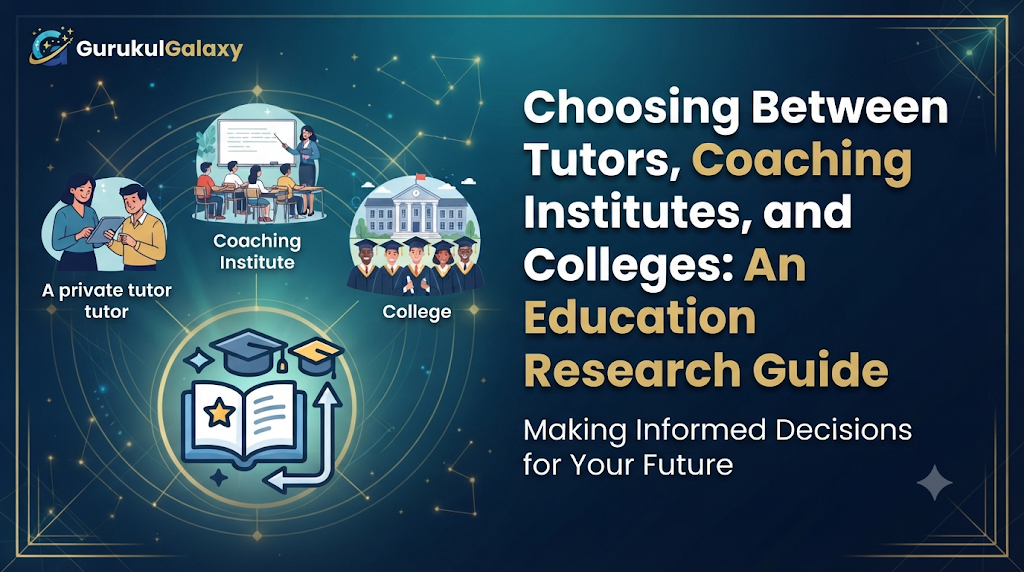
Introduction
A parent wants to find a good tutor for their child before the school exams. A student wants to compare two colleges before applying. Another student wants to know the exam pattern for a competitive exam happening after Class 12. Three different needs, but the same underlying problem: the information needed to make these decisions is rarely available in one place.
Most people end up checking multiple websites, asking friends and relatives, and going through social media pages just to gather basic facts about a tutor’s experience, a college’s course structure, or an exam’s eligibility criteria.
This article looks at GurukulGalaxy, an education discovery platform, and explains what kind of information it brings together. Alongside that, we will walk through a practical way to approach education research, point out mistakes people commonly make, and share an example of how this research usually plays out for a real family.
What Is GurukulGalaxy?
GurukulGalaxy works as an education discovery platform. Rather than being built around one type of education service, it pulls together several categories of education information into a single space.
It is meant to be useful for a wide range of people — students planning their next academic step, parents researching options for their children, working learners looking to pick up a new skill, and even tutors or teachers who want to be discoverable by the right learners.
On the platform, users can look into:
- Tutors and gurus, through a directory of teaching professionals
- Institutions such as schools, colleges, and coaching centres
- Courses offered by different institutions
- Exam guides covering entrance exams, board exams, and other tests
The idea is to give users a single starting point when they begin researching an education decision, instead of having to jump between many different sources.
Why Does GurukulGalaxy Matter for Education Research?
Education research rarely stays confined to one category. A student applying to college is often also checking entrance exam requirements at the same time. A parent looking for a tutor might also be weighing whether a coaching institute would work better for their child. These needs overlap constantly.
When tutor profiles, institution details, course information, and exam guides sit in separate, disconnected places, the research process becomes longer and more tiring. You have to remember which website had which piece of information, and cross-checking becomes harder.
Bringing these categories together in one education discovery space does not replace the need for research. It does not make the decision for the user. What it can do is reduce the back-and-forth involved in simply locating the relevant information in the first place.
This is not a claim that GurukulGalaxy is superior to other resources available to students and parents. It is simply a description of how organising education categories together can support a process that already exists.
What Can You Find on GurukulGalaxy?
Tutors and Gurus
The guru directory on GurukulGalaxy lists teaching professionals along with details like subject, teaching experience, city, and area of specialisation. This gives learners a way to look through multiple tutor profiles and shortlist ones that match their subject and learning requirements.
Institutions
Profiles for schools, colleges, coaching institutes, and other education institutions are available on the platform. Users can go through these profiles to understand what each institution offers and line them up against each other.
Courses
Course listings include details such as the course name, the subject or field it belongs to, the learning format, and the duration. This is useful when a student wants to see how a course at one institution differs from a similar course elsewhere.
Exam Guides
The exam guides section covers eligibility conditions, exam patterns, important dates, and preparation-related information for various entrance and board exams. This helps students get a clearer picture of what an exam actually requires before they commit time to preparing for it.
Online Tutors in India: What to Look For
India has a large and varied pool of online tutors covering everything from school subjects to specialised exam coaching. When trying to find tutors online, the starting point should be clarity about your own need — the subject, your current level, and how much flexibility you want in scheduling.
Online tutors in India often come from different cities and backgrounds, so checking a tutor’s teaching experience and subject expertise matters more than just their location. Reading through a tutor’s profile details before reaching out can save time later.
Searching for a Tutor Nearby
Not everyone prefers online classes. Many students and parents still want to find tutors near me for in-person sessions, particularly for younger children or subjects that benefit from face-to-face interaction.
For this kind of search, location naturally becomes a bigger factor, but it should be weighed alongside the tutor’s subject expertise, experience level, and whether their available time slots actually fit your schedule.
Evaluating Coaching Institutes
When people search for coaching institutes near me, the temptation is to just pick the one that is easiest to reach. But proximity alone does not tell you much about teaching quality.
Before enrolling, it helps to check who teaches the classes, what the batch sizes look like, how the fee structure is set up, and whether the institute provides study material or mock tests. When trying to identify the best coaching institutes in India for a specific goal, comparing a handful of institutes on these points gives a much clearer picture than relying on word of mouth alone.
Researching Colleges and Comparing Courses
A college search in India typically starts with a subject or career direction in mind. From there, it becomes a matter of checking which colleges offer that course, what the eligibility requirements are, and how the fee structure compares.
To compare colleges and courses in a meaningful way, look past the college’s name recognition. Course content, faculty background, learning format, and the general direction graduates tend to take afterward are all worth checking before making a final decision.
Making Sense of Competitive Exams
Competitive exams in India span many fields — engineering, medicine, management, government services, and more — and each one comes with its own eligibility rules and exam structure.
Good competitive exam preparation starts with understanding the syllabus and exam pattern rather than diving straight into solving papers. For students exploring competitive exams after 12th, it is worth checking eligibility and application timelines early, since many exams have strict cut-off dates for registration.
A Simple Process for Education Research
Step 1: Define What You Actually Need
Before searching anywhere, get specific about your need. “I need help with maths” is different from “I need a coaching institute for a specific entrance exam.” Being specific narrows your search significantly.
Step 2: Gather a Shortlist
Look for a handful of relevant options — tutors, institutes, colleges, or exam guides — rather than settling on the very first one you find.
Step 3: Dig Into the Details
For each option on your shortlist, check the details that actually matter: a tutor’s experience, an institute’s faculty and fees, a college’s course structure and eligibility, or an exam’s pattern and dates.
Step 4: Line Up Your Options Side by Side
Put your shortlisted options next to each other and compare them on the same set of factors. This makes differences much easier to spot than judging each option in isolation.
Step 5: Decide With the Full Picture
Once you have compared your options, make the decision based on what you have actually found, not on assumptions or partial information.
Mistakes People Often Make
Picking a tutor based on price alone
A cheaper tutor is not automatically a worse one, but price should never be the only deciding factor. Check their experience and teaching approach too.
Assuming the nearest coaching institute is the best fit
Convenience matters, but it says nothing about faculty quality or how well the institute has handled the specific exam or subject you need help with.
Applying to a college without confirming eligibility first
This is one of the most common and avoidable mistakes. Always confirm eligibility before investing time in the application process.
Judging a college only by its overall reputation
A college can be well known overall while a specific course within it is average. Research the course separately from the college’s general name.
Relying only on reviews found on social media
Reviews can be helpful, but they are often incomplete or one-sided. Cross-check with other sources before trusting them fully.
Leaving exam preparation until the syllabus is unclear
Starting to prepare without a clear grasp of the syllabus wastes time. Get the syllabus and pattern sorted first.
Comparing options on fees without checking what’s included
A lower fee might mean fewer resources or support. Always check what is actually included before comparing costs.
Real-Life Example
Consider a parent named Rakesh, whose daughter is in Class 11 and struggling with physics. Rakesh starts by identifying exactly what she needs — consistent, in-person help twice a week rather than occasional online sessions.
He looks through a few tutor profiles, checking their experience with Class 11 physics specifically, not just their general teaching background. At the same time, since his daughter has also started thinking about future entrance exams, Rakesh briefly checks exam guides to understand what lies ahead over the next two years.
He shortlists three tutors, compares their experience and availability, and picks one whose schedule matches his daughter’s routine. This example shows how a single, simple need — finding a tutor — can naturally lead into checking other related information, like future exam requirements.
Comparison Tables
Table 1: Key Factors by Education Category
| Category | Key Factors to Check |
|---|---|
| Tutor | Subject expertise, experience, availability, teaching mode |
| Coaching Institute | Faculty, batch size, fee structure, study material |
| College | Course details, eligibility, fees, location |
| Course | Duration, format, curriculum |
| Competitive Exam | Eligibility, pattern, dates, syllabus |
Table 2: Online vs In-Person Learning Considerations
| Factor | Online Tutors | In-Person Tutors |
|---|---|---|
| Location flexibility | High | Limited to nearby area |
| Scheduling | Often more flexible | Depends on tutor’s availability |
| Subject variety | Wider pool of specialists | May be limited locally |
| Interaction style | Screen-based | Face-to-face |
Frequently Asked Questions
1. What kind of platform is GurukulGalaxy?
It is an education discovery platform that brings together information on tutors, institutions, courses, and exams.
2. Is GurukulGalaxy only for students?
No. It is designed for students, parents, learners, tutors, and teachers alike.
3. How do I start looking for an online tutor?
Begin by identifying the subject and level you need help with, then look at tutor profiles based on experience and teaching approach.
4. Is it possible to search for tutors based on my city?
Yes, location is one of the details you can factor in while searching for tutors.
5. What should I check before picking a coaching institute?
Look at faculty experience, batch sizes, fee structure, and whether study material or mock tests are provided.
6. How do I compare two colleges offering the same course?
Check course content, eligibility criteria, fees, and location for each college before deciding.
7. What details matter most for competitive exam preparation?
Understanding the syllabus and exam pattern before starting preparation makes the biggest difference.
8. Which exams fall under competitive exams after 12th?
These typically include entrance exams for engineering, medical, commerce, and other professional courses that students take right after Class 12.
9. Should I only compare fees when choosing between coaching institutes?
No, fees alone don’t reflect teaching quality. Faculty background and available resources matter just as much.
10. How much time should I spend researching before choosing an option?
There’s no fixed answer, but comparing at least two or three options on the same factors usually gives a more reliable picture than relying on just one.
Conclusion
Whether it is finding a tutor, shortlisting a coaching institute, comparing colleges, or understanding a competitive exam, education decisions almost always involve gathering information from several sources and comparing it carefully. Having categories like tutors, institutions, courses, and exam guides organised together, as seen on GurukulGalaxy, can make that gathering process a bit more manageable.
This article walked through what such a platform typically includes, a step-by-step way to approach education research, common mistakes worth avoiding, and a practical example of how this research often unfolds for a real family. In the end, the quality of the decision usually comes down to how carefully the available information was checked and compared.

