
Introduction
Software engineering teams face a persistent tension: the need to ship features rapidly while keeping systems stable, secure, and cost-effective. As applications move from simple architectures to multi-cloud environments, microservices, and container platforms, the underlying infrastructure grows increasingly complex. Deployments that once took minutes can turn into manual, error-prone rituals. Security reviews become bottlenecks right before release dates, and unexpected downtime disrupts both users and internal teams.
To resolve these operational bottlenecks, organizations frequently re-evaluate their delivery pipelines, cloud infrastructure, and team structures. Improving these practices requires more than adopting a few modern tools; it demands a clear alignment between development workflows, operational processes, and business priorities. This is where specialized external expertise becomes invaluable.
Working with a dedicated partner allows technology teams to identify friction points, automate repetitive work, strengthen cloud environments, and establish reliable engineering practices. Throughout this guide, we explore how DevOps consulting helps organizations navigate these operational transitions, using the capabilities and service offerings of DevOpsConsulting.in as a practical reference point for modern engineering support.
What Is DevOps Consulting?
DevOps consulting is a practical engagement model where external infrastructure and automation specialists partner with an organization’s engineering teams. Rather than simply delivering static software or issuing high-level advice, consulting partners help assess, design, implement, and refine the technical workflows that connect application development with operational management.
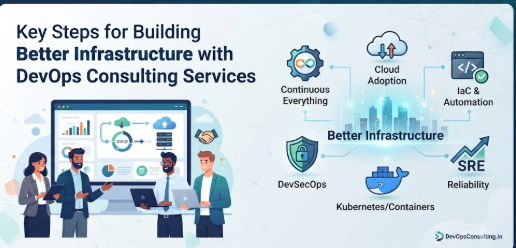
At its core, DevOps consulting addresses how code moves from a developer’s workspace to a live production environment. In many organizations, this pathway is hindered by handoffs between teams, custom manual configurations, inconsistent testing environments, and reactive incident responses. External specialists help streamline this path by introducing standardized automation, clear operational patterns, and modern tooling across several critical domain areas:
- Continuous Integration and Continuous Delivery (CI/CD): Building pipelines that automatically test, package, and deploy code changes safely and predictably.
- Infrastructure as Code (IaC): Managing servers, networks, and cloud resources through version-controlled configuration files rather than manual console clicks.
- Cloud Operations and Optimization: Configuring cloud resources across public and private providers to balance application performance, security, and hosting costs.
- Security and Compliance: Integrating security scans, vulnerability checks, and access controls directly into development and deployment workflows.
- Observability and Monitoring: Setting up metrics, logs, and traces so engineering teams can understand application behavior and spot issues before users are affected.
- Site Reliability Practices: Establishing realistic uptime targets, clear incident response steps, and post-incident reviews to protect overall system stability.
By bringing structured expertise to these areas, DevOps consulting enables internal engineering teams to spend less time managing operational overhead and more time building application features that serve their business goals.
Why Organizations Need DevOps Consulting Services
Adopting modern operational practices is rarely a straightforward path. Technology teams often experience specific operational friction points as their application footprint and team size expand. External DevOps consulting services assist organizations in diagnosing these operational challenges and building structured solutions to address them.
Slow and Unreliable Software Releases
When deployments depend on manual intervention, release cycles naturally slow down. Teams may batch weeks or months of changes into massive, risky deployments. If an unexpected bug reaches production, tracking down the root cause inside a large release bundle becomes difficult and time-consuming, frequently leading to service disruptions and emergency hotfixes.
Complex Cloud Infrastructure
As systems expand, managing cloud environments without strict standardization leads to “configuration drift”—a scenario where staging, testing, and production environments behave differently. This drift causes bugs that only show up in production environments, making troubleshooting unpredictable and frustrating.
Fragmented Security Workflows
When security audits occur only at the end of a development cycle, critical vulnerabilities can delay scheduled launches. Re-architecting software late in the delivery process is expensive and demoralizing for development teams.
Difficulty Scaling Container Platforms
Adopting containerization tools like Kubernetes offers high flexibility, but managing enterprise-grade clusters brings significant operational complexity. Without proper cluster design, ingress setup, resource limits, and role-based access control, platforms become unstable and difficult to maintain.
Poor System Visibility and Reactive Troubleshooting
Teams that rely on basic ping checks or fragmented log files often learn about outages from customer support tickets rather than automated alerts. Without centralized observability, finding the root cause of slow database queries or failing microservices requires tedious manual investigation.
Skill Gaps and High Team Burden
Building internal expertise across cloud platforms, infrastructure automation, container orchestration, security tools, and site reliability takes considerable time. Expecting feature developers to master all these operational domains leads to burnout and high turnover.
Partnering with an experienced DevOps consulting provider allows organizations to resolve these issues by establishing standard frameworks, automated pipelines, and maintainable platform architectures tailored to their operational reality.
Who Should Use DevOpsConsulting.in?
Different organizations encounter operational roadblocks at different stages of their growth. The consulting, automation, and managed operational support provided by DevOpsConsulting.in caters to specific operational challenges faced across several business scenarios.
1. Startups and Growing Technology Companies
Early-stage companies need to validate product features quickly without compromising future scalability. Building a large internal operations team early on can drain financial resources. DevOpsConsulting.in supports growing companies by setting up foundation-level infrastructure automation, secure cloud environments, and streamlined CI/CD pipelines. This structure gives young teams a stable platform to deploy code rapidly without burying themselves in technical debt.
2. Enterprises with Complex Infrastructure
Large organizations often manage diverse portfolios consisting of legacy enterprise apps, modern microservices, and multi-cloud environments across AWS, Azure, or Google Cloud. This variance leads to fragmented tooling and inconsistent security controls across departments. DevOpsConsulting.in helps enterprise engineering teams establish unified deployment processes, standard governance frameworks, and repeatable infrastructure templates that simplify operations across business units.
3. Development and Engineering Teams
Engineering teams frequently lose momentum when they have to wait for manual server provisioning, deal with broken staging environments, or handle manual release tasks. By implementing automated pipelines, Infrastructure as Code, and standardized development environments, DevOpsConsulting.in helps developers focus on writing high-quality application code while routine infrastructure management is handled automatically.
4. Cloud and Kubernetes Teams
Teams running workload-intensive applications on container platforms often run into operational friction around cluster scaling, network security, ingress control, and storage management. DevOpsConsulting.in offers specialized technical support for AWS, Kubernetes, container security, and cloud automation, assisting engineering teams in configuring robust container environments that run reliably under varying workloads.
5. Businesses Modernizing Legacy Systems
Organizations running core business logic on physical data centers or aging virtualized servers often face high maintenance costs, hardware limitations, and slow deployment cycles. Moving these workloads requires structured planning to avoid service outages. DevOpsConsulting.in helps companies transition legacy environments into cloud-native architectures using proven migration steps, minimizing disruption while improving agility.
6. Organizations Needing Ongoing DevOps or SRE Support
Many technology organizations prefer not to maintain dedicated 24/7 internal teams for routine infrastructure monitoring, pipeline management, or incident escalation. For these companies, DevOpsConsulting.in provides managed DevOps services, SRE engagements, and flexible outsourcing models. This ensures critical production systems remain operational, monitored, and regularly optimized without placing an unsustainable burden on internal staff.
Understanding DevOpsConsulting.in: Services and How They Help
To address varying operational requirements, DevOpsConsulting.in offers a comprehensive suite of practical technical services. These services cover everything from initial architecture assessments and modern pipeline engineering to full operational management and specialized reliability consulting.
1. DevOps Consulting Services
The core consulting offering at DevOpsConsulting.in centers on assessing, designing, and modernizing end-to-end delivery ecosystems. This service targets systemic operational bottlenecks across software development lifecycles.
Key areas of support include:
- CI/CD Pipeline Design: Automating code compilation, unit testing, integration checks, and deployment staging to eliminate manual release efforts.
- Infrastructure as Code (IaC): Using tools like Terraform to write declarative infrastructure definitions that can be versioned, reviewed, and audited.
- Cloud Automation: Automating server provisioning, security group management, DNS configuration, and resource scaling.
- Observability Architecture: Integrating centralized logging, metrics dashboards, and distributed tracing to provide clear operational visibility.
- Modern Engineering Best Practices: Structuring team workflows to support trunk-based development, automated testing, and safe blue-green or canary release strategies.
By applying these core practices, organizations can establish repeatable release cycles, lower deployment risk, and eliminate the confusion that often occurs during production launches.
2. Managed DevOps Services
Building an automated platform is only the first step; maintaining pipelines, keeping cloud resources updated, and resolving runtime issues requires continuous effort. Managed DevOps Services from DevOpsConsulting.in help organizations that require dedicated operational support without increasing internal administrative headcount.
Managed capabilities include:
- Continuous System Monitoring: Active oversight of server metrics, application response rates, database loads, and storage limits.
- Pipeline Maintenance: Updating, troubleshooting, and tuning automated CI/CD pipelines to keep builds moving fast.
- Infrastructure Automation Management: Updating IaC scripts, applying cloud configuration patches, and managing environment parameters.
- Deployment Support: Assisting engineering teams during planned production releases and software updates.
- Incident Resolution: Responding promptly to system outages, unexpected errors, and performance degradation.
- Cloud Cost Optimization: Reviewing resource utilization regularly to rightsized idle instances, optimize storage tiering, and lower monthly cloud bills.
This managed support model offers peace of mind, ensuring production platforms remain healthy, secure, and performant over time.
3. AWS DevOps Consulting Services
Amazon Web Services (AWS) provides a vast ecosystem of cloud infrastructure tools, but configuring them correctly demands specialized knowledge. DevOpsConsulting.in delivers focused AWS DevOps Consulting Services to help businesses build, secure, and maintain workloads on AWS.
Key AWS technologies and focus areas include:
- Amazon EKS & ECS: Designing, configuring, and scaling container workloads on Elastic Kubernetes Service and Elastic Container Service.
- Amazon EC2 & AWS Lambda: Balancing traditional server-based compute resources with event-driven serverless architectures.
- AWS CloudFormation & Terraform: Managing cloud resources predictably through infrastructure code templates.
- Automated AWS Deployment Pipelines: Building deployment workflows using native tools like AWS CodePipeline and AWS CodeBuild, or connecting third-party automation tools to AWS services.
These AWS-focused capabilities help organizations build resilient, well-architected cloud environments that scale smoothly with user growth.
4. DevSecOps and Kubernetes Consulting
Modern delivery pipelines must incorporate security controls without delaying feature releases, while container orchestration platforms must be designed with high availability in mind. DevOpsConsulting.in addresses these dual concerns through dedicated DevSecOps and Kubernetes consulting offerings.
DevSecOps Consulting Services:
Security is embedded directly into automated software development processes through:
- Static & Dynamic Application Security Testing (SAST/DAST): Automated code and application scanning within build pipelines to catch bugs early.
- Container Security: Scanning container base images for known vulnerabilities before deployment.
- Secrets Management: Replacing hardcoded passwords, API keys, and certificates with secure secret stores like HashiCorp Vault or cloud key management services.
- Vulnerability & Compliance Automation: Automated checks to maintain regulatory compliance and infrastructure security baselines continuously.
Kubernetes Consulting Services:
To help teams deploy containerized applications confidently, consulting capabilities cover:
- Cluster Design and Deployment: Building resilient Kubernetes architectures across cloud platforms, including AWS EKS, Azure AKS, Google GKE, and enterprise on-premises setups.
- Migration to Kubernetes: Refactoring or containerizing legacy application components to run safely inside container clusters.
- Cluster Operations & Security: Setting up network policies, role-based access controls (RBAC), pod security standards, automated cluster autoscaling, and ingress routing.
Combining DevSecOps and Kubernetes practices provides teams with an automated, secure foundation for managing microservices at scale.
5. Cloud Migration and Platform Engineering
Moving workloads to modern cloud infrastructure while providing engineering teams with self-service tooling helps organizations scale efficiently. DevOpsConsulting.in offers specialized guidance across both cloud migration and platform engineering disciplines.
Cloud Migration Services:
- Assessment & Strategy: Evaluating legacy application dependencies, server workloads, and database structures to build a clear, low-risk migration plan.
- Multi-Cloud Execution: Moving workloads smoothly from on-premises data centers to AWS, Microsoft Azure, or Google Cloud.
- Operational Readiness: Updating operational runbooks, cloud backup procedures, and monitoring profiles during the migration process to ensure business continuity.
Platform Engineering Consulting Services:
- Internal Developer Platforms (IDPs): Creating tailored developer portals that allow software engineers to provision testing environments, databases, and pipelines independently.
- Self-Service Infrastructure: Implementing secure, pre-approved infrastructure templates that developers can deploy without opening manual operations tickets.
- Golden Paths: Establishing clear, standardized pathways for application build, test, and release tasks, reducing cognitive load on engineering teams.
Through these combined practices, organizations can migrate off legacy servers and build internal platforms that accelerate everyday software delivery.
6. SRE Consulting and DevOps Outsourcing
Maintaining high service availability requires disciplined operational processes. At the same time, expanding engineering capacity quickly often calls for flexible staffing models. DevOpsConsulting.in provides Site Reliability Engineering (SRE) consulting along with versatile DevOps outsourcing solutions.
SRE Consulting Services:
- SLI and SLO Definition: Setting measurable Service Level Indicators and Service Level Objectives to establish transparent performance targets.
- Error Budget Management: Using error budgets to balance feature release velocity with overall platform stability.
- Advanced Observability & Incident Management: Setting up alert protocols, clear post-mortem processes, and automated incident escalations.
- Reliability & Performance Engineering: Stress-testing applications, identifying system bottlenecks, and automating recovery steps for common failure modes.
DevOps Outsourcing Services:
When internal teams require specialized talent or extra engineering bandwidth, outsourcing provides flexible access to experienced professionals across:
- Domain Expertise: Skilled specialists across DevOps, Cloud, Kubernetes, SRE, and Platform Engineering.
- Flexible Engagement Models: Support tailored for short-term modernization initiatives, long-term operational projects, or fully managed technical operations.
These models allow businesses to improve platform reliability while adjusting operational capacity based on changing project demands.
How Different DevOps Services Work Together
While individual services like CI/CD, cloud migration, or container orchestration address specific operational pain points, their real strength lies in how they integrate into a cohesive engineering ecosystem. Isolated improvements often shift bottlenecks elsewhere; for instance, speeding up code builds offers limited value if server provisioning takes weeks or manual security reviews stall every release.
A practical engineering ecosystem links these services seamlessly:
- Platform Engineering provides developers with standardized infrastructure templates and self-service capabilities.
- When developers write code, CI/CD pipelines trigger automated builds and unit tests immediately.
- DevSecOps controls automatically scan dependencies and container images during the build phase, flagging security concerns early.
- Once passed, Infrastructure as Code provisions or updates environments on cloud platforms or Kubernetes clusters predictably.
- Deployed applications generate logs, metrics, and traces that stream into centralized Observability tools.
- SRE practices evaluate operational metrics against defined SLOs, triggering automated alerts or incident workflows if performance drops.
- Finally, Managed Services step in to maintain the underlying platform, applying security patches, tuning costs, and resolving complex infrastructure incidents.
When these capabilities operate together, technology teams transition from reactive firefighting to a predictable, repeatable delivery workflow.
Step-by-Step Guide to Planning DevOps Consulting
Planning an infrastructure or workflow modernization project requires a practical, step-by-step roadmap. Following a clear plan ensures that external consulting engagements address real operational bottlenecks and deliver lasting value.
Step 1: Identify Delivery Problems ──> Step 2: Define Goals ──> Step 3: Assess Automation Needs
                                                                             │
Step 6: Plan Integration <── Step 5: Select Services <── Step 4: Review Security & SRE
           │
           v
Step 7: Establish Operations ──> Step 8: Measure & Refine
Step 1: Identify Current Delivery and Infrastructure Problems
Begin by taking stock of your team’s everyday friction points. Are releases frequently delayed by manual checks? Are server configurations inconsistent between staging and production? Are cloud costs rising uncontrollably? Collecting input from developers, operations staff, and security teams highlights where changes are needed most.
Step 2: Define Cloud and Engineering Goals
Establish clear technical objectives before reaching out to consulting partners. Determine whether the team’s priority is accelerating release frequency, migrating off physical servers, improving container uptime, or standardizing development setups. Having explicit goals keeps project scopes aligned with business needs.
Step 3: Assess CI/CD and Automation Requirements
Review how application code moves from development to live production environments. Pinpoint manual verification steps, slow build steps, or missing automated tests. Documenting these manual steps makes it easier to design effective automated pipelines.
Step 4: Review Security and Reliability Requirements
Evaluate your organization’s current approach to system monitoring and vulnerability management. Check whether security scans occur inside build pipelines or late in release cycles. Review incident history to determine whether service targets (SLOs) and alert procedures need improvement.
Step 5: Select the Relevant Consulting Services
Match your identified friction points with targeted service models. An organization migrating legacy apps might prioritize Cloud Migration and AWS Consulting Services, while a team struggling with platform scale may need Kubernetes Consulting or Platform Engineering support. If internal operations bandwidth is constrained, Managed DevOps Services or Outsourcing models may be appropriate.
Step 6: Plan Implementation and Integration
Work with your consulting partner to ensure new automation tools, infrastructure scripts, and security checks integrate smoothly with your team’s existing daily workflows. Technical improvements should fit naturally into how developers build and test code rather than introducing confusing, disruptive processes.
Step 7: Establish Monitoring and Operations
Ensure comprehensive logging, metric dashboards, and alert escalations are active before deploying modified pipelines or newly migrated infrastructure to production. Proper observability ensures technical teams maintain clear operational visibility during and after system changes.
Step 8: Measure and Improve
Review system performance, build speeds, deployment frequency, and error rates regularly after implementing new operational patterns. Use these operational metrics to identify remaining bottlenecks, refine automation scripts, and continuously optimize cloud spending.
Common DevOps Consulting Mistakes to Avoid
Modernization efforts can falter if teams rush into tool changes without addressing underlying workflows. Recognizing common mistakes helps organizations avoid costly missteps during consulting engagements.
- Consulting Without Clear Problem Definition: Engaging external consultants without specifying clear technical bottlenecks often leads to vague outcomes. Define the specific operational friction points you need to resolve before starting.
- Automating Broken Processes: Automating an inefficient, overly complex workflow simply produces bad results faster. Simplify and streamline operational steps before writing automation code.
- Unplanned Cloud Migrations: Rushing workloads into cloud environments without re-architecting configuration, access controls, or storage structures can result in higher costs and performance issues. Plan cloud migrations methodically.
- Treating Security as an Afterthought: Postponing security checks until the end of deployment pipelines risks late-stage release blocks. Integrate security scans early in automated build workflows.
- Adopting Kubernetes Unnecessarily: Kubernetes provides powerful container management, but simple web applications may run fine on simpler, lower-maintenance container hosts. Match platform choices to actual application demands.
- Ignoring Observability and Monitoring: Deploying modern infrastructure without setting up proper logging, tracing, and metric alerts leaves teams blind when runtime errors occur. Prioritize system visibility early.
- Overcomplicating Platform Engineering: Building complex internal portals that developers find difficult to use defeats the purpose of self-service platforms. Keep platforms simple, focusing on intuitive developer workflows.
- Neglecting Long-Term Operations Plan: Setting up automated infrastructure without agreeing on who maintains scripts, patches tools, and handles runtime alerts leads to operational breakdown over time. Establish clear ongoing maintenance roles from day one.
Best Practices for Successful DevOps Consulting
Following proven best practices during a consulting engagement ensures technical improvements yield long-term benefits for your development and operations teams.
- Focus on Tangible Bottlenecks: Direct consulting efforts toward resolving concrete operational pain points—like slow build times or unstable staging servers—before taking on complex, multi-year architectural overhauls.
- Manage Infrastructure via Version Control: Keep all infrastructure configurations, deployment scripts, and platform rules inside version-controlled repositories. This ensures every environment change is traceable, reviewable, and repeatable.
- Shift Security Left in the Delivery Pipeline: Integrate vulnerability scanning, code analysis, and secret detection tools directly into developer build triggers, allowing teams to remediate security issues immediately.
- Set Clear Service Level Objectives (SLOs): Base uptime alerts and incident policies on realistic user-facing performance goals, avoiding alert fatigue while protecting core application features.
- Maintain Maintainable Cloud Architectures: Avoid overly complex cloud designs that demand constant manual intervention. Standardize on maintainable, well-documented cloud configuration patterns.
- Document Runbooks and Workflows: Ensure operational steps, system dependencies, and incident recovery steps are documented clearly so internal teams can operate systems independently.
- Align Support Models with Team Bandwidth: Carefully choose between fully internal management, co-managed services, or outsourced support based on your team’s long-term technical bandwidth.
Service Overview & Provider Evaluation
The following two reference tables outline core service domains and provide key criteria for evaluating an external DevOps consulting partner.
Service Overview Table
| DevOps Consulting Service | What It Covers | When Organizations May Need It |
| DevOps Consulting Services | End-to-end delivery assessment, CI/CD pipeline creation, IaC implementation, and observability setup. | Software releases are slow, environment setups are manual, or development and operations teams lack alignment. |
| Managed DevOps Services | Ongoing pipeline care, cloud monitoring, infrastructure management, deployment help, and cloud cost tuning. | Teams lack dedicated internal operational staff to handle daily cloud upkeep, updates, and incident responses. |
| AWS DevOps Consulting Services | Specialized AWS infrastructure configuration, Amazon EKS/ECS management, serverless Lambda setups, and Terraform automation. | Deploying, modernizing, or scaling applications specifically within the Amazon Web Services cloud environment. |
| DevSecOps Consulting Services | SAST/DAST testing integration, container vulnerability scans, secret management, and compliance automation. | Security reviews delay software releases, or regulatory compliance requires automated audit trails inside pipelines. |
| Kubernetes Consulting Services | Cluster design, deployment, migration, role-based access security, ingress control, and pod scaling across cloud/on-prem platforms. | Managing microservices at scale, resolving cluster stability issues, or migrating workloads to Kubernetes. |
| Cloud Migration Services | Architectural planning, legacy workload migration, database replication, and operational onboarding for cloud platforms. | Moving workloads out of physical data centers or legacy host providers into modern AWS, Azure, or GCP cloud environments. |
| Platform Engineering Services | Building Internal Developer Platforms (IDPs), self-service infrastructure templates, and standardized golden paths. | Developers spend too much time configuring servers or waiting on operations teams to provision environment resources. |
| SRE Consulting Services | SLI/SLO setting, error budget management, observability tuning, incident workflows, and post-incident analysis. | Production outages occur without warning, incident recovery takes too long, or performance limits are unclear. |
| DevOps Outsourcing Services | Supplying specialized DevOps, SRE, platform, or cloud engineers for short-term projects or long-term operational needs. | Rapidly expanding engineering capacity is required without lengthy recruitment cycles for specialized skill sets. |
Evaluation Factor Table
| Evaluation Factor | What to Check | Why It Matters |
| CI/CD Expertise | Experience designing automated build, test, and release pipelines using modern automation tooling. | Reliable pipelines eliminate high-risk manual deployment errors and ensure consistent code delivery. |
| Cloud Architecture Depth | Practical expertise across major providers like AWS, Azure, or Google Cloud, along with Terraform/IaC fluency. | Well-architected cloud setups prevent resource bloat, avoid vendor lock-in, and maintain high performance. |
| Security Capabilities | Experience integrating SAST/DAST tools, secret management, and automated container scanning into pipelines. | Embedding security early prevents vulnerabilities from reaching live production environments without slowing delivery. |
| Kubernetes Proficiency | Hands-on experience configuring EKS, AKS, GKE, ingress controllers, RBAC security, and cluster autoscaling. | Container clusters require sound architectural fundamentals to avoid high operational overhead and runtime outages. |
| Observability Implementation | Practical knowledge setting up centralized logging, metric collection, tracing tools, and clear alerting rules. | Comprehensive observability helps teams identify performance degradation and resolve runtime issues before outages occur. |
| SRE & Incident Workflow | Understanding of SLI/SLO definitions, error budget frameworks, and structured incident escalation processes. | Disciplined reliability practices prevent downtime and establish clear operational accountability across teams. |
| Platform Engineering Vision | Ability to build clear golden paths and self-service portals that simplify developer workflows without adding friction. | Effective platforms improve developer productivity while maintaining system governance and operational safety. |
| Flexible Support Models | Options for short-term consulting, managed services, ongoing reliability engineering, or project-based outsourcing. | Ensures technical engagement models can scale smoothly as business objectives and operational requirements change. |
Benefits of a Well-Planned DevOps Consulting Approach
Engaging experienced consulting support can help technology organizations establish reliable, scalable, and manageable engineering ecosystems.
- Deployment Consistency: Automated delivery pipelines reduce manual release steps, making software launches predictable and repeatable across environments.
- Predictable Infrastructure: Using Infrastructure as Code helps eliminate configuration drift, ensuring development, staging, and production environments mirror each other accurately.
- Improved Cloud Efficiency: Analyzing cloud configurations helps identify idle instances, poor storage tiering, and oversized databases, bringing cloud spending in line with actual workload needs.
- Stronger Security Practices: Integrating automated security tools directly into pipelines allows teams to catch vulnerabilities and access risks during everyday development.
- Centralized System Visibility: Unified logging and metric tracking give engineering teams clear insight into platform health, speeding up root-cause analysis during incidents.
- Reduced Developer Friction: Standardized developer environments and self-service platform tools reduce repetitive operations tickets, giving engineers more time to build features.
- Sustainable Scaling: A well-structured platform architecture supported by managed operations or SRE practices allows systems to handle increased user traffic without overwhelming internal teams.
How to Evaluate a DevOps Consulting Company
Choosing the right consulting partner requires evaluating technical capabilities, operational methodology, and team alignment. When selecting a partner like DevOpsConsulting.in, engineering leaders should consider several core factors:
Assess Practical Engineering Experience
Verify that the provider has practical, hands-on experience in the precise technologies your stack relies on—whether that involves AWS services, Kubernetes cluster management, Terraform automation, or specific CI/CD tools. Request details on how they have resolved technical problems similar to yours.
Evaluate Their Approach to Security and Reliability
Ask potential partners how they integrate security controls and site reliability concepts into everyday delivery workflows. A qualified partner should demonstrate how DevSecOps practices, secret management, and SLO metrics can be embedded naturally into automated build pipelines.
Check Their Observability Knowledge
Ensure the provider prioritizes system visibility. They should be fluent in setting up centralized logging, performance metrics, distributed tracing, and actionable alerting rules rather than basic uptime checks.
Review Communication and Workflow Integration
Consultants must collaborate closely with your internal developers and operations staff. Evaluate whether their communication style, technical documentation standards, and problem-solving methods align with your team’s culture.
Analyze Support and Engagement Flexibility
Determining whether a partner offers adaptable service models—such as project consulting, managed DevOps, SRE support, or technical outsourcing—ensures they can adapt to your organization’s evolving requirements over time.
Frequently Asked Questions
1. What does a DevOps consulting company do?
A DevOps consulting company assesses an organization’s software delivery workflows, cloud setups, and operational processes. They help design, build, and maintain automated pipelines, Infrastructure as Code scripts, cloud environments, container systems, security tooling, and monitoring frameworks to make software deployments reliable and repeatable.
2. When should a business consider managed DevOps services?
Managed DevOps services make sense when an organization lacks internal bandwidth to maintain cloud environments, update CI/CD pipelines, optimize cloud costs, or respond to technical incidents 24/7. It provides dedicated operational support without requiring businesses to hire a full internal operations team.
3. What is included in AWS DevOps consulting services?
AWS DevOps consulting typically includes configuring cloud infrastructure using tools like Terraform or AWS CloudFormation, setting up container orchestration via Amazon EKS or ECS, building automated build pipelines using AWS CodePipeline or third-party tools, managing EC2 and Lambda resources, and tuning AWS architectures for performance, security, and cost efficiency.
4. How does DevSecOps differ from traditional DevOps?
While traditional DevOps focuses on automating and streamlining software delivery and operational tasks, DevSecOps explicitly integrates security practices throughout the entire lifecycle. This involves automated static/dynamic code analysis, container image scanning, secret management, and compliance checks embedded directly within build pipelines.
5. When is Kubernetes consulting beneficial for a technical team?
Kubernetes consulting is helpful when teams transition applications to container clusters, encounter scaling or networking issues on platforms like AWS EKS, Azure AKS, or Google GKE, or need support implementing security policies, role-based access control, and automated deployments for microservices.
6. What factors should an organization evaluate before cloud migration?
Before migrating to the cloud, teams should review application dependencies, database structures, security requirements, expected network traffic, and operational workflows. Proper planning ensures applications are re-architected or configured correctly for cloud performance, avoiding service downtime or unexpected cloud costs.
7. What is platform engineering, and how does an Internal Developer Platform help?
Platform engineering involves creating internal self-service platforms and standardized “golden paths” that allow software developers to provision environments, databases, and pipelines independently. An Internal Developer Platform (IDP) reduces cognitive load on developers and eliminates manual infrastructure provisioning requests.
8. How does SRE consulting help improve system reliability?
SRE consulting helps teams establish clear availability targets using Service Level Indicators (SLIs) and Service Level Objectives (SLOs), manage error budgets, set up centralized observability tools, automate incident escalation steps, and conduct post-incident reviews to prevent recurring production outages.
9. When does DevOps outsourcing make sense over internal hiring?
DevOps outsourcing is practical when an organization needs to fill technical skill gaps quickly, access specialized domain expertise for a short-term project, or scale operational support up or down without navigating long recruitment and onboarding cycles for permanent staff.
10. How should an organization select the right DevOps consulting partner?
Organizations should evaluate partners based on their technical experience in key stack components, hands-on security and SRE practices, communication transparency, ability to integrate with internal teams, and flexibility in offering project-based, managed, or outsourced support options.
Conclusion
Building and maintaining modern software delivery pipelines requires a balance between speed, operational stability, cloud security, and platform cost management. As application architectures grow more complex, relying on manual processes or ad-hoc cloud configurations introduces risk, slows release cadences, and places an unsustainable burden on engineering teams.
Addressing these technical challenges effectively begins with a clear understanding of your organization’s specific operational bottlenecks. Whether your team requires targeted CI/CD pipeline automation, complex Kubernetes cluster design, proactive DevSecOps controls, structured cloud migration, or self-service platform engineering, technical solutions must align with real operational workflows.
Through its comprehensive offerings—ranging from hands-on consulting and managed operations to AWS expertise, SRE practices, and flexible outsourcing—DevOpsConsulting.in provides technology teams with practical, structured support to navigate infrastructure modernizations. By taking a methodical approach to operational improvements, organizations can build predictable deployment workflows, protect system reliability, and empower their developers to deliver high-quality software consistently.

