
Introduction
The evolution of modern software engineering has placed DevOps at the heart of digital transformation. Whether you are aiming to become an SRE, a DevSecOps specialist, or an MLOps engineer, navigating the landscape of professional certifications can be overwhelming. A structured roadmap not only validates your expertise but also bridges the gap between theoretical knowledge and real-world application. Understanding which credentials carry weight in the industry is the first step toward building a resilient, high-growth career in today’s complex cloud-native ecosystem.
What is a DevOps Certification?
A Best DevOps certification is a formal recognition of your proficiency in the tools, processes, and methodologies that enable high-velocity software delivery. Beyond just passing an exam, these programs are designed to instill a culture of collaboration, automation, and continuous improvement. They validate that you possess the hands-on skills required to manage complex infrastructure, secure development pipelines, and maintain scalable, reliable systems. By pursuing structured learning, you gain exposure to industry-standard toolsets and refined workflows that help you solve operational bottlenecks and enhance system reliability.
Why DevOps Certifications Matter
Certifications serve as a roadmap that helps you navigate the rapidly changing technological landscape. They ensure you are keeping pace with new paradigms like GitOps, serverless computing, and AI-driven automation.
Step-by-Step Process to Leverage Certifications:
- Self-Assessment: Identify your current skill gaps and professional aspirations.
- Targeted Selection: Choose a certification that aligns with your specific career direction (e.g., SRE, Security, or Data).
- Structured Training: Enroll in reputable, instructor-led programs that offer comprehensive course material.
- Hands-On Practice: Execute lab-based projects to turn theory into functional experience.
- Validation: Take the official exams to earn credentials that demonstrate your capabilities to employers.
Who Should Take DevOps Certifications
These certifications are essential for anyone involved in the lifecycle of software production. They are particularly beneficial for:
- Software Engineers looking to transition into DevOps or platform engineering.
- System Administrators aiming to upskill for cloud-native environments.
- Cloud & Platform Engineers wanting to master orchestration and infrastructure management.
- SREs and DevSecOps Engineers focusing on system reliability and pipeline security.
- Data & ML Engineers interested in integrating DevOps principles into machine learning workflows.
- IT Managers who need to lead teams through modern operational transformations.
Core Skills Covered
DevOps certifications focus on a multidisciplinary set of skills that are critical for modern technical roles.
- Continuous Integration/Continuous Deployment (CI/CD): Automating code integration and delivery pipelines.
- Infrastructure as Code (IaC): Using tools like Terraform to manage infrastructure programmatically.
- Containerization & Orchestration: Mastering Docker and Kubernetes for scalable application deployment.
- Cloud Platforms: Navigating AWS, Azure, or GCP for robust cloud architecture.
- Security Automation: Integrating security checks directly into the development lifecycle (DevSecOps).
- Monitoring & Observability: Leveraging tools to track system health and performance proactively.
Table 1: Best DevOps Certifications
| Certification Name | Best For | Skill Level | Career Direction |
| DevOps Certified Professional (DCP) | Beginners | Essential | DevOps Engineer |
| DevSecOps Certified Professional (DSOCP) | Security Teams | Advanced | DevSecOps Engineer |
| Site Reliability Engineering (SRE) Certified Professional | Ops/System Admins | Intermediate | SRE |
| Master in DevOps Engineering (MDE) | Intermediate | Professional | Lead DevOps Engineer |
| Master in Azure DevOps | Cloud Admins | Intermediate | Azure Cloud Specialist |
| AWS Certified DevOps Professional | Cloud Engineers | Advanced | Cloud Architect |
| Master in Python Programming | Developers | Essential | Automation Engineer |
| Hashicorp Certified Terraform Associate | Cloud Engineers | Intermediate | IaC Specialist |
| Certified Kubernetes Administrator (CKA) | Cloud/Ops | Advanced | Kubernetes Expert |
| Docker Certified Associate (DCA) | Developers/Ops | Intermediate | Container Specialist |
| Envoy ISTIO Certification Training | Network/Cloud | Advanced | Service Mesh Expert |
| MLOps Certification Training Course | Data Scientists | Advanced | MLOps Engineer |
| Google Cloud Professional Cloud DevOps Engineer | Cloud Engineers | Advanced | GCP Architect |
| Master in Machine Learning | Data Engineers | Intermediate | ML Engineer |
| Master in Artificial Intelligence | Data Engineers | Advanced | AI Specialist |
| Master in AppDynamics | Monitoring | Intermediate | Observability Engineer |
| Master in Data Science | Analysts | Intermediate | Data Scientist |
| Master in Deep Learning | Researchers | Advanced | AI Architect |
| Prometheus with Grafana | Ops/SRE | Intermediate | Monitoring Expert |
| GitOps Certified Professional (GOCP) | Platform Engineers | Intermediate | GitOps Engineer |
Certification Deep Dive
- Real-World Use Case: Automating the deployment of a microservices application from code commit to production, ensuring security patches and scaling policies are applied automatically.
- Skills You Will Learn: CI/CD pipeline automation, Infrastructure as Code management, container orchestration, monitoring, and security integration.
- Career Scope: Roles include DevOps Engineer, SRE, Platform Engineer, and Cloud Architect. Demand is high across all major industries.
- Difficulty Level: Ranges from Foundational to Expert.
- Best Career Fit: Software engineers, system administrators, and cloud engineers.
- Who Should Take It: Anyone transitioning into or seeking to formalize their experience in modern cloud-native operations.
- Hands-On Projects: Building a production-grade CI/CD pipeline, setting up a Kubernetes cluster, and creating automated security scans for software builds.
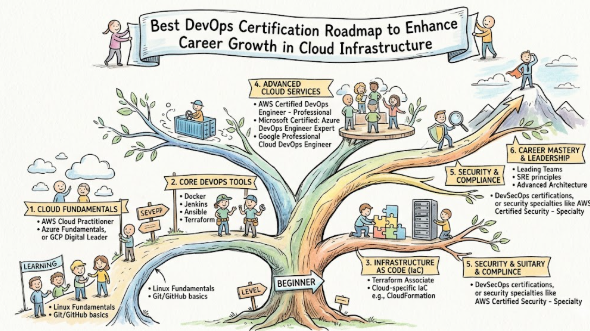
DevOps Certification Roadmap
| Career Goal | Recommended Certification Path | Why It Fits |
| DevOps Foundations | DCP + Master in Python | Builds the fundamental culture and automation skills required for any entry-level role. |
| Cloud-Native Expert | CKA + AWS/Azure DevOps + Terraform | Provides the core technical toolkit for managing enterprise-scale cloud infrastructure. |
| DevSecOps/SRE Specialist | DSOCP + SRE Certified + Prometheus | Focuses on deep reliability engineering, security-first workflows, and advanced observability. |
Common Mistakes to Avoid
- Ignoring Hands-On Practice: Relying solely on theory without working in real lab environments.
- Chasing Too Many Certifications: Collecting badges without deep-diving into the specific tools needed for your target role.
- Skipping Foundations: Jumping into advanced topics like Kubernetes without understanding basic Linux and networking.
- Neglecting Soft Skills: Forgetting that DevOps is primarily about communication and breaking down organizational silos.
Real-Life Examples
- A sysadmin achieved the CKA certification to lead their company’s transition from virtual machines to containerized Kubernetes clusters.
- An application developer used the MLOps certification to automate the deployment of production models, reducing training time by 40%.
- A security analyst completed the DSOCP to implement “security as code,” which identified vulnerabilities before deployment.
- A cloud engineer leveraged Terraform and AWS certifications to optimize multi-cloud infrastructure, significantly lowering monthly operational costs.
- An SRE used Prometheus and Grafana skills to build a real-time dashboard that reduced incident response times during system outages.
FAQs
What is the best DevOps certification for beginners?
The DevOps Certified Professional (DCP) is widely considered the best starting point, as it covers the foundational lifecycle stages of DevOps.
How long does it take to get certified?
Depending on the rigor of the certification and your prior experience, it typically takes 4 to 12 weeks of structured study and hands-on lab work.
Are these certifications enough to get a job?
Certifications prove your knowledge, but employers value hands-on project experience. Pair your certification with a portfolio of projects.
What is the difference between DevOps and SRE certifications?
DevOps certifications focus on the culture and pipeline delivery, whereas SRE certifications focus specifically on system reliability, scaling, and operational efficiency.
Do I need to know programming for DevOps certifications?
Yes, languages like Python are essential for automation. Programs like the Master in Python provide the necessary training for DevOps roles.
Is Kubernetes certification worth it?
Absolutely. As Kubernetes has become the standard for orchestration, the CKA is highly valued by hiring managers.
Can I switch to DevOps from non-IT?
Yes, but you should start with foundational courses to gain the necessary background in Linux, networking, and software development cycles.
How do I choose between AWS and Azure DevOps?
Choose based on the cloud provider your current or target employer uses most. Both are highly marketable skills.
Do certifications expire?
Many technical certifications have renewal periods (typically 2–3 years) to ensure your skills remain updated with current technologies.
Are these certifications recognized globally?
Yes, most DevOps certifications from reputable providers are recognized by multinational corporations and tech leaders globally.
Is DevSecOps a different field?
It is a specialized branch of DevOps that prioritizes embedding security into every stage of the software development lifecycle.
What is the role of GitOps in certification?
GitOps certifications validate your ability to manage infrastructure and application configurations using Git repositories as the “single source of truth.”
Conclusion
Choosing the right certification is more than just an academic exercise; it is a strategic investment in your professional future. By carefully aligning your career aspirations with the appropriate technical roadmap—whether that involves mastering Kubernetes, securing cloud infrastructure, or optimizing MLOps pipelines—you transform theoretical knowledge into high-impact operational value. As we have explored, the combination of a structured learning path, consistent hands-on experimentation, and industry-recognized validation is what sets top-tier engineers apart in a competitive global market. Remember, the true goal of these credentials is to equip you with the confidence and the competence to solve complex problems in ever-evolving technical environments. Your journey doesn’t end with a certificate; it begins with the application of these skills to drive innovation within your organization.

