
Introduction
In the modern era of global mobility, the dream of relocating to a new country is no longer governed by simple paperwork or arbitrary decisions. Instead, it is managed by sophisticated, data-driven algorithms known as PR Points Calculators. These digital tools are the primary gatekeepers for Permanent Residency (PR) programs in the world’s most sought-after destinations. A PR Points Calculator is a weighted assessment tool used by immigration authorities to rank and select candidates based on their potential to contribute to the local economy and integrate into the social fabric of the host nation.
Why It Matters for Immigration Eligibility
The points-based system serves as a transparent and objective meritocracy. Rather than relying on a first-come, first-served basis, countries use these calculators to identify “high-value” individuals. If you do not meet the minimum threshold determined by these tools, your application may never even reach the desk of an immigration officer. Understanding how these points are calculated is the difference between a successful relocation and a rejected application. It allows you to see exactly where you stand, which areas of your profile need improvement, and which country’s criteria align best with your current life stage and professional background.
The Turning Point: A Story of Global Ambition
Imagine a professional named Alex. Alex has spent years building a solid career, gaining expertise in a specialized technical field, and dreaming of a life in a country that offers better healthcare, educational opportunities for children, and a stable economy. For months, Alex felt overwhelmed by conflicting advice on internet forums. One day, Alex discovered a PR Points Calculator.
By inputting data regarding age, educational qualifications, and language test scores, the fog began to lift. Alex realized that while their work experience was top-tier, their language scores were holding them back from a competitive ranking. This realization transformed a vague “dream” into a concrete “project.” Alex stopped guessing and started planning. That is the power of a PR Points Calculator—it turns uncertainty into a roadmap.
What Is a PR Points Calculator?
Concept of Points-Based Immigration
The concept of points-based immigration was pioneered to move away from discriminatory quotas and toward a system that favors human capital. It treats an applicant’s profile as a collection of assets. These assets—such as your ability to speak the local language, your level of education, and your professional track record—are assigned specific numerical values. The sum of these values represents your “score.”
How PR Points Determine Visa Eligibility
In most systems, immigration departments set a “cutoff” score. This cutoff fluctuates based on the labor market’s needs and the volume of applicants.
- The Pool: Applicants enter a “pool” or an “Expression of Interest” (EOI) database.
- The Ranking: The calculator ranks everyone in the pool from highest to lowest score.
- The Invitation: Periodically, the government issues an “Invitation to Apply” (ITA) to those at the top of the list.
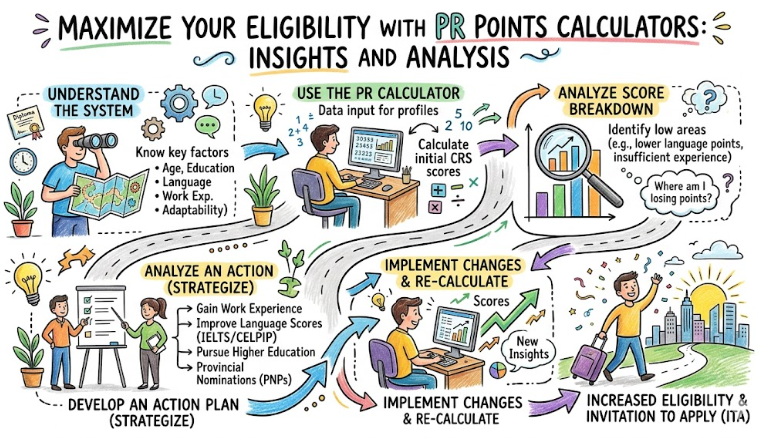
Without a PR points calculator, an applicant is essentially flying blind. Using one allows you to simulate different scenarios—such as how your score would change if you gained another degree or achieved a higher score on a language proficiency exam.
How Points Systems Work
While every country has its unique nuances, the core logic of these calculators remains remarkably consistent. They focus on factors that correlate with long-term economic success and social integration.
Key Factors in Points Calculation
| Factor | Description | Strategic Importance |
| Age | Points are usually highest for those in their prime working years. | High: Encourages long-term economic contribution. |
| Education | Higher degrees (Masters/PhD) yield significantly more points. | Very High: Correlates with higher earning potential. |
| Language Proficiency | Ability to communicate in the national language(s). | Critical: Essential for workplace and social integration. |
| Work Experience | Years spent in a skilled profession or specialized role. | High: Demonstrates immediate employability. |
| Job Offers | A valid offer from a local employer in the destination country. | Massive Bonus: Often acts as a “fast track” or “guarantee.” |
How Factors are Scored
Points are not distributed linearly. For instance, in the age category, you might receive maximum points between ages 25 and 32, with a gradual decline as you approach 45. In language proficiency, a small jump in a test score (like moving from a Level 7 to a Level 8) can sometimes trigger a disproportionately large increase in your total PR points due to “bonus” or “combination” points.
Country-Specific Sections
Canada PR Points Calculator
Canada is a global leader in points-based immigration, primarily through the Express Entry system. The calculator used here is known as the Comprehensive Ranking System (CRS).
The CRS Breakdown:
Canada looks at three main pillars:
- Core Human Capital: Age, education, language, and Canadian work experience.
- Spouse/Partner Factors: If applying with a partner, their education and language skills also contribute.
- Skill Transferability: This is where points are “stacked”—for example, having both a degree and high language scores gives you extra points.
Point Distribution Strategy:
- Maximum Points (Single): 600 points for core factors.
- Additional Points: Up to 600 points for provincial nominations, job offers, or siblings living in Canada.
Australia PR Points Calculator
Australia utilizes a system called SkillSelect to manage its General Skilled Migration (GSM) program. To even be considered, an applicant typically needs a minimum of 65 points, though the actual competitive score is often much higher.
Key Factors for Australia:
- English Proficiency: They recognize levels like “Competent,” “Proficient,” and “Superior.” Superior English can grant a massive 20-point boost.
- Australian Study Requirement: Studying in Australia for at least two years provides extra points.
- Regional Selection: Applicants willing to live in “Regional” areas (outside major cities like Sydney or Melbourne) can receive significant point boosts from state sponsorships.
New Zealand PR Points Calculator
New Zealand’s Skilled Migrant Category (SMC) focuses heavily on the employability of the candidate within the local market.
Scoring Nuances:
New Zealand recently shifted toward a system that emphasizes professional registration, high income (earning a certain threshold above the median wage), and duration of skilled work experience. Points are awarded for:
- Skilled work in New Zealand.
- Meeting specific salary thresholds.
- Post-graduate qualifications.
Japan / Other Countries
Japan has introduced the Highly Skilled Professional (HSP) points system to attract top-tier global talent. This is a departure from their traditional immigration methods and is designed to provide a faster route to permanent residency.
Japan HSP Breakdown:
- Academic Background: Graduating from top-ranked global universities grants points.
- Annual Salary: High projected earnings in Japan provide substantial points.
- Professional Achievements: Patents, published research, or specialized technical skills are heavily weighted.
Comparative Overview of PR Points Systems
| Country | Primary System | Min. Threshold | Focus Area |
| Canada | Express Entry (CRS) | Variable (Draft-based) | Youth, Education, Language |
| Australia | SkillSelect | 65 Points | Specialized Skills, Regional Work |
| New Zealand | SMC | 6 Points (New System) | Income, Professional Registration |
| Japan | HSP System | 70 Points | Academic Excellence, High Salary |
Benefits of Using a PR Points Calculator
Quick Eligibility Assessment
Instead of spending weeks reading through government manuals, a calculator provides a “go/no-go” decision in minutes. It filters out the noise and tells you exactly where you stand against current standards.
Planning to Improve Your Score
The most significant benefit is the ability to perform a “Gap Analysis.” If your score is 430 and the cutoff is 470, the calculator shows you that a higher language score or a professional certification could bridge that 40-point gap.
Selecting the Best Country
You might find that while you are 10 points short for Australia, your profile makes you a top-tier candidate for Canada or Japan. The calculator allows for a comparative strategy, ensuring you invest your resources in the program where you have the highest probability of success.
Step-by-Step Guide to Calculate Your Points
Calculating your points requires precision. A single error in data entry can lead to a false sense of security or unnecessary discouragement.
Detailed Walkthrough
- Gather Documents: You need your degree certificates, recent language test results, and a detailed record of your employment history.
- Determine Your “NOC” or “ANZSCO”: Every country has a classification system for jobs. You must identify the code that matches your professional experience.
- Input Core Factors: Start with age (as of today) and move through your education levels.
- Simulate Language Scores: If you haven’t taken the test yet, input the scores you expect to get to see the impact.
- Calculate Secondary Factors: Include points for a spouse, relatives in the destination country, or specialized work experience.
Realistic Example Profiles
Profile A: The Single Professional
- Background: 28 years old, Master’s degree, 4 years of overseas work experience, “Superior” English scores.
- Outcome: This profile usually scores very high in Canada and Australia due to the “Goldilocks Zone” of age and education.
Profile B: The Married Couple
- Primary Applicant: 35 years old, Bachelor’s degree, 10 years of experience.
- Secondary Applicant: Master’s degree, “Proficient” English.
- Outcome: While the primary applicant loses points on age, the secondary applicant’s high education and language skills “recover” those points, making the joint application competitive.
How to Maximize Your PR Points
If your initial calculation is below the competitive threshold, do not lose hope. There are strategic ways to augment your score:
- Language Re-testing: Moving from an “Advanced” to a “Native-level” equivalent score is often the fastest way to add points.
- Gain “In-Country” Experience: Many countries give massive bonuses if you work for one year within their borders on a temporary visa first.
- Higher Education: Completing a one-year post-graduate diploma can sometimes provide the necessary points to cross the threshold.
- Provincial/State Nomination: This is the “Holy Grail” of points. In Canada, a provincial nomination adds 600 points, virtually guaranteeing an invitation.
Common Mistakes to Avoid
- Overestimating Experience: Only “skilled” work experience counts. Administrative or entry-level roles often do not qualify for points.
- Using Outdated Tools: Immigration rules change frequently. Ensure the calculator you are using is updated to the most recent policy shifts.
- Ignoring the Spouse: A spouse with poor language scores can actually reduce the total score in some systems compared to applying as a single person.
- Miscounting Age: Remember that your points for age often drop on your birthday. If you are calculating today but plan to apply in six months, use your future age.
Practical Case Studies
Case Study 1: The Language Pivot
A mid-career professional in the tech sector initially calculated their points for Canada and found they were 30 points below the recent cutoffs. They had “good” language scores but decided to dedicate three months to intensive language coaching. Upon re-taking the exam and achieving the highest possible bracket, their score jumped by 42 points. This single change moved them from the middle of the pool to receiving an invitation in the very next draw.
Case Study 2: The Regional Strategy
An applicant interested in Australia realized their 75 points were not enough for a popular city like Sydney for their specific occupation. By shifting their focus to a “Regional” visa (Subclass 491) and gaining state sponsorship, they were awarded an additional 15 points. This strategic pivot allowed them to secure PR in a thriving secondary city with a lower cost of living and high demand for their skills.
FAQs
What is a PR points calculator?
A PR points calculator is a strategic tool used to evaluate an individual’s eligibility for permanent residency in countries that use merit-based immigration systems. It aggregates data points like age, education, and skills into a single score.
How accurate are these tools?
While highly effective for planning, these tools are simulations. The final authoritative score is always determined by the official immigration department upon the submission of verified documentation.
How many points are required for Canada PR?
There is no fixed number. The requirement changes with every “draw” based on the quality of candidates in the pool. Historically, competitive scores have fluctuated, making it essential to maximize points wherever possible.
Can I improve my points after submission?
Yes, in most systems like Express Entry or SkillSelect, you can update your profile if you gain a new degree, improve your language scores, or gain more work experience, and your score will update automatically.
What are the differences between Canada, Australia, and NZ systems?
Canada prioritizes youth and education through a fast-paced draw system. Australia leans heavily on specific occupational demand and regional sponsorship. New Zealand focuses more on high-income thresholds and professional registration.
Does my spouse’s profile affect my score?
In many systems, yes. A spouse can contribute points through their own education and language skills, but in some cases, a spouse with no credentials can slightly lower the “core” points compared to a single applicant.
What is the “NOC” or “ANZSCO” code?
These are standardized codes used to categorize occupations. Selecting the correct code is vital because if your work experience doesn’t match the code’s description, your points could be disqualified.
Is there an age limit for PR points?
While there isn’t usually a strict “limit,” points for age typically drop to zero after age 45 in systems like Australia’s and Canada’s, making other factors like job offers or high education more critical.
Does a job offer guarantee PR?
While a job offer provides a significant points boost, you must still meet other criteria like health and character requirements. However, it is often the most powerful factor in a PR points calculator.
How long does it take to get PR after reaching the points threshold?
Once you receive an invitation based on your score, the processing time varies by country, typically ranging from six months to two years depending on the visa category.
Conclusion
Mastering the PR Points Calculator is the first and most vital step in your journey toward global residency. These systems are designed to be objective, but they also reward those who are strategic and well-prepared. By understanding the weight given to education, language, and experience, you can stop viewing immigration as a matter of luck and start seeing it as a goal that can be achieved through careful planning.
Recalculate your scores often, stay updated on policy changes, and always look for ways to maximize your human capital. The door to a new life is open; you simply need the right score to walk through it.

