
Introduction
A shift in how software systems are maintained has been observed over the last decade. The traditional boundary between development and operations is being dissolved. Reliability is no longer seen as a separate task but is integrated into the very fabric of the software lifecycle. Through the Certified Site Reliability Manager designation, a professional is equipped with the tools to manage high-availability systems at scale. Strategic decision-making is combined with technical oversight to ensure that service levels are consistently met.
What is Certified Site Reliability Manager?
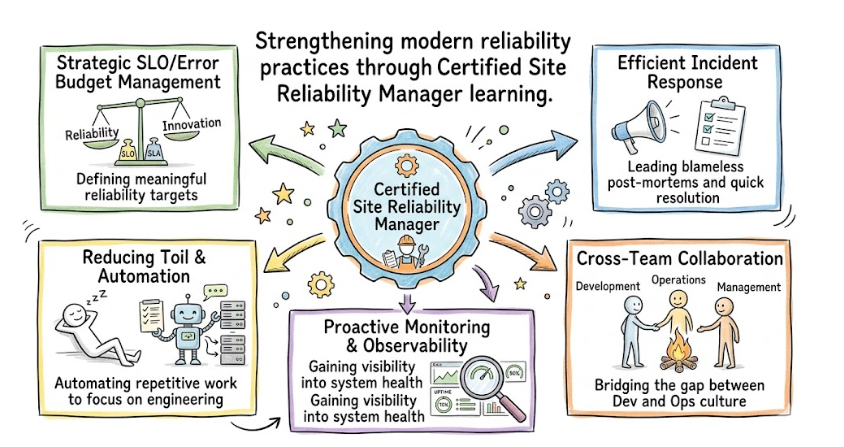
The Certified Site Reliability Manager (CSRM) is a comprehensive certification focused on the governance and leadership of reliability engineering. It is not merely focused on technical tools but emphasizes the management of Service Level Objectives (SLOs), error budgets, and team culture. By this certification, a professional’s ability to balance the need for rapid innovation with the requirement for system stability is validated. It is recognized as a master-level credential for those who aspire to lead infrastructure and platform teams.
Why it matters today?
Systems have become increasingly distributed and complex. When a failure occurs, the impact is felt globally and instantaneously. Therefore, a structured approach to managing reliability is required. Modern organizations demand leaders who can interpret data, manage risks, and lead teams through high-pressure incidents. Through this certification, the gap between business goals and technical reality is bridged. The language of reliability is used to communicate effectively with stakeholders and engineering teams alike.
Why Certified Site Reliability Manager certifications are important?
Expertise in reliability management is proven through formal certification. In a crowded marketplace, a verified set of skills is provided to employers. The importance of this certification is highlighted by the following points:
- Standardization: A unified framework for SRE management is established across the industry.
- Trust: Credibility with clients and management is enhanced through third-party validation.
- Efficiency: Proven methodologies are learned to reduce operational waste and manual toil.
- Career Growth: Access to senior-level roles in platform and infrastructure management is granted.
Why choose SRESchool?
The choice of a training provider is a significant factor in a professional’s success. SRESchool is selected by thousands of engineers because of its niche focus on reliability engineering. Unlike generic platforms, the entire curriculum at SRESchool is built around the SRE and DevOps ecosystem.
Practical wisdom is prioritized over theoretical concepts. The learning materials are designed by individuals who have managed massive production environments. When SRESchool is chosen, a community of dedicated reliability experts is joined. Continuous support and updated resources are provided to ensure that the knowledge remains relevant in a fast-changing industry.
Certification Deep-Dive: Certified Site Reliability Manager
What is this certification?
The Certified Site Reliability Manager is a leadership-focused program. It is designed to teach the principles of site reliability from a managerial and strategic perspective.
Who should take this certification?
This certification is intended for Site Reliability Engineers, DevOps Leads, Platform Managers, and Engineering Directors. It is also suitable for Software Architects who wish to deepen their understanding of operational stability.
Certification Overview Table
| Track | Level | Who it’s for | Prerequisites | Skills Covered | Recommended Order |
| SRE | Intermediate/Advanced | Aspiring Managers | Basic Ops knowledge | SLOs, Error Budgets | After SRE Foundation |
| DevOps | Advanced | DevOps Leads | Engineering exp | Cultural Change | Parallel with DevSecOps |
| Platform | Management | Platform Leads | Cloud infrastructure | Resource Efficiency | Final Step in Track |
Skills you will gain
- SLO Governance: The ability to define and monitor Service Level Objectives is mastered.
- Error Budget Policy: Strategies for balancing feature releases with stability are developed.
- Incident Command: Leadership skills for managing production outages are acquired.
- Toil Reduction: Techniques for identifying and automating manual tasks are learned.
- Post-Mortem Leadership: The process of conducting blameless post-mortems is refined.
- Capacity Planning: Methods for predicting infrastructure needs are explored.
Real-world projects you should be able to do after this certification
- Reliability Dashboard: A system for tracking and reporting SLOs across multiple teams is built.
- Incident Response Playbook: A comprehensive guide for handling major outages is created.
- Toil Audit: An analysis of manual operations is conducted, and an automation roadmap is designed.
- Error Budget Framework: A policy for managing technical debt and release velocity is implemented.
Preparation plan
7–14 days plan
- The exam objectives are carefully reviewed.
- Core SRE management terminology is studied.
- Foundational SRE principles are refreshed.
30 days plan
- Hands-on labs for monitoring and alerting are completed.
- Case studies on industry-standard incident responses are analyzed.
- Practice assessments are taken to identify knowledge gaps.
60 days plan
- Mock incident management simulations are performed.
- Detailed review of organizational change strategies is conducted.
- The final SRESchool guide is reviewed for comprehensive readiness.
Common mistakes to avoid
- Ignoring Culture: Reliability is a cultural shift, not just a set of tools.
- Poor SLO Definition: Meaningless metrics lead to poor decision-making.
- Focusing on Blame: The importance of a blameless culture is often underestimated.
Best next certification after this
- Same track: Certified SRE Expert
- Cross-track: Certified DevSecOps Professional
- Leadership / management: Certified DevOps Executive
Choose Your Learning Path
DevOps Path
Best for engineers focused on the software delivery pipeline. The integration of reliability into continuous deployment is the primary focus here.
DevSecOps Path
Best for security-minded individuals. The intersection of system stability and security compliance is explored in this path.
Site Reliability Engineering (SRE) Path
The core path for technical experts. Deep-level infrastructure management and high-availability architecture are prioritized.
AIOps / MLOps Path
Best for data professionals. The reliability of machine learning models and AI-driven operations is addressed in this curriculum.
DataOps Path
Best for data engineers. The focus is placed on the consistency and availability of large-scale data pipelines.
FinOps Path
Best for cloud architects. The balance between maximum reliability and minimum cloud expenditure is the main topic.
Role → Recommended Certifications Mapping
| Role | Recommended Certifications |
| DevOps Engineer | Certified DevOps Professional |
| Site Reliability Engineer | Certified Site Reliability Manager |
| Platform Engineer | Certified Platform Engineer |
| Cloud Engineer | Certified Cloud Architect |
| Security Engineer | Certified DevSecOps Professional |
| Data Engineer | Certified DataOps Professional |
| FinOps Practitioner | Certified FinOps Specialist |
| Engineering Manager | Certified DevOps Executive |
Next Certifications to Take
Certified SRE Expert (Same-track)
This is the highest level of technical mastery within the SRE track. Advanced patterns for global-scale infrastructure are covered.
Certified DevSecOps Professional (Cross-track)
Security is recognized as an integral part of reliability. This certification teaches how to protect the infrastructure being managed.
Certified DevOps Executive (Leadership-focused)
The transition to organizational leadership is aided by this program. The management of entire departments and strategic goals is explored.
Training & Certification Support Institutions
DevOpsSchool
A vast array of instructor-led training programs is offered by this institution. A strong emphasis is placed on hands-on practical labs for all DevOps and SRE certifications.
Cotocus
Corporate upskilling and tailored training programs are the specialty of Cotocus. Learning paths are customized for organizations looking to transform their engineering culture.
ScmGalaxy
A comprehensive repository of community knowledge and professional resources is provided. Practical tools and implementation strategies for SCM and DevOps are focused upon.
BestDevOps
Complex technical concepts are simplified for easier understanding. Professional development materials are designed for both beginners and seasoned experts in the field.
devsecopsschool.com
Specialized training for the integration of security into the DevOps lifecycle is provided. This is the primary destination for DevSecOps professionals.
sreschool.com
Dedicated expertise in Site Reliability Engineering is offered here. It is the official provider of the Certified Site Reliability Manager program.
aiopsschool.com
The application of Artificial Intelligence to IT operations is taught at this institution. Skills for the next generation of automated operations are developed.
dataopsschool.com
The reliability and speed of data pipelines are the focus here. Training is provided for modern data engineering teams.
finopsschool.com
Cloud cost management and financial optimization are the core subjects. Professionals are taught how to manage infrastructure spend efficiently.
FAQs Section
- What is the difficulty level of the CSRM certification?
The exam is considered to be at a moderate to advanced level of difficulty. - How much time is needed for full preparation?
Usually, 4 to 8 weeks are recommended for thorough study and practice. - Are there any specific prerequisites?
Prior experience in IT operations or software development is highly recommended. - In what sequence should certifications be completed?
The SRE Foundation is often completed before the Manager level is attempted. - What is the primary career value of this credential?
Eligibility for leadership roles and increased salary potential are common outcomes. - Which job roles can be pursued after certification?
Roles such as SRE Lead, Platform Manager, and Infrastructure Director are available. - Is the certification recognized globally?
Yes, the certification is recognized by tech companies across India and worldwide. - Is a coding background required for this manager role?
A basic understanding of software engineering is necessary for effective SRE leadership. - Does the program cover cloud-specific tools?
The principles are cloud-agnostic but are applicable to AWS, Azure, and Google Cloud. - How long does the certification stay valid?
The certification is typically valid for two years, after which renewal is required. - Are practice tests provided?Yes, mock exams are included as part of the training at SRESchool.
- What is the industry demand for reliability managers?
The demand is growing rapidly as companies move to microservices and cloud-native models.
Additional FAQs for Certified Site Reliability Manager
- How is the CSRM different from a project management course?
A focus is placed on technical reliability and production health rather than just project timelines. - What are the main topics covered in the curriculum?
SLOs, Error Budgets, Incident Management, and Toil Reduction are the primary focus areas. - Can an Engineering Manager benefit from this course?
Yes, it is highly beneficial for managers who oversee technical infrastructure teams. - How is the exam conducted?
The exam is administered through a secure online proctored platform. - Is automation a significant part of the training?
Yes, the systematic elimination of toil through automation is a core concept. - Are real-world examples used in the teaching?
Case studies of successful and failed reliability strategies are analyzed in depth. - How does this help in job interviews?
A structured framework for discussing reliability and risk management is gained. - Is SRESchool the primary provider of this program?
Yes, the certification is officially provided and governed by SRESchool.
Testimonials
Aarav
The management of our production systems has been transformed. The focus on error budgets has changed how our team operates.
Isha
Confidence in leading major incident calls was gained through this program. The blameless culture is now practiced daily in our organization.
Advait
A clear path for career progression was provided. The transition from a senior engineer to a manager was made much easier.
Anvi
Operational toil was significantly reduced in our platform. The automation strategies learned have saved hundreds of hours for the team.
Reyansh
The certification is highly respected by my leadership team. It has opened doors to high-level strategic planning roles.
Conclusion
A new standard for engineering leadership is established through the completion of the Certified Site Reliability Manager program. The shift from reactive firefighting to proactive, strategic reliability governance is fully realized. When the principles of SLOs and error budgets are mastered, a professional’s value is significantly enhanced within any modern organization.
The legacy of a stable and resilient infrastructure is built by those who choose to prioritize system health over short-term gains. Every lesson learned through this journey is viewed as a vital step toward a future where downtime is an anomaly rather than a routine. Strategic career growth is secured, and the path to becoming an influential figure in the SRE community is made clear. An invitation is extended to every ambitious professional to embrace this leadership role and drive the next wave of technological excellence.

