
Introduction
In the fast-changing world of technology, the way systems are built and managed has undergone a massive transformation. No longer is it enough for an engineer to simply keep a server running. Today, the focus has shifted toward building systems that are inherently stable, scalable, and self-healing. This shift is led by a new class of professionals: Site Reliability Architects. In this guide, the journey toward becoming a Certified Site Reliability Architect is explored from a strategic perspective, focusing on long-term career growth and technical mastery.
What is a Certified Site Reliability Architect?
A Certified Site Reliability Architect is defined as an expert who focuses on the structural design of reliable software systems. While a standard engineer might handle daily operations, the architect is responsible for the high-level blueprints that prevent failures before they happen.
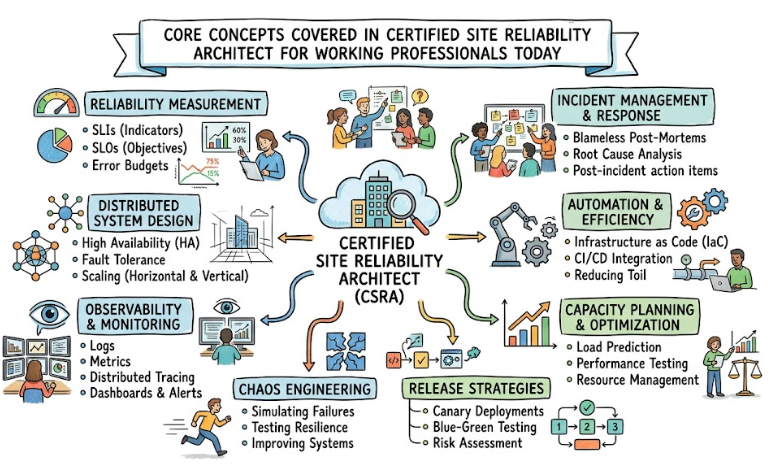
Principles such as automation, observability, and capacity planning are deeply integrated into this role. The certification is designed to validate an individual’s ability to lead complex infrastructure projects and ensure that business-critical services remain available under any level of stress.
Why it Matters Today?
The modern digital economy is built on a foundation of constant availability. When a platform goes down, trust is lost and revenue disappears instantly. Because of this, the role of an architect is more important than ever.
As companies move toward microservices and multi-cloud environments, the complexity of managing these systems grows. A Certified Site Reliability Architect is trained to handle this complexity by using data-driven methods and advanced automation. This expertise is what allows modern businesses to innovate quickly without sacrificing the stability of their products.
Why Certified Site Reliability Architect Certifications are Important
A formal certification in this field is seen as a mark of professional maturity. The following reasons highlight why this credential is held in such high regard:
- Validation of Expertise: A high level of technical competency in distributed systems is proven.
- Strategic Thinking: The focus is shifted from manual tasks to long-term architectural health.
- Market Demand: A significant gap in the industry for qualified architects is addressed.
- Standardized Frameworks: Best practices used by global tech giants are mastered and applied.
Why Choose SRESchool?
For those who are serious about reliability, SRESchool is recognized as the premier destination for specialized training. A curriculum that is purely focused on the SRE domain is provided, ensuring that learners are not distracted by unrelated topics.
The training is delivered through a blend of theoretical knowledge and intensive practical labs. Real-world architectural challenges are simulated to ensure that every student is prepared for the pressures of a live production environment. By choosing SRESchool, a commitment is made to learning from a community that prioritizes system health above all else.
Certification Deep-Dive
What is this certification?
The Certified Site Reliability Architect program is an advanced credential that focuses on the design, implementation, and scaling of highly available systems. The marriage of software engineering and systems architecture is explored in great detail.
Who should take this certification?
This path is intended for mid-to-senior level engineers, including DevOps leads, Cloud Architects, and SREs. It is also highly recommended for engineering managers who wish to gain a deeper technical understanding of system reliability.
Certification Overview Table
| Track | Level | Who it’s for | Prerequisites | Skills Covered | Recommended Order |
| SRE | Architect | Senior Leads | SRE Foundation | Design, Scale, Uptime | 3rd |
| DevOps | Professional | Automation Engineers | Basics of CI/CD | Pipelines, IaC | 1st |
| DevSecOps | Specialist | Security Focused | Security Basics | Compliance, Auditing | 2nd |
| AIOps/MLOps | Advanced | Data/AI Teams | Python Knowledge | Model Monitoring | 4th |
| DataOps | Advanced | Data Architects | Database Knowledge | Pipeline Reliability | 5th |
| FinOps | Management | Billing/Leads | Cloud Finance | Cost Management | 6th |
Skills You Will Gain
- The ability to design resilient multi-cloud architectures is developed.
- Advanced monitoring and distributed tracing techniques are mastered.
- The implementation of global load balancing and traffic management is learned.
- Techniques for managing error budgets and incident response are refined.
- High-level skills in capacity modeling and cost-effective scaling are gained.
- Strategic leadership in site reliability is fostered.
Real-World Projects You Should Be Able to Do
- A global disaster recovery system for a high-traffic e-commerce site is designed.
- An automated incident management pipeline is built from scratch.
- A full-scale observability stack is deployed across multiple Kubernetes clusters.
- A complex chaos engineering experiment is conducted to identify system weaknesses.
- A cost-optimization strategy for massive cloud infrastructures is implemented.
Preparation Plan
7–14 Days Plan (The Revision Phase)
- First Half: The fundamental laws of reliability and architecture are reviewed.
- Second Half: Practice simulations are performed to test architectural decision-making.
30 Days Plan (The Practical Approach)
- Week 1: Theoretical concepts and architectural patterns are studied.
- Week 2: Hands-on labs focusing on observability and automation are completed.
- Week 3: Incident response and case studies of major outages are analyzed.
- Week 4: Final preparations and practice exams are taken.
60 Days Plan (The Expert Mastery)
- Month 1: A deep dive into distributed systems and advanced networking is conducted.
- Month 2: Real-world projects are built and peer-reviewed. The final weeks are spent perfecting the understanding of exam-specific topics.
Common Mistakes to Avoid
- Relying too heavily on tools instead of understanding architectural patterns.
- Underestimating the importance of communication during incident management.
- Ignoring the business impact of reliability metrics like SLOs.
- Failing to practice in a hands-on lab environment before the exam.
Best Next Certification After This
- Same Track: Certified SRE Leadership and Management.
- Cross-Track: Certified DevSecOps Architect.
- Leadership / Management: Strategic Cloud Transformation Specialist.
Choose Your Learning Path
DevOps
This path is chosen by those who want to bridge the gap between development and operations. Automation and speed are the primary focuses.
DevSecOps
Security-minded professionals choose this path to ensure that protection is built into the automation pipeline from day one.
Site Reliability Engineering (SRE)
This is the preferred path for those who view operations as a software engineering problem. Stability and performance are the main goals.
AIOps / MLOps
Engineers working with large data models follow this path to automate the complex lifecycle of machine learning systems.
DataOps
This path is ideal for data professionals who need to ensure that data flows are reliable, consistent, and fast.
FinOps
Business-oriented tech leads choose this path to align cloud spending with company financial goals.
Role → Recommended Certifications Mapping
| Role | Recommended Certification | Secondary Goal |
| DevOps Engineer | Certified DevOps Master | SRE Foundation |
| SRE | Certified SRE Architect | Chaos Engineering |
| Platform Engineer | Certified Kubernetes Expert | DevOps Professional |
| Cloud Engineer | Certified Cloud Architect | FinOps Practitioner |
| Security Engineer | Certified DevSecOps Engineer | SRE Foundation |
| Data Engineer | Certified DataOps Professional | MLOps Specialist |
| FinOps Practitioner | Certified FinOps Specialist | SRE Architect |
| Engineering Manager | Certified SRE Architect | Leadership Master |
Next Certifications to Take
- Same-track Certification: Advanced Infrastructure Automation Specialist. This program is designed to take automation skills to the absolute limit using advanced scripting and AI-driven tools.
- Cross-track Certification: Certified Cloud Security Architect. A deep focus on protecting large-scale cloud environments is provided, making it the perfect partner for an SRE architect.
- Leadership-focused Certification: Chief Technology Leadership Program. This is intended for senior architects who are preparing to enter the executive suite and manage entire engineering departments.
Training & Certification Support Institutions
DevOpsSchool
A wide variety of training programs for all DevOps-related tracks is offered. It is known for its extensive course library and industry reputation.
Cotocus
Specialized guidance and architectural training are provided by Cotocus. They focus on helping professionals master high-level system design.
ScmGalaxy
A wealth of community knowledge and free resources for engineers is found here. It is an excellent starting point for any technical journey.
BestDevOps
Focused, high-quality training sessions are delivered here. Their programs are specifically designed to help students pass international certifications.
devsecopsschool.com
This institution is dedicated to the security aspect of the pipeline. Detailed courses on shift-left security and compliance are available.
sreschool.com
The primary provider for Site Reliability Engineering and Architecture training is found here. It is the official source for the CSRA program.
aiopsschool.com
Courses on how to implement artificial intelligence in IT operations are provided. This is the place for future-focused operations engineers.
dataopsschool.com
The lifecycle of data and how to manage it reliably is taught at this institution. It is highly recommended for data architects.
finopsschool.com
The financial side of the cloud is mastered through the training provided here. It is essential for modern cloud cost management.
FAQs Section
- What is the scope of work for this architect role? The design of the entire system for reliability and scalability is handled by the architect.
- Is previous experience in coding necessary? A strong understanding of software logic is required to design automated reliability systems.
- How is the certification exam delivered? The exam is taken online through a proctored platform for global access.
- What is the duration of the preparation? Most professionals spend between four and eight weeks preparing for the architect level.
- Are there any age restrictions for candidates? No, the program is open to anyone with the required technical knowledge and background.
- How long does the certificate stay active? The credential is valid for two years, and renewal options are provided by the school.
- What is the minimum grade to pass? A score of 70% or higher is typically required to earn the certification.
- Is there a community for certified professionals? Yes, access to a global network of SRE experts is provided for networking and growth.
- Are the study materials updated regularly? Yes, the curriculum is updated frequently to reflect the latest industry trends.
- Can the certification help with remote job searches? Yes, this credential is highly respected by global companies that offer remote engineering roles.
- Is support provided during the course? Guidance from experienced instructors is available to all students during their studies.
- Are there practice exams available? Yes, mock tests are provided to help candidates build confidence before the final exam.
Additional FAQs for Certified Site Reliability Architect
- How does this certification differ from a general SRE course?
The architect level focuses on high-level design and strategy rather than just day-to-day tasks. - Is knowledge of Kubernetes required?
While not the only focus, understanding container orchestration is very helpful for the design portions. - What is the primary focus keyword for this guide?
The focus is placed on the Certified Site Reliability Architect role and its professional impact. - Are scenario-based questions included in the exam?
Yes, the exam tests the ability to solve complex, real-world architectural problems. - Is there a digital badge issued upon passing?
Yes, a verified digital badge is provided for use on professional profiles. - Can the course be taken part-time?
Yes, the flexible learning options allow professionals to study while they continue to work. - Is chaos engineering part of the architect’s toolkit?
Yes, techniques for testing system resilience are covered in the curriculum. - How is the certificate recognized in the market?
It is seen as a sign of advanced technical leadership and specialized knowledge in reliability.
8 FAQs Specific to Certified Site Reliability Architect
- Does the CSRA course cover Kubernetes?
Yes, the architecture of containerized applications is a major part of the program. - Is focus placed on specific cloud providers like AWS or Azure?
The principles are cloud-agnostic, but they are applied to all major cloud platforms. - What is the role of automation in this certification?
Automation is treated as the primary method for ensuring system reliability. - Are soft skills included in the training?
Yes, incident communication and blameless culture are vital parts of the curriculum. - Is capacity planning covered in the architect level?
Yes, advanced methods for predicting and managing system growth are taught. - How are error budgets handled in the exam?
Practical scenarios on how to set and manage error budgets are tested. - Is network architecture included?
Deep dives into load balancing and global traffic routing are provided. - Is there a focus on cost-efficient design?
Yes, building reliable systems that are also cost-effective is a key learning outcome.
Testimonials
Rohan
A completely new perspective on system design was gained through this program. The focus on proactive architecture instead of reactive fixing has changed my daily workflow.
Elena
My technical confidence was greatly boosted. The hands-on labs at SRESchool are very realistic and helped me prepare for the challenges of our recent migration.
Marcus
The career clarity provided by this certification is unmatched. I was able to move into a lead role within months of completion, thanks to the skills learned.
Jasmine
Complex observability concepts were made easy to understand. I now lead the monitoring strategy for my entire department with great success.
David
Real-world application is the biggest strength of this course. The lessons on disaster recovery were put to use almost immediately during a major update.
Conclusion
The Certified Site Reliability Architect certification is an essential credential for those who wish to lead in the digital era. A deep and specialized knowledge of system health and design is provided by the program. Long-term career benefits, including senior roles and higher trust, are earned by certified professionals. Strategic planning and continuous education are encouraged for all software engineers. By choosing a provider like SRESchool, the foundation for a successful and stable career in technology is firmly established.

