
Introduction
In the current world of software development, a major shift is being seen in how systems are managed. For many years, when a website became slow, the cause was often a mystery that took hours or days to solve. This “darkness” in the system is now being removed through a practice called Observability. It is a way to ensure that every part of a computer program is made visible so that problems are caught before they affect the person using the app.
A special path has been created for those who want to learn this skill, known as the Master in Observability Engineering (MOE). Through this certification, a new way of thinking is taught where data is used as evidence to make systems better. It is not just about tools; it is about building a system that can “talk” to its creators. This guide is written to show how this master-level track is used to change the way software is managed globally.
What is Master in Observability Engineering (MOE)
The Master in Observability Engineering (MOE) is an advanced program where the internal state of a system is measured by looking at the data it sends out. In the past, only basic checks were made to see if a system was running. Now, through this master track, a deep understanding of logs, metrics, and traces is developed. These three pieces of data are used to build a complete story of how an application is behaving in the real world.
The program is designed to take an engineer from a basic level to a master level. Every step of the software lifecycle is covered, from the moment code is written to the moment it is used by thousands of people. It is ensured that the learner knows how to make any system “observable,” which means it is made easy to understand and easy to fix.
Why it matters in today’s software, cloud, and automation ecosystem
Modern software is no longer a single block of code. Instead, it is made of many small pieces that talk to each other across the cloud. When one piece fails, the whole system can be put at risk. Observability is used to prevent these “silent failures” from happening. It is considered the most important part of the modern cloud ecosystem because it provides the light needed to see through the complexity of automation and microservices.
By using the skills learned in the MOE, the “uptime” of a system is greatly improved. When a problem is found, it is fixed much faster because the exact location of the error is shown by the data. This leads to a better experience for the user and less stress for the engineering team. In a world where every second of downtime costs money, these skills are seen as essential.
Why certifications are important for engineers and managers
A certification like the MOE is used to prove that a specific set of high-level skills has been mastered. For an engineer, it is a way to stand out in a crowded job market. It shows that the time has been taken to learn the right way to build reliable systems. Instead of just “learning on the job,” a structured and proven path is followed, which gives the engineer more confidence.
For managers, certifications are used as a tool to build a strong and capable team. When a team is certified, it is known that everyone is following the same best practices. Mistakes are reduced, and the quality of the work is kept at a high level. It also helps the company show its clients that their systems are being managed by experts who hold the best credentials in the industry.
Why Choose DevOpsSchool?
When it comes to technical growth, a choice is often made to study at DevOpsSchool. This institution is picked because a very practical and hands-on style of learning is followed. It is believed that skills are best learned by doing, so students are given access to real systems where they can practice. The curriculum is updated every few months to make sure the latest shifts in technology are included. The mentors are people who have worked on some of the largest systems in the world, and their real-world experience is shared directly with the students.
Master in Observability Engineering (MOE) Deep-Dive
What is this certification?
This is a high-level training program where the “science” of looking into systems is taught. It is focused on how to collect, store, and study system data to ensure everything runs perfectly.
Who should take this certification?
This path is best suited for people who work with cloud systems, such as DevOps Engineers, SREs, and Platform leads. It is also very helpful for anyone who is responsible for fixing bugs in large, complex applications.
Certification Overview Table
| Track | Level | Who it’s for | Prerequisites | Skills Covered | Recommended Order |
| DevOps | Advanced | Build Teams | Linux Basics | Automation, Git | 1 |
| DevSecOps | Advanced | Security Teams | DevOps Knowledge | Safe Systems | 2 |
| SRE | Expert | Reliability Staff | System Basics | Uptime, SLOs | 3 |
| MOE | Master | All Tech Roles | Cloud Basics | Data Insights | 4 |
| AIOps | Expert | Data Scientists | Python, Stats | Smart Ops | 5 |
| FinOps | Professional | Managers | Budget Knowledge | Cost Savings | 6 |
Skills you will gain
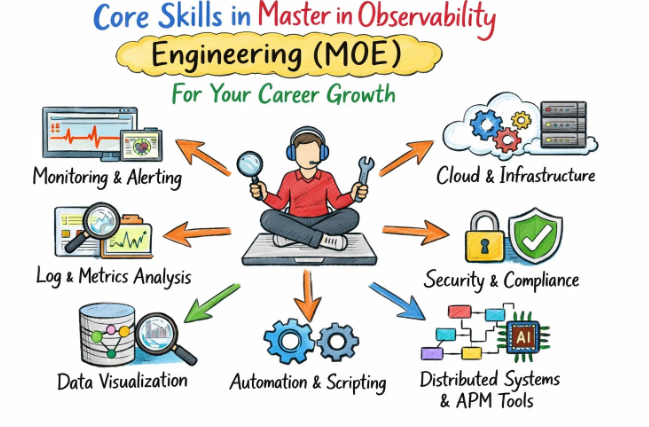
- The skill of pulling data from different types of software is mastered.
- Clear and beautiful dashboards are built to show the health of the system.
- Every single step of a user’s request is followed across many servers.
- Special languages are learned to search through millions of data points in seconds.
- Smart alerts are set up so that the team is only woken up for real emergencies.
- Plans are made to ensure the system can handle a lot of users at once.
Real-world projects you should be able to do after this certification
- The Full-Stack Monitor: A project is completed where a complete app is made 100% observable from top to bottom.
- The Multi-Cloud Dashboard: A single screen is created that shows the status of servers running in different parts of the world.
- The Incident Finder: A hidden error is placed in a system, and it must be found using only the traces and logs.
- The Cost Optimizer: A system is studied to see where too much data is being collected, and the cost is then reduced.
Preparation plan
7–14 days plan
- The basic vocabulary of observability is learned.
- Simple tools are installed on a local machine to see how they work.
- The first few modules of the official MOE course are completed.
30 days plan
- Small apps are built and connected to observability tools every day.
- Different types of logs are studied to understand how they are formatted.
- Practice tests are used to check if the main ideas are understood.
60 days plan
- Large, distributed systems are used for practice sessions.
- Advanced ways of managing data at scale are mastered.
- A final project is submitted to prove that a master level has been reached.
Common mistakes to avoid
- Sometimes too much time is spent on a single tool instead of learning the main ideas.
- Data is gathered without a clear plan, which makes it hard to use later.
- It is forgotten that observability is something the whole team must use.
- Alerts are set up poorly, leading to a lot of “noise” that the team starts to ignore.
Best next certification after this
- Same track: Advanced Telemetry Specialist.
- Cross-track: SRE Master Certification.
- Leadership / management: Digital Transformation Lead.
Choose Your Learning Path
1. DevOps Path
This path is best for those who want to ensure that code is observable from the very beginning. It is focused on building observability into the “delivery pipeline.”
2. DevSecOps Path
The focus here is on safety. It is learned how to use system data to detect when a hacker is trying to break in or when a security rule is being broken.
3. Site Reliability Engineering (SRE) Path
This is for the people who never want a website to go down. Data is used to measure the “health” of the system and to make sure it is always fast and reliable.
4. AIOps / MLOps Path
This is the path of the future. It is learned how to use smart robots (AI) to look at observability data and fix problems automatically.
5. DataOps Path
The flow of data is the main focus here. It is ensured that data moves through the system correctly and that any delays are found and fixed immediately.
6. FinOps Path
This is a path that connects engineering with the business office. It is learned how to see how much each part of the system costs and how to save money.
Role → Recommended Certifications Mapping
| Role | Same-track Recommendation | Cross-track Recommendation | Leadership Recommendation |
| DevOps Engineer | Master in DevOps | Master in Cloud Ops | Digital Leader |
| SRE | Master in SRE | Master in MOE | Engineering Director |
| Platform Engineer | Platform Master | SRE Specialist | Tech Strategy Lead |
| Cloud Engineer | Cloud Architect | DevSecOps Lead | Cloud Business Manager |
| Security Engineer | Security Master | MOE Specialist | CISO Track |
| Data Engineer | DataOps Master | MLOps Specialist | Data Director |
| FinOps Practitioner | Cost Specialist | Cloud Master | Finance for IT Leads |
| Engineering Manager | Project Management | MOE for Managers | Leadership Master |
Training & Certification Support Institutions
- DevOpsSchool: A leader in the field where a lot of practical knowledge is shared. A strong focus on career growth is maintained for all students.
- Cotocus: Great training on cloud-native tools is provided. The lessons are made very simple so that anyone can learn them.
- ScmGalaxy: This is a huge community where many free guides and tools are shared. It is very useful for staying updated with new tech.
- BestDevOps: The best ways to manage software are taught here. A focus on “hands-on” learning is kept at all times.
- devsecopsschool.com: A place where the focus is entirely on keeping systems safe while they are being built.
- sreschool.com: The secrets of building systems that never break are shared here. It is a great place for reliability fans.
- aiopsschool.com: The world of artificial intelligence in operations is explored. It is very forward-looking and modern.
- dataopsschool.com: Everything about managing large amounts of data is taught at this school.
- finopsschool.com: The skill of managing cloud costs is taught here, making it perfect for managers.
FAQs Section
- Is the MOE exam very difficult to pass?
A fair amount of study is required, but if the labs are practiced, the exam is passed by most.
- How many hours of study are needed each week?
About 5 to 10 hours a week are usually spent by students to finish the course in two months.
- Do I need to be an expert in coding?
No, but a basic understanding of how code works is very helpful for the hands-on parts.
- What is the first thing that should be learned?
The basics of Linux and how the cloud works should be understood before starting the MOE.
- How much does this help with my salary?
A significant increase is often seen after getting this certification because it is a very specialized skill.
- What job title will I have?
Titles like Observability Engineer, SRE, or Infrastructure Lead are common after this program.
- Can I take the classes from home?
Yes, the training is provided online so it can be finished from anywhere in the world.
- Is the certificate valid forever?
No, it is usually updated every two years so that the latest technology is always known.
- Are there real projects to work on?
Yes, a big part of the course is spent working on real systems to gain experience.
- Why is MOE called a “Master” track?
It is called a master track because it covers many different areas like DevOps and SRE in one go.
- Is it only about one tool like Prometheus?
No, many different tools are taught so that the student is ready for any company.
- Is support given after the course ends?
Yes, a community of students and mentors is always available for help.
Additional FAQs for Master in Observability Engineering (MOE)
- Is distributed tracing taught in this course?
Yes, the art of following a request across many different services is a core part of the lessons.
- Will I learn how to build dashboards?
Yes, a lot of time is spent learning how to build clear and useful charts for the team.
- Is log management covered?
Yes, how to collect and search through millions of logs is taught in great detail.
- Can this be used for small companies too?
Absolutely, the principles of observability help any company, no matter the size.
- Is there a focus on OpenTelemetry?
Yes, OpenTelemetry is taught as the main way to collect data from any application.
- Does the course help with incident management?
Yes, it is learned how to use data to find the root cause of an incident much faster.
- Are there any discounts for students?
Different offers are often provided, so the official site should be checked regularly.
- Is the training recorded for later use?
Yes, all live sessions are recorded so they can be watched again at any time.
Testimonials
Aman A lot of new things were learned in a very short time. The way systems are managed at work was changed completely.
Riya The focus on hands-on labs was the best part. A lot of confidence was gained by practicing on real systems.
Deepak The path to becoming a senior engineer was made much clearer. The mentorship provided was excellent.
Anjali The lessons were explained in a very simple way. Even though the topics were advanced, they were easy to follow.
Suresh A big jump in my career was achieved. The skills learned are exactly what big companies are looking for right now.
Conclusion
Master in Observability Engineering (MOE) certification is summarized by the total change it brings to how software systems are managed. A fundamental shift is made from simple monitoring to deep, evidence-based understanding. When this master-level track is completed, a powerful and rare set of skills is added to an engineer’s toolkit. Long-term career benefits are highlighted because the need for total system transparency is growing every day in the global market.
Strategic learning and careful certification planning are encouraged for everyone who wishes to stay ahead in the ever-changing tech world. By choosing the Master in Observability Engineering (MOE) path, a clear signal is sent to employers that the highest standards of reliability and performance are valued. The vast complexity of the modern cloud is handled with much more ease when these principles are applied to daily work. A bright and stable future in the technology industry is ensured for those who dedicate themselves to this specialized discipline.

