
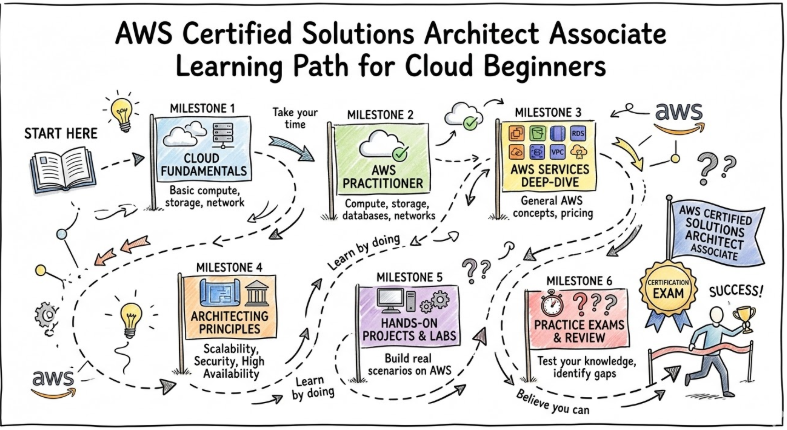
Introduction
In the modern world of software and automation, the cloud is no longer just an option; it is the foundation. For anyone working in IT, understanding how to design systems that are stable, secure, and scalable is a vital skill. One of the most respected ways to prove this knowledge is through the AWS Certified Solutions Architect – Associate certification.
What is AWS Certified Solutions Architect – Associate?
This certification is designed for individuals who want to master the art of designing distributed systems on Amazon Web Services (AWS). It focuses on the core pillars of the AWS Well-Architected Framework: cost optimization, performance, security, reliability, and operational excellence. It is not just about knowing the services; it is about knowing how to connect them to solve business problems.
The exam is structured to test your ability to make technical decisions. For example, instead of just asking what a database is, you are asked which database is best for a specific speed requirement and budget. It is a badge of honor that tells the industry you can build a house on the cloud that will not fall down when the wind blows.
Why it matters in today’s ecosystem
Today, businesses are moving away from traditional data centers. Whether it is a startup or a global bank, the need for cloud-native solutions is massive. Being a certified solutions architect means you understand how to build systems that do not crash under pressure and do not waste company money.
In the world of DevOps, SRE, and DevSecOps, this knowledge is the bridge between writing code and running a successful business. Without a solid architecture, automation can actually make things worse by scaling mistakes. This certification ensures that the foundation is strong before the automation is applied.
Why certifications are important for engineers and managers
For an engineer, a certification is a roadmap. It forces you to learn the services you might not use in your daily job, making you a more well-rounded professional. It stops you from being “just a coder” and turns you into a “system thinker.”
For managers, certifications provide a benchmark. It ensures that the team speaks the same technical language and follows industry best practices. It builds trust with clients and stakeholders that the infrastructure is in capable hands. When a team is certified, the risk of expensive architectural mistakes is greatly reduced.
Certification Overview Table
| Track | Level | Who it’s for | Prerequisites | Skills Covered | Recommended Order |
| Cloud Architecture | Associate | Engineers, Solutions Architects, Managers | Basic Cloud Knowledge | Network, Storage, Compute, Security, Database | After Cloud Practitioner |
Provider: DevOpsSchool
Why Choose DevOpsSchool?
Choosing the right training partner is as important as the certification itself. DevOpsSchool is chosen by many because the focus is kept on real-world scenarios rather than just theory. Many platforms teach you where the buttons are, but here, you are taught why you should click them.
The instructors bring years of field experience, ensuring that every concept is explained through the lens of actual industry problems. Detailed lab sessions and community support make the learning journey much smoother for working professionals. You are not just passing a test; you are gaining the skills needed to handle a production environment on Monday morning.
Certification Deep-Dive
AWS Certified Solutions Architect – Associate
What is this certification? It is a mid-level credential that validates your ability to design and deploy functional applications on AWS. The focus is placed on using AWS services to create resilient, high-performing, and cost-effective solutions for any business size.
Who should take this certification? This is ideal for software developers, system administrators, and solution architects who have at least some hands-on experience with cloud environments. It is also highly beneficial for technical leads and managers who oversee cloud migrations and need to understand the technical trade-offs of different services.
Skills you will gain
- Resilient Design: Learning how to build systems that stay online even if a whole data center goes dark.
- High Performance: Understanding how to use caching and fast storage to make applications feel “snappy” for users.
- Security First: Mastering identity management and encryption so that data is protected at every layer.
- Cost Governance: Learning how to stop the “surprise bill” at the end of the month by choosing the right pricing models.
- Hybrid Connectivity: Understanding how to link a company’s old office servers with the new cloud environment safely.
Real-world projects you should be able to do
- Auto-Scaling Web Apps: Building a system that automatically adds more servers when traffic spikes during a sale and removes them when traffic is low.
- Global Content Delivery: Setting up a system so that a user in India and a user in the USA both experience fast load times for the same website.
- Secure Data Storage: Creating an encrypted “vault” for company documents that only specific employees can access.
- Serverless Processing: Building an image-processing system that works automatically without you ever having to manage a single server.
Preparation Plan
- 7–14 Days Plan: This is for those who already use AWS daily. Focus is placed on high-level overviews. Watch summary videos, review the official exam guide, and take at least three full-length practice exams to identify weak spots.
- 30 Days Plan: Spend two hours daily. Use the first two weeks for core services like EC2, S3, VPC, and RDS. The remaining two weeks should be spent on specialized services like SQS, Lambda, and Route53, followed by intensive practice tests.
- 60 Days Plan: This is the best approach for deep learning. The first month is dedicated to hands-on labs for every major service. The second month is used for deep-diving into AWS whitepapers and taking multiple mock exams until a consistent score of 80% is achieved.
Common mistakes to avoid
- Skipping the Labs: Theory is easy to forget, but the memory of fixing a broken network in a lab stays with you.
- Ignoring Cost: Many students focus on “how it works” but forget “how much it costs.” The exam cares about both.
- Using Old Materials: The cloud changes fast. Always ensure your study guide is updated for the latest version of the exam (SAA-C03).
- Rushing the Questions: The exam often gives two “correct” answers, but one is “more cost-effective.” Always look for those keywords.
Best next certification after this
- Same track: AWS Certified Solutions Architect – Professional (The big brother of this exam).
- Cross-track: AWS Certified Security – Specialty (To become a security expert).
- Leadership / management: AWS Certified Cloud Practitioner or specialized FinOps certifications to handle the business side.
Choose Your Learning Path
- DevOps Path: Best for those focused on automation. Focus is placed on how architecture supports CI/CD pipelines and infrastructure as code. It is about making the architecture “deployable” by machines.
- DevSecOps Path: Best for security-minded engineers. The focus is shifted toward integrating IAM, encryption, and compliance into the architectural design from the very first day.
- SRE Path: Best for those focused on reliability. The path emphasizes monitoring, self-healing systems, and high availability. It is about making sure the “on-call” phone never rings.
- AIOps / MLOps Path: Best for data scientists and engineers. It explores how AWS architecture supports heavy machine learning workloads and automated operations using smart algorithms.
- DataOps Path: Best for data engineers. The emphasis is on S3 data lakes, Redshift warehousing, and Glue ETL processes. It focuses on the “plumbing” of big data.
- FinOps Path: Best for cloud financial managers. The focus is strictly on cost-efficient design and using AWS tools to track and reduce spending across the whole company.
Role → Recommended Certifications Mapping
- DevOps Engineer: Solutions Architect Associate + AWS SysOps Administrator. This combo ensures you can design and run the system.
- Site Reliability Engineer (SRE): Solutions Architect Associate + AWS DevOps Engineer Professional. This is for those who want the highest level of uptime.
- Platform Engineer: Solutions Architect Associate + Advanced Networking Specialty. Focuses on the internal “roads” of the cloud.
- Cloud Engineer: Solutions Architect Associate + Developer Associate. Perfect for those who build and deploy apps.
- Security Engineer: Solutions Architect Associate + AWS Security Specialty. The ultimate path for protecting cloud assets.
- Data Engineer: Solutions Architect Associate + AWS Data Analytics Specialty. For those who turn raw data into business insights.
- FinOps Practitioner: Solutions Architect Associate + Cloud Practitioner. Focuses on the “dollars and cents” of the cloud.
- Engineering Manager: Solutions Architect Associate + AWS Certified Cloud Practitioner. Provides the technical depth to lead without getting lost in the weeds.
Next Certifications to Take
For any professional who has completed the Associate level, growth should not stop. Based on current industry trends, the following steps are suggested:
- Same-track: Moving to the Professional level is recommended. It is a very difficult exam but it places you in the top 1% of cloud experts globally.
- Cross-track: A specialty in Security or Networking is advised. Companies love “T-shaped” professionals who know a lot about architecture but are also masters of one specific area.
- Leadership-focused: Certifications focusing on Cloud Governance and Digital Transformation are suggested for those moving into senior management or Director roles.
Training & Certification Support Institutions
DevOpsSchool This institution is known for its comprehensive curriculum that covers various cloud and DevOps tools. Mentorship is provided by industry experts who focus on practical implementation. It is widely recognized for helping professionals transition into high-paying cloud roles.
Cotocus A specialized organization that offers targeted training for cloud certifications. The focus is placed on delivering high-quality study materials and lab-based learning. They are excellent for those who want a structured path to passing the exam on the first attempt.
ScmGalaxy A community-driven platform that provides a wealth of resources for software configuration management. It is an excellent place for finding technical tutorials, community help, and deep-dive guidance on cloud tools.
BestDevOps This platform focuses on curated content for Cloud professionals. Training is designed to help engineers transition into senior roles by mastering complex architectural patterns that are used in large enterprises.
DevSecOpsSchool.com A dedicated portal for security integration in the cloud. Training is provided on how to build “Security by Design.” It is the best place to learn how to keep hackers out of your AWS environment.
Sreschool.com The core principles of Site Reliability Engineering are taught here. The courses are structured to help architects build systems that are “boring” because they never break.
Aiopsschool.com This institution focuses on the intersection of Artificial Intelligence and IT Operations. It is perfect for those who want to use machine learning to predict and fix cloud problems before they happen.
Dataopsschool.com Data management and pipeline automation are the primary focus here. It helps architects understand how to handle massive data flows and keep data moving smoothly through the cloud.
Finopsschool.com Education is provided on the financial management of the cloud. It is essential for architects who need to prove to their CFO that the cloud is saving the company money, not wasting it.
FAQs Section
General Certification FAQs
- Is this exam difficult?
It is considered moderate; it requires a deep understanding of how services work together rather than just knowing what they are. - How much time is needed for study?
For a working professional, 2 to 3 months of consistent study is usually enough. - Are there any prerequisites?
There are no formal requirements, but having a basic understanding of computer networks is very helpful. - How long is the certification valid?
The certification stays active for a period of three years before you need to recertify. - Does this help in getting a job?
Yes, it is one of the most frequently searched certifications by IT recruiters today. - Can I take the exam from home?
Yes, you can take it online with a proctor watching via webcam. - What is the passing score?
You need to score at least 720 out of 1000 to pass. - How many questions are in the exam?
There are 65 questions, and you have about 130 minutes to finish. - What is the cost?
The standard fee is 150 USD, plus any local taxes. - Is coding required?
You don’t need to be a pro coder, but understanding how scripts work is very useful. - Should I take Cloud Practitioner first?
If you are brand new to the cloud, yes. If you have some experience, you can go straight to the Associate. - Which is better: Developer or Solutions Architect?
Solutions Architect is usually better for your career as it covers a much wider range of topics.
AWS Solutions Architect – Associate Specific FAQs
- What is the main focus of the SAA-C03 exam?
The main focus is on designing secure, resilient, and high-performing architectures. - How much weight is given to Security?
Security is woven into almost every question, but it officially makes up about 30% of the score. - Do I need to know specific CLI commands?
You don’t need to memorize every command, but you should know what the CLI can do. - Are there labs in the actual exam?
No, the exam is made of multiple-choice and multiple-response questions. - Which service is tested the most?
VPC (Networking), EC2 (Servers), and S3 (Storage) are the most common. - Can I use a calculator?
No, you are not allowed a calculator, but the math is very simple. - What happens if I fail?
You can take it again, but you have to wait 14 days and pay the fee again. - Is there a lot of database content?
Yes, you must know when to pick RDS, DynamoDB, or Redshift.
Testimonials
Aman The way the training was structured helped me understand how different AWS parts fit together. My confidence in designing client systems has grown significantly since I started this journey.
Priya As an SRE, I always focused on the code. This path helped me see the bigger picture of the infrastructure. It has made my daily work much easier and more organized.
Rahul The transition from a traditional IT role to the cloud was scary. This guide and the certification gave me a clear path to follow. I now feel like I belong in the modern tech world.
Sneha Security was always something I left to other people. After learning these architectural patterns, I can now build systems that are safe from the start. It is a great feeling.
Kabir Leading a team of engineers is hard if you don’t know the tech deeply. This certification gave me the knowledge to make better decisions for my company and my team.
Conclusion
The AWS Certified Solutions Architect – Associate certification is a cornerstone for any serious career in the cloud. It provides the fundamental knowledge needed to build systems that are not only functional but also efficient and secure. Long-term career benefits include higher salary potential, better job security, and the ability to lead complex projects. Strategic learning should be prioritized, and a structured plan should be followed to ensure success.

