
Introduction
A Master in Azure DevOps is defined as a specialized professional track where the integration of development, quality assurance, and IT operations is prioritized. It is an approach where the entire application lifecycle is managed within the Microsoft Azure ecosystem. This mastery is not limited to tool proficiency; it represents a fundamental understanding of how value is delivered to end-users through continuous feedback and automated workflows.
Why it Matters in Today’s Ecosystem
In the current technological landscape, speed and stability are demanded by every industry. The traditional silos between teams are being broken down to allow for faster release cycles. Azure DevOps is utilized to provide a unified platform where planning, coding, testing, and deployment are handled seamlessly. By mastering this ecosystem, an engineer is empowered to manage complex infrastructure at scale while maintaining high standards of security and performance.
Why Certifications are Important for Engineers and Managers
Professional growth is often accelerated when skills are validated through recognized standards. For engineers, a certification is viewed as a testament to their dedication and technical depth. It ensures that a common language is spoken across global teams. For managers, certified professionals are seen as reliable assets who can mitigate risks during large-scale digital transformations. A structured certification path provides a clear roadmap for skill acquisition, ensuring that no critical area of the DevOps lifecycle is overlooked.
Certification Overview Table
| Track | Level | Who it’s for | Prerequisites | Skills Covered | Recommended Order |
| Master in Azure DevOps | Expert | Engineers & Architects | Cloud Fundamentals | CI/CD, IaC, Security, Automation | Primary |
Why Choose DevOpsSchool?
A decision to pursue professional training is often influenced by the quality of mentorship and the depth of the curriculum. DevOpsSchool is chosen by thousands of professionals because a bridge is built between theoretical concepts and actual industry requirements. The training is conducted by individuals who have spent decades solving real-world infrastructure problems, ensuring that practical wisdom is passed down to the learners.
The curriculum is designed in such a way that every student is challenged to think like an architect. Support is provided through an extensive library of resources and a community that encourages continuous improvement. When this institution is selected, a commitment is made to a learning journey that focuses on long-term career sustainability rather than just short-term exam success. The methodologies taught here are aligned with the latest industry shifts, making the knowledge highly relevant in the competitive job market.
Certification Deep-Dive
Master in Azure DevOps
What is this certification?
This program is structured to provide an expert-level understanding of how the Azure DevOps platform is leveraged to optimize the software delivery pipeline. It is an end-to-end mastery course that covers everything from project management to automated infrastructure.
Who should take this certification?
This path is recommended for software developers, system administrators, and release engineers who are tasked with improving the efficiency of their deployment processes. It is also highly beneficial for those aiming for lead positions in cloud engineering.
Skills you will gain:
- Source Control Management: Proficiency is gained in managing complex branching strategies using Azure Repos.
- Automated Build Pipelines: Knowledge is acquired on how continuous integration is implemented to ensure code quality.
- Release Orchestration: Skills are developed to manage multi-stage deployments across various environments.
- Infrastructure as Code (IaC): Methods are learned for provisioning cloud resources automatically using ARM templates and Terraform.
- Security Integration: Practices are mastered for embedding security scans and compliance checks into the automated workflow.
- Project Governance: Understanding is developed on how Azure Boards are used for tracking progress and managing stakeholder expectations.
Real-world projects you should be able to do:
- End-to-End CI/CD Pipeline: A complete pipeline is designed where code is automatically built, tested, and deployed to a production environment.
- Hybrid Cloud Automation: Strategies are implemented to manage deployments that span across on-premises servers and the Azure cloud.
- Automated Quality Gates: A system is created where code is only promoted to the next stage if it passes pre-defined performance and security benchmarks.
- Self-Healing Infrastructure: Monitoring tools are integrated so that infrastructure issues are automatically detected and resolved without manual intervention.
Preparation Plan:
- 7–14 Days Plan: The core architecture of Azure DevOps is studied. Time is dedicated to understanding the interface of Azure Boards and basic repository management. Small, manual builds are triggered to understand the workflow.
- 30 Days Plan: Focus is shifted towards YAML-based pipelines and release management. Integration with external tools like Docker is explored. Labs are performed to simulate multi-environment deployments.
- 60 Days Plan: Advanced topics such as scale, high availability, and governance are prioritized. Mock scenarios are practiced where broken pipelines are troubleshot and fixed. Final review of security practices is conducted.
Common mistakes to avoid:
- Neglecting Documentation: Pipelines are often built without proper comments or documentation, making them difficult for others to maintain.
- Ignoring Cost Management: Resources are sometimes provisioned without considering the financial impact on the organization.
- Lack of Testing: Automation is frequently implemented without sufficient unit and integration tests, leading to unstable releases.
Best next certification after this:
- Same track: Azure Solutions Architect Expert.
- Cross-track: AWS Certified DevOps Engineer.
- Leadership / management: Certified Agile Leadership (CAL).
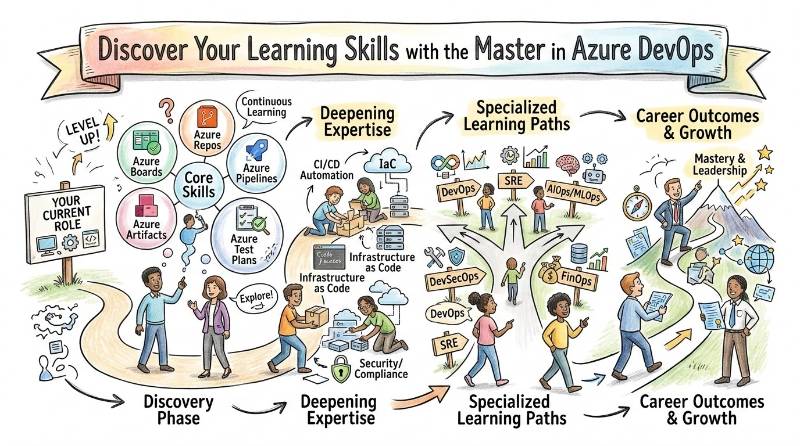
Choose Your Learning Path
1. DevOps Path
This is the foundational path where the focus is placed on the synergy between development and operations. It is best suited for those who wish to master the art of rapid software delivery through automation.
2. DevSecOps Path
In this specialized track, security is treated as a core component of the delivery process rather than an afterthought. It is ideal for professionals who are passionate about building secure and compliant automated systems.
3. Site Reliability Engineering (SRE) Path
The SRE path is designed for those who enjoy solving operational challenges using software engineering principles. Focus is given to scalability, reliability, and the reduction of manual toil in large-scale systems.
4. AIOps / MLOps Path
This modern path is chosen by data scientists and engineers who need to automate the lifecycle of machine learning models. It ensures that AI-driven applications are deployed with the same rigor as traditional software.
5. DataOps Path
The principles of DevOps are applied to data management in this track. It is the best choice for data engineers who want to improve the speed and accuracy of data analytics pipelines.
6. FinOps Path
Financial accountability is brought to the cloud in this path. It is designed for those who need to balance technical performance with budget optimization, ensuring that cloud investments are utilized efficiently.
Role → Recommended Certifications Mapping
- DevOps Engineer: Master in Azure DevOps, CKA (Certified Kubernetes Administrator).
- Site Reliability Engineer (SRE): Master in Azure DevOps, Azure Monitor Specialist.
- Platform Engineer: Master in Azure DevOps, Terraform Associate.
- Cloud Engineer: Azure Administrator, Master in Azure DevOps.
- Security Engineer: DevSecOps Professional, Azure Security Engineer.
- Data Engineer: Azure Data Engineer, Master in Azure DevOps.
- FinOps Practitioner: FinOps Certified, Master in Azure DevOps.
- Engineering Manager: Master in Azure DevOps, PMP.
Next Certifications to Take
- Same-track Recommendation: For those wishing to remain within the Microsoft ecosystem, the Azure Solutions Architect Expert is recommended to gain a broader view of cloud design.
- Cross-track Recommendation: The AWS Certified Solutions Architect is suggested for engineers who wish to operate in multi-cloud environments, as it provides a comparative understanding of cloud services.
- Leadership Recommendation: The Professional Scrum Master (PSM) is advised for those moving into management, as it focuses on team agility and efficient project delivery.
Training & Certification Support Institutions
DevOpsSchool
This institution is regarded as a pioneer in technical training. A hands-on approach is emphasized, where real-world scenarios are simulated to prepare students for the demands of the industry. The focus is maintained on building deep technical expertise.
Cotocus
A high standard of specialized consulting and training is provided by Cotocus. Their programs are designed for professionals who require in-depth knowledge of specific cloud and automation tools, ensuring that learning is both practical and relevant.
ScmGalaxy
This platform is recognized for its vast repository of resources dedicated to configuration management. It is a hub where knowledge is shared among experts, and comprehensive training is offered for those looking to master the intricacies of software delivery.
BestDevOps
The pursuit of excellence in DevOps education is the primary goal of BestDevOps. Their courses are structured to be accessible yet rigorous, providing a clear path for career advancement for engineers at all levels.
Domain Specific Schools:
Targeted training is provided by devsecopsschool.com, sreschool.com, aiopsschool.com, dataopsschool.com, and finopsschool.com. Each of these platforms is dedicated to a specific niche, ensuring that deep expertise is developed in areas like security, reliability, and artificial intelligence.
FAQs Section
General FAQs:
- Is Azure DevOps difficult to learn?
A moderate level of difficulty is associated with it, especially for those without a background in both development and operations. - What is the duration of preparation?
Approximately 8 to 12 weeks of focused effort is usually required for a comprehensive understanding. - Are there mandatory prerequisites?
While not strictly required, a basic understanding of cloud concepts and command-line interfaces is highly beneficial. - How is the certification sequence determined?
The sequence is generally started with fundamental cloud knowledge followed by the Master program. - What is the career impact of this certification?
A significant increase in visibility and professional credibility is often observed after completion. - What job roles are accessible?
Roles such as Cloud Architect, DevOps Specialist, and Automation Lead are made available. - Is salary growth expected?
Yes, a measurable increase in compensation is frequently reported by certified professionals in this field. - How much hands-on practice is needed?
Extensive practice in lab environments is essential for mastering the practical aspects of the platform. - When should renewal be considered?
Certifications are typically updated every two years to keep pace with technological changes. - Is this useful for managers?
Yes, it allows managers to make informed decisions about technology stacks and team workflows. - Is there a global demand for these skills?
High demand is found in almost every major tech market, including India, Europe, and North America. - Can this be learned without a coding background?
Basic scripting knowledge is needed to effectively manage automation pipelines.
Master in Azure DevOps Specific FAQs:
13. What makes this “Master” level?
The curriculum is expanded to cover advanced architectural patterns and complex integration scenarios.
14. Is Azure Repos covered in depth?
Yes, all aspects of version control and branching strategies are included.
15. Are third-party integrations taught?
Integration with tools like SonarQube, Docker, and Kubernetes is a core part of the program.
16. Is the exam proctored?
Yes, a high standard of integrity is maintained through proctored examination environments.
17. How is Azure Boards utilized in the training?
It is used to teach agile project management and task tracking within the DevOps lifecycle.
18. Are cloud costs discussed?
Practices for monitoring and optimizing cloud expenditure are integrated into the curriculum.
19. Can the skills be transferred to other clouds?
Yes, the core principles of DevOps remain the same across different cloud providers.
20. Is post-training support available?
Mentorship and community support are usually provided to help with career transitions.
Testimonials
Vikram, DevOps Engineer
A complete transformation in my understanding of automated delivery was achieved through this program. The complex concepts were explained with remarkable simplicity and depth.
Sangeeta, SRE
The transition into a reliability-focused role was made possible by the structured learning path provided here. My confidence in managing production environments has grown immensely.
David, Cloud Engineer
The focus on real-world application rather than just theory was highly appreciated. Every lab session felt like a real day at work, which prepared me for my current role.
Arjun, Security Engineer
By learning how to embed security into the CI/CD pipeline, I have become a more valuable asset to my organization. The perspective gained here is truly unique.
Meera, Engineering Manager
The strategic view of Azure DevOps provided by this certification has helped me streamline our department’s workflows. Our release cycles are now much more predictable.
Conclusion
The pursuit of a Master in Azure DevOps certification is a strategic investment in one’s professional future. It is a journey that leads to a deep understanding of how technology and process come together to create value. Long-term career benefits are found in the ability to adapt to any cloud environment with confidence. By choosing a structured learning path and a reputable institution, the foundation for a resilient and successful career is laid. The world of automation is vast, and this certification is the key to unlocking its full potential.

