
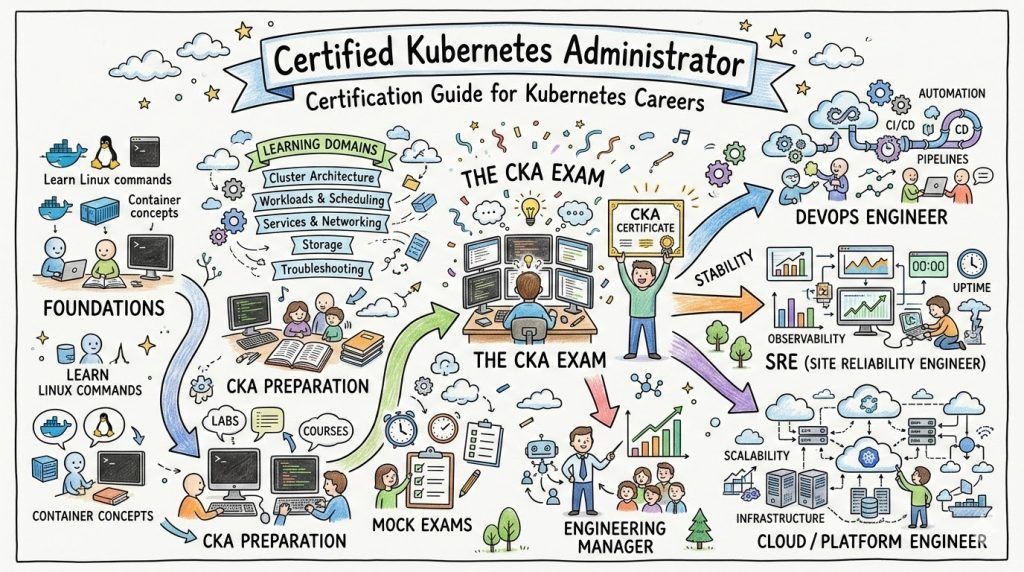
Introduction
The Certified Kubernetes Administrator (CKA) is recognized as a performance-based certification program. It is designed to verify that the skills required to design, build, and manage Kubernetes clusters are possessed by an individual. Unlike traditional exams that rely on multiple-choice questions, the CKA is conducted in a live, command-line environment. A series of real-world problems must be solved within a set timeframe. This ensures that the certification is not merely a test of memory, but a true validation of practical expertise.
Why it Matters in Today’s Software, Cloud, and Automation Ecosystem
In today’s fast-paced environment, applications are expected to be highly available, scalable, and portable. Kubernetes is utilized as the primary tool to achieve these goals. As more organizations migrate to the cloud, the demand for professionals who can maintain these complex systems has surged. The CKA is valued because it proves that a practitioner can navigate the complexities of production-grade environments. It is regarded as a foundational requirement for those involved in automation and cloud-native transformations.
Why Certifications are Important for Engineers and Managers
For an engineer, a certification serves as a structured learning path. It ensures that no gaps are left in their technical knowledge. For a manager, a certified team is seen as a mark of reliability. Decisions are made with more confidence when it is known that the staff is trained according to industry standards. Furthermore, certifications are often used by organizations to demonstrate competence to clients and stakeholders during high-level project bidding.
Certification Overview Table
| Track | Level | Who it’s for | Prerequisites | Skills Covered | Recommended Order |
| Cloud-Native Ops | Professional | Engineers & SREs | Basic Linux & YAML | Setup, Networking, Storage, Security | Taken after KCNA |
Why Choose DevOpsSchool?
A decision to train with DevOpsSchool is often driven by the need for deep, practical immersion. The programs offered are structured around the actual challenges faced in the industry. Extensive lab environments are provided so that students can practice without the fear of breaking production systems. Mentorship is provided by seasoned professionals who have spent decades in the field. This ensures that the learning is not just theoretical but is grounded in real-world scenarios.
Certification Deep-Dive
Certified Kubernetes Administrator (CKA)
What is this certification?
The CKA is an official credential provided by the Linux Foundation and the Cloud Native Computing Foundation (CNCF). It is focused on the administrative aspects of Kubernetes, including installation, networking, and troubleshooting.
Who should take this certification?
- Software Engineers transitioning into platform roles.
- System Administrators modernizing their skill sets.
- Site Reliability Engineers (SREs) managing uptime.
- Engineering Managers who wish to understand the technical constraints of their teams.
Skills you will gain
- Cluster Installation: Mastery over tools like
kubeadmis developed. - API Management: The internal workings of the Kubernetes API are understood.
- Networking Knowledge: Concepts like CNI, Service discovery, and Ingress are mastered.
- Resource Scheduling: The ability to control how and where pods are run is acquired.
- Maintenance Skills: Skills for cluster upgrades and backups are practiced.
Real-world projects you should be able to do
- A multi-node Kubernetes cluster can be deployed from scratch on a cloud provider.
- Application traffic can be managed using complex Ingress rules and TLS certificates.
- Persistent storage solutions can be integrated with containerized workloads.
- Highly available control planes can be configured to prevent single points of failure.
- Security policies can be enforced using Role-Based Access Control (RBAC).
Preparation Plan
7–14 Days Plan (The Intensive Review)
- Days 1–4: A review of core components (etcd, scheduler, controller manager) is conducted.
- Days 5–8: Heavy focus is placed on networking and troubleshooting scenarios.
- Days 9–14: Mock exams are completed daily to build speed and accuracy in the terminal.
30 Days Plan (The Balanced Path)
- Week 1: Basic architecture and manual installation are studied.
- Week 2: Application lifecycle management and storage are explored.
- Week 3: Security, RBAC, and networking policies are practiced.
- Week 4: Troubleshooting and final exam simulations are prioritized.
60 Days Plan (The Mastery Journey)
- Month 1: A slow, deep dive into every Kubernetes object is performed. Real clusters are built and broken intentionally to learn recovery.
- Month 2: Advanced topics like logging, monitoring, and cluster upgrades are mastered. The final two weeks are dedicated to time-pressured labs.
Common mistakes to avoid
- Over-reliance on UI: The exam is strictly CLI-based; manual editing in the terminal must be mastered.
- Ignoring Namespace Context: Errors are often made because commands are run in the wrong namespace.
- Neglecting YAML Syntax: Small indentation errors can lead to significant time loss during the exam.
- Searching Documentation for too long: Familiarity with the official documentation structure is required to find answers quickly.
Best next certification after this
- Same Track: Certified Kubernetes Security Specialist (CKS).
- Cross-Track: Terraform Associate for infrastructure as code.
- Leadership / Management: DevOps Leader (DOL) certification.
Choose Your Learning Path
DevOps Path
This path is chosen by those who aim to bridge the gap between development and operations. A focus is placed on the automation of deployment pipelines. It is best for engineers who want to streamline how code is moved from a local machine to a production cluster.
DevSecOps Path
The security-focused path is ideal for those who believe security is a shared responsibility. Skills related to container scanning, runtime security, and network isolation are prioritized. This is best for professionals working in highly regulated industries.
Site Reliability Engineering (SRE) Path
The SRE path is pursued by those who value system stability and performance. Concepts like error budgets, observability, and automated incident response are studied. It is suitable for those managing large-scale, high-traffic applications.
AIOps / MLOps Path
This specialized path is for those integrating artificial intelligence and machine learning with infrastructure. The deployment of data models on Kubernetes using specialized tools like Kubeflow is mastered. It is best for data-focused engineers.
DataOps Path
The management of data pipelines and databases within containers is the primary focus here. It is designed for engineers who need to ensure that data remains consistent and available across distributed systems.
FinOps Path
Cost management in the cloud is the core of this path. Strategies for resource optimization and budget tracking within Kubernetes are learned. It is ideal for those who need to balance technical performance with financial efficiency.
Role → Recommended Certifications Mapping
| Role | Primary Cert | Secondary Cert |
| DevOps Engineer | CKA | Jenkins / GitOps |
| SRE | CKA | Prometheus / Chaos Eng |
| Platform Engineer | CKA | Terraform |
| Cloud Engineer | CKA | AWS / Azure Architect |
| Security Engineer | CKA | CKS |
| Data Engineer | CKA | Spark / Kafka |
| FinOps Practitioner | CKA | FinOps Certified |
| Engineering Manager | CKA | DevOps Leader |
Next Certifications to Take
For every learner, a strategic progression is advised to maintain a competitive edge.
- For the DevOps Professional:
- Same-track: CKAD (Developer) is often taken next.
- Cross-track: Terraform Associate is recommended.
- Leadership: DevOps Leader (DOL) is the preferred choice.
- For the Infrastructure Specialist:
- Same-track: CKS (Security) is suggested.
- Cross-track: AWS Certified Solutions Architect.
- Leadership: Certified Agile Service Manager.
- For the Data Focused Engineer:
- Same-track: CKA (Advanced storage focus).
- Cross-track: Google Professional Data Engineer.
- Leadership: Digital Transformation Officer (DTO).
Training & Certification Support Institutions
DevOpsSchool
A wide range of hands-on training is provided by DevOpsSchool. Real-world scenarios are used to ensure that students are prepared for the CKA exam. Support is offered through a dedicated community of experts and practitioners.
Cotocus
Enterprise-level training and consulting are delivered by Cotocus. Specialized bootcamps are organized to help large teams transition to cloud-native technologies. Custom learning paths are created to suit specific organizational goals.
ScmGalaxy
A vast library of technical resources and tutorials is maintained by ScmGalaxy. Insights into software configuration management and automation are shared through regular blogs. It is regarded as a key knowledge hub for the DevOps community.
BestDevOps
Focused certification coaching is provided by BestDevOps. Practical exam environments are simulated to help candidates gain confidence before the actual test. Mentorship is offered by professionals with significant industry experience.
devsecopsschool.com
Education regarding the integration of security into the DevOps lifecycle is provided here. Training on vulnerability management and secure coding is delivered. It is a specialized platform for security-conscious engineers.
sreschool.com
The core principles of Site Reliability Engineering are taught at this institution. A focus is placed on monitoring, scalability, and system reliability. It is designed for those managing complex, distributed architectures.
aiopsschool.com
The intersection of AI and operations is explored at this school. Training on how to use machine learning to improve IT operations is offered. It is a forward-looking platform for innovation in infrastructure.
dataopsschool.com
Automated data management and delivery are the main subjects taught here. Skills for managing big data platforms in a containerized environment are developed. It is ideal for data professionals.
finopsschool.com
Strategies for cloud financial management are shared at this institution. A focus is placed on optimizing cloud spend while maintaining technical performance. It is designed for those who bridge the gap between finance and engineering.
FAQs Section
General Career & Certification FAQs
- Is the CKA exam considered difficult?
It is viewed as a challenging exam because it is entirely practical and requires hands-on skill. - How much time should be allocated for study?
Typically, 100 to 150 hours of study and practice are recommended. - Are there any prerequisites for the CKA?
No formal prerequisites are required, though a basic understanding of Linux is very helpful. - In what order should Kubernetes certs be taken?
It is often advised to take KCNA, then CKA, and finally CKS. - What is the value of a CKA in the job market?
It is highly regarded and often leads to increased salary offers and better job opportunities. - Does the CKA expire?
Yes, the certification remains valid for a period of three years. - Is the exam taken online?
Yes, it is a proctored online exam that can be taken from a remote location. - What is the policy for failing the first attempt?
One free retake is usually included with the exam purchase. - Which roles benefit most from CKA?
DevOps Engineers, SREs, and Platform Engineers find it most beneficial. - Is the exam based on multiple-choice questions?
No, it is entirely performance-based using a live terminal. - How long does the exam last??
The time limit for the CKA exam is two hours. - Can documentation be used during the test?
Yes, access to one tab of official Kubernetes documentation is permitted.
CKA Technical FAQs
- Which Kubernetes version is used in the exam?
The version is updated regularly to match a recent stable release. - How many tasks are typically in the exam?
The exam usually consists of 15 to 20 different tasks. - What is the required passing score?
A score of 66% must be achieved to pass the certification. - Is cluster installation part of the test?
Yes, the ability to install a cluster usingkubeadmis tested. - Is networking heavily emphasized?
Yes, configuring services, ingress, and network policies is a major component. - Should JSONPath be learned?
Yes, it is very helpful for filtering output and saving time. - What operating system is used in the terminal?
The exam environment is typically based on a modern Linux distribution. - Can an external notepad be used?
No, but a digital notepad is provided within the exam browser.
Testimonials
Aarav S.
“The CKA certification was achieved after intensive training. The ability to troubleshoot complex cluster issues was greatly improved. This journey has provided immense clarity for my daily tasks as a DevOps engineer.”
Isha P.
“Real-world application was the focus of my learning. The confidence to manage production-grade clusters was built through hands-on labs. My professional value has increased significantly since becoming certified.”
Karthik M.
“A clear path for career growth was found through this program. The skills acquired are used every day to automate infrastructure. It is highly recommended for anyone in the cloud space.”
Meera J.
“Skill improvement was noticeable from the very first week of study. The CKA is not just a certificate; it is a proof of capability. My team now relies on me for critical Kubernetes decisions.”
Siddharth R.
“Confidence growth was the most important outcome for me. Managing large-scale environments no longer feels intimidating. The strategic planning of my learning was the key to success.”
Conclusion
The Certified Kubernetes Administrator (CKA) is established as a cornerstone for modern technical careers. It is not merely an academic exercise but a rigorous validation of the ability to handle the complexities of the cloud-native era. By pursuing this certification, a commitment to professional excellence is demonstrated.
The long-term benefits include career stability and the opportunity to work at the forefront of technology. It is encouraged that a strategic learning plan be adopted to ensure success. Whether the goal is to improve personal skills or to lead a technical team, the CKA provides the foundation required for the journey ahead.

