
Introduction
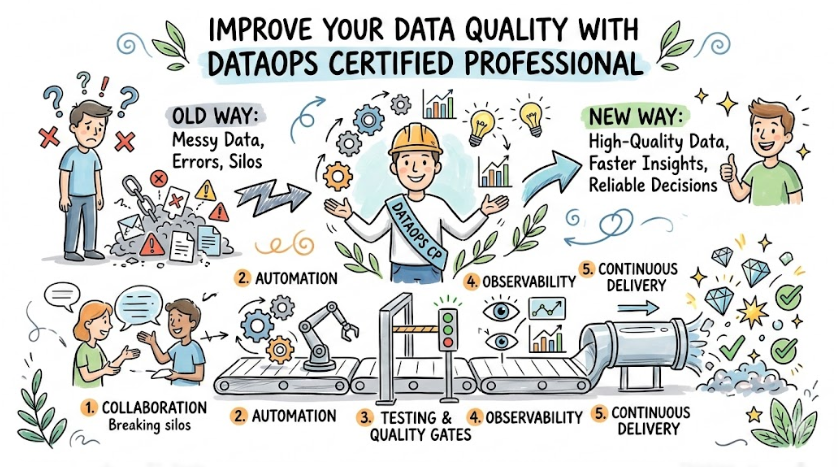
The DataOps Certified Professional is a mastery-level credential that is awarded to those who can bridge the gap between “building” and “maintaining” data systems. It is a discipline where the principles of lean manufacturing are applied to data flows. This certification is intended to prove that a professional can reduce waste, eliminate manual errors, and ensure a continuous flow of high-quality information.
Why it Matters in the Modern Ecosystem
The modern cloud ecosystem is built on the promise of speed. However, this speed is often compromised by “Data Downtime.” DataOps is the methodology used to fix this. By treating data as a product that requires a manufacturing line, the reliability of the entire software stack is improved. It is now seen as the missing piece in the automation puzzle, especially as companies move toward complex multi-cloud environments.
The Power of Certification
The value of an engineer is often judged by the consistency of their output. Certifications are used to ensure that this consistency is backed by a global standard of excellence. For a manager, a certified team represents a lower risk profile. For the individual, it is a shield against career stagnation. In a competitive global market, particularly in India and tech hubs worldwide, these credentials are used as a primary filter for leadership roles.
Certification Overview Table
| Track | Level | Who it’s for | Prerequisites | Skills Covered | Recommended Order |
| Data Operations | Professional | SREs, Devs, Leads | Basic Engineering | Resiliency, Testing, Flow | Immediate Priority |
Official Provider: DevOpsSchool
Why Choose DevOpsSchool?
A solid foundation is required for any professional journey. DevOpsSchool is selected by the world’s leading engineering teams because a “real-world first” approach is taken. The training is not restricted to slides and lectures; instead, it is built around the actual architectural challenges faced by Fortune 500 companies.
A complete ecosystem of support is provided to every student. Mentorship is offered by practitioners who have spent over 20 years in the industry. The curriculum is designed to be evergreen, focusing on principles that will remain relevant even as specific tools change. Furthermore, a lifetime of community access is granted, ensuring that every certified professional stays at the cutting edge of the industry. It is a partnership that extends far beyond the exam day.
Certification Deep-Dive: DataOps Certified Professional
What is this certification?
This program is an intensive study of the data supply chain. It is designed to teach how high-velocity data environments can be built without sacrificing stability or security.
Who should take this certification?
- Site Reliability Engineers (SREs): Those who are responsible for the “always-on” nature of data services.
- Data Engineers: Professionals who want to move away from reactive “firefighting” to proactive system design.
- Engineering Managers: Leaders who need a framework for scaling their data teams efficiently.
- Cloud Engineers: Individuals who manage the infrastructure where data resides and moves.
Skills you will gain
- Automated Observability: The ability to set up systems that “see” a data failure before the user does.
- Data Lifecycle Automation: Techniques for managing data from creation to archival using automated scripts.
- Error Budgeting for Data: A method for balancing the need for new features with the need for system stability.
- Immutable Data Infrastructure: The skill of building data environments that cannot be accidentally changed or corrupted.
- Cross-Functional Orchestration: Strategies for aligning developers, data scientists, and operations under one goal.
Real-world projects you should be able to do
- Zero-Downtime Migration: A project where a massive dataset is moved between clouds without a single second of service interruption.
- Automated Data Audit: A system that automatically checks every record for compliance with privacy laws like GDPR.
- Predictive Pipeline Monitoring: An AI-driven dashboard that predicts when a pipeline is likely to fail based on historical trends.
Preparation Plan
- 7–14 Days Plan: The focus is placed on the core principles of lean and agile as they apply to data. The official “body of knowledge” is reviewed.
- 30 Days Plan: Hands-on labs are prioritized. Simple automation scripts are written for data validation. Case studies of major data failures and their solutions are studied.
- 60 Days Plan: Advanced simulations are performed. Complex multi-stage pipelines are built and tested. Mock exams are taken to refine time management skills for the final test.
Common mistakes to avoid
- Neglecting Documentation: Systems are built that no one else can understand or maintain.
- Over-Reliance on One Tool: Failing to learn the underlying principles that apply across all tools.
- Testing in Production: The dangerous habit of running new data logic on live systems without a sandbox.
Best next certification after this
- Same Track: DataOps Architect.
- Cross-Track: SRE Certified Professional.
- Leadership: Chief Data Officer (CDO) Track.
Choose Your Learning Path
Path 1: DevOps
This path is chosen by those who want to be the “glue” between development and operations. A deep understanding of how data flows through the deployment pipeline is gained.
Path 2: DevSecOps
The “Security First” path. It is designed for those who believe that data is only valuable if it is secure. Automation of encryption and access control is the main focus.
Path 3: Site Reliability Engineering (SRE)
The “Reliability” path. It is for those who focus on the availability and performance of data systems at a massive scale.
Path 4: AIOps / MLOps
The “Intelligence” path. It is focused on how data can be fed into machine learning models automatically and reliably.
Path 5: DataOps
The “Specialist” path. A total mastery of the data lifecycle is achieved, from raw ingestion to final analytics.
Path 6: FinOps
The “Cost-Efficiency” path. It is designed for those who want to ensure that the cloud bill for data remains manageable.
Role → Recommended Certifications Mapping
The following mapping is used to guide professionals toward the most impactful certification combinations.
- DevOps Engineer: DataOps Pro + CI/CD Mastery + Docker/Kubernetes.
- Site Reliability Engineer (SRE): DataOps Pro + Advanced Observability + Chaos Engineering.
- Platform Engineer: DataOps Pro + Infrastructure as Code + Cloud Architecture.
- Cloud Engineer: DataOps Pro + Multi-Cloud Management + FinOps.
- Security Engineer: DataOps Pro + Data Privacy Automation + Threat Modeling.
- Data Engineer: DataOps Pro + Big Data Frameworks + MLOps.
- FinOps Practitioner: DataOps Pro + Cloud Billing & Optimization.
- Engineering Manager: DataOps Pro + Agile Leadership + Strategic Planning.
Next Certifications to Take
To ensure a well-rounded career, these follow-up certifications are recommended.
- One same-track certification: Data Governance and Ethics Professional.
- One cross-track certification: SRE Foundation.
- One leadership-focused certification: Engineering Leadership Excellence.
These choices are based on industry research suggesting that “T-shaped” professionals—those with deep knowledge in one area and broad knowledge in others—are the most successful.
Training & Certification Support Institutions
DevOpsSchool
The primary center for DataOps excellence. A balanced approach of theory and high-level practical labs is provided to every student.
Cotocus
A global leader in professional upskilling. They are known for their high-quality trainers who bring real-world experience into the virtual classroom.
ScmGalaxy
A resource-heavy hub for the modern engineer. A vast collection of technical blogs and community support is offered for free.
BestDevOps
An institution that prides itself on personalized mentorship. Small batches are maintained to ensure every student masters the complex world of DataOps.
devsecopsschool.com
The ultimate destination for security professionals. The focus is placed on how to secure the modern, automated software factory.
sreschool.com
A dedicated platform for reliability engineering. It is where the systems of the future are taught to be resilient.
aiopsschool.com
The intersection of AI and Ops is explored here. It is designed for those who want to automate IT using machine learning.
dataopsschool.com
The definitive source for DataOps training. Deep technical knowledge is shared through structured, project-based learning.
finopsschool.com
The art of cloud financial management is mastered here. It is essential for anyone handling large-scale cloud infrastructures.
FAQs Section
General FAQs
- What is the passing rate?
A high success rate is seen among those who complete the full training program. - Is it a multiple-choice exam?
Yes, it is primarily composed of scenario-based multiple-choice questions. - How do I renew the certification?
Renewal is usually required every two to three years through a simplified process. - Is there a practical component?
Yes, several hands-on projects must be completed during the training. - Can I take the exam in India?
Yes, it is fully accessible to the Indian market online. - What language is the exam in?
The exam is currently offered in English. - Is study material provided?
Yes, comprehensive guides and video lessons are included. - Does it cover specific tools like Airflow?
Yes, major orchestration tools are discussed in the context of the workflow. - Are there mock tests?
Yes, multiple mock tests are provided to simulate the actual exam environment. - Is there career support after the exam?
Yes, a dedicated career portal is available for certified members. - How does this help an Engineering Manager?
It provides a common language and framework for managing the team’s output. - Is the certificate verifiable?
Yes, a digital, verifiable certificate is issued upon completion.
DataOps Specific FAQs
13. Will this help with cloud costs?
Yes, efficient data pipelines are inherently cheaper to run.
14. How does it differ from traditional DBA roles?
It moves from managing databases to managing automated data streams.
15. Is it useful for small startups?
Yes, it helps startups build a solid data foundation that can scale.
16. Is programming required?
A basic understanding of Python or SQL is highly beneficial.
17. How does it impact data quality?
It introduces “Quality at Source” principles to catch errors immediately.
18. Is it compatible with Agile?
Yes, it is essentially Agile applied to data.
19. What is the biggest challenge in DataOps?
Changing the culture from siloed work to collaborative automation.
20. Can it be learned online?
Yes, the entire curriculum is designed for high-quality remote learning.
Testimonials
Nitin S.
A new level of operational stability was achieved after this certification. The principles learned were used to fix a major data bottleneck in our production environment. It was an eye-opening experience.
Kavita B.
The focus on “Data as Code” was exactly what I needed. As an SRE, I can now manage our data pipelines with the same precision as our microservices.
Amit V.
A very simple and direct approach was taken during the training. The mentors were patient and clearly experts in the field. My career has seen a steady upward trend since then.
Ritu P.
The clarity provided on automated testing for data was invaluable. I no longer fear a code change breaking the entire data warehouse. It was a great investment of time.
Sandeep M.
As a manager, the framework for scaling my team was the most useful part. We now have a standardized way of working that has reduced our error rate by 40%.
Conclusion
The DataOps Certified Professional program is the cornerstone of modern operational excellence. By focusing on resilience, automation, and high-quality flow, it prepares professionals for the challenges of the next decade. Long-term career benefits are significant, including a higher degree of job security and the ability to lead high-impact projects. A strategic approach to learning is the only way forward, and this certification is the perfect vehicle for that journey.

