
Introduction
What is DevSecOps Certified Professional Online Training?
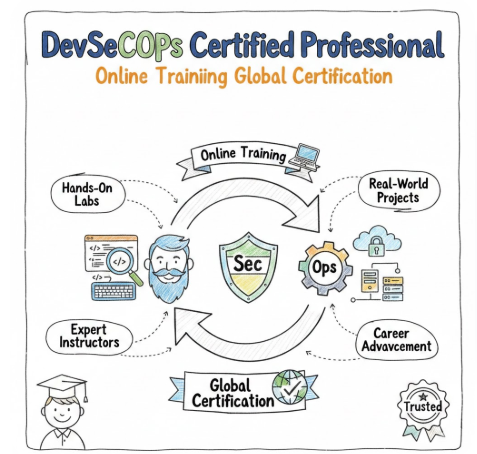
The integration of security practices into the existing DevOps framework is the primary focus of the DevSecOps Certified Professional Online Training. It is a specialized program where the methods for automating security throughout the entire life cycle of software development are taught. Instead of security being treated as a final check, it is woven into the very fabric of the code from the first day. Through this training, a deep understanding of how to balance speed with safety is gained by the students.
Why it Matters in Today’s Software, Cloud, and Automation Ecosystem
As more businesses move their operations to the cloud, the risks associated with digital threats have multiplied. In a fast-paced ecosystem where updates are released daily or even hourly, manual security checks are no longer possible. If security is not automated, the entire delivery pipeline is slowed down, or worse, vulnerabilities are left open for attackers. By following the principles of DevSecOps, a “Security-as-Code” approach is adopted. This ensures that every piece of software is checked for weaknesses automatically before it ever reaches a user.
Why Certifications are Important for Engineers and Managers
A clear benchmark for professional skill is provided by certifications. For an engineer, it serves as a formal recognition of their ability to handle complex security tasks in a modern environment. For a manager, it provides a layer of trust that the team is capable of protecting the organization’s digital assets. Furthermore, a structured learning path is offered by these programs, ensuring that no critical area of knowledge is overlooked during the learning process.
2. Certification Overview Table
| Track | Level | Who it’s for | Prerequisites | Skills Covered | Recommended Order |
| Security Engineering | Professional | DevOps/Security Engineers | Basic IT & Linux knowledge | SAST, DAST, Pipeline Security, Compliance | After DevOps Foundation |
Provider: DevOpsSchool
Why Choose DevOpsSchool?
DevOpsSchool is chosen by thousands of professionals globally because of its deep commitment to practical learning. It is understood by the institution that theory alone is not enough to survive in the industry. Therefore, every lesson is paired with hands-on exercises that mimic real-world challenges. The mentors at DevOpsSchool are individuals who have spent decades in the field, ensuring that the knowledge shared is both relevant and timeless. A very simple and supportive environment is maintained, where every doubt is addressed with patience. Furthermore, the curriculum is updated constantly to reflect the latest changes in the global technology market.
3. Certification Deep-Dive
DevSecOps Certified Professional (DSOCP)
This certification is designed to transform a standard DevOps practitioner into a security-aware professional. The core philosophy of “shifting left”—which means moving security checks to the earliest possible stage—is mastered here.
What is this certification?
A professional credential that validates a person’s ability to automate security within a continuous integration and continuous delivery (CI/CD) pipeline is what this certification represents. It is a bridge between the worlds of software development and cyber security.
Who should take this certification?
- Software developers who wish to write more secure code.
- Operations engineers who are responsible for managing cloud infrastructure.
- Security professionals who want to learn how to use automation to scale their efforts.
- Quality assurance engineers who want to include security testing in their automated suites.
Skills you will gain
- Static Application Security Testing (SAST): The ability to use tools that read through source code to find vulnerabilities without running the program is gained.
- Dynamic Application Security Testing (DAST): It is learned how to test a running application for weaknesses that only appear during execution.
- Software Composition Analysis (SCA): Knowledge is acquired on how to scan third-party libraries and open-source components for known risks.
- Container and Orchestration Security: The methods for hardening Docker images and securing Kubernetes clusters are mastered.
- Compliance as Code: It is understood how to turn legal and policy requirements into automated scripts that check for violations.
Real-world projects you should be able to do
- A complete CI/CD pipeline is built where security scans are triggered automatically with every code commit.
- A centralized dashboard is created where all security vulnerabilities from different tools are collected and visualized.
- An automated system for managing digital secrets, such as API keys and passwords, is implemented to prevent data leaks.
- A security audit of a cloud environment is performed using automated compliance tools.
Preparation Plan
- 7–14 Days Plan: The initial two weeks are spent on understanding the basic definitions and the cultural shift required for DevSecOps. The official course documentation is read, and the primary tools are installed in a local environment.
- 30 Days Plan: A deeper focus is placed on individual tools. Each week is dedicated to a specific area, such as SAST or Container Security. Small, individual labs are completed to build confidence.
- 60 Days Plan: All the learned components are joined into a single, cohesive project. Mock exams are taken to identify any weak areas, and time is spent refining the automation scripts to ensure they run without errors.
Common mistakes to avoid
- Ignoring the Basics: It is often seen that learners jump into complex tools without understanding basic networking or Linux commands.
- Over-Automation: The mistake of trying to automate everything at once is frequently made, leading to broken pipelines and frustration.
- Neglecting Culture: It is forgotten that DevSecOps is as much about people talking to each other as it is about software tools.
Best next certification after this
- Same track: DevSecOps Expert or Architect Level.
- Cross-track: Site Reliability Engineering (SRE) Professional.
- Leadership / management: IT Strategy and Governance Certification.
4. Choose Your Learning Path
- DevOps Path: This is best suited for those who are focused on the movement of code from a developer’s desk to the production server. The goal is to maximize speed and efficiency.
- DevSecOps Path: This is the ideal choice for individuals who believe that a fast release is worthless if it is not secure. It is focused on the “Security-as-Code” mindset.
- Site Reliability Engineering (SRE) Path: This path is followed by those who care about the stability and performance of systems. It is for the engineer who wants to ensure that a website never goes down.
- AIOps / MLOps Path: This is intended for those who wish to use the power of artificial intelligence to manage large-scale IT operations and machine learning models.
- DataOps Path: This is best for professionals who work with massive amounts of data and want to ensure that data pipelines are reliable and secure.
- FinOps Path: This is a newer path for those who want to manage the costs of cloud computing, ensuring that no money is wasted while maintaining performance.
5. Role → Recommended Certifications Mapping
- DevOps Engineer: DevSecOps Professional, Kubernetes Administration, and Terraform Specialist.
- Site Reliability Engineer (SRE): SRE Professional, Observability Specialist, and Incident Management.
- Platform Engineer: Infrastructure as Code training and Cloud Architecture certifications.
- Cloud Engineer: Platform-specific training (such as for AWS or Azure) and Cloud Security.
- Security Engineer: DevSecOps Professional, Penetration Testing, and Cloud Security.
- Data Engineer: DataOps Professional and Big Data Analytics training.
- FinOps Practitioner: FinOps Certified Professional and Cloud Cost Management.
- Engineering Manager: Leadership in Technology and Strategic DevOps Management.
6. Next Certifications to Take
For every learner, a strategic path for the future is suggested:
- Same-track: Advanced Security Architect training is recommended to deepen technical expertise.
- Cross-track: A course in Site Reliability Engineering is advised to understand how security impacts the overall health of a system.
- Leadership-focused: Technical Product Management is suggested for those who wish to lead teams and make business-level decisions.
7. Training & Certification Support Institutions
DevOpsSchool
A prominent name in the field of technical training, DevOpsSchool is known for its extensive library of resources and experienced mentors. A focus is placed on ensuring that every student is ready for the job market. The training provided is comprehensive, covering every small detail of the DevSecOps lifecycle.
Cotocus
Specialized consulting and training services are offered by Cotocus. They are frequently chosen by large organizations for corporate upskilling programs. Their approach is very practical and is designed to solve the real problems faced by businesses during digital transformation.
ScmGalaxy
This institution serves as a massive knowledge hub for the community. A wealth of blogs, videos, and tutorials is provided to help engineers stay updated. It is a place where the latest trends in software configuration management are discussed in depth.
BestDevOps
As the name suggests, the goal of this institution is to provide the highest quality of DevOps education. A very simple and easy-to-understand curriculum is maintained, making it a favorite for those who are just starting their journey in this field.
devsecopsschool.com
This is a dedicated portal for everything related to security in the DevOps world. Specialized courses that focus only on security automation are hosted here, making it a very focused place for learning.
sreschool.com
The art of keeping systems running is taught at SRE School. The lessons are focused on reliability, performance, and the handling of large-scale system failures.
aiopsschool.com
The future of operations is explored at AIOps School. Students are taught how to use machine learning and AI to automate the detection and fixing of IT problems.
dataopsschool.com
The management of data flows is the primary subject here. It is learned how to ensure that data is high-quality, secure, and delivered quickly to those who need it.
finopsschool.com
Financial accountability in the cloud is the focus of this institution. It is taught how to track and optimize the money spent on cloud services like AWS and Azure.
8. FAQs Section
General Career FAQs
- Is the difficulty level of these certifications high?
It is considered moderate, but with consistent practice and study, it is mastered by most students. - What is the minimum time required for completion?
Usually, 6 to 8 weeks of dedicated study is needed to be fully prepared. - Are there any specific prerequisites?
A basic understanding of the software development process and simple command-line usage is recommended. - What is the best sequence for these certifications?
Starting with a general DevOps course before specializing in DevSecOps is suggested. - How is the career value of these programs measured?
It is seen in the increased number of job interviews and the higher salary packages offered to certified individuals. - Which job roles are available after this training?
Roles such as DevSecOps Engineer, Cloud Security Architect, and Automation Lead are common. - Is there a growth path in India?
Yes, India remains one of the largest markets for these skills, with a constant demand for security professionals. - Will this help in moving to a management role?
Yes, a manager who understands security automation is much more effective in a modern tech company. - How is the exam conducted?
The exams are usually proctored online, allowing them to be taken from any location. - Is the certification valid for a lifetime?
No, it is usually valid for two to three years, after which a renewal is encouraged. - Are hands-on labs provided?
Yes, a safe lab environment is provided where students can practice without fear of breaking things. - What kind of support is given after the course?
Community access and lifetime updates to the course material are often provided.
DevSecOps Certified Professional Specific FAQs
- Is programming a requirement?
Expert coding is not needed, but being able to read and write basic scripts is very helpful. - How much time is needed for the DSOCP exam?
The exam is usually designed to be completed within 120 minutes. - What is the passing score?
Typically, a score of 70% or higher is required to be successful. - Can I retake the exam if I fail?
Yes, most providers allow for a second attempt after a short waiting period. - Is cloud security included in this training?
Yes, the principles of securing major cloud platforms are covered in detail. - What tools will be taught?
Popular tools like SonarQube, Vault, and various container scanning tools are included. - Does this training help in getting a remote job?
Yes, security automation is a skill that is highly valued by remote companies worldwide. - Is this certification recognized by large tech companies?
Yes, it is respected across the industry as a sign of technical competence.
9. Testimonials
“A huge amount of clarity was gained regarding how security fits into our daily work. The training was simple yet very deep in its content.”
— Arjun
“The practical labs were the highlight of the course for me. I was able to build my first secure pipeline within the first month of the training.”
— Sneha
“As a manager, this training helped me understand how to better guide my team. The complex ideas were explained in a very human way.”
— Vikram
“I now feel much more confident when applying for high-level DevOps roles. The security knowledge I gained has set me apart from other candidates.”
— Deepika
“The support from the mentors was outstanding. Every time I was stuck on a technical issue, a simple and clear explanation was provided.”
— Rahul
Conclusion
The DevSecOps Certified Professional Online Training is more than just a course; it is an investment in a long-term career. As the world becomes more digital, the need for individuals who can build safe and reliable software will only grow. By choosing a strategic path and learning from trusted institutions, a professional is prepared for the challenges of the future. It is encouraged that a plan for learning be started today to ensure a secure and successful tomorrow.

