
Introduction
Building a machine learning model on a computer is very different from running it for real users. A data scientist might write a great script that predicts housing prices or detects spam in a research notebook. But what happens when thousands of users send data at the same time? What happens if the data changes next month, and the model starts making bad predictions?
These are real-world problems. Solving them requires MLOps.
Many beginners try to learn MLOps by picking up complex tools right away. They get confused by the long lists of software, cloud services, and automation frameworks. This article explains how to learn MLOps from scratch in a clear, practical way. You will learn the core concepts, common mistakes to avoid, and a step-by-step path to build real expertise.
What Is MLOps?
MLOps stands for Machine Learning Operations. It is a set of practices that helps teams build, test, deploy, and manage machine learning models in production safely and quickly.
To understand MLOps, think of a traditional software application. When software developers write code, they use automated tests and deployment pipelines to send updates to users safely. MLOps does the same thing, but for machine learning.
However, machine learning is harder than standard software. Standard software only depends on code. Machine learning depends on code, data, and models. If your data changes, your model breaks, even if your code remains perfect. MLOps bridges the gap between data science and IT operations so that machine learning systems stay reliable, fast, and accurate over time.
Why MLOps Matters
Without MLOps, machine learning projects usually fail after leaving the research phase.
In a traditional setup, a data scientist hands over a model file to an engineering team via email or a shared folder. The engineers struggle to run it because their environment is different from the data scientist’s laptop. This is known as the “it works on my machine” problem. Once deployed, no one tracks if the model’s accuracy drops over time.
MLOps solves these issues by creating a repeatable system. It matters because it brings:
- Speed: Models move from experimentation to production in days instead of months.
- Reliability: Automated tests catch bugs and bad data before they reach users.
- Traceability: You always know which code, data, and parameters created a specific model.
- Cost Control: Efficient resource management stops cloud servers from wasting money.
Important Factors to Understand Before You Start
Before diving into tools like Kubernetes or Kubeflow, you need to understand the core pillars that make up the MLOps ecosystem.
Version Control for Code and Data
In software engineering, Git handles code. In MLOps, you need to track both code and data. If a model’s performance drops, you must be able to go back to the exact dataset and code version that produced it.
Reproducibility
Can you run your training script today and get the exact same model you got last week? If random seeds change, or if your library versions differ, your results will change. Reproducibility ensures consistency.
Continuous Integration and Continuous Delivery (CI/CD)
CI/CD automates testing and deployment. In MLOps, this means automatically testing your data quality, testing your model code, and deploying the winning model to a server without manual human intervention.
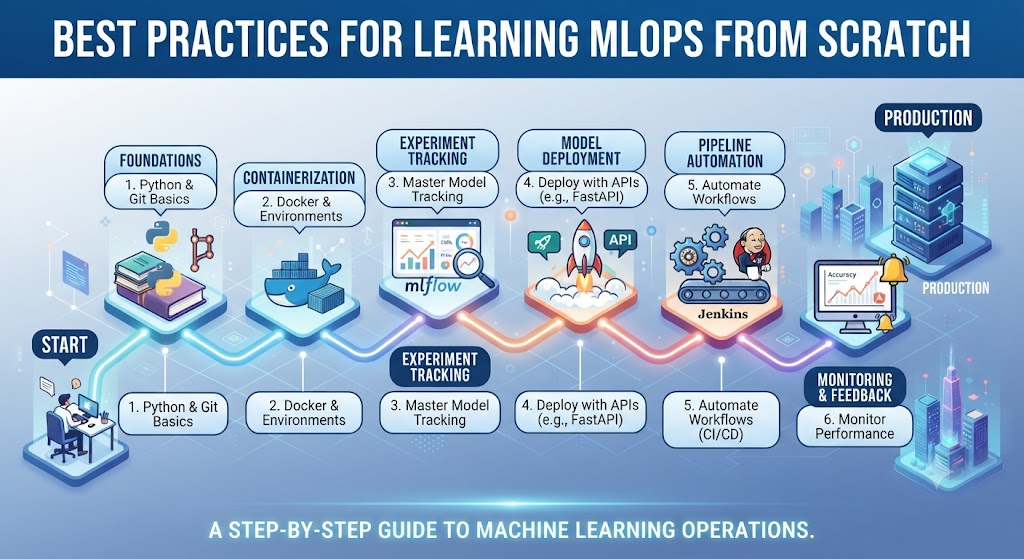
Step-by-Step Path to Learning MLOps from Scratch
Learning MLOps requires a structured approach. Trying to learn everything at once leads to burnout. Follow this progressive path:
Step 1: Build Strong Foundations in Python and Git
You cannot build production systems without knowing how to write clean code and manage versions.
- What to learn: Python scripting, virtual environments, dependency management (using tools like Poetry or Pipenv), and Git branching and merging.
- Why it matters: Production code must be modular, readable, and easy for other engineers to maintain.
Step 2: Learn Basic Data Engineering and Containers
Machine learning models need data, and they need to run inside predictable environments.
- What to learn: Basic SQL, data cleaning, and Docker.
- What is Docker? Docker packs your application and all its dependencies into a single container so it runs the same way on your laptop and on a cloud server.
- Example: You pack your Python prediction script and its exact library versions into a Docker container so your teammate can run it instantly.
Step 3: Master Experiment Tracking
Data science involves trying many different model parameters to see what works best. Doing this manually on paper or in spreadsheets fails quickly.
- What to learn: Experiment tracking tools like MLflow or Weights & Biases.
- Why it matters: These tools record your model’s parameters, metrics, and output files automatically, helping you find the best model easily.
Step 4: Learn Model Deployment Basics
Once you have a trained model, you need to let other applications talk to it.
- What to learn: How to wrap a model in a web framework (like FastAPI) and expose it as an API (Application Programming Interface).
- Example: A mobile app sends customer details to your API, and your model replies with a fraud score in milliseconds.
Step 5: Explore Orchestration and Automation
As your pipeline grows, you need to run steps in a specific order: extract data, clean data, train model, evaluate model, deploy model.
- What to learn: Workflow orchestration tools like Apache Airflow, Prefect, or ZenML.
Real-World Practical Considerations
When you move past tutorials and build real systems, you will face operational realities that textbooks rarely mention.
- Data Drift: The world changes, and user behavior changes with it. A clothing recommendation model trained in summer will perform poorly in winter. You must monitor your data streams to catch when predictions start drifting off target.
- Latency Constraints: An offline model can take ten minutes to run. A production model serving customer checkouts must respond in under 200 milliseconds. Architecture choices matter.
- Technical Debt: Quick hacks during initial deployment pile up. Writing clean code and automated tests from day one saves weeks of debugging later.
Common Mistakes Beginners Make
Learning MLOps is challenging, and beginners often fall into predictable traps.
- Mistake: Learning too many tools at once.
- Why they do it: The MLOps ecosystem has hundreds of trendy open-source tools.
- Why it causes problems: You end up knowing a little bit about fifty tools without understanding how to build a complete pipeline.
- What to do instead: Pick one tool for each category (e.g., Docker for packaging, MLflow for tracking) and build end-to-end projects with them before exploring alternatives.
- Mistake: Treating data like a static file.
- Why they do it: Academic datasets never change.
- Why it causes problems: Real-world data streams are messy, incomplete, and arrive late. Building pipelines without data validation leads to silent model failures.
- Mistake: Deploying models without monitoring.
- Why they do it: Deploying the model feels like the finish line.
- Why it causes problems: Models degrade silently over time as user habits shift. Without monitoring, you won’t know your model is failing until users complain.
Risks and Limitations
Every engineering choice carries trade-offs. Understanding them helps you make better design decisions.
| Approach | Advantages | Risks and Limitations |
| Simple Custom Scripts | Easy to set up, requires no special infrastructure knowledge. | Hard to scale, lacks automation, prone to human error during updates. |
| Full MLOps Platform (Managed Cloud) | High automation, great scalability, strong monitoring out of the box. | High cost, vendor lock-in, steep learning curve for small teams. |
| Open-Source MLOps Stack | Full control, no licensing costs, highly customizable. | Requires significant maintenance effort and internal engineering expertise. |
Decision-Making Framework for Beginners
When starting your first MLOps project, use this simple framework to decide what to build:
- Define the Scope: Start with a simple model (like linear regression or a basic decision tree) rather than a massive Deep Learning network.
- Automate One Step First: Do not build a fully automated pipeline on day one. First, automate model tracking. Once that works, automate testing. Then automate deployment.
- Choose Simpler Infrastructure: Run your containers locally or on a single virtual machine before moving to complex Kubernetes clusters.
- Measure Success: Define what success looks like—such as reducing deployment time or catching bad data automatically.
Key Terms
- API (Application Programming Interface): A software messenger that lets different applications talk to each other, allowing your app to send data to a model and get predictions back.
- CI/CD: Continuous Integration and Continuous Delivery; a practice of automating the testing and building of code updates so they can be released safely.
- Containerization: Packing software code and all its dependencies into a single isolated box (container) so it runs reliably anywhere.
- Data Drift: A change in the input data over time that causes a machine learning model’s accuracy to drop.
- Model Registry: A centralized storage system for managing model versions, metadata, and deployment stages.
- Orchestration: Scheduling, coordinating, and automating complex workflows across multiple steps and servers.
- Pipeline: A series of automated processing steps that take raw data, clean it, train a model, and output predictions.
- Reproducibility: The ability to run an experiment again and get the exact same results.
FAQs
Do I need to be an expert data scientist before learning MLOps?
No. You need a basic understanding of how machine learning models are trained and evaluated, but you do not need to be a research scientist. MLOps focuses much more on software engineering, data pipelines, and system reliability.
Which programming language should I learn for MLOps?
Python is the undisputed standard for MLOps and machine learning. Knowing basic Bash scripting for command-line operations is also very helpful.
Do I need to learn Kubernetes immediately?
No. Kubernetes is powerful for managing large-scale containers, but it is extremely complex for beginners. Start by running your containers using Docker on a single machine before touching Kubernetes.
How long does it take to learn MLOps from scratch?
If you already know basic Python and Git, you can build a solid foundational understanding of MLOps within three to six months by building small, end-to-end projects.
Is MLOps only for large tech companies?
Not at all. Any company running machine learning models in production—whether in finance, healthcare, or retail—benefits from MLOps to prevent models from breaking and to save engineering time.
Conclusion
Learning MLOps from scratch can feel overwhelming because the ecosystem moves fast. The secret to success is ignoring the noise and focusing on fundamentals. Master version control, learn how to containerize your code with Docker, practice tracking your experiments, and always set up monitoring for your deployed models. Build small, working pipelines from end to end, and let your skills grow naturally with every project you complete.

