
Introduction
Building a machine learning model is only half the battle. Many data scientists can train a model on a personal computer with high accuracy. However, moving that model out of a lab environment and into a live application used by thousands of customers is a completely different challenge. Models break, data changes over time, and software systems need constant updates.
This gap between building AI and running AI created a massive demand for professionals who understand MLOps. For professionals, students, and engineers looking to advance their careers, earning an MLOps certification is one of the clearest ways to show employers you have the operational skills needed to make artificial intelligence actually work in production.
What Is MLOps?
Professional Term
MLOps (Machine Learning Operations) is a set of practices that combines Machine Learning, DevOps (Software Development and IT Operations), and Data Engineering.
Simple Meaning
MLOps is the bridge between building AI models and running them reliably in the real world. Think of it as the factory floor and assembly line for artificial intelligence.
Why It Matters
Without MLOps, a machine learning model is just a static file sitting on a developer’s laptop. MLOps ensures the model can accept live data, process it quickly, deliver accurate predictions, and automatically alert engineers if something goes wrong.
Example
Imagine a bank builds a fraud detection model. MLOps is the system that automatically feeds new transaction data into the model every second, checks if the model’s accuracy is dropping, and safely updates the system with a newer version without crashing the bank’s mobile app.
Why AI Careers Get Stuck Without Operational Skills
Many beginners enter the AI field believing that knowing Python algorithms and neural networks is enough to secure a top-tier role. Soon, they hit a career wall.
- The Prototype Trap: Building models that only work in controlled, static Jupyter Notebooks.
- Lack of Production Knowledge: Not knowing how containerization, cloud infrastructure, or CI/CD pipelines function.
- Silent Model Decay: Failing to realize that real-world data changes, causing model accuracy to degrade over time without anyone noticing.
Companies do not just want people who can experiment. They want professionals who understand how to deploy models securely, manage cloud costs, and track performance metrics. MLOps training directly targets these exact gaps.
How MLOps Certifications Accelerate Career Growth
An MLOps certification acts as an official stamp of approval from recognized standards bodies or cloud providers. It signals to hiring managers that you understand the entire lifecycle of an AI application, from data ingestion to monitoring.
1. Proving End-to-End Understanding
Certifications require you to study data versioning, model training automation, deployment strategies, and system monitoring. This proves you are not a narrow specialist who only writes code, but a versatile engineer who understands full-stack AI delivery.
2. Standing Out in a Crowded Job Market
Thousands of candidates enter the job market with basic data science certificates. Earning an advanced operational credential immediately separates your resume from applicants who only know theoretical machine learning.
3. Commanding Higher Salaries
Because MLOps sits at the intersection of data science, software engineering, and cloud infrastructure, professionals with these skills are rare. This scarcity often translates into stronger negotiating power and higher compensation packages.
Core Pillars Covered in MLOps Certifications
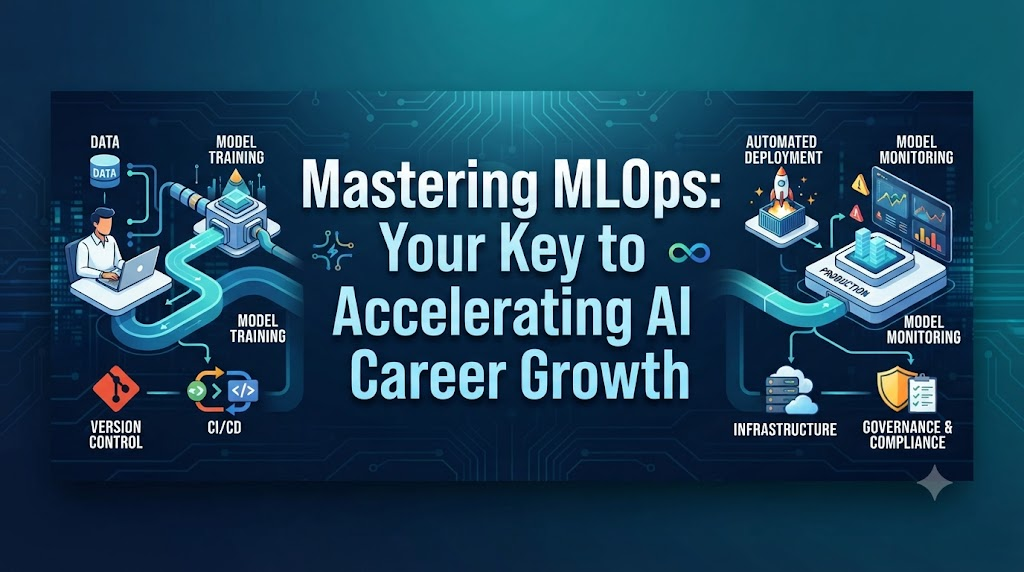
To understand why these credentials carry weight, it helps to look at what they actually teach. A comprehensive certification program typically covers several key technical pillars:
- Data Versioning: Tracking changes in datasets over time so you can reproduce past model training runs accurately.
- CI/CD for Machine Learning: Automating the testing, building, and deployment of machine learning code just like traditional software.
- Model Monitoring and Observability: Watching live models for data drift, concept drift, and performance drops.
- Infrastructure Management: Utilizing cloud services, Kubernetes, and container tools to ensure models scale efficiently under heavy user traffic.
Practical Examples: Certified vs. Non-Certified Career Paths
The Non-Certified Developer
A developer builds an excellent recommendation algorithm for an e-commerce website. However, when deployed, the script lacks proper error handling and logging. When incoming traffic spikes during a holiday sale, the server crashes, and the engineering team has no way to trace why the model failed.
The MLOps-Certified Professional
An engineer with operational training deploys the same recommendation algorithm inside a containerized Kubernetes cluster. They set up automated tests, configure monitoring alerts for data drift, and establish a rollback pipeline. When unusual shopping patterns emerge, the system alerts the team, and a secondary backup model takes over seamlessly.
Common Mistakes When Pursuing MLOps Certifications
- Collecting Badges Without Practice: Passing an exam by memorizing answers without ever building a live pipeline in a cloud environment.
- Ignoring Traditional DevOps: Focusing entirely on machine learning algorithms while ignoring foundational software engineering principles like Git, Docker, and CI/CD basics.
- Chasing Hype Over Fundamentals: Enrolling in expensive, unverified bootcamps instead of recognized, industry-standard vendor or professional certifications.
Risks and Limitations of Certifications
While certifications are valuable, they are not a magic shortcut.
- Theory vs. Reality: An exam cannot fully replicate the messy, undocumented legacy systems you will encounter in real corporate environments.
- Rapid Technology Shifts: Cloud tools and MLOps frameworks evolve quickly. A certification proves you understood the framework at a specific point in time, but continuous learning remains necessary.
- Not a Substitute for Experience: Employers view certifications as proof of foundational knowledge, but they still expect you to demonstrate problem-solving skills during technical interviews.
Decision Framework: Is an MLOps Certification Right for You?
Use this simple framework to decide your next career step:
- Assess Your Current Skillset: Do you already know how to write software and train basic models? If yes, MLOps is the natural next step.
- Define Your Career Goal: Do you want to remain a pure researcher, or do you want to build and maintain production systems?
- Check Job Requirements: Look at job postings for machine learning engineer roles in your target market. Notice how often tools like Docker, Kubernetes, MLflow, or cloud platforms are requested.
- Choose the Right Credential: Select a certification that aligns with the cloud ecosystem (such as AWS, Google Cloud, or Azure) or open-source frameworks most widely used in your industry.
- Build a Portfolio: Combine your certification study with a public GitHub project that showcases a working end-to-end pipeline.
Key Terms
- CI/CD: Continuous Integration and Continuous Deployment; automated practices for publishing code and model updates safely.
- Data Drift: A phenomenon where real-world incoming data changes over time, causing an AI model’s accuracy to drop.
- Model Registry: A centralized storage system for managing the lifecycle, versions, and metadata of trained machine learning models.
- Containerization: Packaging software code and all its dependencies into a single container so it runs reliably on any computing environment.
- Observability: The ability to measure the internal state of a software system by examining its external outputs and logs.
FAQs
Do I need a background in software engineering to learn MLOps?
Yes, having basic programming skills—especially in Python—alongside a foundational understanding of version control and command-line tools makes learning MLOps much easier.
Are cloud-specific certifications better than vendor-neutral certifications?
It depends on your target employer. Cloud-specific credentials (like AWS or Azure machine learning certifications) prove you can use specific enterprise tools, while open-source certifications prove you understand universal workflows. Many professionals choose to learn both.
How long does it take to prepare for an MLOps certification?
Depending on your prior experience with cloud computing and machine learning, dedicated preparation usually takes anywhere from two to four months of consistent study and hands-on practice.
Will an MLOps certification guarantee me a job?
No certification guarantees employment. However, it significantly strengthens your resume, validates your practical capabilities, and helps you pass initial HR and technical screening filters.
Conclusion
AI career growth is no longer about who can train the most complex model in isolation. The industry now rewards engineers who can safely deliver, monitor, and scale AI systems in production. MLOps certifications provide a structured path to master these operational skills. By combining theoretical study with hands-on pipeline building, you position yourself as a dependable, highly capable professional ready to tackle the real-world challenges of modern artificial intelligence.

