
Introduction
The first time you rent a vehicle in a country you do not know, the hard part is rarely the riding. It is the wondering. Which vehicle should I choose? Which rules apply to me? What happens when I hand the keys back?
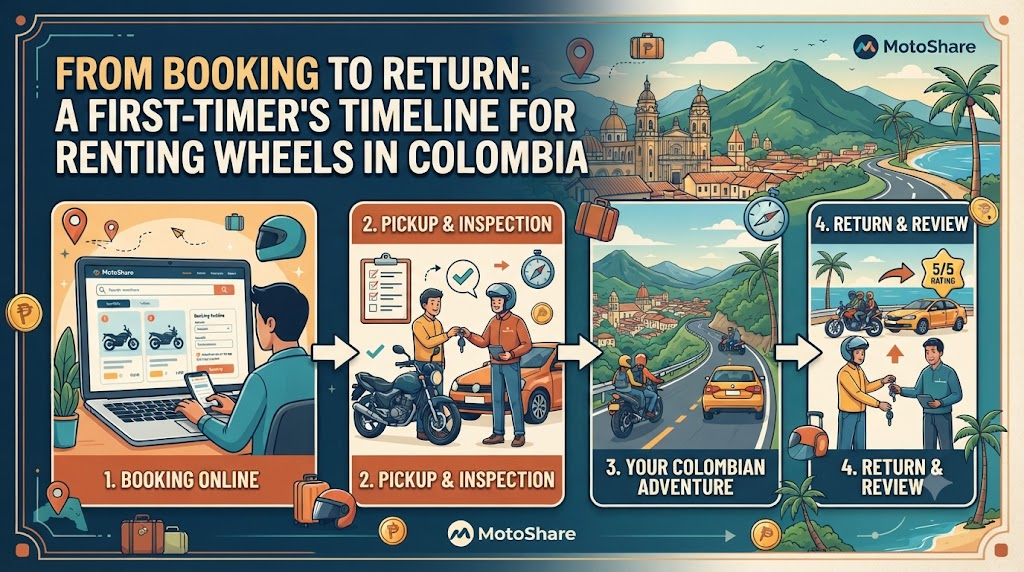
This guide answers those questions in time order, from the first idea to the day you return the vehicle. Each stage has one job and a few questions to settle before you move on. Along the way you will see where MotoShare, an online vehicle-rental marketplace for Colombia, helps you begin.
Where the Journey Starts: Meeting the Marketplace
MotoShare is an online marketplace for vehicle rentals in Colombia. Think of it as a noticeboard where local providers show what they have and travellers browse. It is built for international tourists, local travellers, commuters, backpackers and adventure riders who want flexible transport.
Someone who types motorcycle rental Colombia into a search engine finds scattered results. A marketplace puts them under one roof, organised by place and rental dates, with pricing information alongside the vehicles.
A rental has three beats, and they come in this order:
- Browsing is the search. You see what is listed for your place and dates.
- Weighing is the comparison. You set a few options next to each other and look at vehicle, period, price and terms.
- Committing is the booking. You accept the provider’s terms and confirm.
Keep the beats separate and you will rarely be surprised. Browsing is free of risk, weighing is where you do the thinking and committing is the step you cannot easily undo. Not every vehicle exists in every city, so confirm availability for your own dates.
Stage One: Who Is Going, and What Do They Need?
Start with people, not machines. A tourist who wants viewpoints and villages at an easy pace may enjoy a motorcycle. A commuter who needs wheels for a few weeks of work cares about cost, parking and reliability. A visitor making short city hops may be happy on a scooter. A family counts seats and suitcases before anything else. An experienced rider planning many days of travel may want a bike built for distance. Budget, comfort and local rules shape every one of these choices.
The bike menu
Imagine the bike types as items on a menu:
- Commuter motorcycles are simple and forgiving, the everyday choice.
- Scooters have a step-through frame and, in most cases, an automatic gearbox, which suits short trips.
- Sports bikes are fast and demand a leaning posture, so they are for confident riders on smooth roads.
- Premium motorcycles offer strong engines and extras, often with stricter terms.
- Touring bikes are made for comfort and luggage over long distances.
- Adventure motorcycles are tall, with long suspension for mixed surfaces, and suit experienced riders.
A bigger engine is not a better order for everyone. Heavy bikes are harder to control on wet, steep roads, and your licence has to cover the class you choose.
Scooter or motorcycle? Rules of thumb
- If your trips are short and slow, with light bags, a scooter is usually enough.
- If you ride for hours, climb hills or travel at higher speeds, a motorcycle is steadier and kinder to your body.
- If you carry bags, check for storage under a scooter seat or plan to fit bags to a motorcycle.
- If you are unsure of your skill, choose the lighter and simpler vehicle.
Stage Two: When Four Wheels Fit Better
Typing car rental Colombia into a search bar usually means one of three needs.
People and bags. Families, groups of friends and travellers with big suitcases need seats and space. A car keeps everyone together and everything dry.
Weather and distance. Cold rain in the mountains or heat on the coast is easier in a car, and so is a day of many hours behind the wheel. Comfort cuts tiredness.
Work and schedules. Business trips with several stops in a day need a vehicle that keeps clothes and laptops safe.
Cars come in three sizes of comfort. A hatchback is small and simple, good for one to three people and city parking. A sedan has a separate boot and a smooth highway ride, good for couples and small families. An SUV sits higher and carries more people and gear, which helps on rough or steep roads, though it is thirstier and harder to park.
A visitor based in Medellín can open the listings for car rental Medellin and for bikes side by side, then decide by passengers and weather instead of by habit.
When you compare cars, look at passenger capacity, luggage space, total cost, insurance, deposit, mileage rules and pickup arrangements. Add fuel, tolls on many highways and parking to the price you are weighing.
Stage Three: Studying the City You Will Ride In
A city changes what a good rental looks like. Study yours before you shortlist anything, and remember that a listing does not prove a certain vehicle is free in a certain city on your dates.
If you land in Medellín, expect hills. A search for motorcycle rental Medellin should come with questions about climbing: can the engine carry you, your passenger and your bags up a steep wet street? The city uses pico y placa, a plate-number driving limit. Local news reports in 2026 say it covers motorcycles as well as cars, so ask your provider and check the city’s mobility pages.
If you land in Bogotá, expect changeable weather and heavy traffic at a high altitude. Anyone considering motorcycle rental Bogota should plan layers, a waterproof jacket and gloves, and ask where the vehicle will be parked at night. Bogotá has pico y placa for private cars, so ask whether any limit applies to your vehicle.
If you land in Cartagena, expect heat, strong sun and narrow streets in the old town. For motorcycle rental Cartagena, think about water, sun protection and shaded parking. Short distances mean that a light vehicle may be enough, and travellers who only plan city hops may start with scooter rental Colombia for that reason.
Whichever city you choose, compare the same five items: availability on your dates, the pickup place, the rental period, the total price and the provider’s terms.
Stage Four: Reading the Offer Line by Line
Online discovery lets you compare many vehicles from home, but an offer is only as clear as its details. Terms differ between providers, vehicles, places and rental periods, so read each line below for the listing you are considering.
- Price and period. Work out the total for your dates, not just the daily rate. Ask whether a longer rental lowers the rate.
- Deposit. This is money held until you return the vehicle. Ask how much, how it is held and when it is released.
- Extra charges. Late returns, cleaning, damage and fines can add to the bill.
- Insurance. Ask what is covered, what is excluded and how much of a repair would be yours.
- Distance and fuel. Some rentals cap the kilometres, and most expect the fuel level to match at return.
- Cancellation and refunds. Find the last free moment to cancel and what you receive afterwards.
- Pickup and return. Check the address, opening hours and any fee for returning elsewhere.
If a listing leaves a line blank, ask the provider in writing and keep the reply.
Stage Five: Paperwork and the Colombian Rules
Rules change and they are not identical for every traveller or vehicle. Use these as questions for the official sources, not as legal advice. Check them with the Colombian Ministry of Transport, Migración Colombia and your provider.
- Is my licence accepted, and for how long? Colombian law accepts a valid foreign licence for tourists during their authorised stay. Guides quote different periods, from 90 days to six months, so compare yours with your entry stamp.
- Does it cover this class of vehicle? A car licence does not cover a motorcycle or scooter.
- Is SOAT active? This mandatory accident insurance must be valid on every vehicle. Ask to see proof for your dates.
- What must I carry? Police checks are common, so keep your passport, licence, rental agreement and the vehicle’s registration with you.
- What gear is required? A helmet is required. Current guidance asks riders and passengers to wear a reflective vest or jacket between 6 pm and 6 am and in poor visibility. Authorities say a plate number on helmets or vests is no longer required, but confirm locally.
- Is there an age or payment rule? Some providers set a minimum age, often 21, and some hold the deposit on a credit card.
- Does a city limit apply? Bogotá and Medellín use pico y placa. Rentals follow the same rules as private vehicles, and fines can pass to the renter.
Stage Six: Pickup Day
The handover takes ten minutes and sets the tone for the whole rental. Arrive a little early so you are not hurried.
- Look at the vehicle together. Walk around it with the provider and photograph every scratch, dent and worn tyre.
- Test the basics. Try the brakes, lights, horn and mirrors. On a bike, check the chain and the helmet fit.
- Check the papers. Ask for the rental agreement, the vehicle’s registration and proof that SOAT is active for your dates.
- Note the fuel level. You will probably be asked to match it when you return.
- Confirm the return. Repeat the time, the address and the number to call if something goes wrong.
If anything feels unclear, say so now. Questions are easiest to settle while the provider is standing next to you.
Stage Seven: On the Road, From Morning to Night
Choosing a bike for tougher routes
Travellers who search for adventure motorcycle rental Colombia usually expect mixed roads, so match the bike to the surface, the distance and your own experience. A tall, long-travel bike is a good tool for gravel and long climbs. For a mostly paved route, a lighter bike may be easier on you.
A day’s rhythm
Morning. Check the tyres, brakes, lights, chain, mirrors and oil. Put on a helmet that fits, a jacket, gloves, boots and a rain layer. Load offline maps and fill the tank before leaving town, because petrol stations can be far apart in mountain and rural areas.
Midday. Rest every couple of hours, drink water and look at the sky. Tired riders misjudge bends and distances.
Evening. Aim to arrive before dark. Park somewhere secure and keep the provider’s number and local emergency contacts at hand. Tell someone where you are heading tomorrow.
Drawing up the route
A motorcycle road trip Colombia travellers dream about still needs a plan on paper. Start with the distance and the hours of daylight, then add the forecast, the state of the roads, fuel stops and where you will sleep. Leave gaps for sights and for slow stretches, because mountain roads eat time. The roads feel very different from place to place: bends, fog and trucks in the mountains, crowds and parking limits in cities, potholes, gravel and animals in the countryside. No route suits every rider, so ask local people and your provider about current conditions.
Riding with a guide
Some travellers prefer company and local knowledge. When you study motorcycle tours Colombia travellers can join, ask what the price includes (bike, fuel, gear, lodging, a backup vehicle), how big the group is, who the guide is and which safety rules apply. Check the cancellation terms too. Routes and prices change, so confirm everything with the organiser.
Stage Eight: Returning the Vehicle and What Comes After
The rental is not over until the deposit is back and the paperwork is closed.
- Return on time. Late returns are a common source of extra charges.
- Match the fuel level. Refill if the rules ask for it.
- Repeat the walk-around. Photograph the vehicle again with the provider, so both sides agree on its condition.
- Ask when the deposit returns. Keep a note of the date you were promised.
- Keep your records. Hold on to the agreement, receipts and photos for a while. Traffic fines can reach the renter after the rental ends.
Five Checkpoints, and Why Preparation Helps
These checkpoints are general advice for any rental and say nothing about how one booking system works.
- Decide the place, the dates and the kind of vehicle. Everything later depends on this.
- Compare totals. Put two or three listings side by side with their rental periods and full prices.
- Read the terms. Insurance, deposit and cancellation lines decide how much risk you carry.
- Check licence, documents, gear and pickup details. One missing item can end the plan on collection day.
- Review the booking before you confirm. Names, dates, times and addresses are easiest to fix before payment.
A timeline helps because each stage answers one question, so you never try to solve everything at once. Check the weather, match the vehicle to the trip, understand the terms, gather your documents and leave a time buffer. Those small habits remove most of the confusion that spoils trips.
Traps that catch first-timers
- If you pick a bike you cannot handle, a simple street can turn into a hard day. Choose the lighter vehicle.
- If you look only at the daily price, deposits and extras can reverse the ranking. Compare totals.
- If you skip insurance exclusions, a small mishap can cost a lot. Ask what is not covered.
- If pickup and return details stay vague, you may pay a late fee. Confirm both in writing.
- If you start a long ride without a weather check, a short stage can double in time. Read the forecast.
- If you assume a vehicle is free, you may arrive to find it taken. Check your exact dates.
- If you ignore the cancellation policy, a change of plan can cost you the payment. Note the deadline.
A Hypothetical Month: A Visiting Teacher in Medellín
Imagine Priya, a visiting teacher who will spend four weeks in Medellín. She holds both a car licence and a motorcycle licence from home. Her school is a short ride from her flat, and she hopes to see a few towns on weekends.
She weighs a motorcycle against a car. The car is dry and roomy, but she would leave it parked all week and pay for parking near the school. The route to work is short and hilly, with afternoon rain likely. A light motorcycle suits the daily commute, so long as she packs a rain jacket and gloves.
She reads the terms for a monthly rental. The deposit is moderate, the insurance excludes tyre damage, and the distance limit fits her commute but not long weekend trips. She checks that her licence covers motorcycles, asks to see proof of SOAT and learns that pico y placa in Medellín can apply to motorcycles, so she asks which plate days to avoid.
Priya rents the motorcycle for the month and joins organised excursions or takes public transport on weekends. Her decision came from the route, the weather and the terms, not from the size of the engine.
Questions First-Time Renters Ask
Can I book a vehicle on the day I arrive?
Sometimes, but a listing does not guarantee a vehicle is free. Check your exact dates ahead of time.
Do I need an international driving permit? Colombian law accepts a valid foreign licence for tourists, yet some providers or insurers may ask for extra documents. Ask your provider before you travel.
What if the vehicle breaks down?
Call the provider’s number from your agreement. Ask before you rent what support they give and who pays for repairs.
How do I compare a short rental with a monthly one?
Compare the total cost, who handles servicing and repairs, and whether the distance limit fits your routes.
What if a listing is missing information?
Ask the provider in writing and keep the answer. Do not assume a missing line is in your favour.
Who pays a traffic fine?
In Colombia, fines for rental vehicles can pass to the renter. Check your agreement for how this works.
Does a bigger bike suit two riders better?
Not automatically. Choose a bike you can control with the extra weight and the roads ahead.
Conclusion
A rental goes best when you treat it as a journey with stages: choose, study, read, check, collect, ride and return. Each stage has one question, and each answer makes the next one easier.
MotoShare is one place to start exploring motorcycles, scooters and cars from local providers by location and rental dates. Whichever platform you use, confirm the current details with the provider and the official sources before you book.

