
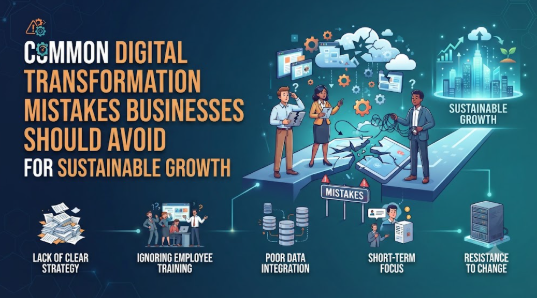
Introduction
Many businesses start digital transformation with excitement, but they often feel confused when software, automation, cloud tools, data systems, and customer platforms become difficult to manage together. A small business may buy a new CRM without training the team. A growing company may automate a broken process and create more confusion. A manager may invest in technology without knowing the real business problem. This is why understanding the Common Digital Transformation Mistakes Businesses Should Avoid is important for beginners. Digital transformation is not only about buying tools. It is about improving work, reducing delays, serving customers better, protecting data, and making smarter decisions. Poor understanding can waste money, create employee resistance, weaken customer experience, and increase operational risk. This blog explains the practical mistakes, better approaches, useful frameworks, and safe steps businesses should follow before making major digital decisions.
Understanding Common Digital Transformation Mistakes Businesses Should Avoid
Digital transformation means using digital tools, systems, data, automation, and modern processes to improve how a business works. It may include cloud software, online customer support, digital payments, automation tools, dashboards, CRM systems, ERP platforms, cybersecurity systems, and AI-based workflows.
The phrase Common Digital Transformation Mistakes Businesses Should Avoid means the wrong decisions companies often make when they try to modernize their business. These mistakes usually happen because leaders focus only on technology and forget people, process, training, customer needs, and long-term planning.
A simple example is a company that buys an expensive project management tool but does not train employees. The tool may be powerful, but the team may continue using WhatsApp, email, and spreadsheets because they do not understand the new system. In this case, the issue is not the software. The issue is poor adoption planning.
Why Common Digital Transformation Mistakes Is Important
Digital transformation affects almost every part of business decision-making. It can influence savings, borrowing, investing, customer service, operations, tax records, compliance, and long-term planning. When businesses choose the wrong tools or automate the wrong process, they may lose time, money, and employee trust.
For small business owners, digital mistakes can affect cash flow. Buying too many software subscriptions without understanding usage can quietly increase monthly expenses. For salaried professionals managing business operations, poor digital systems many software subscriptions without understanding usage can quietly increase monthly expenses. For salar can create reporting errors, delays, and stress. For investors and business leaders, weak technology planning can reduce operational efficiency and lower confidence in future growth.
Digital transformation is also connected with borrowing and investing decisions. A business may take a loan to upgrade technology, but if the project is not planned properly, repayment pressure may increase without improving revenue or efficiency. Similarly, business owners may invest in automation without calculating training cost, maintenance cost, integration cost, and cybersecurity risk.
A short practical scenario is a retail business moving online. If it builds an e-commerce website but ignores inventory management, payment security, customer support, and delivery tracking, customers may face delays and wrong orders. The business may think it has transformed digitally, but in reality, it has only created a digital front without a strong backend.
This is why digital transformation requires clear thinking. The better approach is to connect every technology decision with a real business outcome, such as faster service, lower errors, better customer experience, stronger data visibility, or improved compliance.
The Real Problem Readers Face With Digital Transformation Mistakes
The real problem is not that businesses lack technology. The bigger problem is that they often lack clarity. Many beginners hear words like automation, cloud, AI, CRM, ERP, analytics, digital adoption, and cybersecurity, but they do not know which one matters first.
There is also too much confusing advice online. Some content says every business must use AI immediately. Some vendors claim their software can solve all problems. Some social media posts make digital transformation look simple, fast, and low-risk. This can push beginners into emotional decision-making.
Many businesses also suffer from poor planning. They buy tools without comparing options. They ignore terms and conditions. They do not check data privacy rules. They do not calculate the total cost of ownership. They expect quick results without training people or redesigning processes.
Another real issue is weak comparison. A business may compare only software price but ignore support quality, integration options, scalability, data export rules, security features, and user-friendliness. Later, switching becomes difficult.
Unrealistic expectations are also common. Digital transformation does not automatically increase revenue. It works only when the business has a clear strategy, trained people, clean data, strong processes, and consistent review.
The right next step is to slow down before buying technology. Businesses should ask: What problem are we solving? Who will use the system? What process will change? What risks exist? How will success be measured? What support will be needed after implementation?
How Digital Transformation Works Step by Step
Step 1: Identify the Real Business Problem
The first step is to clearly define the business problem before selecting any digital tool. This means understanding whether the issue is slow customer response, manual reporting, poor sales tracking, inventory errors, weak team collaboration, or lack of data visibility. This matters because technology should solve a real problem, not create another layer of confusion. A business can apply this by writing down the top three operational pain points and discussing them with employees and customers. For example, if customer complaints are increasing because support requests are missed, a helpdesk system may be more useful than a general project management tool. The common mistake is buying software because competitors are using it. The better approach is to choose technology based on verified internal needs.
Step 2: Map the Existing Process
Before automation, businesses must understand how the current process works. Process mapping means writing each step from start to finish, including who does what, what documents are used, where delays happen, and where errors appear. This matters because automating a broken process only makes the broken process faster. A business can apply this by mapping order handling, customer support, accounting, approval, or delivery workflows. For example, if invoice approval takes five manual steps, the company should simplify the approval process before choosing automation software. The common mistake is digitizing confusion. The better approach is to clean the process first and then automate only what is necessary.
Step 3: Set Clear Goals and Success Measures
Digital transformation should have measurable goals. This may include reducing response time, improving order accuracy, cutting manual data entry, increasing customer satisfaction, or improving reporting speed. Goals matter because they help teams know whether the project is working. A business can apply this by setting simple metrics before implementation. For example, a service company may aim to reduce customer ticket response time from two days to same-day acknowledgement. The common mistake is saying “we want to become digital” without defining what success means. The better approach is to use clear business outcomes instead of vague technology goals.
Step 4: Choose the Right Technology Carefully
After identifying the problem, mapping the process, and setting goals, the business can compare tools. The right technology should match business size, budget, team skill, security needs, integration requirements, and future growth plans. This matters because the cheapest tool may not be reliable, and the most expensive tool may be too complex. A business can apply this by comparing features, support, data ownership, user limits, customization, and training needs. For example, a small business may need a simple CRM first instead of a full enterprise ERP system. The common mistake is selecting software based only on price or brand name. The better approach is to select based on fit, usability, security, and long-term value.
Step 5: Train People Before Full Rollout
Digital transformation succeeds only when people use the system properly. Training means helping employees understand why the change is happening, how the tool works, and how it improves their daily work. This matters because even good software fails when people are not confident. A business can apply this by running small training sessions, creating simple guides, and appointing internal champions. For example, before launching a new HR system, the company can train managers on attendance, leave approval, and reporting workflows. The common mistake is launching tools without user training. The better approach is to build comfort before expecting adoption.
Step 6: Start Small and Test First
A pilot project helps businesses test technology with a small team or department before full implementation. This matters because it reduces risk and allows problems to be fixed early. A business can apply this by testing a digital tool in one branch, one team, or one process. For example, a logistics company may test digital delivery tracking in one city before applying it nationwide. The common mistake is rolling out a new system across the whole business at once. The better approach is to start small, learn quickly, improve, and then scale.
Step 7: Protect Data and Review Security
Every digital system creates data security responsibility. Businesses must check access control, password policy, backup systems, vendor security, data privacy, and user permissions. This matters because weak security can lead to financial loss, customer trust issues, and legal problems. A business can apply this by giving access only to people who need it, enabling multi-factor authentication, and reviewing vendor terms. For example, customer payment data should not be stored casually in shared spreadsheets. The common mistake is treating cybersecurity as a later issue. The better approach is to build security into the project from day one.
Step 8: Review, Improve, and Keep Updating
Digital transformation is not a one-time project. It needs regular review, feedback, updates, and improvement. This matters because business needs change, employees discover better workflows, and technology keeps evolving. A business can apply this by reviewing tool usage, customer feedback, process performance, and cost every month or quarter. For example, if employees are not using a new dashboard, the business should understand whether the dashboard is too complex or not useful. The common mistake is assuming implementation means success. The better approach is continuous improvement based on real usage and measurable results.
Key Factors That Influence Digital Transformation Success
Leadership Clarity
Leadership clarity means decision-makers understand why digital transformation is needed. It matters because unclear leadership creates scattered projects. Businesses can apply it by defining priorities, budget, accountability, and expected results. The common mistake is delegating everything to the IT team without business direction. The better approach is shared leadership between business, technology, finance, operations, and customer-facing teams.
Customer Experience
Customer experience should guide digital decisions. It matters because technology should make service easier, faster, and more reliable for customers. Businesses can apply it by reviewing complaints, support requests, payment problems, and delivery issues. The common mistake is improving internal systems while ignoring customer pain points. The better approach is to ask how each digital change improves the customer journey.
Process Readiness
Process readiness means the business has clear workflows before automation. It matters because unclear processes lead to unclear digital systems. Businesses can apply it by documenting approvals, responsibilities, inputs, outputs, and exceptions. The common mistake is automating without process review. The better approach is to simplify the process before selecting tools.
Data Quality
Data quality means business information is accurate, complete, updated, and usable. It matters because poor data creates poor decisions. Businesses can apply it by cleaning customer records, product lists, employee data, finance records, and vendor details. The common mistake is moving messy data into a new system. The better approach is data cleanup before migration.
Integration
Integration means different systems can work together. It matters because disconnected tools create duplicate work. Businesses can apply it by checking whether CRM, accounting, inventory, payment, and reporting tools can connect. The common mistake is buying separate tools that cannot share data. The better approach is to design a connected technology ecosystem.
Change Management
Change management means helping people accept and use new ways of working. It matters because employee resistance can stop digital adoption. Businesses can apply it through communication, training, feedback, and phased rollout. The common mistake is forcing change without explanation. The better approach is to involve users early.
Cybersecurity
Cybersecurity protects business data, customer information, payments, systems, and digital assets. It matters because digital growth also increases digital risk. Businesses can apply it through access control, secure passwords, backups, user permissions, and vendor review. The common mistake is ignoring security until something goes wrong. The better approach is security-first planning.
Budget and Total Cost
Digital projects include more than software price. They may include setup, training, customization, integration, migration, support, renewal, and maintenance. This matters because hidden costs can disturb cash flow. Businesses can apply it by calculating total cost before approval. The common mistake is checking only monthly subscription cost. The better approach is full cost planning.
Detailed Breakdown of Common Digital Transformation Mistakes
Mistake 1: Starting With Technology Instead of Strategy
Many businesses begin by asking, “Which software should we buy?” This is the wrong starting point. The better question is, “Which business problem should we solve first?” A digital transformation strategy should connect technology with business goals, customer needs, cost control, employee productivity, and risk management.
When strategy is missing, companies buy tools that look impressive but do not solve daily problems. For example, a company may invest in analytics software while basic sales data is still inaccurate. The better approach is to create a simple digital roadmap that lists problems, priorities, tools, owners, timelines, risks, and success measures.
Mistake 2: Ignoring Employee Adoption
Employees are the people who use new systems every day. If they do not understand the tool, they may avoid it or use it incorrectly. Digital adoption fails when people feel the change is forced, confusing, or unnecessary.
Businesses should explain why the change matters. They should provide training, allow questions, create internal support, and collect feedback. A better approach is to involve employees during tool selection and pilot testing. This helps the team feel included instead of controlled.
Mistake 3: Automating Broken Processes
Automation is useful only when the process is clear. If a business has poor approval steps, duplicate records, unclear responsibilities, and manual confusion, automation will not fix the root problem. It may only make mistakes happen faster.
Before automation, businesses should review the process. They should remove unnecessary steps, define roles, standardize formats, and improve accountability. The better approach is process improvement first, automation second.
Mistake 4: Underestimating Data Problems
Data is the foundation of digital transformation. If customer names, product codes, pricing details, inventory records, and financial entries are incorrect, digital systems will produce unreliable results.
Many businesses move old data into new tools without cleaning it. This creates reporting errors, customer service issues, and decision-making problems. The better approach is to clean, validate, categorize, and standardize data before migration.
Mistake 5: Treating Digital Transformation as an IT Project Only
Digital transformation affects sales, marketing, finance, HR, operations, customer service, compliance, and leadership. If it is treated only as an IT project, business teams may not take ownership.
A better approach is cross-functional planning. IT can support technology, but business teams must define needs, processes, workflows, customer expectations, and success goals.
Mistake 6: Ignoring Cybersecurity and Privacy
When businesses become more digital, they collect and store more information. This may include customer data, employee records, payment details, contracts, invoices, and business reports. Without proper security, this data can be misused or lost.
Businesses should check access rights, password rules, backup plans, vendor security, and data privacy responsibilities. The better approach is to include cybersecurity from the planning stage, not after implementation.
Mistake 7: Poor Vendor Selection
Choosing a vendor only because of price, popularity, or sales presentation can be risky. A tool may look good in a demo but may not fit daily business needs.
Businesses should compare usability, support, integration, data export options, contract terms, renewal costs, security, and scalability. The better approach is to test the tool with real workflows before signing a long-term agreement.
Mistake 8: No Measurement After Implementation
Some businesses celebrate after launching a new system, but they do not check whether it is actually working. Without measurement, they cannot know if the tool is saving time, reducing errors, or improving customer experience.
Businesses should track adoption, usage, cost, employee feedback, customer feedback, error reduction, and process improvement. The better approach is regular review and improvement.
Common Mistakes Beginners Make With Digital Transformation
Beginners often follow random advice because digital transformation sounds complex. They may believe that buying advanced software will automatically solve business problems. This happens because technology marketing often focuses on features, not practical business readiness. The risk is that businesses spend money on tools they cannot use properly. The better approach is to understand the problem first.
Another common mistake is ignoring risk. Businesses may move data online without reviewing security, backup, and access permissions. This can lead to data loss, privacy issues, fraud, or operational disruption. The better approach is to include risk review before implementation.
Not comparing options is also risky. A business may choose the first tool recommended by a friend or vendor. What works for one company may not work for another. The better approach is to compare features, support, cost, integration, and user experience.
Some businesses trust fake promises. They may believe claims like “fully automated growth” or “instant digital success.” Digital transformation does not work that way. It requires planning, training, review, and discipline.
Emotional decisions also create problems. Leaders may feel pressure to adopt AI, cloud, or automation because competitors are doing it. Panic and fear of missing out can lead to poor investments. The better approach is calm, evidence-based decision-making.
Businesses should also avoid using emergency funds or borrowed money for unclear digital experiments. If the digital project has no defined business outcome, it may create financial stress.
Sharing sensitive business or customer information with unverified platforms is another serious mistake. Companies should check vendor credibility, privacy terms, access rules, and data ownership before using any system.
Don’t Do This Checklist
- Do not buy software without defining the business problem.
- Do not automate a process that is already unclear.
- Do not ignore employee training.
- Do not move messy data into a new system without cleanup.
- Do not depend only on social media advice.
- Do not trust unrealistic digital success claims.
- Do not ignore cybersecurity and privacy.
- Do not sign contracts without reading terms.
- Do not give system access to everyone without roles.
- Do not use borrowed money without a clear repayment and value plan.
- Do not expect instant results.
- Do not stop reviewing after implementation.
Practical Real-Life Examples of Digital Transformation Mistakes
Example 1: Salaried Manager Handling Manual Reports
A salaried operations manager spends every Friday preparing reports from different spreadsheets. The company buys a dashboard tool but does not clean the data source. The reports still show wrong numbers. The better action is to standardize data entry before dashboard implementation. The learning is that reporting tools need reliable data.
Example 2: Small Business Owner Buying Too Many Tools
A small business owner subscribes to CRM, accounting software, email automation, chat support, and inventory tools at the same time. The team feels confused and uses none of them properly. The better action is to implement one tool at a time. The learning is that digital adoption should be phased, not rushed.
Example 3: Retail Company Launching Online Sales
A retail company starts online ordering but does not connect inventory with the website. Customers place orders for products that are out of stock. The better action is to integrate inventory before promoting online sales. The learning is that customer-facing digital systems need strong backend support.
Example 4: Finance Team Moving to Cloud Storage
A finance team uploads invoices and salary files to shared cloud folders without access control. Too many employees can view sensitive files. The better action is to create role-based access and secure folder policies. The learning is that digital convenience must not ignore privacy.
Example 5: Service Business Automating Customer Support
A service company adds a chatbot but does not train it with useful answers or provide human escalation. Customers become frustrated. The better action is to combine automation with human support for complex cases. The learning is that automation should improve customer service, not block it.
Table 1: Beginner Mistake vs Better Digital Transformation Approach
| Beginner Mistake | Why It Creates Problems | Better Approach |
|---|---|---|
| Buying tools without strategy | Money is spent without solving real issues | Define business problems and goals first |
| Automating unclear processes | Errors become faster and harder to trace | Improve the process before automation |
| Ignoring employee training | Teams avoid or misuse the system | Train users before full rollout |
| Moving poor data into new tools | Reports and decisions become unreliable | Clean and validate data before migration |
| Ignoring cybersecurity | Business and customer data may be exposed | Build security checks into the plan |
| Choosing vendors too quickly | Tool may not fit long-term needs | Compare support, integration, cost, and terms |
| Expecting instant results | Creates frustration and poor decisions | Review progress through practical milestones |
Table 2: Digital Transformation Area and Practical Checks
| Transformation Area | What to Check First | Practical Benefit |
|---|---|---|
| Customer service | Response time, complaint tracking, escalation | Better customer experience |
| Sales process | Lead tracking, follow-up system, CRM usage | Stronger sales visibility |
| Finance operations | Invoice records, approvals, payment tracking | Better financial control |
| HR processes | Attendance, leave, payroll, employee records | Reduced manual errors |
| Inventory management | Stock accuracy, reorder process, product codes | Fewer stock-related issues |
| Data reporting | Data source, format, ownership, update frequency | More reliable decisions |
| Cybersecurity | Access rights, backups, passwords, vendor security | Lower digital risk |
Tools, Methods, and Frameworks Readers Can Use
Digital Transformation Roadmap
A digital transformation roadmap is a simple plan that shows what the business will improve, which tools will be used, who will be responsible, and how progress will be checked. It helps beginners avoid random technology decisions. Businesses can use it by listing current problems, priority areas, timelines, budgets, and expected results. It helps avoid the mistake of starting many disconnected projects at once.
Process Mapping
Process mapping means writing down each step of a business activity. It helps identify delays, duplicate work, approval gaps, and manual errors. Beginners can use simple flowcharts or written steps for sales, support, billing, inventory, or HR processes. It helps avoid automating broken workflows.
Digital Readiness Checklist
A digital readiness checklist helps businesses check whether they are prepared for digital change. It may include employee skill, data quality, internet reliability, system compatibility, leadership support, and budget planning. Beginners can use it before selecting tools. It helps avoid rushed implementation.
Cost and Value Review
This method compares the total cost of a digital tool with the practical value it may create. The cost may include subscription, setup, training, customization, integration, renewal, and support. Beginners can use this method before buying software. It helps avoid hidden cost surprises.
Data Cleanup Method
Data cleanup means removing duplicates, correcting errors, standardizing formats, and updating incomplete records. It helps businesses get reliable reports and smoother migration. Beginners can start with customer records, product lists, finance entries, and employee details. It helps avoid poor decision-making based on wrong data.
Pilot Testing
Pilot testing means using a digital tool with a small group before full rollout. It helps identify problems early. Beginners can test one department, one branch, or one process. It helps avoid large-scale failure.
Change Management Plan
A change management plan explains how employees will be informed, trained, supported, and encouraged during digital transformation. It helps reduce resistance. Beginners can use short training sessions, FAQs, feedback forms, and internal support groups. It helps avoid low adoption.
Cybersecurity Checklist
A cybersecurity checklist helps businesses protect data, users, and systems. It may include strong passwords, multi-factor authentication, backup, access control, secure vendors, and data recovery plans. Beginners can use it before moving operations online. It helps avoid privacy and security mistakes.
Monthly Digital Review System
A monthly review system checks whether digital tools are being used properly. Businesses can review usage, cost, employee feedback, customer complaints, errors, and improvements. It helps avoid the mistake of launching a system and forgetting about it.
Expert Tips to Make Better Decisions
1. Start With the Business Problem
This matters because technology should solve a real business issue. Beginners can apply it by writing the exact problem before researching tools. For example, “customer follow-ups are missed” is clearer than “we need automation.”
2. Keep the Customer Journey in Mind
Digital transformation should improve customer experience. This matters because customers judge the business by speed, clarity, support, and reliability. Businesses can apply it by checking where customers face delays or confusion.
3. Do Not Automate Without Process Review
Automation works best when the process is already clear. This matters because automation can increase confusion if the workflow is weak. Businesses can apply it by removing unnecessary steps before using automation tools.
4. Train Employees Early
Training matters because people need confidence before using new systems. Businesses can apply it through simple sessions, written guides, and practical demonstrations. This improves digital adoption.
5. Compare More Than Price
Software price is only one part of the decision. Support, security, usability, integrations, and renewal terms also matter. Businesses can apply this by creating a comparison checklist before selecting vendors.
6. Protect Data From the Beginning
Data privacy and cybersecurity should not be treated as optional. This matters because digital systems often store sensitive information. Businesses can apply it through access control, backups, and secure login policies.
7. Start Small and Scale Carefully
A small pilot reduces risk. This matters because early testing helps identify problems before they affect the whole business. Businesses can apply it by testing tools with one team first.
8. Avoid Copying Competitors Blindly
Competitors may have different goals, budgets, teams, and systems. This matters because copied technology may not fit your business. Businesses can apply it by focusing on their own needs.
9. Keep Written Records
Written plans, decisions, contracts, and training notes help maintain clarity. This matters because digital projects involve many people and moving parts. Businesses can apply it by documenting goals, owners, timelines, and responsibilities.
10. Review Tool Usage Regularly
A tool is useful only when people use it properly. This matters because unused software becomes a hidden cost. Businesses can apply it by checking login activity, reports, feedback, and results.
11. Do Not Ignore Integration
Disconnected tools create duplicate work. This matters because teams may enter the same data in multiple systems. Businesses can apply it by checking whether tools can connect before buying.
12. Keep Emergency Funds Separate
Digital transformation may require investment, but businesses should not risk essential operating cash without a plan. This matters because poor cash flow can affect salaries, vendors, and repayments. Businesses can apply it through careful budgeting.
13. Ask for Professional Advice When Needed
Some areas, such as cybersecurity, tax compliance, data privacy, contracts, and enterprise technology, may require expert review. This matters because wrong decisions can create legal or financial risk. Businesses can apply it by consulting qualified professionals for major decisions.
14. Measure Practical Outcomes
Digital transformation should show practical improvement. This matters because success is not measured by software launch alone. Businesses can apply it by tracking time saved, errors reduced, customer response improved, or reporting speed increased.
15. Treat Transformation as Continuous Improvement
Digital transformation is not a one-time task. This matters because systems, customer expectations, and business needs change. Businesses can apply it through regular reviews and updates.
Case Studies: How Better Understanding Changes Decisions
Case Study 1: Small Retail Business Moving Online
Profile: A local retail business with two physical stores and a small team.
Situation: The owner wanted to start online sales to reach more customers.
Problem: The business launched a website quickly but did not connect inventory, payment confirmation, delivery tracking, or customer support. Customers placed orders for unavailable items, and staff handled complaints manually.
Wrong Approach: The owner focused only on creating an online storefront and ignored backend operations.
Better Approach: The business paused promotions, organized product data, connected inventory records, created a clear order process, and trained staff to manage online queries.
Result or Learning: The business learned that digital transformation is not only about online presence. It requires connected operations.
Key Takeaway: Customer-facing digital tools must be supported by reliable internal systems.
Case Study 2: Service Company Implementing CRM
Profile: A growing service company with sales, support, and operations teams.
Situation: The company bought a CRM to improve lead tracking and customer follow-ups.
Problem: Employees continued using spreadsheets and personal notes because they were not trained. Data in the CRM remained incomplete.
Wrong Approach: Management assumed that buying the CRM would automatically improve sales discipline.
Better Approach: The company created a simple lead entry process, trained employees, assigned CRM owners, and reviewed usage weekly.
Result or Learning: The team started using the system more consistently because expectations became clear.
Key Takeaway: Digital adoption needs training, accountability, and regular review.
Case Study 3: Manufacturing Business Automating Reports
Profile: A mid-sized manufacturing business with manual production and finance reporting.
Situation: Leaders wanted real-time dashboards for faster decision-making.
Problem: The dashboard showed inconsistent numbers because different departments used different formats and outdated records.
Wrong Approach: The company built dashboards before fixing data quality.
Better Approach: Teams standardized data formats, corrected old records, assigned data owners, and then connected reporting tools.
Result or Learning: Reports became more reliable after the data foundation improved.
Key Takeaway: Good dashboards depend on clean, consistent, and trusted data.
Risk Awareness: What Readers Must Check First
Financial Risk
Financial risk means spending money on tools, consultants, or systems without clear value. It matters because poor digital investments can affect cash flow. Businesses can reduce this risk by calculating total cost, expected benefit, training cost, and ongoing support cost before approval.
Operational Risk
Operational risk means daily work may be disturbed during implementation. It matters because system changes can affect sales, billing, customer service, and employee productivity. Businesses can reduce this risk through pilot testing, backup plans, and phased rollout.
Cybersecurity Risk
Cybersecurity risk means business data, customer information, or systems may be exposed to misuse. It matters because digital systems increase data responsibility. Businesses can reduce this risk through secure passwords, access control, backups, multi-factor authentication, and vendor security checks.
Data Privacy Risk
Data privacy risk means sensitive customer or employee information may be collected, stored, or shared improperly. It matters because privacy failures can damage trust and create legal issues. Businesses can reduce this risk by reviewing data collection, consent, access, and retention policies.
Vendor Risk
Vendor risk means the selected software provider may not offer reliable support, security, data export, or long-term stability. It matters because businesses may become dependent on the vendor. Businesses can reduce this risk by reviewing contracts, support terms, service history, and exit options.
Compliance Risk
Compliance risk means the business may fail to follow tax, legal, data, industry, or reporting requirements. It matters because digital tools often affect records and documentation. Businesses can reduce this risk by consulting qualified tax, legal, or compliance professionals where required.
Integration Risk
Integration risk means different tools may not work together. It matters because disconnected systems create duplicate entries and reporting confusion. Businesses can reduce this risk by checking integration options before buying software.
Emotional Decision Risk
Emotional risk means making decisions because of fear, pressure, hype, or competitor activity. It matters because rushed decisions often lead to poor fit. Businesses can reduce this risk by using written evaluation criteria.
Misinformation Risk
Misinformation risk means depending on social media advice, vendor claims, or incomplete online content. It matters because digital transformation decisions affect money, people, and operations. Businesses can reduce this risk by verifying details and taking professional advice when needed.
Checklist Before Taking Action
Before making any digital transformation decision, businesses should review this checklist carefully:
- The real business problem is clearly defined.
- The expected outcome is written in simple terms.
- Current processes are mapped and reviewed.
- Unnecessary steps are removed before automation.
- Employee training needs are identified.
- Customer experience impact is considered.
- Data quality is checked before migration.
- Software options are compared properly.
- Total cost is calculated, not just subscription price.
- Vendor terms and support conditions are reviewed.
- Cybersecurity and privacy checks are completed.
- Access control and user permissions are planned.
- Backup and recovery plans are considered.
- Integration with existing systems is checked.
- Pilot testing is planned before full rollout.
- Success metrics are defined.
- Emergency funds are kept separate.
- Borrowing decisions are reviewed carefully, if required.
- Legal, tax, or compliance impact is checked.
- Professional advice is considered where needed.
- Emotional decisions are avoided.
- A written roadmap is prepared.
- Review meetings are planned after implementation.
This checklist should be used before buying software, hiring a vendor, automating a workflow, moving data to the cloud, or changing business systems. It helps leaders slow down, compare options, understand risks, and make safer decisions.
Strategic Insights for Better Decision-Making
Search Intent and Customer Need
Businesses should understand what customers actually want before creating digital platforms. For example, customers may not need a complex app. They may simply need faster support, accurate delivery updates, and easy payment options. The strategic mistake is building features without understanding customer intent.
Digital Adoption Over Digital Installation
Installing software is easy. Getting people to use it properly is harder. Adoption means employees understand the tool, trust it, and use it consistently. Businesses should measure usage, feedback, and workflow improvement instead of only celebrating launch dates.
Process Before Platform
A strong platform cannot fix a weak process. Before selecting a tool, businesses should simplify workflows, remove duplicate approvals, define responsibilities, and standardize data formats. This improves implementation success.
Data-Driven Decision-Making
Data-driven decision-making means using reliable information instead of guesswork. For example, a business should review customer complaints, sales trends, stock movement, and support delays before choosing a digital solution. The strategic mistake is making technology decisions based only on opinions.
Cybersecurity as Business Protection
Cybersecurity should be seen as business protection, not technical overhead. A small mistake in access control or data sharing can create serious problems. Businesses should include security checks in every digital project.
Long-Term Cost Discipline
Digital tools often start with low monthly cost but become expensive when user count, storage, customization, and support increase. Businesses should review long-term cost before approval. This helps avoid subscription overload.
Change Management as a Leadership Responsibility
Change management is not only an HR activity. Leaders must explain why the change is needed, how it helps the business, and what support employees will receive. Without leadership communication, employees may resist silently.
Avoiding Tool Overload
Too many tools can reduce productivity. Teams may spend more time switching systems than doing actual work. Businesses should review whether tools are overlapping and remove unnecessary systems.
Continuous Review
Digital transformation must be reviewed regularly. Business needs change, customer expectations change, and tools evolve. A quarterly review can help identify unused tools, new risks, training gaps, and improvement opportunities.
Key Terms Explained for Beginners
- Digital Transformation: Digital transformation means using technology, data, and improved processes to make business operations better, faster, and more reliable.
- Digital Transformation Strategy: This is a clear plan that explains why the business needs digital change, what goals it wants to achieve, and how it will measure progress.
- Business Process Automation: Automation means using software to reduce repetitive manual work, such as invoice approval, follow-up reminders, or report generation.
- Digital Adoption: Digital adoption means employees and customers actually use the new digital system correctly and regularly.
- Cloud Software: Cloud software is software accessed through the internet instead of being installed only on one local computer.
- CRM: CRM stands for Customer Relationship Management. It helps businesses track leads, customers, follow-ups, and service history.
- ERP: ERP stands for Enterprise Resource Planning. It connects business areas such as finance, inventory, HR, purchase, and operations.
- Data Migration: Data migration means moving information from one system to another. It must be done carefully to avoid errors.
- Data Quality: Data quality means information is accurate, complete, updated, and useful for decision-making.
- Cybersecurity: Cybersecurity means protecting systems, accounts, devices, and data from unauthorized access or misuse.
- Integration: Integration means connecting different software systems so they can share information and reduce duplicate work.
- Change Management: Change management means helping people understand, accept, and use new ways of working.
- Pilot Testing: Pilot testing means trying a new system with a small group before launching it across the full business.
- Total Cost of Ownership: This means the full cost of using a tool, including setup, training, subscription, customization, support, and renewal.
- Legacy System Modernization: This means improving or replacing old systems that are slow, disconnected, or no longer suitable for business needs.
Who Should Read This Blog
Beginners
Beginners should read this blog because it explains digital transformation in simple language without technical confusion. It helps them understand what to check before taking action.
Students
Students studying business, technology, management, or entrepreneurship can use this blog to understand how digital decisions work in real companies.
Salaried Employees
Salaried employees involved in operations, finance, HR, sales, marketing, or support can learn how digital systems affect daily work and reporting.
Small Business Owners
Small business owners can use this blog to avoid wasting money on tools that do not fit their business needs.
New Investors
New investors evaluating businesses can understand why digital maturity, data systems, and operational efficiency matter.
Traders
Traders who study technology-driven companies can better understand how digital systems may affect business operations and risk.
Loan Seekers
Business owners considering loans for technology upgrades can learn why repayment capacity, project planning, and expected value should be reviewed first.
Crypto Learners
Crypto learners can understand the broader importance of platform risk, cybersecurity, data protection, and digital decision-making.
Casino Content Creators
Casino content creators can learn why digital trust, responsible content, user safety, and compliance-sensitive writing matter in online platforms.
Finance Bloggers
Finance bloggers can use the structure of this blog to explain complex digital and financial decisions in a practical, reader-first way.
People Improving Money Awareness
Anyone trying to avoid poor financial or business decisions can learn how planning, risk review, and comparison improve outcomes.
People Trying to Avoid Financial Mistakes
This blog helps readers avoid rushed spending, poor tool selection, hidden costs, weak contracts, and unclear digital investments.
Frequently Asked Questions
1. What are Common Digital Transformation Mistakes Businesses Should Avoid?
Common Digital Transformation Mistakes Businesses Should Avoid include buying tools without strategy, ignoring employee training, automating broken processes, and neglecting cybersecurity. These mistakes can waste money and reduce business efficiency.
2. Why is digital transformation important for beginners?
Digital transformation helps beginners understand how technology improves business operations, customer service, reporting, and planning. It is important because poor digital decisions can create cost, confusion, and risk.
3. How can a business start digital transformation safely?
A business can start safely by identifying real problems, mapping current processes, setting clear goals, and testing small projects first. This approach reduces risk and improves learning before full rollout.
4. What is the biggest mistake in digital transformation?
The biggest mistake is starting with technology before understanding the business problem. A tool should be selected only after goals, process gaps, users, data, and risks are clearly reviewed.
5. Are Common Digital Transformation Mistakes Businesses Should Avoid useful for small businesses?
Yes, this topic is very useful for small businesses because they often have limited budgets and smaller teams. Avoiding mistakes helps them choose practical tools and reduce unnecessary expenses.
6. How does employee training affect digital transformation?
Employee training improves confidence, adoption, and correct tool usage. Without training, employees may avoid the new system or continue using old manual methods.
7. Why is data quality important in digital transformation?
Data quality is important because digital tools depend on accurate information. Poor data can create wrong reports, customer issues, billing errors, and weak decisions.
8. Should businesses take professional advice before digital transformation?
Businesses should consider professional advice for major technology, cybersecurity, legal, tax, or compliance decisions. Expert review can help reduce risk and avoid costly mistakes.
9. How often should businesses review digital tools?
Businesses should review digital tools monthly or quarterly, depending on usage and importance. Reviews should check cost, adoption, errors, customer feedback, and practical value.
10. What should businesses avoid before buying software?
Businesses should avoid buying software without comparing options, checking total cost, reading terms, reviewing security, and understanding user needs. A written checklist can help.
11. How do Common Digital Transformation Mistakes Businesses Should Avoid connect with financial planning?
Digital transformation affects spending, borrowing, cash flow, and long-term investment decisions. Avoiding mistakes helps businesses protect money and use technology more responsibly.
12. What is the best next step after reading this blog?
The best next step is to list your business problems, review current processes, and create a simple digital transformation roadmap. Start small, test carefully, and improve continuously.
Conclusion
Common Digital Transformation Mistakes Businesses Should Avoid helps businesses make smarter, safer, and more practical decisions. Digital transformation is not about buying the latest tool, following trends, or copying competitors. It is about improving real business problems with the right mix of strategy, people, process, data, technology, security, and review. Beginners should remember that every digital decision has financial and operational impact. A poorly planned project can increase costs, confuse employees, weaken customer experience, expose data, and create long-term dependency on unsuitable systems. A better approach is to start with clarity. Define the problem, map the process, clean the data, compare options, train users, test small, measure results, and improve over time. Businesses should also stay aware of cybersecurity, privacy, compliance, vendor risk, and hidden costs. If borrowing money or making a major investment for digital transformation, leaders should review repayment capacity and expected value carefully. Practical understanding is always better than quick decisions based on hype.

