
Introduction
Digital trust is established when security is treated as a core business value rather than a technical hurdle. In many organizations, the speed of software delivery is prioritized, which often leads to the creation of hidden vulnerabilities. To prevent these risks, a structured approach to security management is required at the leadership level. The Certified DevSecOps Manager program is designed to fulfill this need by preparing professionals to oversee the entire security lifecycle.
This guide is developed to provide a clear understanding of what it means to lead security in a modern technical environment. Guidance is offered to those who wish to transition from purely technical roles into strategic management. By following the path outlined in this certification, a high standard of security governance is achieved.
What is Certified DevSecOps Manager ?
The Certified DevSecOps Manager is a professional designation for individuals who are responsible for the orchestration of security within automated pipelines. It is not merely a technical role; it is a position of leadership where policies, people, and tools are aligned. A deep understanding of how security can be integrated without disrupting the flow of work is demonstrated by those who hold this title.
Why it matters today?
As cyber threats become more frequent and sophisticated, the traditional ways of managing security are found to be insufficient. Massive financial losses are often incurred by companies that do not have a dedicated security management strategy. A manager is needed to ensure that security is “shifted left” and handled at every stage of production. When security is managed effectively, the stability of the entire organization is protected.
Why Certified DevSecOps Manager certifications are important
- Risk Mitigation: Potential threats are identified and neutralized before they reach the production stage.
- Strategic Alignment: Technical security goals are harmonized with the broader objectives of the business.
- Operational Efficiency: Bottlenecks in the delivery process are reduced by automating security checks.
- Professional Recognition: Authority in the field of security management is validated through this credential.
- Cultural Transformation: A security-first mindset is fostered within engineering teams by a trained manager.
Why choose DevSecOpsSchool?
DevSecOpsSchool is chosen by many because of the high quality of its educational resources and its focus on practical application. The curriculum is built by professionals with extensive industry experience who understand the real-world challenges of security management. Every student is provided with the support needed to master complex topics. Because the certification is recognized across many countries, it serves as a powerful tool for career growth in both local and international markets.
Certification Deep-Dive
What is this certification?
The Certified DevSecOps Manager is a management-level program focused on the governance and strategic implementation of security in DevOps. It is designed to produce leaders who can manage secure software delivery at scale.
Who should take this certification?
This course is intended for Engineering Managers, Security Leads, and Senior DevOps Engineers. It is also highly recommended for IT Directors and Project Managers who are responsible for the security of software products.
Certification Overview Table
| Track | Level | Who it’s for | Prerequisites | Skills Covered | Recommended Order |
| DevSecOps | Leadership | Managers & Leads | Basic DevOps skills | Strategy, Risk, Tools | After Professional level |
| DevOps | Foundation | Software Engineers | Coding basics | CI/CD, Automation | Start here |
| SRE | Intermediate | System Admins | Linux knowledge | Reliability, Monitoring | After Foundation |
| AIOps/MLOps | Specialist | Data Scientists | Math & AI basics | ML Security, AI Tools | Specialized path |
| DataOps | Intermediate | Data Engineers | SQL knowledge | Data Privacy, Pipelines | After DevOps |
| FinOps | Management | Finance & Ops | Cloud knowledge | Cost Management | Cross-functional |
Skills you will gain
- Security Policy Development: Clear rules for secure software development are created and enforced.
- Automated Security Oversight: Tools for scanning and monitoring are managed effectively within the pipeline.
- Strategic Risk Assessment: Business risks are analyzed and prioritized for remediation.
- Cross-Functional Collaboration: Better communication between security, development, and operations teams is facilitated.
- Budget and Resource Management: Security investments are planned and tracked to ensure maximum value.
- Regulatory Compliance Management: Adherence to international security standards is ensured throughout the project lifecycle.
Real-world projects you should be able to do after this certification
- DevSecOps Roadmap Creation: A detailed plan for moving an organization toward a secure DevOps model is designed.
- Security Toolchain Integration: A variety of security tools are selected and integrated into a unified automation platform.
- Vulnerability Remediation Plan: A system for prioritizing and fixing security flaws based on their business impact is established.
- Compliance Automation Project: A process where compliance checks are automatically performed during every code commit is implemented.
Preparation plan
7–14 days plan
The exam objectives are reviewed, and a high-level understanding of the curriculum is gained. The main focus is placed on learning the definitions of security governance and the core components of a secure pipeline.
30 days plan
A structured study of each module is conducted. Practical examples of security management are reviewed, and initial practice tests are completed. Areas where more understanding is needed are identified.
60 days plan
A deep dive into the practical application of the concepts is performed. Mock exams are taken regularly to improve accuracy and speed. Case studies are analyzed to understand how complex management problems are solved.
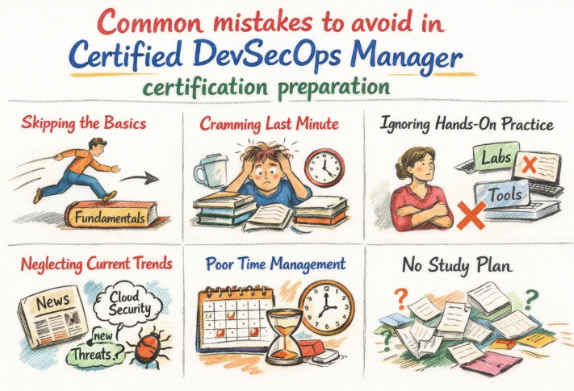
Common mistakes to avoid
- Focusing Only on Tools: It is often misunderstood that a manager’s job is just to buy software rather than build a strategy.
- Ignoring Team Feedback: Input from developers and operations engineers is sometimes neglected during the policy-making process.
- Skipping the Basics: More advanced security concepts are often attempted before the fundamental principles of DevOps are fully understood.
- Overlooking Compliance: Technical security is prioritized while the legal and regulatory requirements are forgotten.
Best next certification after this
- Same track: Advanced DevSecOps Leadership.
- Cross-track: Certified SRE Manager.
- Leadership / management: Certified Information Security Officer (CISO) training.
Choose Your Learning Path
DevOps Path
The essential skills for modern software delivery are built here. It is ideal for those who want to understand how automation and collaboration are used to improve quality.
DevSecOps Path
A focus is placed on adding security to every step of the lifecycle. This path is intended for professionals who want to ensure that speed does not come at the cost of safety.
Site Reliability Engineering (SRE) Path
The use of software engineering to solve operations problems is taught. This path is best for those who want to ensure that systems are reliable, scalable, and secure.
AIOps / MLOps Path
The power of data and artificial intelligence is utilized to improve technical operations. This is recommended for specialists who want to automate security using machine learning.
DataOps Path
The secure management of data flows is emphasized. This path is best for data professionals who need to maintain privacy and integrity across large datasets.
FinOps Path
The financial management of cloud resources is the main priority. It is designed for those who want to optimize costs while maintaining high security and performance levels.
Role → Recommended Certifications Mapping
| Role | Recommended Certification | Key Benefit |
| DevOps Engineer | Certified DevOps Master | Mastery of complex automation is achieved. |
| Site Reliability Engineer | Certified SRE Professional | High availability of systems is ensured. |
| Platform Engineer | Certified Kubernetes Manager | Large-scale infrastructure is managed safely. |
| Cloud Engineer | Certified Cloud Security Expert | Protection of cloud-native assets is improved. |
| Security Engineer | Certified DevSecOps Professional | Automated security skills are deepened. |
| Data Engineer | Certified DataOps Specialist | Integrity of data pipelines is maintained. |
| FinOps Practitioner | Certified FinOps Architect | Maximum cloud value is realized. |
| Engineering Manager | Certified DevSecOps Manager | Leadership in the security domain is established. |
Next Certifications to Take
- For the Career Advancer:
- Same-track: DevSecOps Expert.
- Cross-track: Certified AIOps Practitioner.
- Leadership: Master in Security Management.
Training & Certification Support Institutions
DevOpsSchool
This institution is recognized for its comprehensive training in the field of DevSecOps. A strong emphasis is placed on providing practical experience through hands-on labs. Career guidance is provided to help students achieve their goals in the global market.
Cotocus
Professional training and consulting services are offered by this organization to help individuals master modern technologies. Their courses are designed to meet the specific needs of the current industry. High standards of education are maintained across all programs.
ScmGalaxy
A wealth of knowledge and a large community are provided for those interested in DevOps and security. Regular updates on the latest tools and practices are shared through their platform. A focus is kept on helping engineers grow their technical expertise.
BestDevOps
Quality education in the area of DevOps and automation is provided here. The courses are structured to be easy to follow for both beginners and experienced professionals. Real-world application is always at the center of their teaching method.
devsecopsschool.com
Specialized knowledge in the field of security automation and governance is shared through this educational platform. Practical skills for building secure software delivery pipelines are gained by students who complete the various programs offered.
sreschool.com
A focus on system reliability and the use of software engineering to manage operations is maintained by this site. The methods required to ensure high availability and performance in complex environments are taught to all participants.
aiopsschool.com
The application of artificial intelligence and machine learning to technical operations is explored in depth here. Training is provided to help professionals automate monitoring and incident management using advanced data models.
dataopsschool.com
The orchestration and security of data pipelines across the enterprise are prioritized by this resource. Best practices for maintaining data integrity and privacy throughout the lifecycle are delivered through structured learning modules.
finopsschool.com
Expertise in managing and optimizing cloud costs is provided to bridge the gap between finance and engineering. A clear understanding of how to maximize business value from cloud investments is achieved by those who follow this curriculum.
FAQs Section
1. How is the complexity of this program rated by senior professionals?
The difficulty of the curriculum is considered balanced, as both strategic management and technical integration are addressed.
2. What duration is typically allocated for the completion of the studies?
A period of four to eight weeks is usually dedicated to mastering the materials by most learners.
3. What foundational skills are required before the enrollment is considered?
An understanding of the software development lifecycle and basic security principles is expected from all candidates.
4. How is the order of certifications decided for maximum career impact?
A logical progression from foundational DevOps roles to specialized security management is often recommended.
5. In what way is the professional profile enhanced by this credential?
Significant authority is added to a resume, especially when leadership positions in global markets are sought.
6. What leadership positions are usually attained after the program is finished?
Roles such as Governance Lead, Security Architect, and Technical Director are commonly pursued by graduates.
7. How is long-term career stability influenced by security management expertise?
Resilience against market changes is built when a professional is trained to handle critical organizational safety.
8. Is a global advantage gained by those who hold this certification?
International recognition is provided, allowing for career mobility across various geographic regions.
9. How is the assessment of knowledge conducted?
The evaluation is performed through a proctored online examination to ensure that high standards are maintained.
10. In what manner is the curriculum kept relevant to industry needs?
Regular reviews of the course content are conducted to reflect the latest advancements in security automation.
11. What kind of assistance is provided during the learning journey?
Comprehensive support, including expert mentorship and community access, is provided to every student.
12. How is the investment in this program justified by organizations?
The cost is outweighed by the reduction in security risks and the improvement in delivery speed.
FAQs for Certified DevSecOps Manager
1. How is the oversight of security tools managed by the DevSecOps Manager?
A centralized strategy is created where various automated tools are orchestrated within a single pipeline.
2. In what way is the shift in team mindset facilitated?
A culture of shared responsibility is fostered through the leadership techniques taught in the program.
3. How are security policies integrated into the automated delivery process?
Governance is embedded directly into the code so that compliance is checked automatically during every release.
4. Is the management of regulatory audits simplified by this certification?
The collection of evidence for audits is streamlined through the use of automated reporting and logging.
5. What role is played by the manager during a security incident?
The coordination of the response team and the strategic decision-making process are led by the manager.
6. How is the cooperation between developers and security experts improved?
Clear communication channels and unified goals are established to remove traditional barriers between teams.
7. Is the allocation of security resources optimized through this training?
Budgetary and human resources are directed toward the most critical risks based on strategic analysis.
8. How is the success of a DevSecOps strategy measured by the manager?
Key performance indicators, such as the time taken to fix vulnerabilities, are used to evaluate the effectiveness of the process.
Testimonials
Name: Rohan
A new way of looking at security was gained through this program. The ability to manage complex teams was developed, and a deeper understanding of governance was achieved.
Name: Aditi
Practical skills that could be used immediately in my daily work were learned. The transition into a management role was made much easier thanks to this training.
Name: Vikram
Confidence in leading security projects was built during the course. The material was easy to understand, and the support provided was exceptional.
Name: Sarah
The importance of balancing speed and security was finally understood. My career path is now clearly defined, and my professional value has increased.
Name: Thomas
Excellent insights into the management of automated security were provided. The real-world examples helped me solve several challenges in my current project.
Conclusion
A commitment to operational excellence is demonstrated through the attainment of the Certified DevSecOps Manager credential. Security is no longer treated as an external check but is woven into the very fabric of the engineering culture. A high level of professional integrity is maintained when the management of secure pipelines is prioritized. Sustainable growth is achieved by those who bridge the gap between technical execution and strategic governance. Long-term benefits are realized by the entire organization when leadership is focused on both speed and safety. A strategic roadmap for learning is recommended for all who seek to have their career standing elevated in the global market. By choosing this specialized path, a foundation for excellence and organizational trust is built.

