
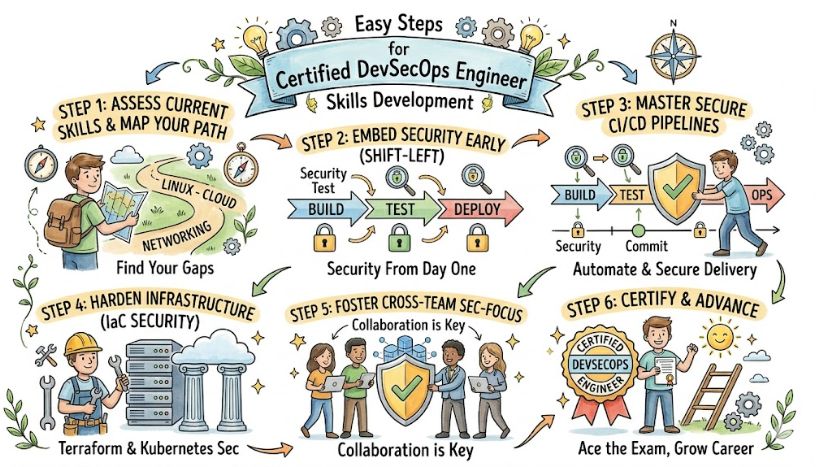
Introduction
A fundamental shift in how software is protected has been observed over the last few years. The old method of building a product and checking it for flaws at the very end is no longer effective. Instead, a more integrated approach is required where security is woven into every single line of code from the start. This manual is prepared for those who wish to master this integration through the Certified DevSecOps Engineer program. It is written to help engineers and managers understand how to build a career that is both technically sound and highly resilient.
What is Certified DevSecOps Engineer?
The Certified DevSecOps Engineer is a professional designation given to those who have mastered the art of combining security with automated operations. It is often described as the bridge between the development team and the security auditors. In this role, the focus is placed on creating a “self-healing” and “self-securing” pipeline.
The training involves learning how to automate complex security tasks that were once done by hand. By doing so, the speed of delivery is maintained while the risk of a breach is greatly lowered. It is a role that requires a deep understanding of both how software is made and how it can be attacked.
Why it matters today?
In an era where digital trust is the most valuable currency, a single security flaw can ruin a company’s reputation. As software is updated more frequently, manual security checks are found to be too slow and prone to error. This is where the DevSecOps approach becomes essential.
By automating security, a safety net is created that works at the speed of the cloud. Vulnerabilities are caught during the coding phase rather than after the software has been deployed to the public. Because of this, the demand for engineers who can handle these automated security systems has never been higher.
Why Certified DevSecOps Engineer certifications are important?
A formal certification is often viewed as a mark of professional maturity. For an engineer, it provides a clear roadmap to learn skills that are often ignored in general DevOps roles.
- Knowledge Standardization: A uniform set of best practices is learned, ensuring that security is handled the same way across different teams.
- Market Competitive Advantage: When many candidates apply for a role, the one with a specialized security certification is often prioritized.
- Technical Depth: It forces a deeper dive into tools and protocols that might not be used in basic daily tasks.
- Leadership Trust: High-level managers are more likely to trust a certified professional with the responsibility of protecting the company’s data.
Why choose DevSecOpsSchool?
When a platform for learning is selected, the depth of the practical material must be checked. DevSecOpsSchool is preferred by industry veterans for several reasons:
- Real-World Labs: The training is not just based on theory; actual scenarios are practiced in live environments.
- Experienced Instructors: Lessons are taught by mentors who have handled large-scale security migrations themselves.
- Continuous Updates: As new threats emerge, the course content is adjusted to ensure the latest tools are covered.
- Career Pathing: Beyond just the exam, guidance is provided on how to apply these security skills to move into senior engineering roles.
Certification Deep-Dive
What is this certification?
The Certified DevSecOps Engineer program is a technical validation of an individual’s ability to implement security automation. It is focused on the “Shift-Left” philosophy, where security tests are moved to the earliest possible stage of the development cycle.
Who should take this certification?
This track is built for software developers, cloud engineers, and system administrators who want to specialize in security. It is also suitable for security analysts who want to learn how to use automation and CI/CD tools.
Certification Overview Table
| Track | Level | Who it’s for | Prerequisites | Skills Covered | Recommended Order |
| DevOps | Foundation | Beginners | Basic Computer Ops | CI/CD, Scripting, Docker | 1 |
| DevSecOps | Professional | Engineers | DevOps Basics | SAST, DAST, SCA, Secrets | 2 |
| SRE | Advanced | Platform Leads | DevOps & Cloud | Reliability, SLIs, On-call | 3 |
| AIOps/MLOps | Specialized | Data Engineers | Python, ML | Model Security, AI Ops | 4 |
| DataOps | Specialized | DBAs/Data Leads | Data Engineering | Data Privacy, Pipelines | 4 |
| FinOps | Management | Leads/Architects | Cloud usage | Cost Control, Budgets | 3 |
Skills you will gain
- Pipeline Hardening: The ability to add security gates to Jenkins or GitLab pipelines is mastered.
- Automated Auditing: Tools are used to scan third-party libraries for known vulnerabilities automatically.
- Infrastructure Security: Terraform and Ansible scripts are checked for security errors before they are executed.
- Secret Protection: Best practices for using digital vaults to store passwords and API keys are learned.
- Container Defense: Images are scanned and Kubernetes clusters are secured against unauthorized access.
Real-world projects you should be able to do after this certification
- Build a Secure Pipeline: A system is created where code is rejected if it contains high-risk security flaws.
- Scan Container Registries: An automated process is set up to clean and verify Docker images before use.
- Implement Compliance as Code: Automated reports are generated to prove that the infrastructure meets security standards.
- Deploy a Security Vault: A centralized system is managed for the safe distribution of sensitive application data.
Preparation plan
7–14 days plan
A fast-paced review is conducted. The core concepts of the DevSecOps culture are studied. The official exam guide is used to identify any gaps in knowledge, and basic security tools are installed for quick testing.
30 days plan
A more structured approach is taken. The first half of the month is spent on learning theory and security protocols. The second half is dedicated to building small lab projects and running automated scans on sample applications.
60 days plan
This is the recommended path for full mastery. Each week is dedicated to a specific domain, such as “Container Security” or “Secret Management.” Multiple mock exams are taken, and a complex end-to-end secure pipeline is built from scratch to ensure complete readiness.
Common mistakes to avoid
- Tool Over-reliance: The mistake of thinking a tool can replace a good security process is often made.
- Ignoring Code Quality: It is sometimes forgotten that secure software starts with clean, well-written code.
- Skipping Documentation: The importance of keeping clear records of security policies is often underestimated.
- Lack of Practice: Trying to pass the exam without spending time in the lab is a common reason for failure.
Best next certification after this
- Same track: Certified DevSecOps Professional (for deeper automation expertise).
- Cross-track: Certified SRE Professional (to balance security with system performance).
- Leadership / management: Certified DevOps Manager (to oversee entire engineering departments).
Choose Your Learning Path
DevOps Path
This is best for engineers who want to focus on speed and automation. It is the starting point for everyone entering the modern engineering field.
DevSecOps Path
This is the ideal choice for those who want to be the guardians of the code. It is for people who enjoy finding bugs and automating the fix.
Site Reliability Engineering (SRE) Path
This path is chosen by those who want to ensure that systems never go down. It focuses on stability and the health of the application.
AIOps / MLOps Path
This is designed for professionals working with big data and machine learning. It teaches how to manage and secure the lifecycle of an AI model.
DataOps Path
This is focused on the flow of information. It is best for data engineers who need to ensure that data is both available and private.
FinOps Path
This is for the business-minded engineer. It focuses on the cost of the cloud and how to keep it within budget without losing performance.
Role → Recommended Certifications Mapping
| Role | Primary Recommended Certification | Next Career Step |
| DevOps Engineer | Certified DevOps Engineer | Certified DevSecOps Engineer |
| Site Reliability Engineer (SRE) | Certified SRE Professional | Certified AIOps Professional |
| Platform Engineer | Certified Kubernetes Expert | Certified SRE Professional |
| Cloud Engineer | Cloud Provider Cert (AWS/Azure) | Certified DevSecOps Engineer |
| Security Engineer | Certified DevSecOps Engineer | Certified Cloud Security Expert |
| Data Engineer | Certified DataOps Professional | Certified MLOps Engineer |
| FinOps Practitioner | Certified FinOps Professional | Certified DevOps Manager |
| Engineering Manager | Certified DevOps Manager | Certified FinOps Professional |
Next Certifications to Take
For someone completing the Certified DevSecOps Engineer course:
- Same-track: Certified DevSecOps Professional.
- Cross-track: Certified SRE Professional.
- Leadership-focused: Certified DevOps Manager.
Training & Certification Support Institutions
DevOpsSchool
Long-term career support is provided by this institution. A wide variety of technical tracks are offered, all of which are focused on practical industry needs. Students are given access to extensive lab environments.
Cotocus
This platform is specialized in corporate-level training and engineering consultancy. Complex technical concepts are broken down into simple, actionable modules for teams and individuals alike.
ScmGalaxy
A wealth of community knowledge and technical documentation is shared here. It is used as a primary resource for professionals who need to stay updated on the latest automation trends.
BestDevOps
Curated learning paths and expert advice are provided by BestDevOps. It is designed to help engineers choose the right tools and certifications for their specific career goals.
sreschool.com
All aspects of system reliability and monitoring are covered by this school. The curriculum is built to help engineers manage large-scale, high-traffic systems with confidence.
aiopsschool.com
The use of artificial intelligence in operations is the core focus here. Training is given on how to use smart algorithms to predict and prevent system failures.
dataopsschool.com
The management of data pipelines is taught through a DevOps lens. The goal is to improve the quality and speed of data delivery within an organization.
finopsschool.com
This institution focuses on the financial side of cloud computing. Professionals are trained to optimize cloud spending while maintaining high performance.
FAQs Section
1. Is the exam for Certified DevSecOps Engineer hard?
The exam is designed to be challenging. A balanced understanding of security theory and hands-on tool usage is expected for a passing score.
2. How long is the preparation period?
Between four to eight weeks are typically required to cover all the material thoroughly.
3. What are the requirements to start?
No specific certificate is required, but a basic knowledge of how a CI/CD pipeline works is strongly recommended.
4. In what order should these be taken?
It is often suggested that a general DevOps certification is obtained before moving into the specialized DevSecOps track.
5. Will this help me get a promotion?
Specialized security skills are very rare. Holding this certification often makes an individual a prime candidate for senior or lead roles.
6. What kind of jobs are available after this?
Positions such as DevSecOps Engineer, Security Architect, and Cloud Security Engineer are frequently offered to certified individuals.
7. Is the training mostly videos or labs?
A high priority is placed on lab-based learning so that the tools can be practiced in a real-world setting.
8. Is the certification valid in other countries?
The curriculum is based on global security standards, making it highly valuable in both Indian and international markets.
9. Can someone from a non-tech background do this?
It is possible, but a foundational course in Linux and programming should be completed first to ensure success.
10. How is the exam taken?
The test is usually administered through a secure online platform with live proctoring.
11. Is cloud security included?
Yes, security for major cloud providers like AWS and Azure is a significant part of the learning path.
12. Are there any coding requirements?
The ability to read and write basic scripts in YAML or Python is very helpful for the automation parts of the course.
Additional FAQs: Certified DevSecOps Engineer
1. What is the main focus of this specific certification?
The main focus is placed on automating security testing within the continuous integration and deployment process.
2. Are tools like SonarQube and Vault covered?
Yes, these tools are central to the curriculum for scanning code and managing sensitive data.
3. Is the certification renewal required?
Like most high-level technical certifications, renewal is recommended every few years to stay current with new technology.
4. How does this differ from a traditional security cert?
This is focused on automation and the developer’s workflow, whereas traditional certs often focus on manual auditing and perimeter defense.
5. Can this be done while working full-time?
The course is designed with flexible hours to accommodate working professionals.
6. Is there a community for students?
Yes, access to a large network of professionals and mentors is provided during and after the training.
7. Is “Compliance as Code” taught?
Yes, learning how to automate the audit process is a key skill gained during the program.
8. What is the passing score?
A minimum score of 70% is usually required to be officially certified.
Testimonials
Arjun
The technical skills needed to secure a modern pipeline were gained through this course. The transition into a security-focused role was made possible because of the hands-on labs.
Sana
Real-world application was the highlight of the training. The confidence to lead security discussions with the engineering team was built through the practical exercises.
Liam
Career clarity was achieved after following the recommended learning path. The skills learned are used every day to protect the company’s cloud infrastructure.
Meera
A significant improvement in the ability to automate security scans was noticed. The course provided a clear understanding of how to balance speed with safety.
David
The knowledge gained from this program is very deep. The ability to manage secrets and secure containers has become a core part of the daily work routine.
Conclusion
The Certified DevSecOps Engineer certification is an essential milestone for any professional who wants to be at the forefront of modern engineering. It is no longer enough to just deliver software quickly; it must be delivered securely. By mastering these automated security techniques, a future-proof career is built.
Long-term benefits such as leadership opportunities and technical mastery are within reach for those who plan their learning strategically. It is recommended that this journey is started today to ensure a place in the next generation of expert engineers.

