
Introduction
A massive wave of data is being faced by modern IT departments every day. In the past, a handful of servers could be monitored by a single engineer using basic dashboards. Today, thousands of microservices and cloud components are running simultaneously. This growth has led to a situation where traditional monitoring tools are simply overwhelmed. Millions of logs, metrics, and alerts are generated every minute, making it impossible for human teams to keep up.
When a critical failure occurs, the “needle in the haystack” is often sought by engineers through manual log analysis. Hours or even days are spent trying to understand which service caused the outage. This constant state of reactive firefighting has become a primary cause of burnout in the tech industry. To address this crisis, a more intelligent approach is required. Artificial Intelligence for IT Operations, or AIOps, is being adopted to transform this chaos into actionable intelligence. By using machine learning to filter out the noise, the root causes of issues are identified automatically, allowing systems to be managed at a scale that was previously unthinkable.
What is Certified AIOps Engineer?
The Certified AIOps Engineer is a professional program designed to teach the skills needed to manage modern IT operations. In this program, the combination of Big Data, Machine Learning, and traditional DevOps practices is explored. It is intended to help engineers move away from reactive troubleshooting and toward proactive system management.
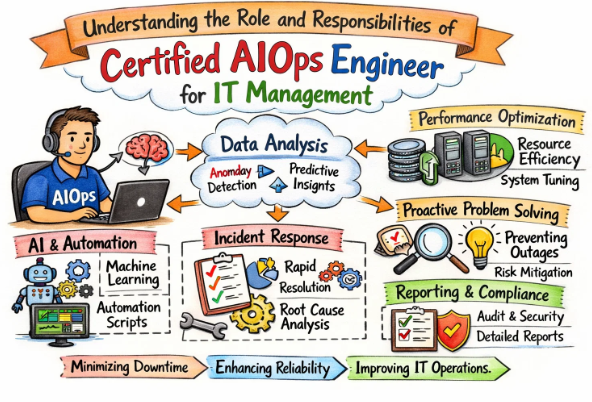
The focus of this certification is on using AI to automate routine tasks and enhance decision-making. Skills related to data collection, anomaly detection, and automated incident response are developed. By completing this certification, a deep understanding of how AI can be integrated into the existing DevOps pipeline is gained by the learner.
Why it matters today?
In today’s market, speed and reliability are expected by every customer. Downtime is no longer tolerated, and even a few minutes of service interruption can lead to huge financial losses. Because infrastructure is now mostly cloud-based and distributed, the volume of data has grown beyond human control.
AIOps matters because it provides the “brain” for the infrastructure. Automation is given a higher level of intelligence. Instead of just following simple scripts, systems are empowered to learn from historical data. This transition is essential for any company that wants to scale its operations without hiring thousands of additional engineers.
Why Certified AIOps Engineer certifications are important?
Certifications are viewed as a benchmark for technical competence. In a crowded job market, a Certified AIOps Engineer is recognized as someone who understands the future of infrastructure management. These certifications are important because they provide a structured learning path.
The gap between traditional software engineering and data science is bridged by this certification. It ensures that an engineer is not just running tools but understands the underlying data patterns. Furthermore, professional credibility is established, and higher salary brackets are often reached by those who hold such specialized credentials.
Why Choose AIOps School?
AIOps School is chosen by many professionals because of its focus on practical, real-world application. While many platforms only teach theory, deep technical labs and hands-on scenarios are provided here. The curriculum is constantly updated to reflect the latest shifts in the industry.
Support is offered to students throughout their learning journey. High-quality resources and expert guidance are made available to ensure that the exam is passed on the first attempt. The certification from AIOps School is respected globally and is often preferred by hiring managers in India and abroad.
Certification Deep-Dive: Certified AIOps Engineer
What is this certification?
This certification is a specialized credential that validates an individual’s ability to implement AI and Machine Learning within IT operations. It covers the end-to-face lifecycle of data-driven automation.
Who should take this certification?
Software engineers, DevOps practitioners, and SREs who want to automate complex monitoring tasks should take this. It is also highly recommended for engineering managers who need to oversee modern, high-scale platforms.
Certification Overview Table
| Track | Level | Who it’s for | Prerequisites | Skills Covered | Recommended Order |
| DevOps | Intermediate | DevOps Engineers | Linux, Scripting | CI/CD, Automation | 1 |
| DevSecOps | Advanced | Security Engineers | DevOps Basics | Security Testing | 2 |
| SRE | Advanced | Platform Engineers | System Admin | Reliability, SLOs | 3 |
| AIOps/MLOps | Specialist | SRE/Data Engineers | Python, Statistics | AI Monitoring, ML | 4 |
| DataOps | Specialist | Data Engineers | SQL, Big Data | Data Pipelines | 5 |
| FinOps | Management | Cloud Architects | Cloud Billing | Cost Optimization | 6 |
Skills you will gain
- Data ingestion from various monitoring tools is mastered.
- Anomaly detection using machine learning models is implemented.
- The noise in alerting systems is significantly reduced.
- Root cause analysis is automated through correlation.
- Predictive maintenance for hardware and software is established.
- Intelligent incident response workflows are created.
Real-world projects you should be able to do after this certification
- An automated system that predicts server disk failure 24 hours in advance is built.
- A centralized dashboard that correlates logs from 100+ microservices is developed.
- A machine learning model that filters out 90% of false-positive alerts is deployed.
- An auto-scaling policy based on predicted traffic patterns is configured.
Preparation plan
7–14 days plan:
Focus is placed on the core concepts of AIOps and the architecture of the platform. The official documentation is read thoroughly. Basic labs on data collection are completed.
30 days plan:
Detailed study of machine learning algorithms used in operations is performed. Practical exercises on anomaly detection and correlation are practiced daily. Mock exams are taken to identify weak areas.
60 days plan:
Deep dives into complex integrations are conducted. Real-world scenarios are simulated in a lab environment. Advanced troubleshooting of AI models is practiced. Full-length practice tests are mastered.
Common mistakes to avoid
- The importance of data quality is often ignored by candidates.
- The fundamental principles of traditional monitoring are sometimes forgotten.
- Complex ML models are used where simple logic would suffice.
- The human-in-the-loop requirement for AI is overlooked.
Best next certification after this
- Same track: Certified MLOps Engineer.
- Cross-track: Certified SRE Professional.
- Leadership / management: Certified FinOps Practitioner.
Choose Your Learning Path
DevOps Path:
This path is best for those who focus on the speed of delivery. Continuous integration and continuous deployment are the main priorities here.
DevSecOps Path:
Security is integrated into every stage of the lifecycle. This is ideal for professionals who want to ensure that code is both fast and secure.
Site Reliability Engineering (SRE) Path:
Reliability and uptime are the focus. This path is chosen by those who enjoy solving complex infrastructure problems and maintaining high availability.
AIOps / MLOps Path:
This is best for engineers who want to work at the intersection of data science and operations. Intelligence is added to every automation task.
DataOps Path:
The flow of data within an organization is managed. This path is perfect for those who want to ensure data quality and accessibility for AI models.
FinOps Path:
Cloud spending is optimized. This is best for those who want to balance technical performance with business costs.
Role → Recommended Certifications Mapping
| Role | Recommended Certification | Key Benefit |
| DevOps Engineer | Certified DevOps Professional | Mastery of CI/CD |
| SRE | Certified SRE Professional | High availability skills |
| Platform Engineer | Certified Kubernetes Expert | Infrastructure scaling |
| Cloud Engineer | Certified Cloud Architect | Multi-cloud management |
| Security Engineer | Certified DevSecOps Engineer | Automated security |
| Data Engineer | Certified DataOps Professional | Data pipeline mastery |
| FinOps Practitioner | Certified FinOps Specialist | Cost management |
| Engineering Manager | Certified AIOps Manager | Strategic oversight |
Next Certifications to Take
One same-track certification:
The Certified MLOps Professional is recommended. Deep learning models are deployed and managed in production environments. This allows for a more specialized career in AI-driven infrastructure.
One cross-track certification:
The Certified SRE Professional should be considered. Reliability concepts are combined with AI skills. This combination is highly valued by top-tier tech companies globally.
One leadership-focused certification:
The Certified FinOps Practitioner is a great choice. The financial impact of technical decisions is understood. Leadership roles are often offered to those who can manage both technology and budgets.
Training & Certification Support Institutions
DevOpsSchool:
Comprehensive training for various DevOps tools and methodologies is provided. A long history of helping students transition into high-paying roles is maintained. Expert-led sessions are conducted regularly.
Cotocus:
Tailored corporate training programs and individual coaching are offered. Practical implementation of cloud and AI technologies is emphasized. Modern learning techniques are used to ensure knowledge retention.
ScmGalaxy:
A vast community and resource hub for software configuration management are managed here. Technical blogs, tutorials, and certification guides are shared with thousands of engineers. Deep industry insights are provided.
BestDevOps:
Specialized bootcamps for intensive learning are organized. Real-world projects are integrated into every course. A high success rate in certification exams is achieved by their students.
devsecopsschool.com:
The integration of security into the DevOps workflow is the primary focus. Specialized labs for vulnerability scanning and compliance are provided. Security-first mindsets are developed in students.
sreschool.com:
The principles of site reliability engineering are taught here. Error budgets, SLOs, and incident management are explored in detail. Reliability is treated as a first-class citizen.
aiopsschool.com:
The latest advancements in AI-driven operations are covered. Specialized tracks for AIOps and MLOps are provided. Hands-on experience with AI tools for IT is ensured.
dataopsschool.com:
Data lifecycle management and pipeline automation are focused on. The challenges of big data in modern enterprises are addressed. Data quality and governance are taught.
finopsschool.com:
The art of cloud cost optimization is taught to technical and financial professionals. Strategies for reducing cloud waste are shared. The business value of cloud engineering is highlighted.
FAQs Section
- What is the difficulty level of this certification?
The difficulty is considered intermediate to advanced. A solid understanding of IT operations is required before starting. - How much time is required to prepare?
Between 30 to 60 days are usually needed by most candidates. This depends on prior experience with AI or DevOps. - Are there any prerequisites for the exam?
Basic knowledge of Linux and at least one cloud platform is recommended. Familiarity with monitoring tools is also helpful. - In what sequence should these certifications be taken?
DevOps basics should be mastered first, followed by SRE, and then AIOps for the best results. - What is the career value of becoming a Certified AIOps Engineer?
Significant growth in career opportunities is seen. Specialized roles in AI and automation are opened up. - Which job roles can be applied for after this?
Roles such as AIOps Engineer, Automation Architect, and Senior SRE are common choices. - Is this certification recognized globally?
Yes, the credentials from AIOps School are respected by international companies and local firms alike. - How is the exam conducted?
The exam is conducted online in a proctored environment. Multiple-choice questions and scenario-based problems are included. - Are there any renewal requirements?
Periodic updates to the certification are required every two years to ensure skills remain current. - Does the certification include hands-on labs?
Yes, the training program includes several practical labs where real-world problems are solved. - What is the passing score for the exam?
A minimum score of 70% is usually required to be awarded the certificate. - Is study material provided?
Comprehensive study guides, videos, and practice tests are provided by the training partners.
Additional FAQs specifically focused on Certified AIOps Engineer
- How does AIOps differ from traditional DevOps?
While DevOps focuses on automation and collaboration, AIOps adds a layer of machine learning to analyze the data generated by those processes. - Do I need to be a data scientist to pass this?
No, a data science degree is not required. The focus is on applying AI to operations rather than building complex models from scratch. - What programming languages are most useful for this certification?
Python is highly recommended because of its extensive libraries for data analysis and automation. - Can an entry-level engineer take this certification?
It is recommended that at least 2 years of experience in IT operations be gained before attempting this specialist track. - What tools are covered in the Certified AIOps Engineer program?
Tools for log management, metric aggregation, and machine learning integration are explored. - How does this certification help with cloud cost management?
Patterns of resource waste are identified by AI, which allows for better cost optimization strategies. - Is real-time data processing part of the curriculum?
Yes, the ingestion and analysis of data streams in real-time are key components of the training. - Will this certification remain relevant in the future?
As systems become more complex, the need for AI-driven management will only grow, making this certification very relevant.
Testimonials
Rajesh
Practical knowledge was gained through this program. The way complex logs are now managed has completely changed. My confidence in handling large-scale incidents has improved significantly.
Ananya
A clear path for career growth was provided. The lessons on anomaly detection were very helpful for my daily tasks. I feel much more prepared for the future of IT.
Vikram
The training helped in understanding the bridge between AI and SRE. Real-world scenarios were used, which made the learning very effective. My team is now implementing the strategies I learned.
Siddharth
The certification gave me a new perspective on monitoring. False alerts have been reduced in our system because of the techniques taught here. It is a must for every modern engineer.
Kavita
Clarity was achieved regarding how AI can be used in the workplace. The course was simple to follow despite being very technical. I was able to secure a better role shortly after completion.
Conclusion
The shift toward intelligent operations is no longer optional for those who wish to lead in the tech industry. As systems continue to grow in scale and complexity, the traditional ways of managing them are being left behind. The Certified AIOps Engineer certification is a gateway to this new era of engineering. It ensures that a professional is not just keeping up with changes but is driving them within their organization.Long-term strategic value is added to an engineer’s profile through this credential. By moving from a “doing” mindset to a “governing” mindset, where AI is used as a force multiplier, a superior level of reliability is achieved. Strategic learning and certification planning are strongly recommended for anyone who aims to be a key player in the global technology landscape.

