
Introduction
The landscape of enterprise technology is being reshaped by the rapid adoption of artificial intelligence. It is no longer sufficient for models to be developed in isolation; instead, they must be deployed, monitored, and maintained with the same rigor as traditional software. This necessity has given rise to the role of the MLOps Manager, a position that blends technical oversight with strategic coordination.
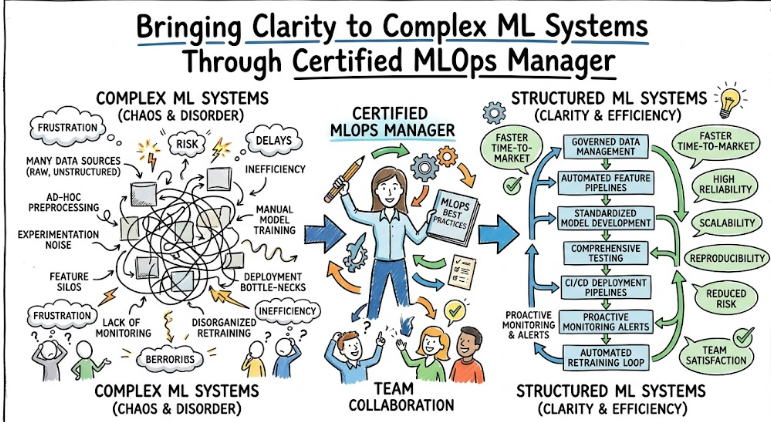
Operational friction is often encountered when data science teams and IT operations teams work without a unified framework. Efficiency is improved and time-to-market is accelerated when a standardized MLOps approach is adopted. This guide is intended to provide a deep understanding of the certification process and the career trajectory associated with this specialized field.
The complexities of managing AI at scale are addressed in this guide. Guidance is provided for both individual contributors and leadership figures who aim to stabilize their AI infrastructure. A clear, humanized perspective is maintained to ensure that the content is accessible to all levels of professional experience.
Defining the Certified MLOps Manager Role
The Certified MLOps Manager is recognized as a leader who orchestrates the lifecycle of machine learning models. This role is not merely focused on technical execution but involves the high-level management of automated workflows and team collaboration.
Why it matters today?
The reliance on manual processes for model deployment is seen as a major risk in today’s fast-paced market. Reliability is compromised when models are not monitored for performance decay or data drift. A manager with specialized certification is equipped to implement systems that ensure continuous delivery and continuous integration for machine learning.
Business value is maximized when AI initiatives are aligned with operational excellence. The wastage of computational resources is minimized, and the accuracy of predictive models is preserved over time. Consequently, the presence of a certified professional is deemed essential for any organization scaling its AI capabilities.
Why Certified MLOps Manager certifications are important?
A benchmark for excellence is established through formal certification. In an industry where titles can be vague, a verified credential provides clarity to employers regarding an individual’s capabilities. The latest industry standards are mastered, and a commitment to professional growth is demonstrated.
Furthermore, a comprehensive perspective is gained through a structured learning path. Fragmented knowledge is replaced by a holistic understanding of how data pipelines, model training, and production monitoring interact. This foundational knowledge is critical for making informed decisions at an executive level.
Certification Deep-Dive: Certified MLOps Manager
Why Choose AIOps School?
AIOps School is selected by many because of its dedication to bridging the gap between theory and practical application. The training is centered on the needs of the modern industry, ensuring that every lesson is relevant to real-world challenges. A supportive environment is provided where complex concepts are simplified and made actionable.
The curriculum is curated by seasoned professionals who have managed large-scale infrastructure. High-quality learning materials and practical labs are made available to all participants. By choosing this institution, a commitment is made to a high standard of educational integrity and professional success.
What is this certification?
The Certified MLOps Manager program is a specialized track designed for managing the operational side of machine learning. It focuses on the governance, automation, and scaling of AI models within a corporate environment.
Who should take this certification?
This certification is ideal for senior software engineers, system administrators, and technical project managers. It is also highly recommended for individuals currently working in DevOps or SRE roles who wish to specialize in the AI sector.
Certification Overview Table
| Track | Level | Who it’s for | Prerequisites | Skills Covered | Recommended Order |
| ML Fundamentals | Associate | New Entrants | Basic Programming | Data prep, Model types | 1 |
| Certified MLOps Manager | Professional | Lead Engineers | DevOps Knowledge | Pipeline automation, Governance | 2 |
| AIOps Specialist | Expert | SRE Professionals | MLOps Foundation | Self-healing systems, Analytics | 3 |
| Data Operations Lead | Specialist | Data Architects | SQL/Data Basics | Data quality, ETL automation | 4 |
| Enterprise AI Architect | Master | Senior Managers | Advanced Management | Strategy, Multi-cloud AI | 5 |
Skills You Will Gain
- The architecture of end-to-end machine learning pipelines is understood and implemented.
- Automated testing protocols for machine learning models are established.
- Scalable infrastructure for AI workloads is managed with efficiency.
- Strategies for model versioning and data lineage are mastered.
- Cross-functional team leadership within the AI lifecycle is developed.
- Compliance and ethical governance frameworks are applied to AI projects.
Real-World Projects Post-Certification
- A fully automated CI/CD pipeline for a natural language processing model is designed.
- A centralized logging and monitoring system for multiple production models is built.
- A resource allocation strategy for GPU-intensive training tasks is optimized.
- A data validation framework to prevent training-serving skew is implemented.
- A disaster recovery plan for critical AI-driven services is established.
Preparation Plan
7–14 Days Plan
The core terminology and the MLOps manifestos are reviewed. A high-level understanding of the model lifecycle is developed. Initial practice exams are taken to identify specific knowledge gaps.
30 Days Plan
A deep study of pipeline automation tools is conducted. Weekly hands-on sessions are scheduled to build simple deployment scripts. Community discussions are engaged in to explore common industry hurdles.
60 Days Plan
Advanced topics such as infrastructure as code (IaC) for ML are explored. Comprehensive mock exams are completed under timed conditions. The practical application of governance and cost-management principles is rehearsed.
Common Mistakes to Avoid
- The management aspect is often overlooked in favor of purely technical coding tasks.
- The significance of data quality and its impact on model performance is frequently undervalued.
- Documentation of the pipeline architecture is sometimes neglected, leading to operational confusion.
- Monitoring is treated as an afterthought instead of being integrated from the start.
Best Next Certification After This
Same Track: Enterprise AI Architect for those seeking to design high-level organizational AI strategies.
Cross-Track: Data Operations Lead to gain better control over the data ingestion layers.
Leadership / Management: FinOps Practitioner to ensure the economic viability of large-scale AI operations.
Choose Your Learning Path
DevOps Path: This journey is designed for those transitioning from standard software operations. The focus is placed on adapting CI/CD practices for the unique requirements of machine learning.
DevSecOps Path: This path is suitable for security-conscious professionals. Vulnerabilities in ML models and data pipelines are identified and mitigated through integrated security checks.
Site Reliability Engineering (SRE) Path: This is intended for experts in system uptime. The principles of error budgets and SLIs/SLOs are applied to machine learning services to ensure constant availability.
AIOps / MLOps Path: This is the direct route for those dedicated to AI infrastructure. Every phase of the machine learning operational lifecycle is covered in great detail.
DataOps Path: This is the preferred route for data engineers. The emphasis is placed on the reliability and speed of the data flowing into the machine learning models.
FinOps Path: This path is chosen by those responsible for cloud budgets. The high costs of training and serving AI models are managed through strategic resource optimization.
Role → Recommended Certifications Mapping
| Current Role | Recommended Certification | Secondary Goal | Leadership Path |
| DevOps Engineer | Certified MLOps Manager | AIOps Specialist | Director of Infrastructure |
| Site Reliability Engineer | AIOps Specialist | MLOps Manager | VP of Engineering |
| Platform Engineer | Certified MLOps Manager | DataOps Specialist | Cloud Strategy Lead |
| Cloud Engineer | Certified MLOps Manager | FinOps Practitioner | IT Operations Manager |
| Security Engineer | DevSecOps Professional | MLOps Manager | Chief Security Officer |
| Data Engineer | DataOps Specialist | MLOps Manager | Chief Data Officer |
| FinOps Practitioner | FinOps Certified | MLOps Manager | Strategic Finance Director |
| Engineering Manager | Certified MLOps Manager | Enterprise AI Architect | CTO / AI Director |
Next Certifications to Take
One Same-Track Certification
The Enterprise AI Architect certification is considered the natural next step. It allows for the transition from managing individual pipelines to overseeing the entire AI strategy of an organization. Advanced design patterns for global AI deployments are explored.
One Cross-Track Certification
The Data Operations Lead credential is highly beneficial. A deeper mastery of the data supply chain is achieved. This ensures that the foundation upon which models are built is consistently of high quality.
One Leadership-Focused Certification
The FinOps Practitioner certification is recommended for those in senior positions. The financial implications of AI scale-up are better understood. Decisions regarding cloud infrastructure spend are made with greater confidence and accuracy.
Training & Certification Support Institutions
DevOpsSchool
A wide range of technical training and career support is provided by this institution. A strong emphasis is placed on practical skill acquisition and industry readiness. Students are guided through every step of their professional journey.
Cotocus
Specialized training and consulting services are delivered to professionals worldwide. Complex technical concepts are broken down into manageable learning modules. Real-world expertise is shared to ensure students can handle production challenges.
ScmGalaxy
A community-driven platform that offers extensive resources for DevOps and AI enthusiasts is found here. Knowledge sharing and collaborative learning are encouraged. Professional networks are expanded through their various engagement programs.
BestDevOps
The focus of this organization is on the latest advancements in infrastructure management. Hands-on training is prioritized to build technical competence. Professionals are prepared for the evolving demands of the modern workforce.
devsecopsschool.com
Integrated security practices are the core focus of the curriculum offered here. The importance of building secure software lifecycles is emphasized. Professionals are taught to protect organizational assets throughout the development process.
sreschool.com
The science of system reliability and performance is taught at this institution. Scalable and resilient infrastructures are the main topics of study. Students are trained to maintain high availability in complex environments.
aiopsschool.com
The primary destination for those seeking to master the intersection of AI and operations. Dedicated programs for MLOps and AIOps are provided. Expert guidance is offered to help professionals lead the AI revolution.
dataopsschool.com
The operational management of data is explored in depth here. High-quality data pipelines are built and maintained by the students. The curriculum is designed to support the data-driven needs of modern AI.
finopsschool.com
Financial accountability in the cloud is the primary subject of instruction. Cost-effective infrastructure management strategies are developed. Professionals are trained to balance performance with budget constraints.
FAQs Section
What is the difficulty level associated with obtaining these credentials?
The level is categorized as professional and demanding, as both deep technical skill and management logic are tested. A background in software or systems operations is usually required for success.
How much time is generally allocated for the completion of the study?
A duration of 4 to 12 weeks is common for most professionals to feel prepared. This timeline depends on the individual’s prior exposure to automation and machine learning concepts.
Are there specific prerequisites mandated before enrollment?
A foundational understanding of cloud platforms and the software development lifecycle is expected. Familiarity with basic data science concepts is recommended for a smoother experience.
What sequence of certifications is suggested for a long-term career?
The journey is often started with the Manager level, followed by specialized tracks like AIOps or DataOps, and finalized with the Architect level.
What is the perceived career value of being a certified professional?
Significant value is placed on these certifications by global recruiters. It often leads to roles with greater responsibility and improved compensation packages.
How is job growth impacted by these specialized skills?
Growth is accelerated as organizations look for experts to manage their growing AI investments. Leadership roles in AI operations are becoming more prevalent.
Is recertification or continuous learning required in this field?
The industry is observed to move very quickly, so staying updated through community engagement and advanced modules is highly encouraged.
Can these methodologies be utilized by smaller organizations?
Efficiency and cost-management are beneficial at any scale. Smaller teams find that automation allows them to compete with larger enterprises.
How is the success of a certified manager measured by a company?
Success is often measured by the reduction in model deployment failures and the optimization of cloud spending.
Are specific tools like Docker or Terraform covered in the training?
While the focus is on the management principles, common industry tools are frequently used in labs to demonstrate the concepts.
Is assistance provided for career placement after completion?
Guidance is available through professional networks and partner institutions to help certified individuals find suitable roles.
Are these credentials recognized across different countries?
Yes, the curriculum is based on international best practices, making the certification valuable in any global market.
Certified MLOps Manager FAQs
1. What is the primary objective of the Certified MLOps Manager program?
The goal is to prepare professionals to oversee the entire lifecycle of machine learning models in a production setting.
2. How are team dynamics improved through this certification?
A standardized framework for communication between data scientists and operations engineers is provided, reducing internal friction.
3. Is extensive programming experience a requirement for this role?
A conceptual understanding of code is necessary for management, though the daily tasks are more focused on workflow orchestration and policy.
4. How is the issue of “model decay” handled in the curriculum?
Advanced monitoring and automated retraining strategies are taught to ensure that models remain accurate over time.
5. Are ethical considerations and data privacy included?
Yes, the responsible management of data and adherence to privacy regulations are core parts of the governance module.
6. What distinguishes MLOps from traditional DevOps?
The inclusion of data versioning and model performance monitoring as core components is what sets MLOps apart from traditional software operations.
7. Is the training conducted in a fully digital format?
The program is designed to be flexible and accessible through online platforms, catering to working professionals globally.
8. How are practical skills validated during the examination?
Scenarios based on real-world operational challenges are presented to test the candidate’s strategic decision-making and problem-solving abilities.
Testimonials
The ability to manage complex AI lifecycles was greatly enhanced. A structured approach to model deployment is now followed, which has led to much higher team efficiency.
— Arjun
A new level of clarity regarding model monitoring was achieved. The lessons learned are being applied daily to ensure the reliability of production services.
— Li
The strategic insights provided by the program were exceptional. The gap between business goals and technical execution is now bridged with much greater ease.
— Sofia
Confidence in managing large-scale AI infrastructure was developed through the hands-on labs. The certification has opened doors to new leadership opportunities.
— David
Skill improvement was seen immediately in the area of cost optimization. The organization’s cloud spend on AI has been significantly reduced thanks to the techniques learned.
— Kenji
Conclusion
The pursuit of the Certified MLOps Manager certification is seen as a strategic move for any professional aiming to lead in the AI-driven economy. A robust understanding of how to bridge the gap between innovation and operations is provided. As the demand for stable and scalable AI grows, the value of this credential will only continue to rise. The long-term career benefits include a defined path to leadership and the ability to drive significant technological change within an organization. Strategic planning for continuous learning is encouraged to maintain a competitive edge. By partnering with AIOps School, the foundation for a successful and impactful career in MLOps is firmly established.

