
Introduction
The evolution of modern engineering is being defined by the integration of intelligence into every layer of the software stack. For professionals aiming to stay ahead of this shift, the MLOps Foundation Certification serves as a vital entry point.
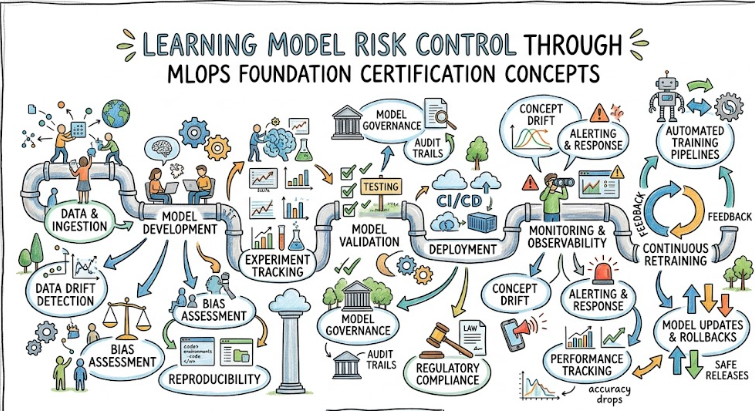
For those involved in software delivery, the challenge of managing machine learning models is often encountered. Unlike traditional code, models require a unique lifecycle that includes data handling, continuous training, and specialized monitoring. By understanding the foundational principles of MLOps, a strategic advantage is gained in a market that increasingly rewards the ability to operationalize artificial intelligence. This guide is crafted to offer a fresh perspective on how this certification can be utilized to future-proof a technical career.
What is MLOps Foundation Certification?
The MLOps Foundation Certification is established as a standardized credential for individuals seeking to understand the mechanics of machine learning operations. It is designed to bridge the gap between pure data science and robust software engineering. The focus is placed on the end-to-end lifecycle of a model, ensuring that the transition from a development environment to a production system is managed with precision.
Why it matters today?
In the current global economy, data is viewed as the most valuable asset of an enterprise. However, the value of data is only realized when it is processed by models that are reliably deployed. MLOps is recognized as the framework that makes this possible.
Systemic stability is improved when automated workflows are adopted for machine learning. Without these practices, models often become stagnant or fail to perform as data shifts over time. Because businesses are now deploying AI at an unprecedented scale, the demand for professionals who understand these operational foundations is at an all-time high.
Why MLOps Foundation Certification certifications are important?
A professional certification is more than just a document; it is a validation of specialized competence. In a competitive field, it serves as a clear signal to employers that industry-best practices are understood.
- Career Resilience: Technical skills are updated to meet the requirements of the next generation of IT roles.
- Workflow Consistency: A shared understanding is created among cross-functional teams, leading to fewer errors.
- Project Speed: The time required to deploy models is reduced through the application of standardized automation.
- Quality Assurance: High standards for model performance and data integrity are maintained through proven methodologies.
Why Choose AIOps School?
When a career pivot into AI operations is considered, the quality of instruction is of paramount importance. At AIOps School, the curriculum is built around the needs of the modern professional. Complex topics are broken down into simple, digestible modules that emphasize practical understanding over abstract theory.
The learning journey is supported by a wealth of resources, including hands-on labs and updated study materials. A focus is placed on ensuring that students are not just prepared for an exam, but are ready to solve real-world problems in a corporate setting. The institution is highly regarded for its ability to deliver high-impact education that aligns with the current demands of the global technology sector.
Certification Deep-Dive: MLOps Foundation Certification
What is this certification?
The MLOps Foundation Certification is a foundational program that validates a candidate’s grasp of how machine learning models are operationalized. It is the first step in mastering the automation and monitoring techniques required for modern AI systems.
Who should take this certification?
This track is ideal for Cloud Engineers, Platform Engineers, and Software Developers who wish to transition into AI-focused roles. It is also suitable for technical leads who need to supervise the deployment of machine learning projects.
Certification Overview Table
| Track | Level | Targeted Professionals | Prerequisites | Core Knowledge Areas | Recommended Order |
| MLOps | Foundational | IT Professionals | Basic Software Logic | ML Lifecycle, Automation | 1st |
| AI Ops | Intermediate | Systems Engineers | MLOps Foundation | Intelligent Monitoring | 2nd |
| Data Ops | Foundational | Data Architects | Data Fundamentals | Pipeline Integrity | Optional |
Skills you will gain
- The stages of the machine learning lifecycle are clearly identified and managed.
- Automated pipelines for model training and deployment are constructed.
- Techniques for tracking and managing data versions are mastered.
- Performance monitoring strategies for live models are implemented.
- Collaboration between engineering and data science teams is facilitated.
Real-world projects you should be able to do after this certification
- A continuous integration pipeline for a predictive model is developed.
- A system for detecting and alerting on model performance decay is designed.
- A version-controlled repository for machine learning artifacts is managed.
- The deployment of a model into a containerized production environment is executed.
Preparation Plan
7–14 Days Plan (Quick Start)
- Phase 1: Core definitions and the role of automation in ML are reviewed.
- Phase 2: The specifics of the ML lifecycle are studied, followed by practice quizzes.
- Phase 3: A final review of key concepts and exam strategies is conducted.
30 Days Plan (Structured Learning)
- Week 1: Theoretical foundations and the history of MLOps are explored.
- Week 2: Practical laboratory exercises focusing on pipelines are performed.
- Week 3: Monitoring and logging for machine learning systems are studied in depth.
- Week 4: Extensive mock exams are taken to ensure readiness for the final test.
60 Days Plan (Comprehensive Mastery)
- Month 1: Every topic in the syllabus is studied with a focus on real-world case studies.
- Month 2: Complex labs are built from scratch, and rigorous final preparation is completed.
Common mistakes to avoid
- The difference between traditional CI/CD and ML-specific pipelines is often misunderstood.
- The impact of data quality on model outcomes is sometimes ignored.
- Practical lab work is frequently skipped in favor of reading theory.
- The need for continuous retraining of models is often underestimated.
Best next certification after this
- Same track: Professional MLOps Architect.
- Cross-track: SRE Foundation Certification.
- Leadership / management: AI Program Manager.
Choose Your Learning Path
DevOps Roadmap
The focus is placed on extending existing automation skills to include machine learning. Traditional deployment pipelines are modified to support the unique needs of AI models.
DevSecOps Roadmap
Security is integrated into every stage of the machine learning process. It is ensured that both data and models are protected against potential vulnerabilities.
Site Reliability Engineering (SRE) Roadmap
The stability and uptime of machine learning services are prioritized. Techniques for managing the reliability of AI systems at scale are learned.
AIOps / MLOps Roadmap
A comprehensive study of how artificial intelligence is used to manage operations and how operations support AI. This is the most direct route for specialized engineers.
DataOps Roadmap
The quality and flow of data are the primary concerns. The relationship between data processing and model performance is strengthened through better management.
FinOps Roadmap
The costs associated with AI development and deployment are managed. Strategies for optimizing cloud resource usage for machine learning are developed.
Role → Recommended Certifications Mapping
| Professional Role | Primary Recommendation |
| DevOps Engineer | MLOps Foundation |
| Site Reliability Engineer | SRE Professional |
| Platform Engineer | Automation Specialist |
| Cloud Engineer | Infrastructure Architect |
| Security Analyst | DevSecOps Foundation |
| Data Scientist | DataOps Foundation |
| Financial Analyst | FinOps Certified |
| Engineering Lead | AI Strategy Professional |
Next Certifications to Take
One Same-Track Certification
Deep technical knowledge of orchestration and governance is provided. This is intended for those who wish to lead large-scale machine learning initiatives.
One Cross-Track Certification
The use of machine learning to predict system failures and automate responses is mastered. This is an ideal cross-track for senior operations staff.
One Leadership-Focused Certification
A focus is placed on the strategic management of AI teams. Leadership skills are developed to ensure that technical projects align with business goals.
Training & Certification Support Institutions
DevOpsSchool
A wide array of training programs for the modern IT professional is offered. Expert instruction and a strong community are provided to support career growth.
Cotocus
Professional training and consulting services are delivered with a focus on practical results. Corporate teams are helped to master new technologies effectively.
ScmGalaxy
A comprehensive library of resources for configuration management and automation is maintained. Detailed guides and community forums are accessible to all.
BestDevOps
Quality education in the field of software operations is provided. The curriculum is designed to be accessible for learners at all levels of experience.
devsecopsschool.com
A dedicated platform for learning about secure software delivery is managed. The integration of security into the DevOps lifecycle is the core focus.
sreschool.com
The principles of site reliability are taught with a focus on system performance and scalability. Skills for maintaining high-availability systems are developed.
aiopsschool.com
Specialized education in the field of AI-driven operations is delivered. This is the primary institution for the MLOps Foundation Certification.
dataopsschool.com
The management of data pipelines and data quality is the primary focus. Training is provided to ensure that data flows are efficient and reliable.
finopsschool.com
Cloud cost management and optimization are taught. Professionals are helped to manage the financial aspects of modern cloud infrastructure.
FAQs Section
1. Is the MLOps Foundation exam suitable for non-programmers?
While some technical background is helpful, the exam is designed to be accessible to anyone who understands basic IT logic and the software lifecycle.
2. What is the recommended study time for a working professional?
A period of 30 days, with approximately one hour of study per day, is usually sufficient for most candidates.
3. Are there any prerequisites for taking the certification?
No formal prerequisites are required, but a general understanding of cloud computing and data science is recommended.
4. How is the certification delivered to the candidate?
The certificate is issued digitally upon successful completion of the proctored online exam.
5. What is the cost-to-value ratio of this credential?
The value is considered very high, as it opens doors to specialized roles that typically offer higher compensation.
6. Which industries value this certification the most?
Finance, healthcare, and technology sectors are currently the largest employers of certified MLOps professionals.
7. Can the exam be taken from any location?
Yes, the exam is conducted through an online platform, allowing candidates to take it from their home or office.
8. How long does the certification stay current?
The certification is generally valid for two to three years, after which a renewal or advancement is suggested.
9. Is there support available if I fail the first attempt?
Yes, study support and retake options are provided by the training institution to ensure eventual success.
10. Does this course cover specific tools like Kubernetes?
The principles of orchestration are covered, though the focus remains on the methodologies rather than a single specific tool.
11. Is the curriculum updated regularly?
Yes, the syllabus is reviewed frequently to ensure it reflects the latest trends and technologies in the MLOps space.
12. Is the MLOps Foundation recognized by global recruiters?
The certification is widely recognized by recruiters in major markets, including India, Europe, and the United States.
MLOps Foundation Certification Specific FAQs
1. What are the key modules in the MLOps Foundation exam?
The exam includes modules on the ML lifecycle, data versioning, CI/CD for ML, and model monitoring.
2. What type of questions can be expected?
The exam consists of multiple-choice questions that assess both conceptual understanding and logical application.
3. Is there a practical component to the exam?
While the exam itself is multiple-choice, the training includes practical labs that are essential for a full understanding.
4. What is the minimum passing score for the certification?
A score of 70% is required to successfully pass and receive the credential.
5. Can the exam be rescheduled if needed?
Yes, rescheduling options are available through the exam portal, provided enough notice is given.
6. Is the focus on supervised or unsupervised learning?
The focus is on the operational management of all machine learning models, regardless of the learning type.
7. How does this certification help a DevOps engineer?
It provides the specialized skills needed to handle the data and model artifacts that traditional DevOps does not cover.
8. Where is the official exam syllabus located?
The complete syllabus can be found on the AIOps School website after the registration process is initiated.
Testimonials
Aarav
The complexity of machine learning operations was made simple through this program. A very clear learning path was provided that helped in achieving career goals quickly.
Sana
Confidence in managing production models was significantly boosted. The practical labs were particularly helpful in understanding how theoretical concepts are applied in the industry.
Kartik
Career clarity was found after earning this certification. It has allowed for a much better understanding of how data science and engineering teams can work together effectively.
Nisha
A deep dive into model monitoring was provided, which has been invaluable in my current role. The training is professional and very easy to follow for any engineer.
Kabir
The transition from a cloud role into MLOps was handled very smoothly thanks to this curriculum. The knowledge gained has been immediately applicable to ongoing projects.
Conclusion
The MLOps Foundation Certification is an essential milestone for any professional seeking to lead in the field of intelligent systems. By successfully completing this program, a robust understanding of the modern machine learning lifecycle is demonstrated. Long-term benefits include enhanced job security, a stronger professional reputation, and the ability to manage complex technical environments. Strategic planning and a commitment to professional development are encouraged for all who wish to excel in this evolving landscape.

