
Introduction
Moving applications to the cloud feels like renting a massive, high-tech office space where you only pay for the exact lights, desks, and computers you use. At first, this flexibility is wonderful. Engineers can spin up servers with a single click to test new features or launch products in minutes.
However, this freedom often leads to a painful surprise: the end-of-month cloud bill arrives, and it is far higher than expected.
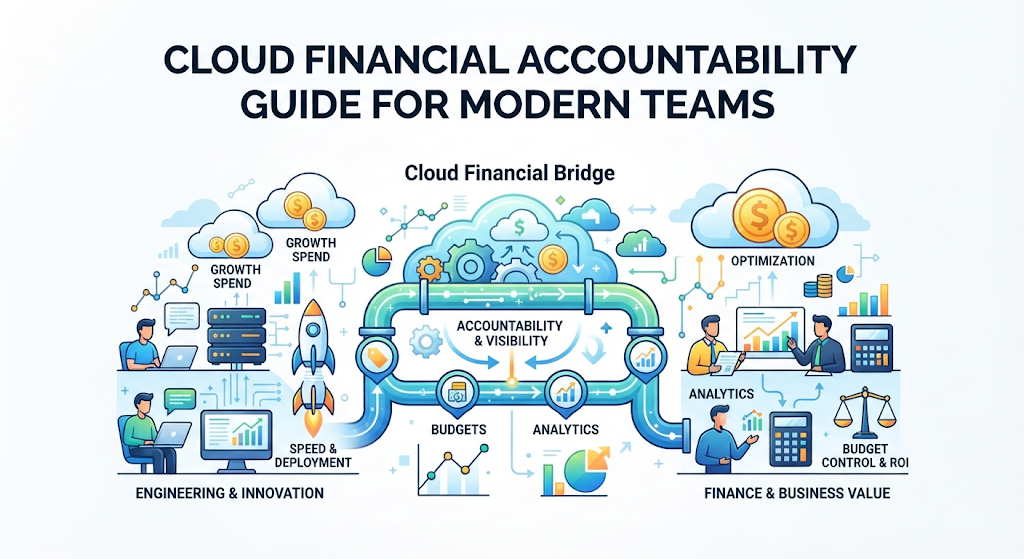
When finance teams panic about rising costs, they often react by freezing budgets or slowing down new projects. When engineering teams are restricted, innovation grinds to a halt. Teams find themselves trapped in a constant tug-of-war between spending money to move fast and saving money to keep budgets healthy.
This guide explains how modern organizations bridge that gap through cloud financial accountability. You will learn how to track spending, build teamwork across departments, avoid common financial traps, and keep your cloud costs aligned with business value.
What Is Cloud Financial Accountability?
Cloud financial accountability is a cultural and operational practice that brings financial responsibility to the people who write code and design systems.
In traditional data centers, hardware was bought months in advance through capital expenses. In the cloud, infrastructure is rented by the second. Anyone with a corporate credit card or cloud console access can launch expensive resources instantly. Accountability means giving those same people visibility into how much their architectural choices cost.
Why It Matters
Without clear accountability, cloud waste grows quietly. Forgotten test servers run 24 hours a day, over-provisioned databases sit idle, and data transfer fees pile up unnoticed. Accountability turns cloud costs from an unpredictable overhead mystery into a clear, manageable metric tied directly to business revenue.
How Cloud Financial Accountability Works
Implementing financial accountability in the cloud requires a blend of visibility, allocation, and shared ownership. It moves an organization through four main stages:
- Visibility: Seeing exactly where money is being spent down to the specific team, project, or feature.
- Allocation: Tagging and organizing cloud resources so costs belong to clear owners rather than a general corporate pool.
- Optimization: Removing waste, resizing oversized servers, and taking advantage of volume discounts.
- Collaboration: Regular syncs between finance, engineering, and product teams to review spending trends and set realistic targets.
Why Traditional Cloud Budgeting Fails
Many companies try to control cloud spending the old way: by letting the finance department review bills once a month and send warning emails when totals are too high. This approach almost always fails for several reasons.
- The Feedback Loop Is Too Slow: If an engineer accidentally leaves a heavy database running on the first of the month, finance might not notice until day thirty. By then, the damage is already done.
- Engineers Don’t Speak Accounting: Expecting software developers to understand complex amortization schedules or corporate finance terms creates a communication barrier.
- Finance Doesn’t Speak Architecture: Accountants often look at raw totals without understanding that a sudden cost spike might be tied to a profitable product launch or a necessary seasonal traffic spike.
Modern accountability replaces slow monthly emails with real-time dashboards and shared metrics that both engineers and finance professionals can understand.
Important Factors to Understand
To build a strong foundation for cloud financial accountability, teams must master a few core concepts.
Unit Economics
Instead of looking at total cloud spend in isolation, successful teams measure cost per unit of business value—such as cost per active user, cost per transaction, or cost per gigabyte delivered. If your total cloud bill goes up by twenty percent, but your customer base grows by fifty percent, your unit economics are actually improving.
Cost Allocation and Tagging
Cloud providers like Amazon Web Services (AWS), Microsoft Azure, and Google Cloud Platform (GCP) allow you to attach metadata tags (such as Team:Marketing, Environment:Production, or CostCenter:402) to resources. Clean tagging is the bedrock of accountability; without it, you cannot tell who is responsible for which line item on the bill.
Reserved Capacity and Savings Plans
Cloud providers offer discounts if you promise to use a certain amount of computing power for one to three years. Balancing these long-term commitments with the flexibility to scale down is a core skill in financial management.
Practical Examples
Example 1: The Forgotten Testing Environment
- The Situation: A development team spins up powerful servers to test a new mobile app feature over the weekend. On Monday, they move on to a different task and forget to shut the servers down.
- Without Accountability: The servers run quietly for three months. The company discovers the waste only when the annual audit happens.
- With Accountability: Automated alerts notify the engineering lead after forty-eight hours of low server utilization. The team shuts down the test environment immediately, saving thousands of dollars.
Example 2: Scaling for a Product Launch
- The Situation: An e-commerce company prepares for a massive holiday shopping event and provisions three times their normal server capacity.
- Without Accountability: Finance panics at the sudden tripling of the weekly cloud bill, assuming someone made a mistake.
- With Accountability: Because engineering and finance planned the event together using unit metrics, everyone understands that the higher cloud spend is directly supporting a record-breaking sales weekend.
Real-World Considerations
Implementing cloud accountability is not just about software tools; it requires changing habits across your organization.
- Cultural Resistance: Engineers often view cost tracking as annoying bureaucracy that slows them down. To overcome this, frame cost visibility as a tool for engineering efficiency, not just a tool for cutting budgets.
- Tagging Discipline: Enforcing consistent naming and tagging rules across large engineering organizations is notoriously difficult. Teams need automated guardrails that block untagged resources from being created in production.
- Tooling Complexity: Many cloud vendors offer native cost management tools, while third-party platforms provide advanced multi-cloud analytics. Choosing the right tool depends on your organization’s size and cloud footprint.
Common Mistakes
| Common Mistake | Why It Happens | Result | What to Do Instead |
|---|---|---|---|
| Blaming Engineers for Bills | Finance treats rising costs as a disciplinary issue. | Engineers become defensive and hide experimental projects. | Treat cost anomalies as engineering puzzles to solve collaboratively. |
| Over-Tagging Everything | Teams try to categorize every single tiny resource on day one. | Tagging fatigue sets in, and compliance drops to zero. | Start with high-level cost centers and owner tags for expensive resources. |
| Cutting Budgets Blindly | Leadership slashes cloud spending by a flat percentage across the board. | Critical customer-facing services slow down or experience outages. | Cut waste and idle resources first; protect resources that drive revenue. |
Risks and Limitations
- Stifling Innovation: If cost controls are too strict, engineers may hesitate to experiment with new technologies or test new product ideas.
- Data Privacy and Security: Granting finance teams broader visibility into cloud setups can sometimes expose sensitive configuration details if role-based access controls are not properly maintained.
- False Economies: Focusing too heavily on saving pennies on server costs can waste expensive engineering hours that would be better spent building product features.
Decision-Making Framework
Use this simple framework when evaluating whether a cloud spending decision or cost-cutting initiative makes sense:
- Identify the Driver: Is this cloud cost tied directly to revenue growth or customer usage? If yes, spending more is often healthy.
- Check for Waste: Are these resources running idle, or are they actively serving business needs?
- Evaluate Alternatives: Can we achieve the same performance using a smaller server size, a serverless architecture, or a committed-use discount?
- Assess Operational Overhead: Will saving money on this resource require more engineering maintenance than the savings are worth?
- Align and Decide: Share the findings with both technical and financial stakeholders before making changes.
Checklist for Cloud Financial Accountability
- Establish clear ownership tags for all major production cloud resources.
- Set up automated real-time alerts for unexpected cost spikes.
- Review unit economics (cost per user or transaction) rather than raw totals alone.
- Schedule monthly or quarterly syncs between engineering leads and finance teams.
- Audit idle databases, unattached storage volumes, and forgotten test environments regularly.
- Evaluate reserved capacity and savings plans to capture volume discounts.
Key Terms
- Cloud Financial Management (FinOps): The cultural practice of bringing financial accountability to the variable spend model of cloud computing.
- Cost Allocation: The process of dividing up a total cloud bill and assigning specific costs to individual teams, products, or departments.
- Over-provisioning: Renting more cloud computing power, memory, or storage than your application actually needs.
- Reserved Instances: A billing discount offered by cloud providers in exchange for a commitment to use a specific amount of computing power over a one- or three-year term.
- Unit Economics: Measuring business costs and revenues on a per-unit basis, such as the cloud cost required to serve a single customer.
- Tagging: Adding descriptive labels (like metadata) to cloud resources to track who owns them and what purpose they serve.
- Idle Resources: Cloud servers or storage volumes that are powered on and costing money but performing no useful work.
- Cost Anomaly: An unexpected, sudden spike in cloud spending that deviates from normal historical patterns.
FAQs
What is cloud financial accountability in simple terms?
It is a way of working where engineers and finance teams track cloud spending together so everyone knows who is spending money and whether that spending is helping the business grow.
Why do cloud bills get out of control so easily?
Because launching cloud servers is as easy as clicking a button. Without active monitoring, teams leave test servers running, buy more power than they need, and forget to clean up old projects.
Does cutting cloud costs mean slowing down development?
Not if it is done correctly. Good financial accountability focuses on eliminating waste and idle resources rather than restricting the computing power needed to build great products.
Who should be responsible for cloud costs?
Responsibility should be shared. Engineers are responsible for writing efficient code and shutting down unused resources, while finance helps track budgets and set high-level financial goals.
What is the first step a team should take to control cloud spending?
Start by improving resource tagging so you can clearly see which team or project is generating each part of the monthly cloud bill.
How often should cloud costs be reviewed?
While real-time alerts should catch major emergencies instantly, teams should hold formal cost-review meetings at least once a month.
Are cloud savings plans always worth it?
Not always. Savings plans offer great discounts, but they lock you into a contract. If your application architecture changes drastically, you might get stuck paying for capacity you no longer use.
Conclusion
Cloud financial accountability transforms the way organizations view their technology infrastructure. By breaking down the walls between finance and engineering, teams can stop treating cloud bills as unpredictable surprises.
When everyone understands the cost of their architecture, organizations can innovate rapidly, eliminate wasteful spending, and ensure that every dollar spent in the cloud directly supports business success.

