
Introduction
Moving applications and data to the cloud offers incredible flexibility. Companies can scale up resources instantly when traffic spikes and scale them down when things slow down. However, this flexibility comes with a hidden trap: unpredictable bills.
Many organizations move to platforms like Amazon Web Services (AWS), Microsoft Azure, or Google Cloud Platform without a clear plan for managing expenses. Cloud bills often arrive much higher than expected, causing panic among executives.
To solve this problem, companies rely on FinOps (Cloud Financial Operations). It is a cultural and technical practice that brings finance, technology, and business teams together to get the maximum value from every dollar spent in the cloud. Because companies desperately need help controlling these costs, professionals who understand this practice are in high demand.
Earning a formal credential in this field is one of the fastest ways to prove your expertise. This article explores how FinOps certifications improve cloud career opportunities, what you learn, and how these credentials help you stand out to employers.
What Is FinOps and Why Is It Transforming Cloud Careers?
FinOps (Cloud Financial Operations) is an operational framework that combines cloud technology, business strategy, and financial accountability.
- Simple meaning: FinOps helps companies figure out exactly what they are spending in the cloud, who is spending it, and how to get rid of wasted resources.
- Why it matters: Traditional IT budgets were predictable because servers were physical and bought once every few years. Cloud spending changes every second. Without control, companies waste massive amounts of money on idle virtual machines and unoptimized storage.
- Example: Imagine a software company that leaves test servers running 24/7 over the weekend when no one is working. A FinOps professional spots this waste, sets up automated shutdown schedules, and saves the company thousands of dollars a month.
As cloud adoption matures, companies are moving past the “lift-and-shift” phase. They are no longer just trying to get into the cloud; they are trying to run efficiently. This shift has created a massive job market for professionals who speak both the language of software engineers and the language of corporate finance.
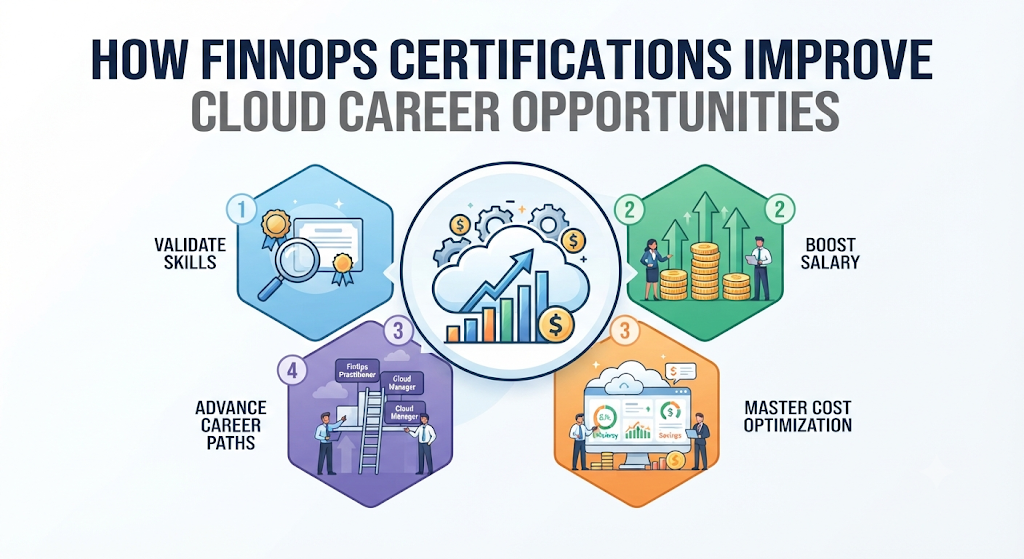
How FinOps Certifications Validate Your Expertise
A certification is a formal credential awarded by a recognized organization after you pass an exam. It acts as an official stamp of approval on your skills.
1. Proof of Cross-Functional Knowledge
Cloud engineers often struggle to understand corporate budgeting, depreciation, and unit economics. Conversely, finance professionals often struggle to understand containers, virtual CPUs, and data egress fees. A FinOps certification proves that you understand both worlds. It shows employers that you can talk to a software developer about optimizing code architecture and talk to a Chief Financial Officer (CFO) about quarterly forecasts.
2. Industry Recognition
Organizations like the FinOps Foundation (part of the Linux Foundation) set the global standards for cloud financial management. When your resume lists a recognized credential from such a body, hiring managers immediately know your knowledge aligns with modern industry best practices.
3. Accelerated Credibility
If you are trying to transition from a traditional IT role, a general cloud certification (like an associate-level cloud architect exam) shows you know how to build things. A FinOps certification shows you know how to build things cost-effectively. This commercial awareness makes you invaluable to leadership teams.
Core Skills Gained Through FinOps Certification Training
Preparing for a FinOps exam teaches you practical skills that you can apply immediately on the job.
- Cost Allocation: Learning how to tag and label cloud resources so companies know which department, product, or customer is driving specific cloud expenses.
- Unit Economics: Connecting cloud spend directly to business metrics, such as calculating the cloud cost per active user or per transaction.
- Rate and Usage Optimization: Understanding how to use commitment-based discounts like Reserved Instances and Savings Plans without locking the company into rigid contracts.
- Anomaly Detection: Setting up alerts to catch unexpected cost spikes before they turn into massive financial surprises at the end of the month.
- Cultural Change: Learning how to motivate engineering teams to care about cost efficiency without slowing down product delivery or software deployment speed.
Impact on Career Opportunities and Job Roles
Earning a specialized credential opens doors to specific career paths that did not exist a few years ago.
Emerging Job Titles
- FinOps Practitioner: A professional responsible for day-to-day cost tracking, reporting, and driving optimization conversations between teams.
- Cloud Cost Optimization Engineer: A technical role focused on resizing underutilized servers, cleaning up orphan storage volumes, and automating efficiency workflows.
- FinOps Manager / Director: A leadership role responsible for building a company-wide cloud financial strategy, setting organizational budgets, and reporting directly to executive leadership.
Expanding Responsibilities for Existing Roles
Even if you do not want a dedicated FinOps job title, having the credential makes you a stronger candidate for your current position:
- For Cloud Architects: It helps you design systems that are both high-performing and budget-conscious.
- For Finance Professionals: It helps you move from looking backward at past bills to predicting future cloud expenses accurately.
- For DevOps Engineers: It adds a layer of financial accountability to your technical deployments.
Common Mistakes Professionals Make Regarding Certifications
Many people approach professional certifications with the wrong mindset. Avoiding these common errors will help you get a much better return on your investment.
- Mistake: Collecting certifications just to pad a resume without understanding the underlying concepts.
- Why it causes problems: Interviewers quickly spot candidates who memorized exam answers but cannot solve real-world problems.
- What to do instead: Focus on practical labs, real-world case studies, and applying cost-saving principles in your current workplace or sandbox environment.
- Mistake: Assuming FinOps is only about cutting costs.
- Why it causes problems: Aggressive cost-cutting can slow down innovation and upset engineering teams.
- What to do instead: Learn how FinOps focuses on maximizing business value, which sometimes means spending more money if the investment drives revenue and growth.
- Mistake: Ignoring the cultural aspect of cloud financial management.
- Why it causes problems: Treating FinOps as purely a software tool or spreadsheet exercise ignores the human element.
- What to do instead: Study organizational change management, collaboration techniques, and how to build a culture of shared accountability.
Risks and Limitations of Relying Solely on Credentials
While certifications improve career opportunities, they are not a magic shortcut.
- Practical Experience Gap: A certificate proves you passed a test; it does not replace hands-on experience dealing with messy, poorly tagged enterprise cloud environments.
- Rapidly Changing Technology: Cloud providers update their pricing models, discount structures, and native tools constantly. What you learn in an exam prep course must be updated with continuous learning.
- Organizational Resistance: Introducing financial accountability to engineering teams can cause friction. Certification exams teach you the ideal framework, but real life involves politics, legacy systems, and stubborn habits.
How to reduce these risks: Combine your certification studies with hands-on practice. Use free tier cloud accounts to practice tagging resources, setting up budgets, and analyzing cost explorer dashboards.
Decision-Making Framework: Is a FinOps Certification Right for You?
Use this simple step-by-step framework to decide if you should pursue a FinOps credential right now:
- Check Your Current Role: Are you working in cloud engineering, finance, DevOps, procurement, or IT management? If yes, FinOps is likely relevant.
- Assess Market Demand: Look at job boards in your region or target market. Search for terms like “FinOps” or “Cloud Cost Optimization” to see how many companies are hiring for these skills.
- Evaluate Your Knowledge Gap: Do you understand cloud pricing models, commitment discounts, and cost allocation? If these concepts are unfamiliar, structured certification training will accelerate your learning.
- Consider Return on Investment (ROI): Compare the cost and study time of the certification against the potential salary bump or career advancement it could unlock.
- Commit to Practical Application: Ensure you have an opportunity—either in your current job or through personal projects—to apply what you learn so the credential translates into real competence.
Key Terms
- Cloud Financial Operations (FinOps): An operational framework that brings finance and engineering together to control cloud costs and drive business value.
- Reserved Instances (RIs): A billing discount model where a company commits to using a specific type of cloud resource for a 1- or 3-year term in exchange for a lower hourly rate.
- Unit Economics: A financial calculation that measures costs and revenues in relation to a specific business metric, such as cost per active customer.
- Cloud Tagging: The practice of attaching metadata labels to cloud resources to track who owns them and what project they support.
- Orphaned Resources: Cloud storage volumes, virtual servers, or IP addresses that are no longer attached to an active application but continue to generate charges.
Frequently Asked Questions
What is the most recognized FinOps certification?
The Certified FinOps Practitioner (FOCP), offered by the FinOps Foundation, is currently the most widely recognized and respected foundational credential in the industry.
Do I need a technical background in coding to learn FinOps?
No. While understanding basic cloud concepts is helpful, FinOps sits at the intersection of finance, business, and technology. Many successful professionals come from financial analysis, procurement, or project management backgrounds.
How long does it take to prepare for a FinOps exam?
For professionals with some basic familiarity with cloud computing or corporate finance, preparation typically takes between 2 to 4 weeks of dedicated study.
Will a FinOps certification help me get a higher salary?
Yes. Because cloud waste is a major pain point for enterprises, specialized skills in cost optimization make professionals more valuable, often leading to promotions, specialized roles, and higher compensation packages.
Can FinOps principles be applied to multiple cloud providers?
Yes. FinOps is a methodology, not a specific software tool. The core principles of visibility, optimization, and collaboration apply equally across AWS, Azure, Google Cloud, and multi-cloud environments.
What is the difference between standard cloud certifications and FinOps certifications?
Standard cloud certifications (like AWS Solutions Architect) focus primarily on how to build, secure, and scale cloud infrastructure. FinOps certifications focus on how to manage the financial impact, efficiency, and business value of that infrastructure.
Conclusion
Managing cloud expenses is no longer an afterthought; it is a critical business priority for modern organizations. As companies continue migrating workloads to the cloud, the demand for professionals who understand how to control costs without slowing down innovation will only grow.
Earning a FinOps certification provides structured knowledge, validates your cross-functional expertise, and signals to employers that you understand how to drive both technical performance and financial accountability. By combining this credential with hands-on practice and strong communication skills, you can position yourself for exciting new career opportunities in the fast-growing world of cloud financial management.

