
Introduction
In the past, running a technology company was physically heavy. If a business needed more computing power, someone had to buy physical servers, carry them into a data room, plug them in, and wire them up.
This process had a built-in brake. Buying physical hardware required long procurement cycles, capital expenditure approvals, and deep financial reviews. Finance teams loved this because costs were predictable and visible.
Today, the cloud has changed everything. With a few clicks or a line of code, an engineer can spin up thousands of servers in seconds. This brings incredible speed and flexibility, but it also creates a massive financial blind spot. At the end of the month, the finance team receives an unpredictable cloud bill that looks nothing like traditional expenses.
When this happens, friction begins. Finance panics over rising costs and tries to enforce strict spending freezes. Engineers feel micromanaged, seeing finance as an obstacle that slows down innovation.
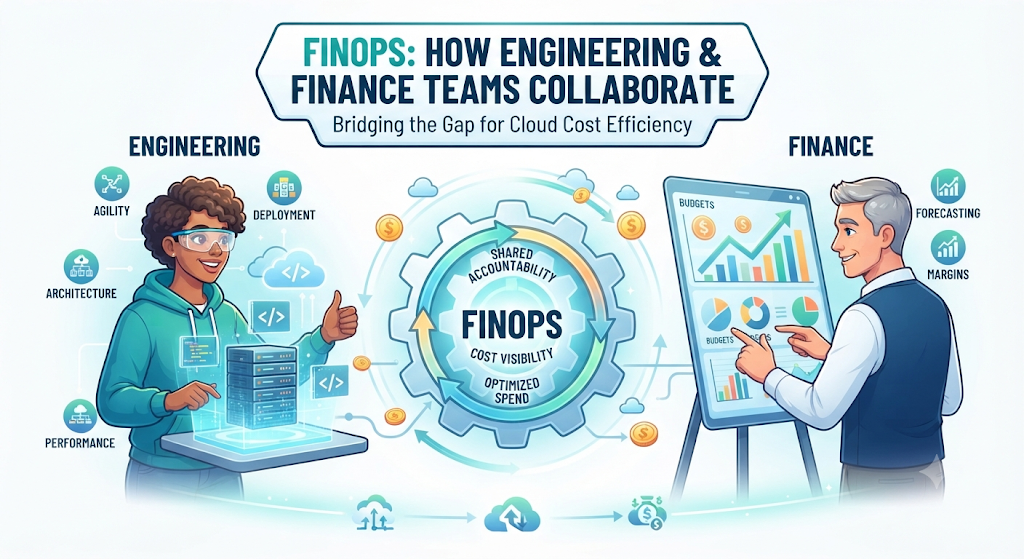
This is where FinOps comes in. It bridges the gap between the people who build products and the people who manage budgets, turning cloud spending from a source of conflict into a shared superpower.
What Is FinOps?
FinOps stands for Cloud Financial Operations.
- Simple meaning: FinOps is a team sport where engineering, finance, and business leaders work together to figure out how much the cloud costs and how to spend that money wisely.
- Why it matters: Without FinOps, cloud costs spiral out of control, or innovation stops because finance cuts budgets blindly.
- Example: Imagine an engineering team launching a new streaming feature. Under FinOps, the team builds cost visibility directly into their project planning, ensuring they know how much user traffic the feature can handle before the monthly bill surprises the finance department.
FinOps is not a software tool you install, and it is not just a department inside the finance building. It is a cultural shift. It changes how an organization thinks about money in the digital age.
How FinOps Works: The Three-Phase Lifecycle
FinOps operates as a continuous journey rather than a one-time project. The framework moves through three core phases: Inform, Optimize, and Operate.
[ Inform (Visibility) ] ---> [ Optimize (Efficiency) ] ---> [ Operate (Alignment) ]
        ^                                                            |
        +------------------ ( Continuous Loop ) ---------------------+
1. Inform (Visibility and Allocation)
You cannot manage what you cannot see. In the Inform phase, organizations gather cloud usage data and map it directly to the teams, products, or features that use it.
- The Problem: Many companies get a single massive cloud bill that lists thousands of server hours, but nobody knows which department caused the spike.
- The Solution: FinOps introduces “tagging” and attribution. Every server, database, and storage bucket is labeled with owner metadata so costs are clearly assigned.
2. Optimize (Efficiency)
Once everyone can see where the money goes, it is time to reduce waste. Cloud providers like Amazon Web Services (AWS), Microsoft Azure, or Google Cloud offer various pricing discounts, and engineers often leave test resources running by accident.
- The Problem: Engineers focus on uptime and performance, leaving idle resources running after tests finish.
- The Solution: Teams identify waste—such as oversized servers or forgotten databases—and apply discounts like reserved instances or savings plans.
3. Operate (Cultural Alignment)
This phase is where engineering and finance lock arms. Teams set continuous goals, track unit economics (such as cost per active user), and adjust budgets based on business growth rather than arbitrary limits.
Why Engineering and Finance Teams Struggle to Communicate
To understand why FinOps is necessary, we have to look at how differently engineering and finance teams view the world. They speak completely different languages.
| Dimension | Engineering View | Finance View |
|---|---|---|
| Primary Goal | Speed, uptime, feature delivery, and performance. | Predictability, margin protection, budget adherence, and risk management. |
| View of Money | Money is fuel to build products and scale systems. | Money is a limited resource that must be carefully allocated and tracked. |
| Planning Cycle | Agile sprints, continuous deployment, real-time adjustments. | Quarterly budgets, annual forecasts, fixed financial periods. |
| Common Frustration | “Finance slows us down with unnecessary paperwork and bureaucracy.” | “Engineering spends money without warning and misses budget forecasts.” |
When these two worldviews collide without a framework like FinOps, organizations experience continuous tension. Engineers feel micromanaged, and finance teams feel ignored.
How FinOps Brings Engineering and Finance Together
FinOps creates a neutral meeting ground where both teams win.
Giving Finance Real-Time Visibility
Finance teams are used to looking backward. They analyze financial statements weeks after a month ends. In the cloud, waiting a month to see a bill is far too late; a misconfigured database can rack up thousands of dollars in a single weekend.
FinOps gives finance near-real-time visibility into cloud consumption. Instead of being the “budget police” who say no after the fact, finance becomes a strategic advisor helping engineers forecast future costs.
Empowering Engineers with Cost Accountability
Engineers do not want to waste money; they simply lack financial context when writing code. A developer might choose a high-performance database because it is fast and reliable, without realizing it costs ten times more than a standard option that would work just as well.
FinOps integrates cost metrics directly into engineering dashboards. When an engineer sees the financial impact of their architecture choices right inside their development tools, they can make smarter design decisions naturally.
Practical Examples: FinOps in Action
Example 1: The E-Commerce Search Feature
An online retail company launches a new AI-powered product search.
- Without FinOps: The engineering team builds the search tool using high-end cloud instances to ensure lightning-fast results. It launches successfully, but at the end of the month, the cloud bill jumps by 40%. Finance panics and demands an immediate 50% budget cut across the board. The engineering team has to scramble, hastily disabling features and damaging user experience.
- With FinOps: During the design phase, engineering and finance collaborate. They estimate that each search query will cost a fraction of a cent, but project high user volume. They set up cost alerts and optimize the search queries to run on more cost-effective hardware. The feature launches smoothly, stays within budget, and delivers strong profit margins.
Example 2: The Forgotten Test Environment
- Without FinOps: Developers spin up a massive cluster of servers on a Friday evening to test a software update. They forget to shut it down over the weekend. On Monday, the company has paid for 72 hours of heavy computing power that nobody used.
- With FinOps: Automated guardrails and tagging alert the engineering team when non-production environments are left running idle outside of working hours, saving money instantly without manual finance intervention.
Common Mistakes When Implementing FinOps
Organizations often stumble when starting their FinOps journey. Avoiding these common pitfalls ensures a smoother cultural shift.
- Treating FinOps as a Cost-Cutting Exercise: If finance uses FinOps purely as a weapon to slash cloud budgets, engineers will rebel and hide their resource usage. FinOps is about maximizing value, not just spending less.
- Leaving Out Engineering Leadership: Finance cannot impose a FinOps tool or policy without engineering buy-in. Engineers must help design the workflows.
- Focusing Solely on Tooling: Buying expensive FinOps software does not fix a broken culture. Communication and shared goals matter far more than software dashboards.
- Ignoring Unit Economics: Looking only at total cloud spend is misleading. If your cloud bill doubles, but your customer base triples, your cloud efficiency actually improved. Always measure cost relative to business growth.
Risks and Limitations of FinOps
While FinOps is powerful, it is not a silver bullet. Understanding its limitations helps manage expectations.
- Cultural Resistance: Changing how people work takes time. Engineers may view FinOps metrics as administrative overhead that pulls them away from coding.
- Data Complexity: Modern cloud environments are vast and complex. Accurately attributing shared costs (like core networking or security tools) to specific teams can be technically difficult.
- Over-Optimization Risk: If teams become overly obsessed with cutting every penny, they can slow down product delivery or create brittle, hard-to-maintain architectures. Speed and innovation still matter.
Decision-Making Framework: Is Your Organization Ready for FinOps?
Use this simple framework to evaluate whether your company needs to formalize a FinOps practice:
- Check Your Cloud Spend Growth: Is your cloud bill growing faster than your revenue or user base?
- Review Visibility: Can you instantly tell which team or product drove last month’s cloud cost increase?
- Assess Team Relationships: Do engineering and finance point fingers at each other when budgets are exceeded?
- Evaluate Accountability: Do engineers factor cost into their architectural choices before writing code?
If you answered “yes” to growth and visibility problems, but “no” to accountability and collaboration, your organization is an ideal candidate for FinOps.
FinOps Implementation Checklist
Before rolling out a FinOps initiative across your organization, verify that you have covered these foundational steps:
- Establish a Cross-Functional Team: Bring together representatives from engineering, finance, and product leadership.
- Implement Resource Tagging Standards: Create a clear, mandatory naming convention for all cloud resources.
- Establish Cost Visibility: Set up dashboards that show daily cloud spending trends to both engineers and finance.
- Define Unit Metrics: Determine how you will measure cloud efficiency relative to business output (e.g., cost per active user).
- Set Up Anomaly Alerts: Configure automated notifications for unexpected daily spikes in cloud spending.
- Review Commitments Regularly: Analyze usage patterns to take advantage of volume discounts and reserved capacity.
Key Terms
- Attribution: The practice of assigning specific cloud costs to the exact team, product, or customer that consumed the resources.
- Reserved Instances: A billing discount offered by cloud providers in exchange for committing to use a specific type of resource for a 1- or 3-year term.
- Unit Economics: A financial calculation that measures profitability or cost on a per-unit basis, such as the cost to serve a single customer.
- Tagging: Adding metadata labels (like “Owner: Marketing” or “Environment: Testing”) to cloud resources to track their purpose and cost.
- Over-Provisioning: Buying or provisioning more cloud computing power than you actually need “just in case,” leading to wasted money.
- Cloud Sprawl: The uncontrolled proliferation of unmanaged cloud resources accumulating across an organization over time.
- Forecast Accuracy: How closely your predicted cloud spending matches your actual monthly bill.
- Idle Resources: Cloud servers or storage volumes that are running and costing money but performing no useful work.
Frequently Asked Questions
What is the main goal of FinOps?
The main goal of FinOps is to bring financial accountability to the variable spend model of the cloud, helping engineering, finance, and business teams work together to maximize business value.
Who should lead a FinOps initiative?
FinOps is usually driven by a cross-functional team. It often starts with champions from either finance or engineering who understand both operational costs and technical architecture, but it requires buy-in from leadership across all departments.
Is FinOps only for large enterprises?
No. While large enterprises with massive cloud bills benefit greatly, startups and mid-sized companies can use FinOps principles early to build cost-aware habits before cloud waste gets out of hand.
How does FinOps differ from traditional IT budgeting?
Traditional IT budgeting involves fixed yearly costs for physical hardware. FinOps addresses the cloud model, where costs fluctuate daily based on usage, requiring real-time tracking and dynamic adjustments.
Does FinOps mean cutting engineering budgets?
Not at all. FinOps is about spending smarter, not spending less. If an engineering team can prove that spending an extra $1,000 on cloud infrastructure generates $10,000 in new revenue, a FinOps culture will greenlight that investment.
What tools are used in FinOps?
Organizations use a mix of native cloud provider dashboards (like AWS Cost Explorer or Azure Cost Management) and specialized third-party FinOps platforms to track, analyze, and optimize spending.
How do you get engineers to care about cloud costs?
You get engineers to care by giving them clear, easy-to-use data without bogging them down in bureaucracy. When engineers see how cost data helps them build better, more efficient systems, they embrace it naturally.
Conclusion
Cloud computing unlocked unprecedented speed and innovation for modern businesses, but it broke traditional financial management models. Leaving engineering and finance in separate silos leads to surprise bills, friction, and wasted resources.
FinOps restores balance by uniting these two critical teams under a shared mission. By combining engineering expertise with financial visibility, organizations can innovate rapidly without losing control of their bottom line.
True financial success in the cloud is not about spending as little as possible—it is about ensuring that every dollar spent drives real, measurable business value.

