
Introduction
Choosing a career in cloud computing can feel overwhelming. Many people look at massive lists of tools, services, and certifications and wonder where to start.
The cloud has completely changed how companies build software. Instead of buying physical computers, servers, and storage hard drives, companies rent computing power from technology giants like Google. Because of this massive shift, the demand for people who know how to set up, secure, and manage these cloud environments is higher than ever.
However, many beginners make the mistake of trying to learn everything at once. They study every single database, networking tool, and security product without a clear plan. This leads to burnout and confusion.
This guide breaks down the Google Cloud career path into clear, manageable steps. You will learn what skills you need, how roles progress from beginner to expert, and how to avoid common career traps along the way.
What Is a Google Cloud Career Path?
A Google Cloud career path is a step-by-step roadmap that guides your professional growth in cloud computing, specifically focusing on Google Cloud Platform (GCP).
Think of GCP as a giant digital toolbox provided by Google. A career path helps you figure out which tools to pick up first, which ones to learn next, and how to prove your skills to employers.
Why Google Cloud Matters
Google Cloud is one of the top three major cloud providers in the world, alongside Amazon Web Services (AWS) and Microsoft Azure. Thousands of companies—from small startups to massive banks and retail giants—use Google Cloud to run their websites, store their data, and build artificial intelligence applications.
When you specialize in Google Cloud, you position yourself in a high-demand job market where skilled engineers are constantly needed.
The Core Roles: Cloud Engineer vs. DevOps Engineer
As you explore this career path, you will often see two distinct titles: Cloud Engineer and DevOps Engineer. While they work closely together, their day-to-day focus is different.
1. Cloud Engineer
A Cloud Engineer is responsible for day-to-day operations in the cloud. They set up servers, manage storage, configure secure networks, and ensure that applications run smoothly.
- Primary Focus: Building and maintaining cloud infrastructure.
- Key Tasks: Creating virtual machines, setting up databases, managing user access, and monitoring system health.
2. DevOps Engineer
A DevOps Engineer bridges the gap between software developers and IT operations. “DevOps” combines Development and Operations. Their goal is to make software delivery faster, safer, and more automated.
- Primary Focus: Automation, speed, and reliability.
- Key Tasks: Writing code to build infrastructure automatically (Infrastructure as Code), setting up automated testing pipelines, and ensuring rapid software updates without crashing production systems.
Step-by-Step Google Cloud Career Journey
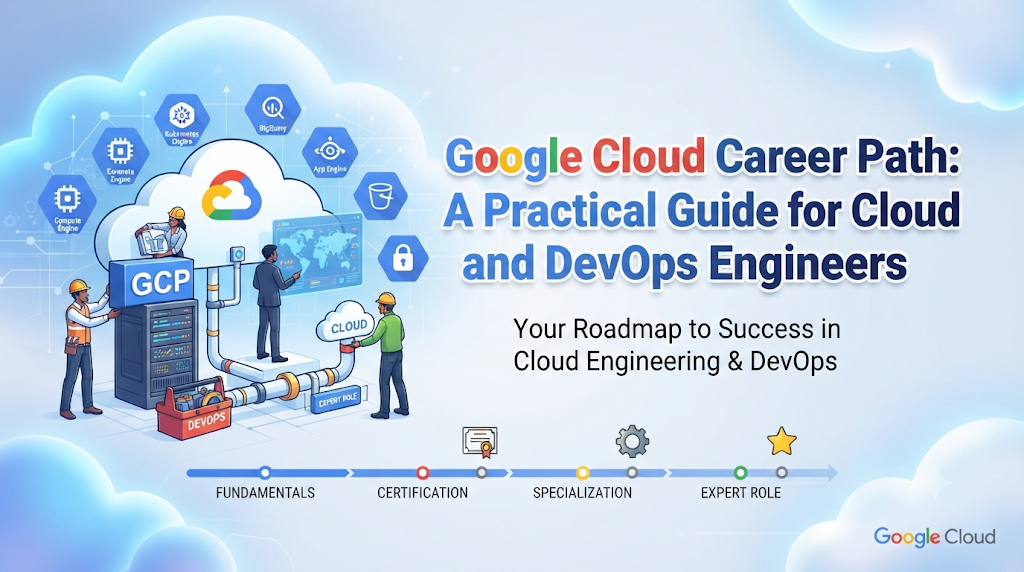
Your career journey will typically move through three main stages: Foundation, Specialization, and Leadership.
Stage 1: The Foundation (Getting Started)
Before touching Google Cloud, you need to understand how traditional computers and networks work. You cannot secure a cloud network if you do not understand how basic networking works.
- Operating Systems: Learn the basics of Linux, as most cloud servers run on Linux.
- Networking: Understand IP addresses, DNS, firewalls, and routers.
- Version Control: Learn how to use Git and GitHub to manage code.
Stage 2: Associate Level (Entry to Mid-Level)
Once you have the basics, you step into your first official cloud role. At this stage, you prove your competence through hands-on work and certification.
- Target Certification: Google Cloud Certified Associate Cloud Engineer.
- What You Learn: How to deploy applications, monitor operations, and manage enterprise solutions on GCP. You will use core services like Compute Engine (virtual servers) and Cloud Storage.
Stage 3: Professional and Expert Level (Advanced)
After a few years of hands-on experience, you specialize. You can choose to become a deep technical architect, a security specialist, or a senior DevOps automation expert.
- Target Certifications:
- Google Cloud Certified Professional Cloud Architect
- Google Cloud Certified Professional DevOps Engineer
- What You Learn: Complex system design, disaster recovery planning, advanced security frameworks, and cost optimization at scale.
Why These Skills Matter: Real-World Scenarios
To understand why these roles are valuable, consider a real-world example.
Imagine a popular online clothing store. On a normal Tuesday, they have a few thousand visitors. But on Black Friday, millions of shoppers visit the site at the same time.
- Without Cloud Engineering: The company’s physical servers would crash under the sudden traffic spike, customers would get error messages, and the company would lose millions of dollars in sales.
- With Cloud Engineering: A skilled Google Cloud and DevOps engineer sets up auto-scaling. This means that when traffic increases, Google Cloud automatically creates hundreds of new virtual servers in seconds to handle the load. When the rush is over, those servers automatically shut down so the company doesn’t waste money.
Common Mistakes Beginners Make
Many aspiring cloud and DevOps engineers struggle because they fall into common traps.
1. Collecting Certifications Without Practice
- What people do: They watch video courses and pass multiple-choice exams without ever building anything hands-on.
- Why it causes problems: When an interviewer asks them to fix a broken server configuration, they freeze because they only know theory.
- What you should do instead: For every hour you spend watching a tutorial, spend two hours building projects in a free-tier or sandbox cloud environment.
2. Ignoring the Fundamentals
- What people do: They jump straight into advanced Kubernetes and automation tools without learning basic Linux command lines or networking principles.
- Why it causes problems: Advanced tools are built on top of basic technology. If a network packet fails, you need to know how routing works to fix it.
- What you should do instead: Build a strong foundation in networking, Linux, and scripting (like Python or Bash) before tackling complex cloud platforms.
3. Focusing Only on Tools, Not Problem Solving
- What people do: They try to memorize every single product name and feature inside Google Cloud.
- Why it causes problems: Cloud platforms change constantly, and Google frequently updates or renames services.
- What you should do instead: Focus on concepts (like load balancing, security principles, and data persistence) rather than just memorizing tool names.
Decision-Making Framework: Choosing Your Specialization
When you reach the mid-level stage of your career, you will need to choose whether to lean closer to pure Cloud Architecture or DevOps and Site Reliability Engineering (SRE). Use this simple framework to decide:
- Assess Your Interests: Do you enjoy designing large, secure networks and planning how systems connect? Lean toward Cloud Architecture. Do you love writing scripts, automating repetitive tasks, and building deployment pipelines? Lean toward DevOps.
- Evaluate Your Current Skills: If you enjoy software coding and logic, DevOps is a natural fit. If you prefer system administration, infrastructure layout, and business alignment, architecture is ideal.
- Check Market Demand: Both paths are in extremely high demand, but DevOps engineers who understand modern container tools (like Docker and Kubernetes) often find rapid job placement.
Key Terms
- Compute Engine: Google’s service that provides virtual machines (computers running in Google’s data centers).
- Containers (Docker): A lightweight way to package an application and everything it needs to run so it can work reliably on any computer.
- Kubernetes: An open-source system (originally created by Google) for automating the deployment and scaling of containerized applications.
- Infrastructure as Code (IaC): Managing and provisioning cloud infrastructure through code files rather than manually clicking buttons in a web dashboard.
- Auto-scaling: Automatically adjusting the number of computing resources running based on current traffic demand.
- IAM (Identity and Access Management): A security system that controls who can access specific cloud resources.
- CI/CD (Continuous Integration / Continuous Delivery): A method to frequently deliver apps to customers by introducing automation into the stages of development.
- Serverless: A cloud computing model where you write code, and Google manages the servers entirely—you only pay when your code runs.
FAQs
1. Do I need a computer science degree to follow a Google Cloud career path?
No. While a degree can be helpful, the tech industry values practical, demonstrable skills above all else. Many successful cloud and DevOps engineers are self-taught or transitioned from unrelated fields by building strong portfolios and earning recognized certifications.
2. Which Google Cloud certification should I get first?
You should start with the Google Cloud Certified Associate Cloud Engineer. It is designed for individuals with 6+ months of hands-on experience on GCP and tests practical, real-world operational skills.
3. Is coding required for a DevOps career?
Yes, but not in the way software developers code. You won’t be building mobile apps or video games. Instead, you will write scripting languages (like Python or Bash) and configuration code (like YAML or Terraform) to automate infrastructure tasks.
4. How long does it take to become a certified Google Cloud Engineer?
If you already have a background in IT, networking, or software development, it typically takes 3 to 6 months of dedicated study and hands-on practice to pass the Associate exam. If you are starting completely from scratch, plan for 6 to 12 months.
5. Can I practice Google Cloud without spending money?
Yes. Google Cloud offers a Free Tier that includes a monthly credit or always-free resource limits, allowing you to build and test basic applications without incurring costs. Always remember to shut down resources when you finish practicing!
Conclusion
Building a career in Google Cloud as a Cloud or DevOps engineer is a rewarding journey that blends technical problem-solving with high earning potential. Success does not come from rushing through certifications or trying to memorize every tool overnight.
Instead, focus on building a solid foundation in networking and Linux, mastering core GCP services through hands-on practice, and learning how to automate workflows. By focusing on practical skills and continuous learning, you can build a stable, long-term career in the fast-growing world of cloud computing.

