
Introduction
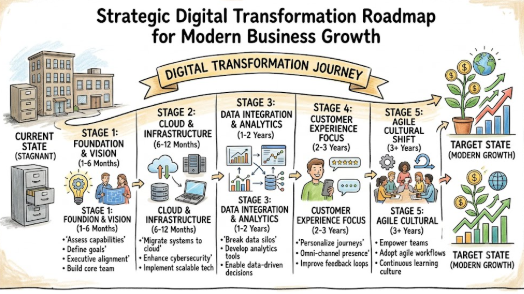
Many businesses know they need technology, but they do not always know where to begin. A startup may feel pressure to launch faster, reduce manual work, and serve customers better, while an enterprise may struggle with old systems, slow approvals, disconnected data, and rising competition. This is where a Digital Transformation Roadmap for Startups and Enterprises becomes important. It helps organizations move from random tool adoption to a structured plan. Instead of buying software without direction, businesses can understand their current problems, define goals, improve workflows, protect data, train teams, and measure progress. This blog explains digital transformation in a beginner-friendly way so leaders can make practical, safe, and scalable decisions.
Understanding Digital Transformation Roadmap in Simple Words
A digital transformation roadmap is a structured plan that shows how a business will use technology to improve operations, customer experience, decision-making, security, and growth.
Digital transformation is not only about buying software. It is about improving the way people, processes, data, and technology work together.
For example, a small business may still manage customer orders using phone calls, WhatsApp messages, paper notes, and spreadsheets. As the business grows, this approach can create missed orders, delayed responses, duplicate work, and poor customer experience. A digital roadmap may recommend a CRM system, automated order tracking, digital payment records, cloud storage, and customer support workflows.
A common misunderstanding is that digital transformation means replacing humans with technology. In reality, good transformation helps people work better by reducing repetitive tasks and improving clarity.
The practical takeaway is simple: digital transformation should begin with business problems, not with software shopping.
Why Digital Transformation Roadmap for Startups and Enterprises Is Important
A Digital Transformation Roadmap for Startups and Enterprises is important because technology decisions affect cost, productivity, customer trust, employee performance, and long-term competitiveness.
For startups, a roadmap helps avoid messy growth. Many startups begin with quick fixes, free tools, and informal processes. That may work in the early stage, but it becomes risky when customers, employees, transactions, and data increase.
For enterprises, a roadmap helps modernize old systems, reduce operational delays, improve collaboration, and make better use of data. Enterprises often have multiple departments using separate systems, which creates silos and slows decision-making.
Digital transformation affects:
- Savings: Automation can reduce repetitive manual effort and operational waste.
- Borrowing and investment decisions: Better digital records can improve financial planning and business visibility.
- Tax and compliance: Organized digital records help businesses maintain invoices, reports, and audit trails.
- Risk awareness: Cybersecurity, data privacy, vendor dependency, and system downtime must be reviewed.
- Better planning: Leaders can prioritize projects based on business value.
- Emotional decision-making: A roadmap prevents rushed decisions driven by trends or competitor pressure.
- Long-term discipline: Businesses can modernize in phases instead of trying to change everything at once.
A practical scenario: A growing startup wants to buy five different software tools because competitors are using them. Without a roadmap, it may waste money. With a roadmap, it first identifies the biggest bottleneck, such as customer support delays, and selects one tool that solves the most urgent problem.
The Real Problem Readers Face With Digital Transformation
The biggest problem is not a lack of technology. The real problem is lack of clarity.
Many founders, managers, and business owners hear words like cloud, automation, AI, CRM, ERP, DevOps, cybersecurity, analytics, and digital strategy. However, they may not know which one matters first for their business.
Common problems include:
- Too much confusing advice online
- Pressure to copy competitors
- Buying tools without understanding workflows
- Weak comparison between platforms
- Unrealistic expectations from automation or AI
- Ignoring cybersecurity and data privacy
- Not training employees properly
- Depending only on social media trends
- Not calculating long-term maintenance cost
- Not knowing the right next step
A startup may think digital transformation means launching an app. An enterprise may think it means migrating everything to the cloud. Both views are incomplete.
The better approach is to start with business goals. For example, does the business want faster delivery, lower operating cost, better customer service, stronger reporting, improved security, or scalable infrastructure? Once the goal is clear, technology selection becomes easier.
Digital transformation fails when it becomes a tool project. It works better when it becomes a business improvement journey.
How Digital Transformation Roadmap Works Step by Step
Step 1: Assess the Current Business Situation
What it means:
This step identifies how the business currently works, including processes, systems, teams, customer journeys, data flow, and pain points.
Why it matters:
Without understanding the current situation, businesses may solve the wrong problem.
How to apply it:
Review daily operations, customer complaints, team delays, manual work, system gaps, and reporting problems.
Practical example:
A retail startup notices that order delays happen because inventory is updated manually at the end of each day.
Common mistake:
Jumping directly to software purchase without process review.
Better approach:
Map the current workflow first, then decide what should be automated or improved.
Step 2: Define Clear Business Goals
What it means:
This step connects digital transformation with measurable business goals.
Why it matters:
Technology should support business outcomes, not create unnecessary complexity.
How to apply it:
Set goals such as reducing manual approvals, improving customer response time, centralizing data, or increasing reporting accuracy.
Practical example:
An enterprise may define a goal to reduce duplicate data entry across departments.
Common mistake:
Using vague goals like “become digital” or “use AI.”
Better approach:
Create specific goals such as “centralize customer records across sales, support, and billing.”
Step 3: Prioritize Processes for Transformation
What it means:
Not every process needs digital transformation at the same time. This step selects the most important areas first.
Why it matters:
Trying to transform everything together can increase cost, confusion, and resistance.
How to apply it:
Rank processes based on business impact, urgency, cost, risk, and ease of improvement.
Practical example:
A startup may prioritize digital invoicing before advanced analytics because billing errors are causing payment delays.
Common mistake:
Choosing the most exciting technology instead of the most painful problem.
Better approach:
Start with high-impact, low-complexity improvements.
Step 4: Select the Right Technology Stack
What it means:
This step identifies tools, platforms, and systems needed to support the roadmap.
Why it matters:
Wrong technology can create integration problems, extra cost, and poor adoption.
How to apply it:
Compare tools based on scalability, security, usability, integrations, support, and total cost.
Practical example:
A small business may choose a cloud-based CRM that integrates with email, billing, and customer support.
Common mistake:
Selecting tools only because they are popular.
Better approach:
Choose technology based on business fit and future scalability.
Step 5: Build Data and Security Foundations
What it means:
This step ensures business data is organized, protected, accessible, and reliable.
Why it matters:
Digital transformation depends on clean data and secure systems.
How to apply it:
Create data ownership rules, access controls, backup systems, cybersecurity policies, and compliance checks.
Practical example:
An enterprise may restrict sensitive financial data access only to authorized finance users.
Common mistake:
Treating cybersecurity as an afterthought.
Better approach:
Build security into every digital initiative from the beginning.
Step 6: Train Teams and Manage Change
What it means:
This step prepares employees to use new systems correctly and confidently.
Why it matters:
Even the best technology fails if people do not adopt it.
How to apply it:
Provide training, user guides, feedback sessions, internal champions, and phased rollouts.
Practical example:
A company introduces a project management tool department by department instead of forcing everyone to use it overnight.
Common mistake:
Assuming employees will automatically adapt.
Better approach:
Communicate the reason for change and support users during adoption.
Step 7: Launch in Phases and Measure Results
What it means:
This step implements transformation gradually and tracks outcomes.
Why it matters:
Phased execution reduces risk and allows learning before scaling.
How to apply it:
Start with a pilot, measure results, collect feedback, fix issues, and then expand.
Practical example:
An enterprise tests a new customer support workflow in one region before rolling it out nationally.
Common mistake:
Big-bang implementation without testing.
Better approach:
Pilot, improve, and scale carefully.
Step 8: Review, Improve, and Scale
What it means:
Digital transformation is not a one-time activity. It needs regular review.
Why it matters:
Business needs, customer expectations, security risks, and technology options keep changing.
How to apply it:
Review performance every month or quarter, update processes, remove unused tools, and improve integrations.
Practical example:
A startup reviews its automation system after customer volume doubles and upgrades workflows accordingly.
Common mistake:
Thinking transformation is complete after tool installation.
Better approach:
Treat transformation as continuous business improvement.
Key Factors That Influence Digital Transformation
Business Goals
Digital transformation should begin with business goals. A startup may want faster customer onboarding, while an enterprise may want better data visibility across departments. The mistake is starting with tools before goals. The better approach is to write clear outcomes first.
Customer Experience
Customers expect fast responses, smooth payments, clear communication, and reliable service. Digital tools can improve these areas, but only if the customer journey is understood properly. The mistake is improving internal systems while ignoring customer pain points. The better approach is to map the full customer journey.
Process Quality
Bad processes become worse when automated. If a workflow is confusing offline, automation may only make confusion faster. The mistake is digitizing broken processes. The better approach is to simplify the process first and then automate it.
Technology Scalability
Startups and enterprises need systems that can grow with them. A tool that works for ten users may fail for five hundred users. The mistake is choosing short-term convenience only. The better approach is to check scalability, integrations, security, and vendor support.
Data Readiness
Data is useful only when it is accurate, organized, and accessible. Many businesses have customer data, sales data, finance data, and operations data spread across different files. The mistake is making decisions from incomplete data. The better approach is to build clean data practices.
Cybersecurity
Digital systems increase convenience, but they also increase cyber risk. Businesses must protect passwords, customer records, financial data, and internal systems. The mistake is adding security after a problem happens. The better approach is to include security from planning stage.
Budget and Cost Control
Digital transformation has direct and indirect costs, including software fees, implementation cost, training, maintenance, integrations, and support. The mistake is looking only at subscription price. The better approach is to calculate total cost of ownership.
Leadership Support
Transformation needs leadership commitment. If leaders do not communicate clearly, teams may resist change. The mistake is treating transformation as only an IT department task. The better approach is to make it a business-wide priority.
Employee Adoption
People decide whether transformation works in daily operations. If employees find tools confusing, they may return to old habits. The mistake is poor training. The better approach is to involve users early and provide continuous support.
Measurement and Review
Without measurement, businesses cannot know whether transformation is working. The mistake is assuming new technology automatically creates value. The better approach is to track results using relevant business metrics.
Detailed Breakdown of Digital Transformation Roadmap
Digital Transformation Starts With Business Strategy
A digital transformation roadmap should connect with the business model. For a startup, this may mean building digital-first operations from the beginning. For an enterprise, it may mean modernizing old workflows, improving data visibility, and reducing operational delays.
The common mistake is treating digital transformation as a technology upgrade. The better approach is to ask: “What business result should this technology improve?”
Process Automation
Business process automation means using technology to reduce repetitive manual tasks. Examples include automated invoices, approval workflows, customer notifications, payroll processing, lead assignment, and support ticket routing.
Automation helps when the process is clear and repeatable. It becomes risky when the process is poorly designed.
A better approach is to document the process first, remove unnecessary steps, then automate the remaining workflow.
Cloud Transformation
Cloud transformation means moving selected applications, data, or infrastructure to cloud platforms. It can support scalability, remote access, faster deployment, and flexible resource usage.
However, cloud adoption must be planned carefully. Businesses should consider cost control, data security, backup, compliance, vendor dependency, and access management.
The mistake is moving everything to the cloud without understanding business needs. The better approach is to migrate in phases.
Data and Analytics
Data helps businesses understand customers, sales, costs, operations, and performance. Startups can use data to validate product decisions. Enterprises can use data to improve forecasting, efficiency, and compliance.
The mistake is collecting data without structure. The better approach is to define what data matters, who owns it, how it is stored, and how it is used.
Customer Experience Modernization
Digital transformation should improve the customer experience. This may include faster onboarding, self-service portals, mobile-friendly systems, automated updates, chat support, and personalized communication.
The mistake is focusing only on internal efficiency. The better approach is to measure how digital changes improve customer trust and satisfaction.
DevOps and Faster Delivery
DevOps helps technology teams build, test, deploy, and improve software faster and more reliably. For startups, DevOps supports quick product iterations. For enterprises, it supports stable releases, automation, monitoring, and collaboration.
The mistake is seeing DevOps as only tools. The better approach is to combine culture, automation, process discipline, and continuous improvement.
Cybersecurity and Governance
Every digital roadmap should include cybersecurity and governance. This means protecting systems, managing access, reviewing vendors, maintaining backups, monitoring risks, and following compliance requirements.
The mistake is assuming small businesses are not targets. The better approach is to create basic security controls from the beginning.
Integration Between Systems
Many businesses use separate tools for sales, finance, HR, support, inventory, and operations. If these tools do not communicate, teams waste time copying data manually.
The mistake is buying isolated tools. The better approach is to choose systems that integrate or can connect through APIs.
Change Management
Transformation affects people. Employees may fear job loss, extra workload, or unfamiliar systems. Leaders must communicate clearly, explain benefits, provide training, and listen to feedback.
The mistake is forcing change without explanation. The better approach is to involve teams early and build confidence gradually.
Common Mistakes Beginners Make With Digital Transformation
Following Random Advice
This happens when business owners copy competitors or social media trends. It is risky because every business has different needs, budgets, teams, and customers. What works for one company may not work for another. The better approach is to diagnose your own business problems first.
Ignoring Risk
Digital transformation includes cybersecurity, data privacy, vendor, cost, and operational risks. Ignoring these risks can lead to data loss, downtime, compliance issues, or wasted investment. The better approach is to review risks before implementation.
Not Comparing Options
Some businesses select the first tool they see. This can create hidden costs, poor support, weak integrations, or scalability problems. The better approach is to compare at least a few options using clear criteria.
Trusting Big Claims
Some tools promise dramatic improvements without explaining implementation effort. This can create unrealistic expectations. The better approach is to ask for use cases, limitations, support details, and real implementation requirements.
Ignoring Hidden Costs
Software cost is not only the monthly fee. It may include setup, migration, training, customization, integration, support, and maintenance. The better approach is to calculate total cost before commitment.
Making Emotional Decisions
Fear of missing out can push businesses to adopt AI, cloud, or automation without readiness. The better approach is to make decisions based on business value, not pressure.
Not Reading Terms and Conditions
Contracts may include data ownership terms, cancellation rules, usage limits, support limits, and renewal conditions. The better approach is to review terms carefully before signing.
Sharing Sensitive Information Carelessly
Businesses may upload customer, financial, or internal data into tools without checking security. The better approach is to verify privacy, access controls, and data protection policies.
Ignoring Compliance Responsibilities
Some industries need stronger data, audit, security, or legal controls. The better approach is to consult qualified experts where required.
Depending Only on Social Media Advice
Social media can create awareness, but it should not replace proper evaluation. The better approach is to combine research, expert advice, internal review, and pilot testing.
Don’t Do This Checklist
- Do not buy software only because it is trending.
- Do not automate a broken process.
- Do not ignore employee training.
- Do not skip cybersecurity review.
- Do not migrate critical systems without backup.
- Do not depend only on one person for system knowledge.
- Do not ignore long-term cost.
- Do not share sensitive data without checking controls.
- Do not expect instant transformation.
- Do not treat digital transformation as only an IT project.
Practical Real-Life Examples of Digital Transformation
Example 1: Startup Managing Customer Leads
A startup receives leads from its website, social media, and phone calls, but the team tracks them manually. Some leads are forgotten. The better action is to use a CRM with lead status, reminders, and owner assignment. The learning is that simple digital tracking can improve follow-up discipline.
Example 2: Small Business Handling Invoices
A small business creates invoices manually and stores them in different folders. During tax preparation, records become difficult to find. The better action is to use digital invoicing and organized cloud storage. The learning is that documentation discipline saves time and reduces stress.
Example 3: Enterprise With Department Silos
An enterprise has sales, support, and finance teams using different systems. Customer issues take longer because teams cannot see the same information. The better action is to integrate systems or create a shared customer data layer. The learning is that connected data improves service quality.
Example 4: Manufacturing Company Reducing Manual Approvals
A manufacturing company uses paper-based purchase approvals. Files move slowly between departments. The better action is to create a digital approval workflow with roles, limits, and tracking. The learning is that automation works best when approval rules are clear.
Example 5: Growing Startup Improving Cybersecurity
A growing startup gives shared passwords to multiple employees. This creates security risk. The better action is to use role-based access, password managers, and multi-factor authentication. The learning is that security habits should begin before the company becomes large.
Two Useful Tables for Better Understanding
Table 1: Startup vs Enterprise Digital Transformation Focus
| Area | Startup Focus | Enterprise Focus |
|---|---|---|
| Main Goal | Build scalable systems early | Modernize complex existing systems |
| Biggest Challenge | Limited budget and fast growth | Legacy systems and internal silos |
| Best Starting Point | CRM, billing, cloud tools, automation | Process redesign, integrations, governance |
| Risk Area | Tool overload and weak security | Slow adoption and integration complexity |
| Better Approach | Start small, test fast, scale carefully | Align departments, govern data, modernize in phases |
Table 2: Common Mistake vs Better Digital Approach
| Common Mistake | Why It Creates Problems | Better Approach |
|---|---|---|
| Buying tools without strategy | Increases cost and confusion | Define business goals first |
| Automating poor processes | Makes errors happen faster | Simplify workflow before automation |
| Ignoring cybersecurity | Exposes data and systems | Add security controls from the start |
| Skipping employee training | Reduces adoption | Train users and collect feedback |
| Measuring only tool usage | Misses business value | Track outcomes like speed, accuracy, and customer experience |
Tools, Methods, and Frameworks Readers Can Use
Digital Maturity Assessment
A digital maturity assessment helps businesses understand where they stand today. It reviews processes, technology, data, security, culture, and customer experience. Beginners can use it by rating each area as basic, improving, or mature. It helps avoid the mistake of starting transformation without knowing current gaps.
Process Mapping
Process mapping shows each step in a workflow. It helps teams identify delays, duplicate work, approvals, and manual tasks. Beginners can draw a simple flow from request to completion. It helps avoid automating unclear processes.
Technology Stack Review
A technology stack review lists all tools used by the business. It checks cost, purpose, owner, usage, integrations, and duplication. Beginners can use it to remove unused tools and improve system planning. It helps avoid software clutter.
Cloud Readiness Checklist
A cloud readiness checklist helps decide which systems can move to the cloud and which need more preparation. It covers data sensitivity, application dependency, cost, security, and backup. It helps avoid rushed migration.
Cybersecurity Checklist
A cybersecurity checklist covers password policy, access control, backups, multi-factor authentication, vendor review, and incident response. Beginners can use it before adopting new tools. It helps avoid preventable security mistakes.
Data Governance Method
Data governance defines who owns data, who can access it, how it is stored, and how quality is maintained. It helps businesses make reliable decisions. It avoids confusion from duplicate or outdated records.
Pilot Project Method
A pilot project tests a digital change on a small scale before full rollout. It helps teams learn, adjust, and reduce risk. Beginners can apply it by choosing one team, one process, or one location first.
Change Management Plan
A change management plan explains how employees will be informed, trained, supported, and encouraged during transformation. It helps avoid resistance and confusion.
KPI Review System
A KPI review system tracks whether digital transformation is producing value. It may measure process time, customer response, error reduction, employee adoption, or cost visibility. It helps avoid judging success only by tool installation.
Expert Tips to Make Better Decisions
1. Start With Business Pain Points
This matters because technology should solve real problems. Beginners can apply it by listing the top five delays, errors, or customer complaints before choosing tools.
2. Avoid Tool-First Thinking
A tool-first approach can waste money. Apply this by asking, “Which process will this improve?” before approving any software.
3. Keep Transformation Phased
Phased execution reduces operational risk. Start with one department or process, learn from it, and then expand.
4. Involve Employees Early
Employees understand daily workflow problems. Involve them through interviews, feedback forms, and pilot testing.
5. Check Integration Before Buying
A tool that does not connect with existing systems can create more manual work. Always check API, data export, and integration options.
6. Protect Data From Day One
Data protection builds trust and reduces risk. Use role-based access, backups, strong passwords, and multi-factor authentication.
7. Measure Business Outcomes
Do not measure success only by software adoption. Track whether work becomes faster, errors reduce, and customers receive better service.
8. Train Teams Continuously
One-time training is rarely enough. Provide short guides, videos, internal support, and refresher sessions.
9. Avoid Over-Customization
Too much customization can increase cost and make upgrades difficult. Use standard features when they meet the business need.
10. Review Vendor Reliability
A vendor should offer support, security, documentation, and scalability. Do not choose only based on price.
11. Keep Emergency Backup Plans
Digital systems can fail. Keep backup, recovery, and manual fallback processes for critical operations.
12. Align IT and Business Teams
Digital transformation should not be isolated in IT. Business teams must define requirements, test systems, and measure impact.
13. Document Every Major Change
Documentation helps future employees understand systems and processes. Keep records of workflows, access rules, vendors, and decisions.
14. Think Long Term
Cheap tools may become expensive if they cannot scale. Choose systems that support future growth.
15. Review the Roadmap Regularly
Business needs change. Review the roadmap every quarter or whenever major growth, regulation, or customer changes occur.
Case Studies: How Better Understanding Changes Decisions
Case Study 1: Startup Building Scalable Operations
Profile: A growing SaaS startup with a small sales and support team.
Situation: The team used spreadsheets for leads, customer onboarding, and renewal tracking.
Problem: As customers increased, follow-ups were missed and support became inconsistent.
Wrong approach: The founders wanted to buy multiple tools immediately without mapping processes.
Better approach: They first mapped the customer journey, selected one CRM, created lead stages, automated reminders, and trained the team.
Result or learning: The company improved visibility and reduced confusion without adding unnecessary tools.
Key takeaway: Startups should build simple, scalable systems before complexity grows.
Case Study 2: Enterprise Modernizing Legacy Systems
Profile: A large services company with multiple departments and older internal software.
Situation: Customer data existed across sales, finance, and support systems.
Problem: Teams had different versions of customer records, causing delays and errors.
Wrong approach: The company initially planned a full system replacement at once.
Better approach: It created a phased integration roadmap, cleaned customer data, defined ownership, and modernized workflows step by step.
Result or learning: The business reduced risk and improved cross-team coordination.
Key takeaway: Enterprises should modernize in controlled phases instead of forcing sudden large-scale change.
Case Study 3: Small Business Improving Security and Documentation
Profile: A small business handling customer payments and service records.
Situation: The business stored documents in personal email accounts and shared passwords among employees.
Problem: Data access was unclear, and sensitive information was not protected properly.
Wrong approach: The owner assumed cybersecurity was only important for large companies.
Better approach: The business moved documents to organized cloud storage, created access rules, enabled multi-factor authentication, and documented key processes.
Result or learning: The business improved control, reduced risk, and made record management easier.
Key takeaway: Security and documentation should begin early, even for small businesses.
Risk Awareness: What Readers Must Check First
Cybersecurity Risk
Cybersecurity risk means the possibility of data theft, unauthorized access, malware, or system misuse. It matters because digital systems store customer, financial, and operational information. Reduce this risk with strong passwords, multi-factor authentication, backups, access control, and security reviews.
Data Privacy Risk
Data privacy risk occurs when personal or business data is collected, stored, or shared without proper controls. It matters because customers expect responsible handling of their information. Reduce this risk by limiting access, reviewing vendor policies, and collecting only necessary data.
Platform Risk
Platform risk means depending too heavily on one software provider or cloud platform. It matters because pricing, outages, or service limitations can affect operations. Reduce this risk by checking export options, contracts, uptime history, and backup plans.
Cost Overrun Risk
Digital projects can become expensive due to customization, training, migration, and maintenance. It matters because poor budgeting can hurt cash flow. Reduce this risk by calculating total cost of ownership before commitment.
Integration Risk
Integration risk happens when tools do not connect properly. It matters because disconnected systems create manual work and data errors. Reduce this risk by checking API support, integration options, and data compatibility.
Employee Adoption Risk
Employees may resist new tools if they are confusing or poorly explained. It matters because low adoption reduces transformation value. Reduce this risk through training, communication, feedback, and phased rollout.
Operational Downtime Risk
System changes can interrupt daily work. It matters because downtime affects customers and revenue. Reduce this risk with testing, backups, staged rollout, and recovery plans.
Compliance Risk
Some businesses must follow industry, tax, legal, or data rules. It matters because non-compliance can create penalties or trust issues. Reduce this risk by consulting qualified professionals where required.
Misinformation Risk
Businesses may follow online trends without proper validation. It matters because poor advice can lead to wrong investments. Reduce this risk by using verified information, expert review, and pilot testing.
Checklist Before Taking Action
Before starting a digital transformation project, review this checklist:
- Business problem is clearly defined.
- Current process is mapped.
- Digital transformation goals are written.
- Options are compared properly.
- Total cost is reviewed.
- Security risks are checked.
- Data privacy impact is reviewed.
- Integration requirements are understood.
- Employee training plan is prepared.
- Backup and recovery plan is ready.
- Vendor terms and support are reviewed.
- Timeline is realistic.
- Success metrics are defined.
- Pilot project is planned.
- Compliance or legal impact is reviewed.
- Internal ownership is assigned.
- Emergency manual process is available.
- Professional advice is considered where needed.
Use this checklist before buying tools, moving systems, automating workflows, or changing critical operations. It helps businesses slow down, think clearly, reduce risk, and make better long-term decisions.
Strategic Insights for Better Decision-Making
Start With Value Streams
A value stream is the full path from customer request to final delivery. When businesses improve value streams, they solve real customer and operational problems. For example, a service company can map inquiry, quotation, approval, delivery, billing, and support to find delays.
Build a Digital Operating Model
A digital operating model defines how teams, tools, data, and decisions work together. Startups need this early to avoid chaos. Enterprises need it to reduce silos. The better approach is to define roles, ownership, governance, and workflows clearly.
Use Automation Carefully
Automation should remove repetitive work, not hide process problems. For example, automating invoice reminders is useful, but automating incorrect billing rules will create bigger issues.
Treat Data as a Business Asset
Data should be accurate, accessible, secure, and useful. Businesses should define data owners and quality rules. For example, customer contact records should not be duplicated across five systems without ownership.
Balance Speed and Control
Startups often move fast, while enterprises often move slowly due to approvals. A good roadmap balances speed with control. Pilot projects help both types of organizations move safely.
Create Governance Without Bureaucracy
Governance means clear rules, not unnecessary delays. It includes access control, vendor review, data ownership, and security checks. Good governance protects the business while still allowing innovation.
Modernize Legacy Systems in Phases
Enterprises should avoid sudden replacement of critical old systems unless necessary. A phased approach reduces downtime and gives teams time to adapt.
Connect Digital Transformation With Customer Trust
Digital tools should make customers feel served, informed, and protected. Faster responses, transparent updates, secure payments, and reliable records all support trust.
Review Technology Debt
Technology debt means old systems, poor integrations, manual workarounds, and unsupported tools that slow the business. Reviewing technology debt helps leaders decide what to fix first.
Make Continuous Improvement a Habit
Digital transformation is not finished after implementation. Businesses should review workflows, adoption, cost, security, and customer feedback regularly.
Key Terms Explained for Beginners
- Digital Transformation: Digital transformation means improving business operations, customer experience, and decision-making using technology, better processes, and data.
- Digital Roadmap: A digital roadmap is a step-by-step plan that shows what technology changes will happen, why they matter, and how they will be implemented.
- Automation: Automation means using systems to perform repetitive tasks with less manual effort, such as reminders, approvals, reports, or notifications.
- Cloud Computing: Cloud computing means using internet-based servers and applications instead of depending only on local computers or office servers.
- CRM: CRM stands for Customer Relationship Management. It helps businesses manage leads, customers, follow-ups, and communication history.
- ERP: ERP stands for Enterprise Resource Planning. It connects business functions such as finance, inventory, operations, HR, and procurement.
- Data Governance: Data governance means rules for how data is collected, stored, accessed, protected, and maintained.
- Cybersecurity: Cybersecurity means protecting systems, networks, accounts, and data from unauthorized access or digital attacks.
- Legacy System: A legacy system is an older technology system that may still work but can be difficult to maintain, integrate, or scale.
- API: API stands for Application Programming Interface. It helps different software systems communicate with each other.
- Change Management: Change management means helping people understand, accept, and use new systems or processes.
- KPI: KPI stands for Key Performance Indicator. It is a measurable value used to track whether a business goal is improving.
- Scalability: Scalability means the ability of a system or process to handle growth without breaking or becoming inefficient.
- Integration: Integration means connecting different tools or systems so data can move smoothly between them.
- Digital Adoption: Digital adoption means how effectively employees and customers use new digital tools in real life.
Who Should Read This Blog
- Beginners: This blog helps beginners understand digital transformation without technical confusion.
- Startup Founders: Founders can learn how to build scalable systems without wasting money on unnecessary tools.
- Small Business Owners: Small business owners can understand how automation, cloud tools, and digital records can improve daily work.
- Enterprise Leaders: Enterprise leaders can use this guide to plan modernization, integration, governance, and change management.
- Managers: Managers can learn how to connect technology decisions with team productivity and business outcomes.
- Students: Students can understand how digital transformation works in real business environments.
- Salaried Employees: Employees can understand why companies adopt new systems and how digital skills support career growth.
- New Investors: Investors can use this knowledge to evaluate whether a business is building scalable and efficient operations.
- Technology Teams: IT and engineering teams can understand the business side of transformation planning.
- Finance Teams: Finance teams can understand cost control, digital records, reporting, and system governance.
- Business Consultants: Consultants can use this structure to guide clients through practical transformation planning.
- People Improving Business Awareness: Anyone interested in business modernization can use this blog to make safer and smarter decisions.
Frequently Asked Questions
1. What is a Digital Transformation Roadmap for Startups and Enterprises?
A Digital Transformation Roadmap for Startups and Enterprises is a structured plan for using technology to improve business processes, customer experience, data, security, and scalability. It helps businesses avoid random software decisions and focus on practical outcomes.
2. Why is digital transformation important for beginners?
Beginners often think digital transformation is only about tools or apps. In reality, it is about solving business problems with better processes and technology. Understanding the basics helps avoid costly mistakes.
3. How should a startup begin digital transformation?
A startup should begin by identifying its biggest operational problem. It may start with CRM, digital invoicing, cloud storage, automation, or customer support tools. The best approach is to start small and scale gradually.
4. How should an enterprise approach digital transformation?
An enterprise should assess legacy systems, department silos, data quality, security, and process delays. It should modernize in phases rather than changing everything at once. Governance and change management are very important.
5. What is the biggest mistake in digital transformation?
The biggest mistake is buying technology without a clear business goal. This creates tool overload, extra cost, and poor adoption. Businesses should define the problem first and select tools later.
6. Does a Digital Transformation Roadmap for Startups and Enterprises require a big budget?
Not always. A roadmap can begin with low-cost improvements such as process mapping, better documentation, cloud storage, basic automation, and CRM setup. Budget depends on business size, goals, and complexity.
7. What risks should businesses check before digital transformation?
Businesses should check cybersecurity risk, data privacy risk, cost risk, integration risk, vendor dependency, downtime risk, and compliance requirements. A risk review should happen before implementation.
8. How can businesses measure digital transformation success?
Success can be measured through faster processes, fewer errors, better customer response, improved reporting, higher employee adoption, stronger security, and better cost visibility. The metric should match the business goal.
9. Is digital transformation only for large enterprises?
No. Startups and small businesses also need digital transformation. Simple improvements like digital records, automation, CRM, and online collaboration can create strong foundations for growth.
10. How often should a digital roadmap be reviewed?
A digital roadmap should be reviewed regularly, such as monthly for startups and quarterly for larger organizations. It should also be updated when business goals, customer needs, risks, or systems change.
11. Should businesses take expert advice before transformation?
Yes, expert advice can help when dealing with cybersecurity, compliance, cloud migration, enterprise systems, or complex integrations. Professional review reduces the chance of costly mistakes.
12. What is the best next step after reading this blog?
The best next step is to map your current business process and identify the top three problems technology should solve. Then create a phased roadmap with goals, risks, budget, owners, and success metrics.
Conclusion and Next Steps
A Digital Transformation Roadmap for Startups and Enterprises helps businesses move from confusion to clarity. It shows that digital transformation is not about chasing every new tool, trend, or platform. It is about improving how the business works, how teams collaborate, how customers are served, how data is protected, and how decisions are made. Beginners should remember that the safest approach is to start with real business problems, review current processes, define goals, compare options, check risks, train people, and implement changes in phases. Startups should build scalable foundations early, while enterprises should modernize carefully without disrupting critical operations. The next step is to assess your current digital maturity, identify the most painful workflow, and create a practical action plan. Digital transformation does not guarantee success by itself, but a clear roadmap can reduce confusion, improve discipline, and support better long-term decisions.

