
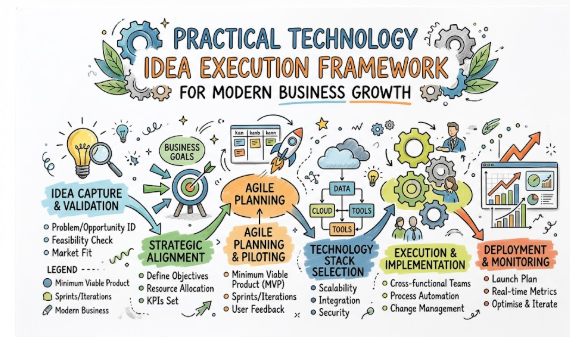
Introduction
Every business starts with an idea, but not every idea becomes a useful solution. Many people imagine a mobile app, business website, automation system, online marketplace, customer dashboard, finance tracker, learning platform, or internal management tool. The idea may sound exciting in a meeting, but the real challenge begins when the business has to convert that thought into something users can actually use.
This is where many beginners feel confused. They may know what problem they want to solve, but they may not know how to plan the product, choose the right technology, define features, estimate cost, manage risk, test the solution, or improve it after launch. Without proper understanding, even a good technology idea can become delayed, expensive, confusing, or difficult to use.
For small business owners, technology is no longer only about having a website. It can support sales, customer service, accounting, marketing, delivery, payments, reporting, compliance, and team communication. A simple automation system can save time. A customer portal can reduce repeated calls. A well-built application can help a company serve clients faster. However, poor planning can create the opposite result: wasted budget, weak user adoption, security gaps, unclear workflows, and technical dependency.
The topic How Businesses Can Turn Technology Ideas into Real Solutions matters because businesses need a practical process. They should not jump directly from idea to development without understanding the problem, user need, budget, timeline, risks, and long-term maintenance. A real solution is not just software. It is a working system that solves a real problem, supports users, protects data, and delivers business value.
This blog is written for beginners, small business owners, startup teams, students, finance learners, bloggers, crypto learners, casino content creators, salaried professionals, and decision-makers who want to understand technology execution in simple words. It explains how ideas are evaluated, planned, designed, developed, tested, launched, and improved.
The goal is not to sell a quick shortcut. The goal is to help readers make careful decisions. A practical understanding is always better than rushing because technology decisions often involve money, people, data, security, compliance, and long-term business operations. When businesses take time to understand the process, they can avoid common mistakes and build solutions that are useful, scalable, and easier to manage.
Understanding How Businesses Can Turn Technology Ideas into Real Solutions
A technology idea becomes a real solution when it moves from a rough thought into a planned, tested, and usable digital system. This system may be a website, mobile app, software platform, automation tool, customer portal, analytics dashboard, payment system, internal workflow tool, or AI-powered feature.
In simple words, the process means:
First, the business identifies a problem.
Then, it studies who faces the problem.
After that, it plans a practical solution.
Next, it designs, builds, tests, and improves the product.
Finally, it launches the solution and keeps improving it based on real feedback.
People search for this topic because they often have business ideas but do not know the next step. They may ask questions like: “Should I build an app first?” “How much planning is needed?” “What features should be included?” “How do I avoid wasting money?” “How do I know whether the idea is useful?”
This topic connects with finance, investment, loans, crypto, tax, trading, casino content, and financial planning because every technology decision has a money impact. A business may need to budget development cost, compare vendors, manage operational expenses, protect user data, follow compliance rules, and measure return on effort. For example, a loan comparison website must handle financial information responsibly. A crypto education platform must explain risk clearly. A casino content website must use responsible language and transparent review methods.
A beginner-friendly example is a small business owner who wants to reduce repeated customer calls. Instead of immediately building a large app, the owner can start with a simple FAQ page, enquiry form, customer dashboard, or chatbot. After testing user response, the business can decide whether a bigger solution is needed.
A common misunderstanding is that technology success depends only on coding. In reality, coding is only one part. Research, planning, design, testing, security, content, support, and improvement are equally important.
The practical takeaway is simple: a technology idea should be treated like a business decision, not only a technical project.
Why Technology Idea Execution Is Important
Technology idea execution affects real business decisions because it influences cost, customer experience, efficiency, security, and long-term growth. A strong idea without execution remains only a discussion. A weakly executed idea may become a burden. A well-planned idea can become a useful business asset.
For savings, technology can reduce repeated manual work. For example, an automated invoice system may reduce time spent on billing. For borrowing, a business must understand whether taking a loan for software development is necessary and affordable. For investing, a founder may need to decide whether the product can create long-term value before spending heavily.
For trading, crypto, tax, or finance-related platforms, execution becomes even more important because users depend on accurate information, risk explanation, data protection, and transparent processes. A poor financial calculator, weak crypto dashboard, or confusing tax tool can mislead users and damage trust.
For casino content decisions, technology execution matters because casino websites need clear structure, responsible language, content freshness, affiliate transparency, and user safety. A platform should never mislead users with unrealistic claims or unsafe suggestions.
One practical scenario is a salaried person starting a side business. They may want to create a budgeting app for beginners. If they build all advanced features at once, they may overspend. A better approach is to start with basic expense tracking, test with a small group, collect feedback, and then add more features gradually.
Technology execution is important because it helps businesses plan better, reduce emotional decisions, manage risk, and create solutions that serve real users.
The Real Problem Readers Face With Technology Ideas
The real problem is not lack of ideas. Most businesses have many ideas. The bigger problem is lack of clarity. Many people do not know which idea should be built first, how much money should be spent, what features matter, and how to measure success.
Beginners often face too much confusing advice online. Some people say every business needs an app. Others say automation solves everything. Some recommend AI, blockchain, or advanced platforms without checking whether the business actually needs them. This creates confusion and may lead to poor decisions.
Emotional decision-making is another issue. A founder may see a competitor launch an app and immediately feel pressure to build one. A small business owner may hear about AI tools and rush into automation without understanding workflow needs. A finance blogger may add calculators or comparison tools without checking accuracy, compliance, or user safety.
Poor planning also causes problems. Without clear requirements, development teams may build unnecessary features. Without budget discipline, the cost may increase. Without testing, users may struggle. Without security planning, sensitive data may become vulnerable.
Weak comparison is another common problem. Businesses sometimes compare only price and ignore experience, support, security, scalability, communication, and maintenance. Cheap development may look attractive at the start, but poor quality can become expensive later.
Unrealistic expectations also create disappointment. Technology does not automatically increase sales, reduce all problems, or create instant growth. It works when it solves a real problem and is supported by training, content, support, marketing, and continuous improvement.
The right next step is to slow down, define the problem clearly, compare options carefully, test small, protect user data, and make decisions based on evidence rather than pressure.
How Technology Ideas Become Real Solutions Step by Step
Step 1: Define the Real Business Problem
The first step is to clearly identify the problem the technology idea will solve. A business should not begin with “We need an app.” It should begin with “What problem are we solving, and for whom?”
This matters because unclear problems create unclear products. If the problem is repeated customer enquiries, the solution may be a help center, chatbot, or customer portal. If the problem is payment tracking, the solution may be billing automation.
To apply this step, write the problem in one simple sentence. For example: “Customers are unable to track their service requests after submitting them.”
A common mistake is starting development without defining the problem. The better approach is to document the pain point, affected users, current process, and expected improvement.
Step 2: Understand the Target Users
A real solution must serve real users. Target users may include customers, employees, vendors, students, investors, loan seekers, crypto learners, or content readers.
This matters because different users need different experiences. A beginner investor needs simple explanations. A small business owner needs practical dashboards. A customer support team needs fast access to records.
To apply this step, create simple user profiles. Write who the users are, what they struggle with, what they expect, and how they currently solve the problem.
A common mistake is building features based on internal assumptions. The better approach is to speak with users, review support queries, study common complaints, and collect practical feedback.
Step 3: Validate the Idea Before Building Fully
Validation means checking whether the idea is useful before spending heavily. It can be done through surveys, interviews, landing pages, manual testing, small prototypes, or simple workflow trials.
This matters because not every idea deserves full development. Some ideas look good internally but fail when users do not need them.
For example, before building a complete loan comparison platform, a business can test whether users want EMI comparison, eligibility guidance, document checklist, or repayment planning first.
A common mistake is building a full product without validation. The better approach is to test the smallest useful version and learn from real response.
Step 4: Create a Clear Feature Plan
A feature plan explains what the solution should include. Features should be divided into must-have, should-have, and future features.
This matters because too many features can increase cost, delay launch, and confuse users. A simple solution with strong core features is often better than a complex product with weak usability.
To apply this step, list all possible features and then ask: “Which features are necessary to solve the main problem?”
A common mistake is adding every idea into the first version. The better approach is to build a minimum useful solution and expand later.
Step 5: Plan Budget, Timeline, and Resources
Every technology solution needs money, time, people, tools, and ongoing maintenance. The budget should include design, development, testing, hosting, security, content, support, updates, and training.
This matters because many beginners budget only for development and forget long-term costs. A solution may need monthly hosting, bug fixes, user support, software subscriptions, and security updates.
For example, a finance education website may need content review, calculator maintenance, SEO updates, and compliance-sensitive writing.
A common mistake is choosing the lowest cost without checking quality. The better approach is to compare value, support, clarity, and long-term reliability.
Step 6: Build a Prototype or Minimum Viable Product
A prototype shows how the solution may look and work. A minimum viable product is the first usable version with essential features.
This matters because it allows the business to learn early. Users can test the flow, suggest improvements, and reveal issues before full-scale investment.
For example, a small business may first build a simple order tracking dashboard before creating a complete marketplace.
A common mistake is waiting for a perfect product. The better approach is to build a practical first version, test it carefully, and improve step by step.
Step 7: Test Security, Usability, and Accuracy
Testing checks whether the product works correctly, is easy to use, and protects data. For finance, tax, crypto, loan, and casino-related platforms, accuracy and responsible communication are especially important.
This matters because mistakes can damage trust. A broken form, wrong calculation, unclear disclaimer, or weak password system can create serious problems.
To apply this step, test with real users, check different devices, review content, verify calculations, and examine privacy controls.
A common mistake is launching without proper testing. The better approach is to test functionality, user experience, security, performance, and content clarity before launch.
Step 8: Launch, Measure, and Improve
Launch is not the end. It is the beginning of learning from real users. Businesses should track usage, feedback, errors, support questions, and improvement opportunities.
This matters because user behavior may be different from expectations. Some features may be popular, while others may be ignored.
For example, users may prefer a simple calculator over a long registration process. This feedback can guide improvement.
A common mistake is launching and forgetting maintenance. The better approach is to review performance regularly, fix issues, improve content, and add features based on evidence.
Key Factors That Influence Technology Idea Execution
Problem Clarity
Problem clarity means knowing exactly what the technology solution should fix. Without clarity, development becomes directionless. Beginners should write the problem in simple language before discussing features.
User Need
A solution is useful only when users need it. Businesses should not assume user behavior. They should study customer questions, complaints, search intent, support tickets, and real usage patterns.
Budget Discipline
Technology requires planned spending. A business should not spend everything on the first version. It should keep funds for testing, maintenance, content, security, and updates.
Research Quality
Good research helps businesses understand competitors, user expectations, legal requirements, and technology options. Poor research leads to copied ideas and weak differentiation.
Security and Privacy
If a solution handles customer data, financial details, documents, login information, or payment data, security must be planned from the beginning. Ignoring privacy can create legal and trust issues.
Content Trust
For finance, crypto, tax, loan, or casino-related platforms, content must be clear, responsible, and transparent. Claims should not mislead users. Risks should be explained properly.
Scalability
Scalability means the solution can handle more users, features, and data in the future. Beginners should not overbuild, but they should avoid decisions that block future growth.
Long-Term Maintenance
Every solution needs updates, bug fixes, security patches, content improvement, and user support. A business should plan ownership after launch, not only during development.
Detailed Breakdown of Turning Technology Ideas into Real Solutions
Start With Business Purpose, Not Technology Trend
Many businesses start with trends like AI, blockchain, automation, or mobile apps. But a trend is not a strategy. A business should first define the purpose. Is the goal to reduce manual work, improve customer experience, manage data, increase transparency, support sales, or educate users?
For example, a crypto learning website may not need blockchain integration at the beginning. It may first need simple educational content, risk explainers, beginner guides, and safe navigation.
Convert the Idea Into a Use Case
A use case explains how a user will use the solution. It answers questions like:
- Who is the user?
- What action will the user take?
- What problem will be solved?
- What result should happen?
- What information is needed?
For example, a loan seeker may visit a website, compare EMI concepts, understand repayment risks, and prepare documents. This use case helps the business design useful pages and tools.
Separate Must-Have Features From Future Ideas
Not every feature should be built immediately. Must-have features solve the main problem. Future features improve convenience later.
For example, a budgeting tool may first need income tracking, expense categories, savings goals, and monthly review. Advanced charts, AI suggestions, and bank integrations can come later.
Think About Trust From the Beginning
Trust is especially important when money, tax, crypto, investment, loans, or casino-related content is involved. Users need clear explanations, disclaimers, transparent comparisons, responsible wording, and privacy protection.
A common mistake is focusing only on design and ignoring credibility. A better approach is to include author information, review process, risk warnings, clear definitions, and practical examples.
Design for Beginners
A solution for beginners should use simple language, clear navigation, short forms, helpful tooltips, and step-by-step guidance. If users feel confused, they may leave even if the product is technically strong.
For example, instead of saying “risk-adjusted allocation,” a beginner investing platform can explain: “Do not put all your money in one place. Spread your money based on your comfort with risk.”
Build in Stages
Building in stages reduces risk. The first stage can solve the main problem. The second stage can improve automation. The third stage can add analytics, integrations, or advanced features.
This approach protects budget and helps businesses learn from real usage.
Test With Real People
Internal testing is useful, but real users reveal practical problems. They may misunderstand labels, skip important steps, or struggle with forms. Their feedback helps improve the product.
For finance, loan, tax, crypto, and casino content, testing should also include content clarity and risk explanation.
Measure Practical Outcomes
A technology solution should be measured by useful outcomes, not only design quality. Useful measures may include fewer support calls, faster processing, better user completion, improved content engagement, fewer errors, or better internal reporting.
The better approach is to define success before development begins.
Common Mistakes Beginners Make With Technology Ideas
Following Random Advice
This happens when beginners copy what competitors or social media influencers suggest. It is risky because every business has different users, budget, workflow, and goals. What works for one company may not work for another.
The better approach is to study your own users and business needs before choosing features or tools.
Ignoring Risk
Many beginners focus only on benefits. They ignore security risk, cost risk, compliance risk, user adoption risk, and maintenance risk. This can create expensive problems later.
The better approach is to prepare a risk checklist before development starts.
Not Comparing Options
Some businesses choose the first developer, tool, or platform they find. This may lead to poor quality, weak support, or hidden limitations.
The better approach is to compare multiple options based on quality, experience, support, scalability, security, and cost.
Trusting Fake Profit Claims
Some technology vendors or online advice may suggest that an app, trading tool, crypto product, or affiliate website will generate guaranteed income. Such claims are risky and often misleading.
The better approach is to focus on realistic planning, user value, and risk awareness.
Ignoring Hidden Costs
Technology projects may include hosting, maintenance, subscriptions, security, testing, content updates, and support costs. Ignoring these can disturb budgets.
The better approach is to create a full cost plan before starting.
Making Emotional Decisions
Fear of missing out can push businesses into rushed decisions. They may build features because competitors have them, not because users need them.
The better approach is to use data, feedback, and clear goals.
Using Emergency Money for Risky Activities
Some founders spend emergency funds on untested ideas. This can create financial pressure.
The better approach is to keep emergency money separate and invest gradually.
Not Reading Terms and Conditions
Businesses may sign contracts or subscribe to platforms without reading limitations, data rules, cancellation policies, or ownership terms.
The better approach is to review terms carefully and ask questions before committing.
Sharing Sensitive Information Carelessly
Technology projects may involve passwords, customer data, financial information, or business documents. Sharing these without proper controls can create security problems.
The better approach is to use secure access, permissions, and data protection practices.
Ignoring Tax, Legal, or Compliance Responsibilities
Finance, loan, crypto, tax, and casino-related platforms may require careful compliance-sensitive language and professional review.
The better approach is to consult qualified experts where needed.
Don’t Do This Checklist
- Do not start development without a clear problem.
- Do not build every feature in the first version.
- Do not trust guaranteed profit claims.
- Do not ignore user feedback.
- Do not choose only the cheapest option.
- Do not share passwords casually.
- Do not skip testing.
- Do not ignore privacy and security.
- Do not spend emergency funds on untested ideas.
- Do not copy competitors blindly.
- Do not ignore legal, tax, or compliance review.
- Do not launch and forget maintenance.
Practical Real-Life Examples of Technology Idea Execution
Example 1: Salaried Person Starting a Budgeting Tool
A salaried person notices that many friends struggle with month-end expenses. The mistake would be building a complex finance app immediately. A better action is to start with a simple expense tracker and monthly review template. The learning is that small validated solutions are safer than expensive assumptions.
Example 2: Beginner Investor Building an Education Website
A beginner investor wants to create a stock market learning platform. The mistake would be publishing random stock tips without risk explanation. A better action is to create beginner guides, risk warnings, watchlist education, and comparison content. The learning is that trust matters more than excitement.
Example 3: Loan Seeker Creating a Repayment Planner
A loan seeker wants to help others compare borrowing options. The challenge is avoiding misleading claims about approval or low EMI. A better action is to explain interest rate, repayment capacity, charges, and late payment risk. The learning is that responsible borrowing content protects users.
Example 4: Small Business Owner Managing GST Records
A small business owner struggles with invoices and tax records. The mistake would be depending only on memory or scattered files. A better action is to use a structured record system with monthly review. The learning is that simple technology can improve compliance discipline.
Example 5: Casino Blogger Improving Content Trust
A casino blogger wants better search visibility. The mistake would be using aggressive bonus claims and unclear affiliate language. A better action is to write transparent reviews, explain risks, and use responsible gaming language. The learning is that trust-based content is safer and more useful.
Two Useful Tables for Better Understanding
Table 1: Idea Stage vs Better Business Approach
| Idea Stage | Common Beginner Action | Better Business Approach |
|---|---|---|
| Rough idea | Start development quickly | Define the problem clearly first |
| Feature planning | Add every feature | Separate must-have and future features |
| Budgeting | Count only development cost | Include testing, hosting, maintenance, and support |
| User research | Assume users will like it | Speak with users and validate need |
| Launch | Release without testing | Test usability, security, and content clarity |
| Growth | Add features randomly | Improve based on feedback and data |
Table 2: Technology Risk vs Safer Action
| Risk Type | What Can Go Wrong | Safer Action |
|---|---|---|
| Budget risk | Project cost increases unexpectedly | Plan full project and maintenance costs |
| Security risk | User data may be exposed | Use secure access, backups, and privacy controls |
| User adoption risk | People do not use the solution | Validate need before full development |
| Compliance risk | Content or process may mislead users | Get professional review where needed |
| Platform risk | Tool or vendor may limit growth | Compare options before choosing |
| Maintenance risk | Product becomes outdated | Plan regular updates and support |
Tools, Methods, and Frameworks Readers Can Use
Problem Statement Framework
This framework helps businesses explain the problem in one clear sentence. It prevents confusion and keeps the team focused. Beginners can use it before speaking with developers or vendors. It helps avoid the mistake of building technology without purpose.
User Journey Map
A user journey map shows how a person moves through the solution. It includes discovery, signup, action, result, and support. Beginners can draw this on paper before design begins. It helps avoid confusing navigation and unnecessary steps.
Feature Priority Checklist
This checklist divides features into must-have, useful, and future features. It helps teams control budget and avoid overbuilding. Beginners can use it during planning meetings. It prevents feature overload.
Budget Planning Sheet
A budget sheet tracks development, design, hosting, security, tools, content, testing, and maintenance costs. It helps businesses understand the full financial picture. It prevents the mistake of spending all money only on development.
Risk Review Checklist
A risk checklist covers security, privacy, compliance, cost, vendor, and user adoption risks. Beginners can use it before signing contracts or launching products. It helps reduce avoidable mistakes.
Prototype Testing Method
A prototype testing method allows users to test a simple version before full development. It helps businesses collect feedback early. It prevents wasting money on features users do not understand or need.
Content Quality Review
For finance, loan, crypto, tax, or casino-related platforms, content quality review is essential. It checks whether the content is accurate, clear, responsible, and risk-aware. It helps avoid misleading claims.
Monthly Improvement System
After launch, businesses should review user feedback, errors, performance, and content updates every month. This method keeps the solution useful. It prevents the product from becoming outdated.
Expert Tips to Make Better Decisions
1. Start With the Problem, Not the Tool
This matters because tools are only useful when they solve a real problem. Beginners should write the problem clearly before choosing software, developers, or platforms.
2. Validate Before Spending Heavily
Validation reduces the risk of building something users do not need. Beginners can test ideas through surveys, interviews, prototypes, or small manual processes.
3. Build the Smallest Useful Version First
A smaller version is easier to test, improve, and afford. Businesses should focus on essential features first instead of building a large product immediately.
4. Compare Multiple Options
Comparing vendors, tools, and platforms helps avoid poor decisions. Readers should compare quality, support, security, scalability, and long-term cost.
5. Keep Written Records
Written requirements reduce confusion. Businesses should document features, user needs, timelines, responsibilities, costs, and approval points.
6. Protect Personal and Business Data
Data protection is important for trust and safety. Beginners should use secure passwords, access control, backups, and privacy-aware processes.
7. Avoid Emotional Decisions
Technology decisions should not be based on fear, pressure, or trends. Readers should use research, feedback, and business goals.
8. Review Content Carefully
For finance, crypto, tax, loan, trading, and casino topics, content must be responsible. Businesses should avoid guaranteed claims and explain risks clearly.
9. Plan for Maintenance
A product needs updates after launch. Readers should budget for bug fixes, security updates, content improvements, and user support.
10. Keep Emergency Money Separate
Emergency funds should not be used for risky experiments. Businesses should invest gradually and protect financial stability.
11. Take Professional Advice When Needed
Tax, legal, investment, and compliance matters may need expert review. Beginners should not rely only on online advice for major decisions.
12. Track Mistakes and Improve
Every project teaches lessons. Businesses should record what worked, what failed, and what needs improvement.
13. Focus on User Trust
Trust helps long-term growth. Clear communication, transparent policies, accurate content, and responsible design build confidence.
14. Avoid Blind Copying
Competitor research is useful, but copying is risky. Businesses should understand their own users and create solutions based on real needs.
15. Measure Real Outcomes
A solution should improve something meaningful. Track user completion, support reduction, engagement, accuracy, or workflow improvement.
Case Studies: How Better Understanding Changes Decisions
Case Study 1: Small Retail Business Building an Order System
Profile: A small retail business owner managing orders manually.
Situation: Customers frequently called to ask about order status.
Problem: The business wanted to build a large mobile app immediately.
Wrong Approach: The owner planned many features, including loyalty points, chat, analytics, and product recommendations before solving the main issue.
Better Approach: The business first created a simple order tracking page with SMS updates and admin status controls.
Result or Learning: Customer calls reduced because users could check status themselves. The owner learned that solving the core problem first was more useful than building advanced features.
Key Takeaway: Start with the most painful problem and expand after validation.
Case Study 2: Finance Blogger Creating a Loan Education Platform
Profile: A finance blogger writing for salaried people and loan seekers.
Situation: Readers wanted help understanding EMI, repayment pressure, and loan comparison.
Problem: The blogger initially planned to publish articles with broad claims about easy borrowing.
Wrong Approach: The content did not explain hidden charges, repayment capacity, credit score impact, or late payment risk.
Better Approach: The blogger created educational guides, repayment checklists, EMI explanation pages, and risk-aware content.
Result or Learning: The content became more useful and trustworthy because it helped readers make careful decisions.
Key Takeaway: Financial technology and content must focus on clarity, risk awareness, and responsible guidance.
Case Study 3: Startup Testing a Digital Marketplace Idea
Profile: A startup team planning a service marketplace.
Situation: The team wanted to connect customers with local service providers.
Problem: They assumed users would immediately trust a new platform.
Wrong Approach: They wanted to spend heavily on full development without testing demand or trust factors.
Better Approach: The team first tested a small version with verified providers, clear profiles, basic booking requests, and manual support.
Result or Learning: Users cared most about trust, provider details, response time, and transparent pricing.
Key Takeaway: Marketplace solutions need trust-building features before advanced automation.
Risk Awareness: What Readers Must Check First
Budget Risk
Budget risk means the project may cost more than expected. It matters because hidden costs can create financial pressure. Businesses can reduce this risk by planning development, testing, hosting, maintenance, tools, content, and support costs.
Security Risk
Security risk means data, accounts, or systems may become exposed. It matters because users trust businesses with sensitive information. Businesses can reduce this risk through secure passwords, access control, backups, encryption, and regular updates.
Platform Risk
Platform risk means a chosen tool, vendor, or system may not support future needs. It matters because changing platforms later can be expensive. Businesses should compare options and avoid depending blindly on one provider.
Compliance Risk
Compliance risk means the solution may not follow relevant tax, legal, financial, privacy, or content rules. It matters especially for finance, loans, crypto, tax, and casino-related websites. Businesses should consult qualified professionals where required.
Data Privacy Risk
Data privacy risk means personal or financial information may be collected, stored, or shared improperly. It matters because privacy mistakes can damage trust. Businesses should collect only necessary data and explain usage clearly.
User Adoption Risk
User adoption risk means people may not use the solution. It matters because even a technically strong product can fail if users find it confusing. Businesses should validate ideas, test prototypes, and improve usability.
Misinformation Risk
Misinformation risk is common in finance, crypto, investing, tax, loans, and casino content. Wrong or unclear information can misguide readers. Businesses should verify details and avoid unsupported claims.
Emotional Risk
Emotional risk means decisions are driven by pressure, greed, fear, or excitement. It matters because rushed choices often lead to poor planning. Businesses should use written plans and review decisions calmly.
Maintenance Risk
Maintenance risk means the solution may become outdated or broken over time. Businesses can reduce this risk by planning regular updates, content reviews, security patches, and support systems.
Readers should verify important details and consult qualified financial, tax, legal, technology, or investment professionals where required.
Checklist Before Taking Action
Before moving forward with a technology idea, check these points carefully:
- The main problem is clearly written.
- The target user is clearly identified.
- The idea has been validated with real feedback.
- The must-have features are separated from future features.
- The budget includes development, testing, hosting, security, maintenance, and support.
- Multiple options or vendors have been compared.
- Charges, fees, contracts, or terms have been reviewed.
- Data privacy and security requirements are understood.
- Risk review has been completed.
- Emergency funds are kept separate.
- Guaranteed profit or unrealistic claims are avoided.
- Content is reviewed for accuracy and responsible language.
- Tax, legal, or compliance impact is checked where relevant.
- A written plan is prepared.
- Emotional decisions are avoided.
- Professional advice is considered where needed.
- Launch testing is planned.
- Post-launch maintenance is assigned.
Use this checklist before making any major decision. It helps readers slow down, compare options, protect money, reduce mistakes, and move forward with better confidence.
Strategic Insights for Better Decision-Making
Search Intent Clarity
If the solution includes content, businesses must understand why users search. A loan seeker may want repayment guidance. A crypto learner may want safety steps. A casino reader may want transparent review information. Matching search intent improves usefulness.
Workflow Mapping
Workflow mapping shows how work happens today and how technology will improve it. For example, if invoices are currently handled through messages and spreadsheets, a simple billing dashboard may reduce confusion.
Risk Allocation
Risk allocation means deciding how much time, money, and effort should be placed into each stage. Beginners should not spend the entire budget before testing demand.
User Trust Structure
Trust structure includes clear policies, transparent information, secure systems, simple explanations, and responsible claims. It is important for finance, crypto, tax, loan, and casino-related platforms.
Content Freshness
Digital solutions with educational content must be reviewed regularly. Outdated finance, tax, crypto, or casino content can mislead users. A review schedule helps maintain accuracy.
Responsible Language
Responsible language avoids overpromising. Instead of saying “earn easily,” content should explain risks, choices, and careful planning. This builds long-term credibility.
Scalable Planning
Scalable planning means building today’s solution in a way that can grow later. Businesses should avoid overbuilding but should choose structures that do not block future improvement.
Feedback-Based Improvement
Real users reveal real problems. Businesses should collect feedback through forms, support queries, analytics, and interviews. Improvement should be based on evidence, not assumptions.
Key Terms Explained for Beginners
- Technology Idea: A technology idea is a concept for using digital tools to solve a business or user problem. It may become an app, website, software, dashboard, or automation system.
- Digital Solution: A digital solution is a working technology system that helps users complete a task, solve a problem, or improve a process.
- Prototype: A prototype is a simple sample version of a product. It helps businesses test design and user flow before full development.
- Minimum Viable Product: A minimum viable product is the first usable version with only essential features. It helps test the idea with lower risk.
- User Experience: User experience means how easy and comfortable the solution feels for users. Good user experience reduces confusion.
- Validation: Validation means checking whether people actually need the solution before spending heavily on development.
- Scalability: Scalability means the solution can handle more users, data, or features in the future without breaking easily.
- Automation: Automation means using technology to reduce repeated manual work. It can save time when planned correctly.
- Security: Security means protecting systems, data, accounts, and users from misuse, hacking, or unauthorized access.
- Privacy: Privacy means handling personal information responsibly. Businesses should collect only necessary data and protect it carefully.
- Compliance: Compliance means following relevant laws, rules, policies, and industry standards. It is important in finance, tax, loans, crypto, and casino content.
- Risk: Risk means the chance of loss, error, failure, or negative impact. Every technology decision should include risk review.
- Maintenance: Maintenance means keeping the solution updated, secure, and working after launch.
- User Feedback: User feedback is information from real users about what works, what is confusing, and what should improve.
- Content Trust: Content trust means users can rely on the information because it is clear, responsible, transparent, and not misleading.
Who Should Read This Blog
Beginners
Beginners who have technology ideas but do not know where to start will find this guide useful. It explains the process in simple steps.
Students
Students learning business, finance, technology, or entrepreneurship can understand how real-world digital products are planned and executed.
Salaried Employees
Salaried employees planning a side business or digital product can learn how to avoid rushing and manage budget carefully.
Small Business Owners
Small business owners can learn how to use technology for customer service, billing, operations, marketing, and reporting.
New Investors
New investors can understand how technology decisions affect business value, risk, and long-term planning.
Traders
Traders planning dashboards, journals, or educational platforms can understand the importance of accuracy, risk, and emotional control.
Loan Seekers
Loan seekers can learn how technology tools can support repayment planning, EMI understanding, and responsible comparison.
Crypto Learners
Crypto learners can understand why security, scam awareness, wallet safety, and platform risk must be considered in digital solutions.
Casino Content Creators
Casino content creators can learn how to build trust through responsible language, transparent reviews, and user safety.
Finance Bloggers
Finance bloggers can understand how technology ideas, calculators, comparison pages, and content systems should be planned responsibly.
People Improving Money Awareness
Anyone trying to avoid financial mistakes can use this guide to think more carefully before taking action.
Frequently Asked Questions
1. What does How Businesses Can Turn Technology Ideas into Real Solutions mean?
It means converting a business idea into a working digital product or system. This may include research, planning, design, development, testing, launch, and improvement. The goal is to solve a real problem, not just build technology for appearance.
2. Why is this important for beginners?
Beginners often have ideas but may not know the right process. Without planning, they may waste money or build features users do not need. A structured approach helps reduce confusion and risk.
3. How can businesses start safely?
Businesses can start by defining the problem, understanding users, validating the idea, and building a small first version. They should avoid spending heavily before testing demand. This keeps the process practical and controlled.
4. What is the biggest mistake to avoid?
The biggest mistake is starting development without clear problem understanding. This can lead to unnecessary features, poor usability, and budget pressure. A better step is to validate the idea first.
5. Is How Businesses Can Turn Technology Ideas into Real Solutions useful for small businesses?
Yes, it is very useful for small businesses because they often have limited budgets. A step-by-step approach helps them choose practical solutions, avoid overbuilding, and improve operations gradually.
6. What risks should businesses know before building technology?
Businesses should check budget risk, security risk, data privacy risk, compliance risk, platform risk, and user adoption risk. These risks can be reduced through planning, testing, and professional review where needed.
7. How can I compare technology options properly?
Compare options based on features, cost, support, security, scalability, ownership, maintenance, and user experience. Do not choose only the cheapest option. Long-term reliability matters.
8. Should businesses take professional advice?
Yes, professional advice is helpful when the solution involves finance, tax, legal, investment, loan, crypto, or casino-related topics. Expert review can reduce mistakes and improve trust.
9. How often should businesses review a launched solution?
Businesses should review the solution regularly, especially after launch. Monthly reviews can help identify bugs, user confusion, outdated content, security needs, and improvement opportunities.
10. What should businesses avoid before taking action?
They should avoid emotional decisions, fake guaranteed claims, unclear contracts, weak security, poor planning, and copying competitors blindly. A written plan is safer than rushed execution.
11. How does this topic help with financial planning?
Technology projects involve cost, maintenance, risk, and long-term value. Understanding the process helps businesses budget properly, avoid waste, and make careful financial decisions.
12. What is the best next step after reading this blog?
The best next step is to write your problem statement, identify users, list essential features, prepare a budget, and validate the idea. This turns thinking into practical action without rushing.
Conclusion and Next Steps
Understanding How Businesses Can Turn Technology Ideas into Real Solutions is important because ideas alone do not create value. A real solution needs planning, validation, user understanding, careful budgeting, security, testing, content clarity, and continuous improvement.
Beginners often feel excited when they imagine a new app, platform, website, dashboard, or automation tool. That excitement is useful, but it should be guided by practical thinking. Rushing into development without a clear plan can create financial pressure, poor user experience, and long-term maintenance problems.
The most important lesson is to start with the problem. A business should ask what issue needs to be solved, who is facing it, how they currently handle it, and what better result the technology should create. Once the problem is clear, the business can validate the idea, plan features, estimate costs, build a small version, test carefully, and improve based on real feedback.
Financial awareness also matters. Technology projects are business investments. They involve direct costs, hidden costs, opportunity costs, and future maintenance. Businesses should not treat technology as a magic shortcut. They should treat it as a structured decision that needs discipline and review.
Risk awareness is equally important. Data privacy, cybersecurity, misinformation, compliance, budget control, and user adoption should not be ignored. This is especially true for finance, loan, tax, crypto, trading, and casino-related platforms, where users may make important decisions based on the information or tools provided.
The practical next step is simple. Write down your idea, define the problem, identify your users, list essential features, prepare a budget, compare options, and test the smallest useful version. Avoid emotional decisions, unrealistic promises, and overbuilding. Take professional advice wherever tax, legal, financial, investment, or compliance matters are involved.
Long-term success comes from steady improvement. A good technology solution is not finished on launch day. It grows through feedback, updates, better content, stronger security, and clearer user experience. When businesses follow a careful process, they can turn ideas into practical solutions that support users, protect trust, and create meaningful value over time.

