
Introduction
In the quiet world of engineering, trust is the invisible foundation upon which every successful product is built. For a long time, software was created with a primary focus on what it could do, rather than how it could be protected. This led to a gap between the creation of a tool and the safety of its users. Now, a different perspective is being adopted by those who design the digital world. Security is no longer seen as a separate task or a final check; it is being treated as the very fabric of the development process itself.
The transition from a traditional engineer to a secure automation expert is not just about learning new tools. It is about a change in how problems are solved. Instead of reacting to threats after they appear, systems are being designed to be inherently safe from the first line of code. This guide is written to explore how this level of excellence is achieved. By focusing on the architecture of safety, a more stable and reliable future is being constructed for everyone who relies on technology.
What is Certified DevSecOps Architect?
The Certified DevSecOps Architect is a professional designation given to those who have mastered the art of building safety into automated systems. This program is viewed as a blueprint for creating secure software delivery pipelines. It moves beyond basic technical tasks and focuses on the high-level design of entire engineering ecosystems. A deep understanding of how to balance speed with protection is required for this role.
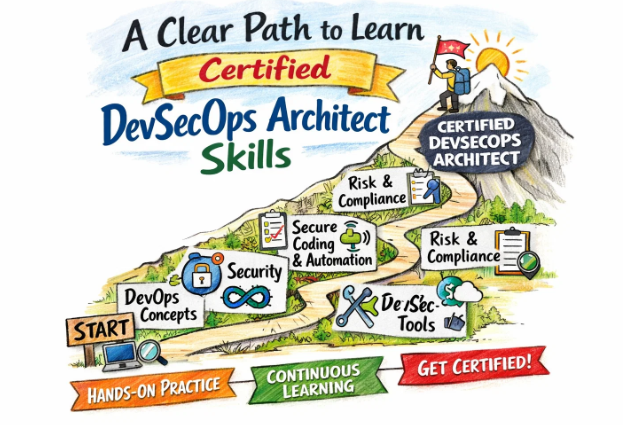
Through this path, expertise is developed in the strategic integration of security gates within the development lifecycle. The architect is trained to look at the entire landscape of a project, from the initial design to the final deployment. The goal is to ensure that every part of the system is validated and protected without manual intervention. It is a role that combines technical depth with a broad vision for organizational safety.
Why it matters today?
As the world becomes more connected, the fragility of unprotected systems is being exposed more frequently. A single flaw in a digital product can now have a global impact. In the past, software was updated slowly, allowing time for manual security reviews. However, the pace of delivery has increased so much that manual checks are no longer possible. Without automated safety, the risk of failure is being magnified every day.
The need for a dedicated architect is driven by the complexity of modern technology. With thousands of updates being pushed to the cloud, a structured and automated approach to security is the only way to maintain control. By having a specialized leader, a culture of continuous safety is established. This ensures that protection is not a burden on the development team but an essential part of the quality they provide to their customers.
Why Certified DevSecOps Architect certifications are important
Certifications are recognized as a shared standard of excellence in the engineering community. In a field where technology changes rapidly, having a validated set of skills is essential for professional trust. For an architect, this credential serves as proof that a high level of competency has been reached. It signifies that the professional is capable of handling the heavy responsibility of protecting an organization’s most valuable assets.
A certification provides a clear and structured path for learning that ensures no critical area is overlooked. It helps in aligning the goals of different departments, such as security and operations, by creating a common language. When a professional is certified, it is understood that they have been trained to follow industry-best practices. This level of validation is highly valued by employers who are looking for leaders to secure their digital transformations.
Why Choose DevSecOpsSchool?
DevSecOpsSchool is selected by professionals because of its deep focus on the intersection of security and automation. While many platforms offer general technical training, this institution is dedicated to the specific challenges of building secure architectures. The curriculum is developed with a focus on real-world utility, ensuring that every lesson can be put into practice immediately.
At DevSecOpsSchool, the learning experience is centered around practical application. Students are not just taught theory; they are given the tools to build and break systems in a controlled environment. This hands-on approach is essential for developing the problem-solving skills needed by a top-tier architect. The support provided by the mentors is designed to help students navigate the complexities of secure engineering, making it a preferred choice for those aiming for leadership roles.
Certification Deep-Dive: Certified DevSecOps Architect
What is this certification?
This is a high-level professional program that focuses on the design and implementation of secure automation frameworks. It is designed to produce architects who can lead the integration of security across all layers of the technology stack.
Who should take this certification?
This path is intended for experienced engineers, cloud architects, and security professionals. It is also highly recommended for technical leads who are responsible for the overall safety and reliability of software products.
Certification Overview Table
| Track | Level | Who it’s for | Prerequisites | Skills Covered | Recommended Order |
| DevSecOps | Architect | Senior Engineering Leads | Basic Automation Skills | SCA, SAST, DAST, IaC | 1st or 2nd |
| DevOps | Expert | Automation Engineers | Linux & Cloud Basics | CI/CD, Scripting | 1st |
| SRE | Professional | Reliability Leads | Operations Background | Monitoring, Incident Mgmt | 2nd |
| AIOps/MLOps | Specialist | Data & ML Leads | Python & AI Basics | Model Security, Data Sec | 3rd |
| DataOps | Lead | Data Architects | Database Experience | Data Governance, ETL | 2nd |
| FinOps | Practitioner | Cloud Financial Leads | Cloud Cost Knowledge | Optimization, Governance | 1st |
Skills you will gain
- Security Strategy Design: The ability to create a comprehensive plan for protecting the entire software lifecycle.
- Automated Tool Integration: Expertise in embedding security scanners directly into the build process.
- Infrastructure as Code Security: Skills in ensuring that cloud environments are secure before they are even built.
- Secret and Identity Management: Knowledge of how to handle sensitive credentials without exposing them to risk.
- Regulatory Compliance Automation: Methods for automatically ensuring that all systems meet legal safety standards.
Real-world projects you should be able to do after this certification
- Secure Delivery Pipeline Construction: A full automation flow is designed where security checks are mandatory for every update.
- Container Security Hardening: Docker and Kubernetes environments are audited and protected against potential attacks.
- Cloud Governance Policy Implementation: Rules are written in code to prevent the creation of insecure cloud resources.
- Automated Vulnerability Management: A system is built to detect, prioritize, and report risks in real-time across multiple projects.
Preparation plan
7–14 days plan
The core principles of the architect role are reviewed. The official documentation and study materials are read to understand the exam domains. Familiarity with basic security tools is established in a local lab.
30 days plan
A deeper study of each technical module is conducted. Daily hands-on practice is performed to master the integration of security tools within common pipelines. Mock exams are taken to identify and fix knowledge gaps.
60 days plan
Complex architectural designs are simulated in a lab environment. Real-world case studies are analyzed to understand how to apply security at scale. Feedback is sought from peers or mentors to refine the practical implementation skills.
Common mistakes to avoid
- Focusing Only on Tools: Forgetting that a successful architect must also focus on process and people.
- Ignoring Operational Speed: Designing security measures that are so complex they stop the flow of work.
- Lack of Practical Practice: Attempting to master the role through theory alone without enough hands-on lab time.
Best next certification after this
- Same track: Advanced Cloud Security Engineering.
- Cross-track: Site Reliability Engineering Master.
- Leadership / management: Strategic Engineering Leadership.
Choose Your Learning Path
DevOps
This path is for those who want to be the builders of the software engine. The focus is on the tools and workflows that allow for fast and efficient delivery. It is the starting point for modern engineering careers.
DevSecOps
This is the specialized route for architects of safety. It is designed for those who believe that security is an essential part of quality. It is the most critical path for anyone looking to lead in a threat-heavy world.
Site Reliability Engineering (SRE)
The focus here is on the stability and resilience of systems. This path is for professionals who are passionate about uptime and proactive monitoring. It ensures that systems are always available for users.
AIOps / MLOps
This path deals with the unique challenges of artificial intelligence. It is suited for those who manage the lifecycle of AI models and want to ensure they are secure and high-performing.
DataOps
This is for data professionals who want to ensure the safe and reliable flow of information. It focuses on the governance and security of data pipelines throughout an organization.
FinOps
This is a business-minded path focused on cloud financial health. It is designed for those who want to optimize spending and ensure that cloud resources are used efficiently and responsibly.
Role → Recommended Certifications Mapping
| Role | Primary Certification | Secondary Certification | Leadership Goal |
| DevOps Engineer | DevOps Expert | DevSecOps Architect | Platform Director |
| SRE | SRE Professional | DevSecOps Architect | Head of Operations |
| Platform Engineer | Kubernetes Specialist | Cloud Architect | Infrastructure Lead |
| Cloud Engineer | Cloud Professional | FinOps Practitioner | Cloud Manager |
| Security Engineer | DevSecOps Architect | SRE Professional | CISO |
| Data Engineer | DataOps Lead | MLOps Specialist | Data Director |
| FinOps Practitioner | FinOps Certified | Cloud Economics | Financial Lead |
| Engineering Manager | Management Cert | DevSecOps Overview | VP of Engineering |
Next Certifications to Take
To remain at the top of the field, the following steps are recommended:
For Technical Leaders:
- Same-track: Expert Level Cloud Security.
- Cross-track: SRE Master Class.
- Leadership: Chief Technology Officer Program.
For Strategy Focused Professionals:
- Same-track: Enterprise Architecture.
- Cross-track: FinOps Master.
- Leadership: IT Governance and Ethics.
Training & Certification Support Institutions
DevOpsSchool
This institution is known for its wide range of automation training programs. Expert-led sessions are provided to help professionals bridge the gap between traditional IT and modern DevOps. Practical skills are built through intensive lab work and real-world scenarios.
Cotocus
Consulting and training services are delivered by Cotocus with a focus on enterprise transformation. Specialized tracks are available for teams looking to adopt cloud-native technologies securely. Professional growth is supported through industry-standard education.
ScmGalaxy
A vast knowledge hub is maintained here for the community. Resources for software configuration and automation are shared through blogs and tutorials. Support is provided for various global certifications to help engineers stay updated.
BestDevOps
Simplified learning modules are provided here for aspiring engineers. The focus is on making complex technical topics easy to understand for everyone. Guidance is offered to help students clear their professional exams successfully.
devsecopsschool.com
This platform is dedicated entirely to the intersection of security and operations. Deep technical training is provided for those aiming for architect-level roles. The curriculum is designed to produce high-caliber security leaders.
sreschool.com
Expertise in system reliability and performance is developed at this school. The principles of SRE are taught using practical scenarios. It is an essential resource for those who want to build stable and scalable systems.
aiopsschool.com
The use of artificial intelligence in managing IT operations is the focus here. Training is provided on how to leverage AI for better monitoring and incident response. This is a forward-looking institution for modern engineers.
dataopsschool.com
This school focuses on the secure and efficient delivery of data across pipelines. Programs are designed to teach the modern lifecycle of data management. It is highly beneficial for data engineers and architects.
finopsschool.com
The discipline of cloud financial management is mastered here. Training is offered to help organizations control their cloud costs effectively. It bridges the gap between engineering, finance, and business teams.
FAQs Section
1. Is the architect certification too difficult for someone with only two years of experience?
The program is designed for more senior roles, but it can be completed by anyone with a strong foundation and dedication.
2. How much time is typically needed to prepare for the final assessment?
Usually, six to ten weeks of consistent study is required to fully grasp the architectural concepts.
3. Are there any specific technical prerequisites to enroll?
A basic understanding of cloud computing and at least one automation tool is highly recommended.
4. What is the recommended sequence for these certifications?
It is often suggested to start with a foundational DevOps course before moving into the specialized architect role.
5. How does this certification impact long-term career growth?
High-level roles such as Security Architect or Infrastructure Lead are often made accessible through this certification.
6. Is the training conducted in a live or recorded format?
Both options are typically available, allowing for flexibility based on the learner’s schedule.
7. Is the exam based on real-world scenarios?
Yes, the assessment is designed to test how knowledge is applied to solve actual engineering problems.
8. Is the certification recognized by international companies?
The program is recognized globally as a standard for excellence in secure automation.
9. Can a software developer benefit from becoming a DevSecOps Architect?
Yes, it provides a unique perspective on how to build more reliable and secure code.
10. What kind of support is offered after the certification is completed?
Access to community forums and ongoing learning resources is usually provided to help professionals stay current.
11. Are the lab environments provided by the institution?
Yes, secure cloud-based labs are typically included as part of the training program.
12. Is recertification required to maintain the architect status?
To keep up with changing technology, a review or recertification is often suggested every few years.
Certified DevSecOps Architect Specific FAQs
1. How is this architect role different from a regular security engineer?
The focus is shifted from managing individual tools to designing the entire system’s security blueprint.
2. Does the course cover security for multi-cloud environments?
Yes, principles that can be applied across AWS, Azure, and Google Cloud are included in the curriculum.
3. Is coding a major part of the architect’s daily work?
A basic understanding is required, as most security policies and configurations are now written as code.
4. Are there any live projects included in the program?
Yes, hands-on projects that mirror industry challenges are a mandatory part of the learning journey.
5. Can this certification be taken by someone in a management role?
Yes, it is very helpful for managers who need to oversee secure engineering teams and make strategic decisions.
6. Is the focus on open-source or commercial security tools?
A wide variety of both open-source and industry-standard commercial tools are typically explored.
7. How is the practical implementation verified during the exam?
Practical skills are often assessed through a dedicated project or lab-based evaluation.
8. What is the most important mindset for a DevSecOps Architect?
The ability to see security as a quality feature that helps the business move faster, rather than a hurdle.
Testimonials
Karan
A very simple and clear approach to secure automation was provided. The lessons were easy to follow and very practical. My understanding of cloud safety has been transformed.
Ishita
The hands-on labs were the highlight of the entire program. I was able to build a secure pipeline from scratch with confidence. This has been a great boost for my career.
Nikhil
A different perspective on how to handle security in the cloud was gained. The language used in the training was simple and humanized. I feel much more prepared for senior roles now.
Ananya
The mentorship and support were excellent throughout the journey. Complex topics were broken down into small, manageable parts. My technical skills have improved significantly.
Rahul
A lot of value was found in the real-world projects. The transition from a developer to an architect mindset was made very smooth. This program is highly recommended for any engineer.
Conclusion
A simple realization is often reached after a long time spent in this industry: the best work is the work that lasts. The importance of the Certified DevSecOps Architect certification is found in the trust it builds. By choosing this path, a foundation for a stable and meaningful career is laid. A future filled with leadership and growth is made possible for those who decide to focus on quality.
The long-term benefits of being an architect go far beyond a simple title. A deep sense of pride is felt when it is known that the systems being built are safe for everyone. Strategic learning and certification planning are encouraged for anyone who wishes to truly master their craft. The journey is started with a single decision to prioritize quality and trust in everything that is created. Every professional is invited to take this step and help build a safer digital world for the future.

