Introduction
Few ideas appeal to a busy engineering team like the promise of “no servers to manage.” Serverless computing is often presented as the purest form of NoOps. You write code, the provider runs it, and operations work seems to vanish.
The reality is more balanced. Serverless does remove real work, but it also changes what you must understand, test, and watch. This guide explains what serverless is, which operational tasks it takes off your plate, where it struggles, and how to decide when it is the right choice.
First, the Basics
Readers new to the topic often start with a simple question: what is NoOps? It is an approach in which automation and managed cloud services handle routine operations, such as provisioning, scaling, patching, and recovery, while people design the system, set rules, and stay accountable for results.
Serverless is one way to move toward that goal. In a serverless model, the cloud provider manages the servers, operating system, patching, and scaling. You supply the code or configuration, and you are usually billed for actual use rather than for idle capacity. The word “serverless” does not mean servers do not exist. It means you do not manage them.
On the NoOps vs DevOps question, serverless fits both. DevOps habits, like version control, automated testing, and blameless reviews, still apply. Serverless simply shifts more of the operational layer to the provider.
A Spectrum, Not a Switch
Serverless is not a single product. It is a range of options, from more control to less:
| Option | You manage | Provider manages | Example category |
|---|---|---|---|
| Virtual machines | OS, patches, runtime, scaling rules, application | Physical hardware, virtualization | Cloud virtual machines |
| Managed Kubernetes | Workloads, configuration, cluster add-ons | Control plane, often node management | Managed cluster services |
| Container platforms (serverless containers) | Container image, settings | Servers, scaling, patching | Managed container services |
| Functions as a service | Function code, triggers | Runtime, scaling, infrastructure | Event-driven function services |
| Fully managed services | Configuration and data | Almost everything else | Managed databases, queues, storage, identity |
Most real systems mix several levels. A team might run a core API on containers, process uploads with functions, and use managed databases and queues throughout.
What Serverless Takes Off Your Plate
- Server patching and maintenance. The provider handles operating systems and runtimes.
- Capacity planning for variable load. Functions and many managed services scale automatically within limits.
- Idle cost for low-traffic workloads. You pay for use, so a rarely used function costs little.
- Much of the high-availability setup. Many services spread work across multiple data centres by default.
- Infrastructure scripting for common patterns. Event triggers, queues, and storage notifications are available as built-in features.
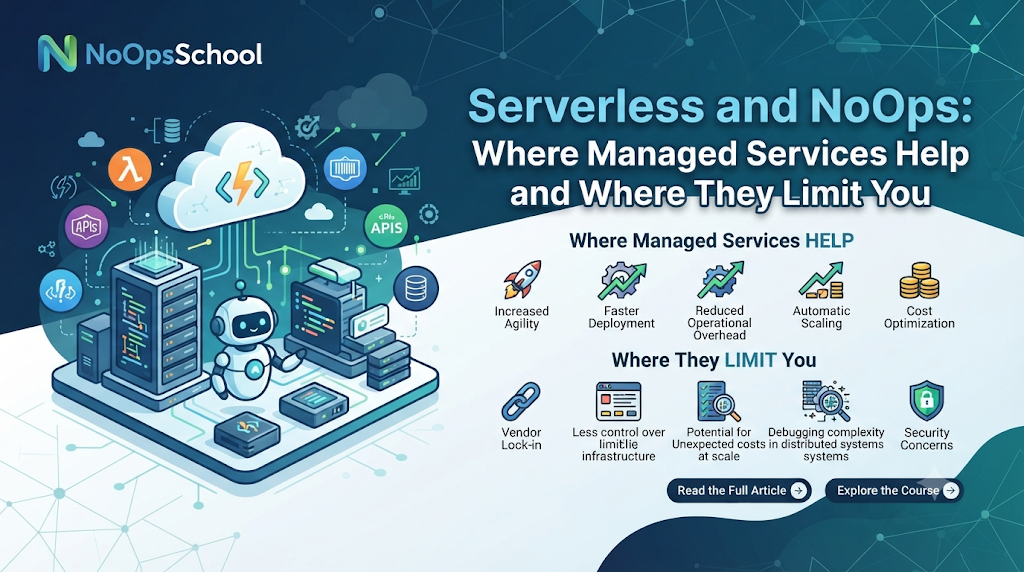
These benefits are real, which is why serverless is attractive to small teams and to workloads that rise and fall sharply.
What It Leaves on Your Plate
Serverless does not remove responsibility. You still own:
- Application correctness and testing. A bug in a function is still your bug.
- Security configuration. Permissions, secrets, input validation, and data protection remain your job.
- Cost control. Pay-per-use can surprise you if something loops or traffic spikes.
- Observability. You need logs, metrics, and traces to understand behaviour you cannot inspect on a server.
- Architecture decisions. Poor design can cause delays, failures, and high bills, whatever the platform.
- Recovery planning. You still need backups, rollback paths, and tested incident responses.
Where Serverless Struggles
Be aware of these common constraints. Details vary by provider, so check current documentation.
Execution limits. Functions usually have maximum run times, memory limits, and package size limits. For example, AWS Lambda’s maximum timeout is 15 minutes. Long-running or heavy jobs may need a different approach.
Cold starts. When a function has not run recently, the provider may need to start a new execution environment, which adds delay to the first request. Teams with strict latency needs often measure this and use mitigation options, or choose another model.
Concurrency limits. Providers set limits on how many instances run at once. A sudden spike may be throttled, and a function that scales fast can overwhelm a database that cannot.
Duplicate or out-of-order events. Many event systems deliver messages at least once, so the same event may arrive twice. Functions should be idempotent, meaning that processing the same event again causes no harm.
Harder local testing. Reproducing cloud triggers, permissions, and services on a laptop is difficult. Teams rely on emulators, test accounts, and thorough automated tests in cloud environments.
Provider dependence. Heavy use of provider-specific features can make future moves difficult. This is not always a problem, but it should be a conscious choice.
Cost at steady high load. For constant, heavy traffic, always-on capacity can sometimes cost less than paying per invocation. Compare using your real usage numbers.
Choosing Between Functions and Containers
Use these questions as a decision guide.
| Question | Leans serverless functions | Leans containers or other models |
|---|---|---|
| Is traffic spiky or unpredictable? | Yes | Traffic is steady and high |
| Is each task short and independent? | Yes | Tasks are long-running or stateful |
| Is occasional extra latency acceptable? | Yes | Strict, consistent latency is required |
| Does the team want minimal runtime management? | Yes | Team needs custom runtimes or deep tuning |
| Is event-driven design a natural fit? | Yes | Application is a large, tightly coupled system |
| Is portability a high priority? | Lower priority | High priority |
If most answers lean one way, that is a useful signal, not a rule. Many teams choose a hybrid design.
Practical Patterns (Hypothetical Examples)
Event-driven file processing. A user uploads an image to object storage. The upload triggers a function that creates thumbnails and writes them back. Workload is bursty, tasks are short, and nobody wants to run servers for idle time. This is a classic serverless fit.
Scheduled jobs. A nightly report runs once a day for a few minutes. A scheduled function avoids paying for a server that sits idle for the rest of the day, as long as the job stays within time limits.
Queue-based processing. Orders are placed on a queue, and functions process them at a controlled pace. The queue absorbs spikes, and concurrency limits protect the database. Design the function to handle repeated messages safely.
API backend. A function behind an API gateway handles requests. This works well for modest, variable traffic. For steady heavy traffic or strict latency targets, compare it against containers.
A poor fit: long, heavy computation. A job that needs hours of processing or large amounts of memory is usually better placed on containers or batch services.
Running Serverless Safely
Infrastructure as code
Define functions, triggers, permissions, and queues in code, using tools such as Terraform, AWS SAM, or the Serverless Framework. Review changes before applying them and keep every environment reproducible.
Observability
Without servers to log into, visibility depends on what you instrument. Aim for:
- Structured logs with a correlation ID that follows a request across services.
- Metrics for invocations, errors, duration, throttling, and queue age.
- Distributed tracing to see how a request moves through functions and services. OpenTelemetry offers a common approach, and providers offer native tracing tools.
- Alerts on user impact, such as failed requests or growing backlogs, not only on technical errors.
Security
- Give each function its own minimal permissions, never a shared broad role.
- Keep secrets in a secrets manager, not in code or plain environment settings.
- Validate all input, since functions are often exposed to external events.
- Scan dependencies, and keep packages small.
- Log and review access to sensitive data.
Cost control
- Set budget alerts and spending limits.
- Put limits on concurrency where a runaway function could cause damage.
- Watch for infinite loops, such as a function that writes to the same bucket that triggers it.
- Review the cost per business transaction, not just the total bill.
Resilience
- Make functions idempotent.
- Configure retries with limits, and use dead-letter queues to capture messages that keep failing.
- Plan for downstream limits, such as database connection counts.
- Test failure paths, not only successful runs.
A Readiness Checklist
Before adopting serverless for a workload, confirm that:
- The task fits within time, memory, and size limits.
- The team can handle at-least-once event delivery.
- Latency requirements allow for occasional cold starts, or mitigation is planned.
- Monitoring, tracing, and alerting are ready before launch.
- Permissions follow least-privilege rules.
- Costs are modelled using realistic traffic estimates.
- A rollback path is documented and tested.
- An owner is named for each function and each alert.
Skills and Support
Serverless work combines cloud services knowledge, event-driven design, security, observability, and cost awareness. Learners often look for a NoOps training course with hands-on labs that cover these areas. NoOpsSchool describes learning programs and certification tracks for NoOps engineers, architects, managers, and professionals, with course content that includes serverless architecture. If you plan to design systems, look for NoOps architect training that explains trade-offs, not just service names. When comparing options for NoOps certification, check the official page for syllabus, exam format, fees, and validity, and avoid assuming details that are not published.
Organizations that need results quickly may seek outside help. NoOps consulting services typically include assessing which workloads suit serverless, planning a migration, and setting up pipelines and monitoring. If you decide to hire NoOps freelancers, test their experience with your specific cloud provider, start with a small and well-defined task, give limited access, and require documentation and code ownership. Be cautious about anyone who promises guaranteed savings or “zero operations.”
Frequently Asked Questions
Is serverless the same as NoOps?
No. Serverless can reduce operations work, but NoOps is a broader approach that also includes automation, monitoring, and governance.
Does serverless mean no operations team is needed?
No. Someone must still own security, cost, reliability, and incident response.
Can serverless run an entire application?
Sometimes, but many systems mix functions, containers, and managed services.
How can I reduce cold-start impact?
Keep packages small, choose runtimes carefully, use provider features designed for warm capacity where appropriate, and measure real user impact before optimizing.
Is serverless always cheaper?
Not always. It often helps with variable or low traffic, but steady heavy workloads can cost more than alternatives.
Can Kubernetes be serverless-like?
Yes. Projects such as Knative and KEDA bring event-driven and scale-to-zero behaviour to Kubernetes, though your team then manages more of the platform.
Conclusion
Serverless is a powerful tool for reducing operational work, and it fits naturally with NoOps thinking. But it is a trade-off, not a free lunch. You gain automatic scaling and less maintenance, and you accept limits, new failure patterns, and a stronger need for good observability and cost discipline.
The best approach is usually to match each workload to the model that suits it. Use serverless where tasks are short, events drive the work, and traffic varies. Use containers or other platforms where control, steady performance, or portability matter more. Whatever you choose, keep ownership clear, test failure paths, and measure real results before expanding.