
Introduction
Moving to the cloud feels like unlocking a superpower. Engineering teams can launch servers, databases, and storage buckets in seconds with just a few clicks or lines of code. This speed allows companies to build products faster than ever before.
However, that same speed creates a massive hidden problem: the monthly cloud bill.
Traditional finance teams are used to predictable IT budgets where servers are bought once every few years. In the cloud, expenses change every second based on user traffic and system design. Without coordination, companies often discover they are paying for idle servers, oversized databases, and forgotten testing environments only when the invoice arrives. By then, it is too late.
A FinOps roadmap solves this problem. It bridges the gap between the people who build software (engineers), the people who manage budgets (finance professionals), and the people who drive business growth (managers). This article explores how to build and follow a practical FinOps roadmap to control costs, improve accountability, and accelerate business growth.
What Is FinOps?
At its core, FinOps is short for Cloud Financial Operations.
- Simple meaning: FinOps is a teamwork practice that helps companies manage and optimize how much money they spend on cloud computing (like Amazon Web Services, Microsoft Azure, or Google Cloud).
- Why it matters: Cloud bills can quickly spiral out of control if no one owns the financial responsibility. FinOps ensures that speed and cost efficiency work hand in hand.
- Example: Imagine an engineering team launches a high-performance database for a weekend test and forgets to shut it down. Without FinOps, nobody notices until the bill arrives at the end of the month. With FinOps, automated alerts flag the idle resource within hours, and the engineer responsible turns it off, saving hundreds of dollars.
FinOps is not about cutting costs blindly. Cutting costs everywhere can slow down product releases and frustrate customers. Instead, FinOps focuses on value realization—making sure every dollar spent on the cloud generates business value, revenue, or customer satisfaction.
The Three Phases of the FinOps Journey
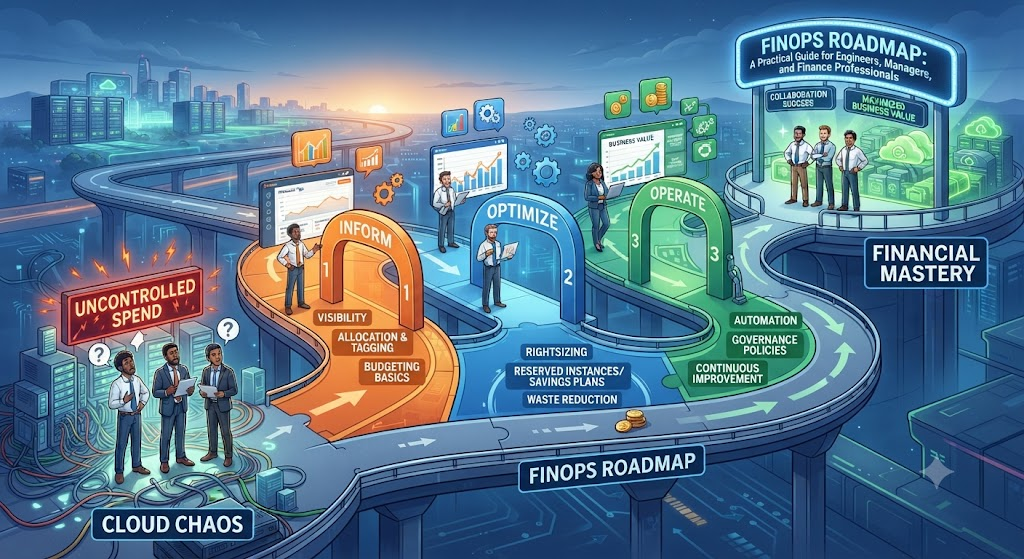
The FinOps Foundation defines the adoption lifecycle in three distinct phases: Inform, Optimize, and Operate. Every organization moves through these phases, regardless of their size.
[ INFORM ] ---> [ OPTIMIZE ] ---> [ OPERATE ]
(Visibility)     (Efficiency)       (Continuous Culture)
1. Inform Phase (Visibility and Allocation)
You cannot manage what you cannot see. The first step of the roadmap is giving everyone clear visibility into cloud spending.
- Allocation: Breaking down the cloud bill so you know which team, product, or customer generated specific costs. This is often done using tagging (adding labels like
team:marketingorenvironment:productionto cloud resources). - Benchmarking: Understanding your unit costs (e.g., how much does it cost to host a single user or process a single transaction?).
- Accountability: Empowering engineers and managers to see their spending dashboards in real-time.
2. Optimize Phase (Taking Action)
Once you have visibility, you look for waste and take immediate steps to reduce it without harming system performance.
- Right-sizing: Changing oversized servers to smaller ones that match actual workload demands.
- Waste elimination: Deleting unattached storage disks, old snapshots, and idle staging environments.
- Commitment discounts: Purchasing Reserved Instances or Savings Plans for predictable, long-term workloads in exchange for steep discounts from cloud providers.
3. Operate Phase (Cultural Maturity)
This is the final destination where FinOps becomes part of the company’s daily routine.
- Continuous monitoring: Setting up automated guardrails and anomaly detection alerts.
- Cross-functional collaboration: Regular meetings where engineering, finance, and product teams review budgets together.
- Refining goals: Aligning cloud spending targets directly with company revenue forecasts.
Why FinOps Requires a Cross-Functional Approach
A common mistake is treating FinOps as a software tool or assigning it entirely to the finance department. Finance professionals often do not understand server architecture, and engineers usually do not track profit margins.
A successful FinOps roadmap relies on three core pillars working together:
| Role | Primary Focus | What They Bring to FinOps |
|---|---|---|
| Engineers | Speed, uptime, and architecture | Deep knowledge of cloud systems and where waste happens. |
| Finance Professionals | Budgets, forecasting, and margins | Clear financial guardrails and unit economics models. |
| Managers / Product Owners | Business value and timelines | Prioritization of features versus cost constraints. |
When these three groups communicate using shared data, friction disappears. Engineers learn to factor cost into their architectural choices, and finance teams gain confidence in cloud budget forecasts.
Step-by-Step FinOps Implementation Roadmap
Building a FinOps practice does not happen overnight. Organizations should follow a structured rollout plan.
Step 1: Establish the FinOps Culture
Before looking at tools or data, get leadership buy-in. Appoint a cross-functional team (often starting small with one interested engineer and one finance analyst). Make it clear that cloud cost management is about efficiency, not punishment.
Step 2: Implement Cost Visibility and Tagging
Create a mandatory tagging policy for all cloud resources.
- What to do: Define standard tag keys (e.g.,
Owner,Environment,CostCenter). - Why it matters: Without tags, your cloud bill is just one giant lump sum. Tags allow you to slice and dice costs by department.
- Common pitfall: Creating too many complex tags. Keep the policy simple so engineers can follow it easily.
Step 3: Set Up Anomaly Detection and Budgets
Set up automated alerts for unexpected spending spikes. If a developer accidentally launches a massive machine learning cluster on a Friday evening, the system should notify the team immediately rather than waiting for a monthly invoice shock.
Step 4: Quick Wins and Waste Cleanup
Run an initial audit to capture low-hanging fruit:
- Shut down non-production environments during nights and weekends.
- Delete unattached network storage volumes.
- Identify and downgrade over-provisioned databases.
These quick savings often fund the internal tools and time needed for deeper optimization.
Step 5: Establish Unit Economics
Move beyond total monthly spending. Calculate metrics that matter to the business, such as Cost per Active User or Cost per Order Processed. If your revenue is growing by 50% while your cloud costs grow by 20%, your unit economics are improving.
Common Mistakes to Avoid
Even with good intentions, teams often stumble during their FinOps journey.
1. Treating FinOps as a One-Time Project
Cloud environments change daily. New code is deployed, traffic fluctuates, and teams launch new features. FinOps is an ongoing operational habit, not a project with an end date.
2. Blaming Engineers for High Bills
If an engineer feels shamed or blamed for a high cloud bill, they will become defensive and hide architectural experiments. Frame high costs as a visibility problem to be solved together, not a personal failure.
3. Focusing Only on Cutting Costs
Cutting cloud spending should never break customer experience, app performance, or system security. Always weigh the financial savings against the potential impact on system reliability.
Risks and Limitations of Cloud Financial Management
While FinOps provides massive benefits, organizations must be aware of its operational trade-offs:
- Over-Engineering: Sometimes teams spend dozens of engineering hours trying to save $50 a month on cloud bills. Always balance the engineering labor cost against the actual cloud savings.
- Commitment Traps: Buying long-term cloud discounts (like 3-year savings plans) can lock a company into old technology if the product architecture needs to change rapidly.
- Tool Fatigue: Buying too many third-party FinOps software platforms before your team is ready can waste money and confuse staff. Start with native cloud provider dashboards before investing in advanced tools.
Key Terms
- Cloud Provider: A company that rents out computing power, storage, and networking over the internet (e.g., AWS, Azure, GCP).
- Right-Sizing: Matching the size and power of a cloud server to its actual workload requirements.
- Reserved Instances / Savings Plans: Discounted pricing models offered by cloud providers in exchange for a 1-year or 3-year usage commitment.
- Unit Economics: Measuring business costs and revenues on a per-unit basis (such as per customer or per transaction).
- Tagging: Attaching metadata labels to cloud resources to track ownership and billing categories.
- Unattached Storage: Digital storage disks that remain active and billable even though they are disconnected from any running server.
- Anomaly Detection: Automated monitoring systems that flag sudden, unusual spikes in spending.
- Over-Provisioning: Buying or reserving much more cloud capacity than your application actually needs.
FAQs
What is the primary goal of FinOps?
The primary goal of FinOps is to maximize business value in the cloud by bringing financial accountability to engineering, finance, and business teams.
Do small startups need FinOps?
Startups can start light by setting up basic budget alerts and simple tagging rules. Implementing lightweight FinOps early prevents bad architectural habits from becoming expensive problems later.
Who should lead the FinOps initiative?
FinOps is usually driven by a champion from finance, engineering, or cloud operations who understands both technical infrastructure and business budgeting.
How does FinOps differ from traditional IT budgeting?
Traditional IT budgeting involves buying fixed hardware every few years. FinOps manages a dynamic, variable cloud utility expense that changes hourly based on system usage.
Will FinOps slow down engineering teams?
When implemented correctly, FinOps actually increases engineering speed by providing clear financial guardrails, automated feedback loops, and transparent resource budgets.
Conclusion
Cloud computing offers unmatched speed and flexibility, but financial control cannot be left to chance. A solid FinOps roadmap transforms cloud spending from an unpredictable monthly headache into a transparent, manageable investment.
By bringing engineers, managers, and finance professionals together with clear visibility, practical optimization steps, and a shared vocabulary, organizations can innovate rapidly without breaking their budgets. Start small, focus on quick visibility wins, and build a collaborative culture where financial efficiency supports business growth.

