
1. Introduction
The MLOps Certified Professional (MLOCP) certification is recognized as a cornerstone for those who wish to master the operational side of Artificial Intelligence. In traditional software development, DevOps solved the problem of slow and manual deployments. However, machine learning introduced new challenges, such as data drift and model retraining, which required a more specialized approach.
This certification matters in today’s ecosystem because AI is no longer a research project; it is a core business driver. For software, cloud, and automation systems to remain reliable, machine learning models must be managed with the same rigor as application code.
Certifications are viewed as essential tools for both engineers and managers. For the engineer, it provides a structured learning environment where skills are validated against industry standards. For the manager, it ensures that the team possesses a unified language and framework for solving complex production issues. By achieving this professional status, the gap between experimental code and scalable production systems is finally closed.
2. Certification Overview Table
| Track | Level | Who it’s for | Prerequisites | Skills Covered | Recommended Order |
| Machine Learning Operations | Expert / Professional | DevOps & Data Professionals | Basic Python & Cloud Knowledge | ML Pipelines, CI/CD, Monitoring, Scaling | Post-DevOps Foundation |
Why Choose DevOpsSchool?
A significant emphasis is placed on the quality of instruction and practical outcomes at DevOpsSchool. This institution is chosen because the training is led by seasoned professionals who have encountered real-world production failures and successes. The curriculum is not just theoretical; it is designed around the actual tools and workflows used by top-tier tech companies. Comprehensive support is provided throughout the learning journey, ensuring that every participant is prepared for the challenges of the modern job market. Furthermore, a vast community of alumni is available for networking and continuous growth, making it a preferred choice for career advancement.
3. Certification Deep-Dive
What is this certification?
The MLOCP is a high-level professional certification that validates an individual’s ability to design, implement, and manage automated machine learning workflows. It is focused on the intersection of data engineering, machine learning, and DevOps practices.
Who should take this certification?
- Software Engineers: Those who want to expand their coding skills into the AI infrastructure domain.
- DevOps and Platform Engineers: Professionals who are tasked with managing the servers and pipelines that host ML models.
- Data Scientists: Individuals who wish to understand how their models are deployed and maintained in the real world.
- IT Managers: Leaders who need to oversee teams working on AI-driven automation projects.
Skills you will gain
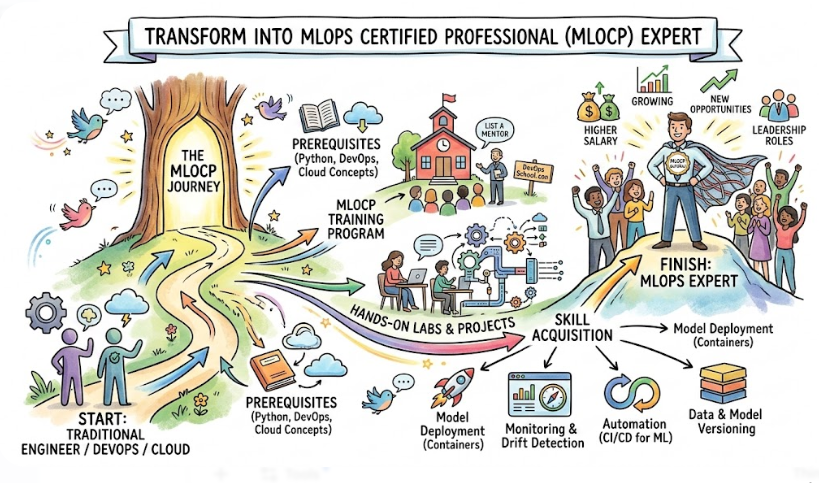
- Automated Pipeline Construction: The ability to build end-to-end CI/CD pipelines specifically for machine learning models is developed.
- Data and Model Versioning: Techniques for tracking changes in datasets and model versions are mastered to ensure reproducibility.
- Infrastructure as Code (IaC) for ML: Skills in using tools like Terraform or CloudFormation to provision environments for ML workloads are acquired.
- Advanced Monitoring: Knowledge of how to monitor model performance and detect “concept drift” in real-time is gained.
- Scalable Deployment: Mastery of containerization tools like Docker and Kubernetes for serving models to millions of users is achieved.
Real-world projects you should be able to do
- End-to-End Image Recognition Pipeline: An automated system is built where new images trigger model retraining and redeployment without manual intervention.
- Fraud Detection System Monitoring: A real-time dashboard is created to track the accuracy of a fraud detection model and alert engineers when performance drops.
- Centralized Model Registry: A secure repository is established where multiple teams can store, version, and share machine learning models.
- Resource Optimized ML Clusters: Kubernetes clusters are configured to scale automatically based on the computational demand of incoming ML requests.
Preparation Plan
- 7–14 Days Plan (The Foundation): The first two weeks are spent understanding the core philosophy of MLOps. Key terminologies and the differences between traditional CI/CD and ML CI/CD are studied. The official MLOCP syllabus is reviewed, and a local development environment with Python and basic Docker is set up.
- 30 Days Plan (Core Tooling): The focus is shifted toward the tools used for data versioning and model tracking. Hands-on practice with model registries is performed. Small models are deployed into containers, and basic automation scripts are written to handle the deployment process.
- 60 Days Plan (Advanced Integration): Detailed attention is given to monitoring, security, and scaling. Full-scale pipelines are integrated with cloud services. Mock exams are taken, and complex real-world scenarios are practiced to ensure all edge cases are understood before the final assessment.
Common mistakes to avoid
- Underestimating Data Management: A common error is focusing too much on the model code while ignoring the complexities of data pipelines.
- Over-Engineering Solutions: Simple problems are often solved with overly complex tools, leading to high maintenance costs.
- Neglecting Security: Many engineers forget to secure the data and the model endpoints, leaving the system vulnerable.
- Lack of Monitoring: Deploying a model without a plan to monitor its performance over time is a frequent mistake that leads to business failure.
Best next certification after this
- Same Track: AIOps Certified Expert (to automate the operations of the ML infrastructure itself).
- Cross-Track: DevSecOps Certified Professional (to ensure the entire pipeline is encrypted and secure).
- Leadership / Management: Platform Engineering Lead (to manage the entire infrastructure department).
4. Choose Your Learning Path
Six distinct paths are identified for professionals based on their current focus and career goals:
- DevOps Path: This is best for those who enjoy the “plumbing” of software. The focus is on automation, server management, and the speed of delivery.
- DevSecOps Path: This path is chosen by those who believe security should never be an afterthought. It involves baking security into every automated step.
- Site Reliability Engineering (SRE) Path: This is the ideal choice for those focused on system uptime and scalability. It is about making sure the system never breaks under pressure.
- AIOps / MLOps Path: This is recommended for the future-focused engineer. It combines the world of data science with the reliability of operations.
- DataOps Path: This path is designed for data enthusiasts who want to ensure that high-quality data is always available for analysis and modeling.
- FinOps Path: This is a modern path focused on cloud cost transparency. It is chosen by those who want to balance high performance with financial efficiency.
5. Role → Recommended Certifications Mapping
To reach the top of the field, the following mappings are suggested:
- DevOps Engineer: MLOps Certified Professional + Kubernetes Mastery.
- Site Reliability Engineer (SRE): SRE Certified Professional + Chaos Engineering.
- Platform Engineer: Platform Engineering Professional + Terraform Certification.
- Cloud Engineer: Multi-Cloud Architect + MLOCP.
- Security Engineer: DevSecOps Certified Professional + Advanced Cloud Security.
- Data Engineer: DataOps Professional + MLOps Certified Professional.
- FinOps Practitioner: FinOps Certified Professional + Cloud Economics.
- Engineering Manager: Leadership in DevOps + MLOps Strategy.
6. Next Certifications to Take
Continuous learning is required in the tech industry. After the MLOCP, these steps are advised:
- One Same-Track Certification: AIOps Professional is recommended to understand how AI can be used to manage the very systems that host ML models.
- One Cross-Track Certification: DevSecOps is suggested to ensure that the machine learning models and the data they use are protected from external threats.
- One Leadership-Focused Certification: Engineering Management for DevOps is advised for those who wish to transition from technical roles into leading large engineering organizations.
7. Training & Certification Support Institutions
- DevOpsSchool: This institution is recognized for its extensive catalog of certifications and its “learning by doing” approach. A deep understanding of both legacy and modern systems is provided to all students.
- Cotocus: Highly specialized training for niche cloud technologies and automation frameworks is offered here. It is a preferred destination for those seeking personalized guidance in their certification journey.
- ScmGalaxy: This platform serves as a massive knowledge hub for the community. It is used by thousands of engineers to stay updated on the latest trends in configuration management and CI/CD.
- BestDevOps: A clear and concise roadmap for career progression is provided by this organization. It is known for its focus on the most industry-relevant skills and certifications.
- devsecopsschool.com: All resources here are dedicated to the integration of security into the DevOps lifecycle. It is the primary school for aspiring security engineers.
- sreschool.com: The curriculum here is focused entirely on the principles of site reliability and high availability. It helps engineers build systems that are truly resilient.
- aiopsschool.com: Specialized training on the use of artificial intelligence to optimize and automate IT operations is provided at this institution.
- dataopsschool.com: This school focuses on the methodology of improving the quality and reducing the cycle time of data analytics.
- finopsschool.com: Training is provided on the financial management of cloud resources, helping organizations maximize the value of every dollar spent on the cloud.
8. FAQs Section
General Career FAQs
- Is the MLOCP certification difficult?
A moderate level of difficulty is expected, as it requires knowledge of both DevOps tools and machine learning concepts. - How much time should be spent on daily study?
At least 1–2 hours of daily study is recommended for a period of two months. - Are coding skills required?
Yes, a basic understanding of Python is necessary for script automation and model handling. - Is cloud knowledge a prerequisite?
While not mandatory, it is highly beneficial to understand how platforms like AWS or Azure operate. - Can a fresher take this certification?
It is recommended that basic DevOps concepts are mastered before attempting the MLOCP. - What are the primary job roles after certification?
Roles such as MLOps Engineer, DataOps Engineer, and Cloud Architect become accessible. - Is the certification recognized globally?
Yes, it is valued by companies worldwide that are adopting AI and machine learning at scale. - Does the certification help with career growth?
It provides a clear path to senior and lead engineering positions by validating high-demand skills. - Are there any renewals needed?
Renewal is typically suggested every few years to stay updated with the latest technological shifts. - Is the exam practical or theoretical?
A combination of both is used to ensure that practical implementation skills are truly mastered. - Can this help in transitioning from a non-tech role?
It is a technical certification, so some foundational background in IT is usually required. - Is training mandatory before the exam?
While not mandatory, it is highly recommended to follow a structured training program like those offered by DevOpsSchool.
MLOps Certified Professional (MLOCP) Specific FAQs
- Is Docker covered in the MLOCP syllabus?
Yes, containerization is a fundamental part of the deployment process taught in the program. - How is MLOCP different from a Data Science certificate?
MLOCP focuses on the “engineering” and “operational” side, whereas data science focuses on the “mathematics” and “modeling.” - Are real-world datasets used in the training?
Yes, practical labs are performed using realistic datasets to simulate production environments. - Is Kubernetes used for the deployment labs?
Kubernetes is a primary focus for learning how to scale ML models effectively. - Is there any focus on security?
Security best practices for ML pipelines are integrated throughout the course. - Can the exam be taken in multiple languages?
Currently, the primary language for the exam and materials is English. - What is the value of MLOCP for an SRE?
It helps SREs understand how to maintain the uptime and reliability of AI-driven services. - Is post-training mentorship available?
Ongoing support and community access are provided to help learners with their real-world projects.
9. Testimonials
- Kavita, Cloud Engineer: A significant improvement in my technical confidence was noticed after completing the MLOCP. The complex world of ML deployment was made easy to understand.
- Suresh, SRE: The way our team handles model failures was completely changed. The monitoring techniques learned are now being applied to all our production systems.
- Meera, DevOps Engineer: I found the hands-on labs to be incredibly helpful. The career clarity I gained has allowed me to move into a specialized MLOps role.
- Rahul, Security Analyst: The security of our ML pipelines was greatly enhanced. I am now able to identify risks that were previously overlooked.
- Ishaan, Engineering Manager: Strategic planning for our AI projects is now much more effective. The technical depth provided by this program is unmatched.
Conclusion
The MLOps Certified Professional (MLOCP) is more than just a credential; it is a gateway to the future of engineering. As the world shifts toward AI-native applications, the demand for professionals who can manage these systems will continue to rise. By completing this certification, long-term career benefits such as job stability, higher compensation, and leadership opportunities are secured.
A strategic approach to learning is recommended. By focusing on the practical application of these skills, a resilient and high-growth career path is built in the ever-evolving tech landscape.
