
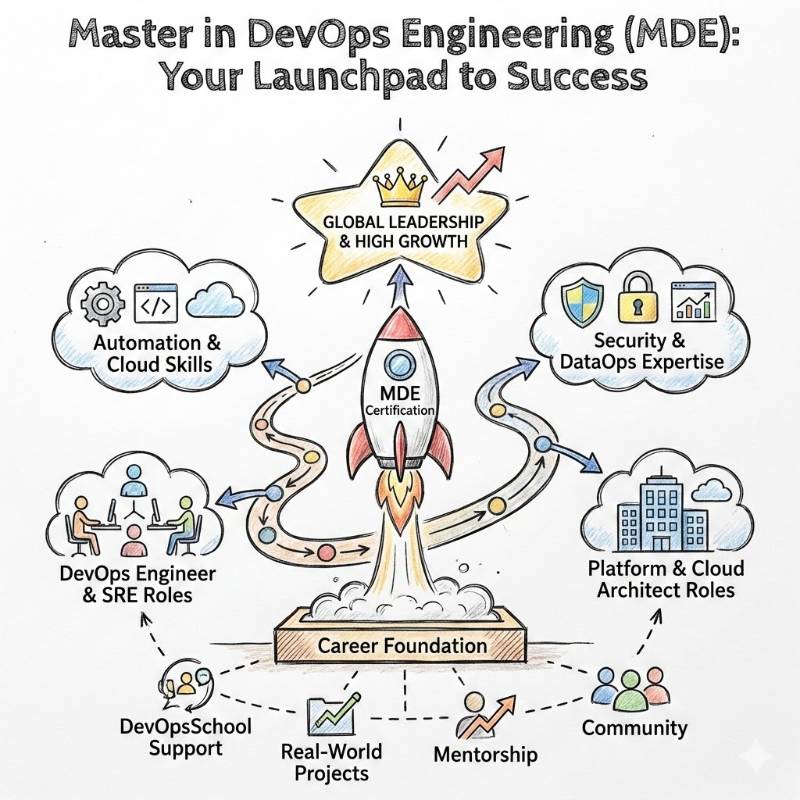
1. Introduction
The software development world is moving faster than ever before. To keep up with this pace, the way code is built, tested, and deployed has been completely transformed. This is exactly where the Master in DevOps Engineering (MDE) comes into play. It is a comprehensive framework that was created to bridge the long-standing gap between development teams and operations teams. By focusing on automation, scalability, and security, it is ensured that software is delivered to users reliably and without delay.
In today’s technology ecosystem, a deep understanding of cloud computing and automation is no longer considered optional. Companies are constantly searching for professionals who can manage complex infrastructures without the risk of manual errors. The MDE program was specifically built to address these urgent industry needs. It covers not just the tools, but also the essential mindset that is required to succeed in modern engineering roles.
Certifications are viewed as a vital part of any professional journey. For engineers, a structured way to learn and validate new skills is provided by these programs. For managers, certifications offer a reliable benchmark to measure the actual expertise of a team. Having a recognized credential like the MDE helps in gaining trust from employers and clients in both Indian and global markets. It is seen as a clear sign of a commitment to continuous learning and technical excellence.
2. Certification Overview Table
| Track | Level | Who it’s for | Prerequisites | Skills Covered | Recommended Order |
| DevOps | Master | Engineers & Managers | Basic Linux & Scripting | CI/CD, IaC, Monitoring | Foundation → MDE |
Why Choose DevOpsSchool?
DevOpsSchool is chosen by thousands of professionals because of its heavy focus on practical, real-world training. The curriculum is updated on a regular basis to match exactly what is happening in the industry at this moment. Students are taught by trainers who have spent years handling large-scale production environments for major corporations. The support that is provided both during and after the course helps in mastering complex tools with much less effort. It is regarded as a community where learning is continuous and support is always available.
3. Certification Deep-Dive
Master in DevOps Engineering (MDE)
What is this certification?
This certification is an advanced, high-level program that was designed to provide a deep and thorough knowledge of DevOps practices. A focus is placed on the entire lifecycle of software development, ensuring that every step from the initial code commit to the final production release is handled with precision.
Who should take this certification?
It is intended for software engineers, system administrators, and technical leads who want to elevate their careers. Anyone who is looking to move into a specialized DevOps, Platform Engineering, or SRE role will find this certification to be highly beneficial for their growth.
Skills you will gain
- The ability to automate complex software builds and deployments is developed.
- Knowledge of managing entire infrastructures using code (IaC) is acquired.
- Robust monitoring and logging systems are designed and implemented.
- Containerization and orchestration techniques using Docker and Kubernetes are mastered.
- Collaboration and communication between different technical teams are significantly improved.
- Security is integrated into the heart of the delivery process.
Real-world projects you should be able to do after this certification
- A fully automated CI/CD pipeline for a microservices-based application is built from scratch.
- A highly scalable and fault-tolerant Kubernetes cluster is deployed on a public cloud provider.
- Automated security scanning and compliance checks are created within the software delivery process.
- A zero-downtime deployment strategy, such as Blue-Green or Canary, is successfully designed.
- A centralized logging and monitoring dashboard is set up to track system health in real-time.
Preparation Plan
- 7–14 Days Plan: A focus is placed on the core philosophy and the “why” behind DevOps. The basics of Git version control, Docker containers, and essential Linux commands are learned. It is understood how these fundamental pieces fit together to form a larger system.
- 30 Days Plan: A deep dive into CI/CD tools like Jenkins or GitLab CI is performed. Practice is started with Infrastructure as Code (IaC) using tools like Terraform or Ansible. Simple, automated workflows are set up to gain confidence in the process.
- 60 Days Plan: Advanced orchestration is worked on using Kubernetes. Complex monitoring solutions using Prometheus and Grafana are implemented. At least two end-to-end, real-world projects are completed to solidify the knowledge gained.
Common mistakes to avoid
- A focus is placed only on learning tools while the cultural and human side of DevOps is ignored.
- Too many tools are tried to be learned at once instead of mastering the core fundamentals first.
- The critical importance of security is neglected during the creation of automation processes.
- Documentation is often forgotten, making it difficult for others to understand the automated systems.
Best next certification after this
- Same track: Advanced Kubernetes Security or Cloud-Specific Professional Architect.
- Cross-track: Site Reliability Engineering (SRE) Foundation.
- Leadership / management: DevOps Leader (DOL) certification for those moving into management.
4. Choose Your Learning Path
1. DevOps Path
This path is best for individuals who want to focus on the core delivery and automation of software. It is ideal for developers or system administrators who want to ensure the path from code to production is as smooth and fast as possible.
2. DevSecOps Path
This is designed specifically for security-minded engineers. It is best for those who want to ensure that security is not an afterthought but is integrated into every single step of the automated delivery pipeline.
3. Site Reliability Engineering (SRE) Path
This path is focused heavily on the stability, performance, and reliability of large-scale systems. It is best for professionals who enjoy solving complex operational puzzles and managing environments that can never go down.
4. AIOps / MLOps Path
This is meant for data scientists and engineers who want to automate the deployment and management of machine learning models. It is best for those working in cutting-edge, AI-driven technical environments.
5. DataOps Path
This path focuses on the seamless flow of data within an organization. It is best for data engineers and analysts who want to bring the discipline and speed of DevOps to their data pipelines.
6. FinOps Path
This is best for professionals who want to manage and optimize cloud costs effectively. It is ideal for those who sit at the intersection of finance and engineering, ensuring that the cloud is used efficiently.
5. Role → Recommended Certifications Mapping
- DevOps Engineer: Master in DevOps Engineering (MDE) and Kubernetes Administration (CKA).
- Site Reliability Engineer (SRE): SRE Practitioner and MDE.
- Platform Engineer: Cloud Native Professional and MDE.
- Cloud Engineer: AWS/Azure/GCP Solutions Architect and MDE.
- Security Engineer: DevSecOps Professional and MDE.
- Data Engineer: DataOps Certified Professional and MDE.
- FinOps Practitioner: FinOps Certified Practitioner and Cloud Cost Management.
- Engineering Manager: DevOps Leader and MDE for technical oversight.
6. Next Certifications to Take
For every learner who completes the MDE, a strategic next step is recommended to stay ahead of the market:
- One same-track certification: Certified Kubernetes Administrator (CKA) is often pursued to deepen container expertise.
- One cross-track certification: SRE Foundation is recommended to understand how to maintain systems at scale.
- One leadership-focused certification: DevOps Leader (DOL) is suggested for those who wish to guide teams through digital transformations.
7. Training & Certification Support Institutions
DevOpsSchool
Extensive training programs are provided here for all levels of expertise. A very strong emphasis is placed on hands-on labs and solving real-world scenarios. It is a highly respected name for anyone seeking the MDE certification.
Cotocus
This institution is recognized for its specialized consulting and high-end training services. Deep technical knowledge is shared by industry experts to help teams adopt modern engineering practices. It is a great place for those seeking personalized learning.
ScmGalaxy
A massive community and resource hub is maintained by this platform. Highly valuable insights into configuration management and various DevOps tools are provided to members. It serves as a solid support system for independent and lifelong learners.
BestDevOps
Focus is placed on delivering high-quality training content that is made very easy to follow. Simplified learning paths are created for even the most complex technical topics. It is highly recommended for those who are just starting their journey.
DevSecOpsSchool.com
This platform is dedicated entirely to the critical integration of security into the DevOps process. Specialized courses are offered to help engineers master the art of security automation. It is the primary destination for security-focused professionals.
Sreschool.com
Everything related to system reliability, performance, and scalability is covered here. The curriculum is designed to teach the exact principles used by top-tier global tech companies. It is ideal for aspiring Site Reliability Engineers.
Aiopsschool.com
The fascinating intersection of Artificial Intelligence and Operations is explored at this institution. Training is provided on how to use AI to improve system monitoring and incident response. It is perfect for future-looking engineers.
Dataopsschool.com
Modern techniques for managing data pipelines with high agility are taught here. The focus is placed on improving data quality and reducing the time to market for data products. It is essential for modern data-driven teams.
Finopsschool.com
Financial management in the modern cloud era is the primary focus of this school. Methods for optimizing cloud spending while maintaining high performance are shared. It is highly valuable for those managing cloud budgets.
8. FAQs Section
1. How difficult is the MDE certification?
The difficulty level is considered advanced, but success is achieved through consistent practice and a strong understanding of technical basics.
2. How much time is required to prepare for MDE?
Typically, two to three months of preparation are needed if a few hours are dedicated to study and practice each day.
3. What are the prerequisites for this program?
A basic understanding of the Linux command line, some scripting knowledge, and familiarity with the software development lifecycle are recommended.
4. In what sequence should certifications be taken?
It is usually suggested to start with a foundation-level course before moving on to the Master in DevOps Engineering program.
5. What is the real career value of this certification?
A very high demand is seen in the global industry for certified professionals, which often leads to better job opportunities and higher salary packages.
6. Which job roles can be applied for after completing MDE?
Roles such as DevOps Engineer, Cloud Architect, SRE, and Release Manager can be successfully pursued.
7. Is a lot of coding required for a career in DevOps?
While deep software development isn’t always needed, basic scripting and an understanding of code are necessary to automate tasks effectively.
8. How long is the MDE certification valid?
Most industry-standard certifications are valid for two to three years, after which renewal or moving to a higher-level certification is suggested.
9. Can a complete fresher take this certification?
It is possible for a fresher to take the course, but some prior knowledge of how software is built will make the learning process much smoother.
10. Is the MDE certification recognized globally?
Yes, the skills and tools taught in this program are based on global standards that are used by major technology firms around the world.
11. Does this certification help in securing a remote job?
Absolutely, as many DevOps and Cloud roles are perfectly suited for remote work and are highly sought after by companies worldwide.
12. How does MDE differ from a standard Cloud provider certification?
Cloud certifications focus on one specific platform, while MDE focuses on the universal processes and tools that work across any cloud platform.
Questions Focused on the MDE Program
1. What makes MDE unique compared to other training programs?
A very wide range of tools and the entire software lifecycle are covered in a single, comprehensive, and cohesive program.
2. Is there a lab component included in the MDE training?
Yes, hands-on practical labs are a core part of the training to ensure that real, usable skills are gained by every student.
3. Are there practice exams available for students?
Practice tests and mock exams are usually provided to help students get comfortable with the actual exam format and timing.
4. What kind of support is provided after the training is finished?
Continued mentorship and access to a large community of experts are often made available to help with career growth and technical hurdles.
5. Is the MDE curriculum updated for the year 2026?
The curriculum is reviewed and updated on a regular basis to include the latest tools, trends, and industry best practices.
6. How much does the MDE certification cost?
The pricing varies depending on the specific training package and support level chosen, but it is considered a high-value long-term investment.
7. Can MDE lead to a path in technical management?
Yes, the deep technical foundation provided by the MDE is exactly what is needed to lead and manage engineering teams effectively.
8. Why is MDE important for companies undergoing digital transformation?
It provides the speed, reliability, and security that companies must have to stay competitive in today’s digital-first world.
9. Testimonials
Aarav
“My technical skills were greatly improved by the MDE program. The focus on real-world automation has made my daily tasks much more efficient and productive.”
Priya
“Career clarity was finally gained after I completed this certification. The transition from a traditional operations role to an SRE role was made much smoother than expected.”
Vikram
“Confidence growth was the biggest benefit for me personally. I now feel fully capable of designing and managing complex cloud infrastructures for any scale of business.”
Ananya
“The practical application of security tools within the automated CI/CD pipeline was eye-opening. It has completely changed the way I approach my daily work as an engineer.”
Arjun
“Better alignment within my entire team was achieved thanks to the principles learned in the MDE. It is a must-have for any technical leader in today’s market.”
10. Conclusion
The Master in DevOps Engineering (MDE) certification is a powerful and essential tool for any engineer looking to stay ahead in a fast-changing world. The necessary skills, the correct mindset, and the professional validation needed to succeed in a competitive market are all provided by this program. By focusing on automation and collaboration, long-term career benefits are secured for the future. Strategic learning and careful certification planning are strongly encouraged for anyone who is serious about their professional growth in the cloud and automation space.
