
Introduction
In the modern landscape of digital services, the reliability of a system is treated as a foundational feature rather than an afterthought. For a long time, a gap existed between the people who wrote the code and the people who maintained the servers. This gap often led to slow deployments and frequent system failures. Site Reliability Engineering (SRE) was introduced to solve these specific problems by applying a software engineering mindset to system operations.
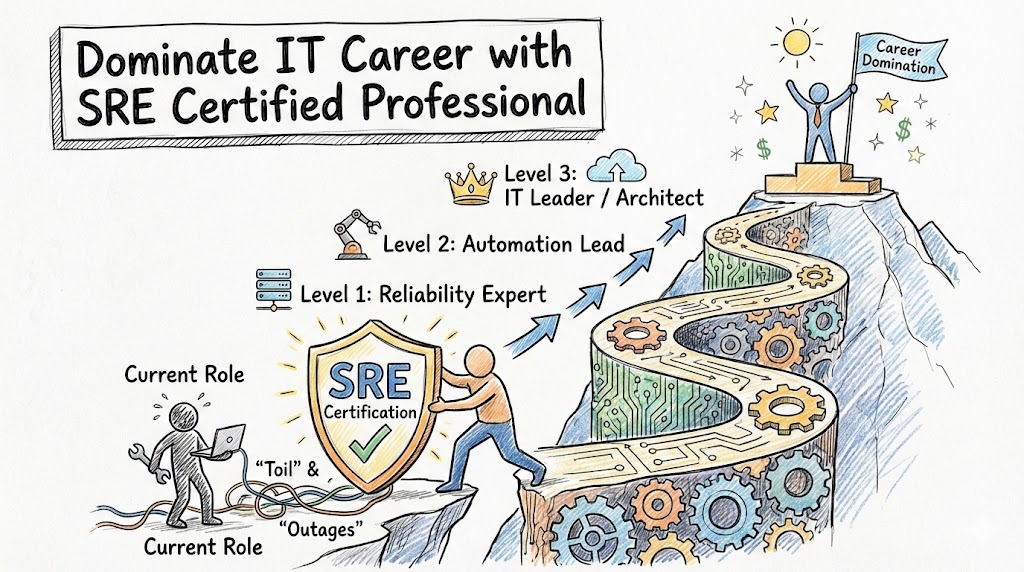
The SRE Certified Professional program is structured to help engineers move beyond traditional administration. It is focused on how large-scale systems are managed using code and automation. The certification is not just about learning a new tool; it is about adopting a methodology where operational tasks are handled as if they were software problems. By doing this, the reliability of the platform is increased while the manual workload of the engineer is decreased.
Certifications are highly valued in today’s competitive market because they provide a standardized benchmark for skill. For engineers, it serves as a formal validation of their ability to handle production environments. For managers, these certifications are important because they ensure that the entire team is aligned with the same best practices and vocabulary. When everyone understands what an “Error Budget” or a “Service Level Objective” is, the efficiency of the organization is naturally improved.
Certification Overview Table
| Track | Level | Who it’s for | Prerequisites | Skills Covered | Recommended Order |
| SRE | Professional | Software Engineers, DevOps, SREs | Basic Linux & Coding | Error Budgets, SLIs/SLOs, Automation | Foundational to Advanced |
Why Choose DevOpsSchool?
The choice of a training institution is a critical decision for any professional looking to advance their career. DevOpsSchool is often selected because the curriculum is built by veterans who have spent years managing complex infrastructures. The training is not limited to theory; it is heavily focused on the practical application of SRE principles.
Students are provided with an environment where real-world failures are simulated, allowing them to practice their response skills in a safe setting. Furthermore, the support provided by DevOpsSchool extends beyond the classroom. Guidance is offered for exam preparation and career transitions, ensuring that every learner has the tools needed to succeed. The institution is recognized for its commitment to quality and its ability to stay updated with the latest industry shifts.
Certification Deep-Dive: SRE Certified Professional
What is this certification?
This is a comprehensive professional-level program that defines the role of a Site Reliability Engineer. It is designed to teach how software engineering practices can be used to create highly available and scalable systems. The focus is placed on the balance between releasing new features and ensuring that the system remains stable for the users.
Who should take this certification?
This program is ideal for Software Engineers who wish to understand the operational side of their code. It is also highly beneficial for System Administrators who want to transition into a role that requires more programming and automation. Platform Engineers and Cloud Architects will find the content extremely relevant for managing modern cloud-native infrastructures. Even Engineering Managers should consider this certification to better lead teams that are responsible for system uptime.
Skills you will gain
- Defining Reliability: Methods for measuring the health of a service using Service Level Indicators (SLIs) and Service Level Objectives (SLOs) are mastered.
- Risk Management: The concept of Error Budgets is learned, allowing teams to make data-driven decisions about when to push updates and when to focus on stability.
- Toil Reduction: Strategies for identifying and eliminating “toil”—manual, repetitive work—through advanced automation are developed.
- Incident Response: The process of managing production incidents and performing blameless post-mortems is practiced to ensure that the same mistake is never made twice.
- Monitoring and Alerting: Skills in building observable systems that provide meaningful alerts instead of “noise” are gained.
- Capacity Planning: The ability to predict system growth and plan for resource needs before they become a problem is cultivated.
Real-world projects you should be able to do after this certification
- Service Level Dashboard: A dashboard is created that tracks the actual user experience against the defined SLOs in real-time.
- Automated Remediation: A system is built where common failures are automatically detected and fixed by a script without human intervention.
- Blameless Post-Mortem Report: A detailed analysis of a simulated system outage is conducted, focusing on process improvements rather than human blame.
- Infrastructure as Code (IaC): Large-scale environments are deployed and managed entirely through code, ensuring consistency and speed.
Preparation plan
- 7–14 days plan: The focus is placed on understanding the history and core philosophy of SRE. The differences between DevOps and SRE are studied. Initial readings from recommended handbooks are completed.
- 30 days plan: Hands-on practice with monitoring and logging tools is started. The math behind SLIs and SLOs is practiced using sample data. Basic automation scripts for common tasks are written.
- 60 days plan: Deep dives into complex topics like distributed systems and networking are performed. Mock exams are taken to identify weak areas. Real-world case studies of system failures are reviewed and analyzed.
Common mistakes to avoid
- Tool Obsession: A common error is focusing only on learning specific software tools while neglecting the underlying cultural and philosophical changes needed for SRE.
- Unrealistic SLOs: Many beginners set reliability targets at 100%, which is impossible and expensive. Learning how to set realistic targets is crucial.
- Ignoring Toil: If manual work is not identified and automated early, the engineer will eventually be overwhelmed as the system grows.
Best next certification after this
- Same track: Advanced SRE Practitioner or Chaos Engineering Specialist.
- Cross-track: DevSecOps Professional or Cloud Security Architect.
- Leadership / management: SRE Manager or Digital Operations Leader.
Choose Your Learning Path
- DevOps Path: This is best for those who want to oversee the entire lifecycle of software. It focuses on the speed of delivery and the collaboration between various departments.
- DevSecOps Path: This path is designed for engineers who believe that security is everyone’s responsibility. It teaches how to bake security into the automation pipeline from the start.
- Site Reliability Engineering (SRE) Path: This is the ideal choice for those who are passionate about the technical challenges of scale and stability. It is about making sure the system works perfectly every time a user clicks a button.
- AIOps / MLOps Path: This path is intended for those who want to use data science to manage IT operations. It involves using algorithms to predict failures and managing the deployment of machine learning models.
- DataOps Path: This is best for professionals who manage massive data sets. It ensures that data pipelines are reliable, fast, and produce high-quality information for the business.
- FinOps Path: This path is for those who want to bridge the gap between engineering and finance. It focuses on ensuring that cloud resources are used in the most cost-effective way possible.
Role → Recommended Certifications Mapping
- DevOps Engineer: DevOps Professional, SRE Certified Professional, and CI/CD Expert.
- Site Reliability Engineer (SRE): SRE Certified Professional, Chaos Engineering, and Kubernetes Specialist.
- Platform Engineer: SRE Certified Professional, Infrastructure as Code Expert, and Cloud Architect.
- Cloud Engineer: Cloud Practitioner, SRE Certified Professional, and Network Automation.
- Security Engineer: DevSecOps Professional, Security Automation, and SRE Certified Professional.
- Data Engineer: DataOps Professional, Big Data Architect, and SRE Certified Professional.
- FinOps Practitioner: FinOps Certified, Cloud Cost Management, and SRE Certified Professional.
- Engineering Manager: SRE Certified Professional, Agile Leadership, and Digital Transformation.
Next Certifications to Take
To maintain a competitive edge, continuous learning is required. Once the SRE certification is obtained, the following steps are suggested:
- Same-track: A certification in Chaos Engineering is recommended to learn how to proactively find weaknesses in a system before they cause an outage.
- Cross-track: A Cloud Native Security certification is advised because a reliable system must also be a secure system.
- Leadership-focused: For those moving into management, a course on Leading Technical Teams or SRE Management is highly beneficial for understanding how to build reliable cultures.
Training & Certification Support Institutions
DevOpsSchool
This institution is recognized for its hands-on approach to technical training. Extensive labs and mentorship are provided to ensure that students can apply what they learn in a real job environment.
Cotocus
A global leader in high-end technical training, Cotocus provides support for both individuals and large organizations. Specialized tracks in SRE and Cloud are offered to help professionals stay ahead of the curve.
ScmGalaxy
This community-focused platform provides a wealth of resources for those interested in configuration management and automation. It is a vital resource for staying updated on the latest open-source tools.
BestDevOps
Curated learning paths are provided here to ensure that the most important skills are mastered first. The focus is on helping students achieve certification through high-quality instruction and support.
devsecopsschool.com
The curriculum here is designed specifically for the intersection of security and operations. It is the premier place for learning how to secure automated pipelines.
sreschool.com
As the name suggests, the focus is entirely on Site Reliability Engineering. Every aspect of the SRE role, from monitoring to incident response, is covered in great detail.
aiopsschool.com
The future of operations is taught here. Students are shown how to use Artificial Intelligence and Machine Learning to make IT systems smarter and more self-healing.
dataopsschool.com
This institution focuses on the reliability and speed of data workflows. It is designed for engineers who want to apply DevOps principles to the world of data science.
finopsschool.com
Financial management in the cloud is the core focus here. Training is provided to help organizations get the most value out of their cloud investments.
FAQs Section
- What is the core difference between SRE and DevOps?
DevOps is a set of cultural philosophies, whereas SRE is a specific implementation of those philosophies using software engineering. - How long does it take to get SRE certified?
A period of 4 to 8 weeks is usually sufficient if consistent study is maintained. - Is coding required for this certification?
Yes, a basic ability to read and write code in languages like Python or Go is necessary for the SRE role. - Are there any age limits for taking the exam?
No, anyone with the required technical knowledge can take the certification exam. - How does SRE certification impact salary?
A significant increase in salary is often seen because SRE is one of the highest-paying roles in the tech industry. - Can I take the training online?
Yes, most of the training institutions mentioned provide flexible online learning options. - Is the SRE Certified Professional exam difficult?
It is considered a professional-level exam, so a deep understanding of the concepts and practical experience is required to pass. - What happens if I fail the exam?
Retake options are usually provided by the certification body after a short waiting period. - Are SLIs and SLOs important for the exam?
Yes, these are central themes and will be covered extensively in the questions. - Do I need to know Kubernetes?
While not always a strict prerequisite, a basic understanding of Kubernetes is very helpful as it is the standard for modern SRE. - Is this certification recognized globally?
Yes, the principles of SRE are universal, and the certification is recognized by major tech companies worldwide. - How often should I renew my certification?
It is recommended that certifications be updated every 2 to 3 years to stay current with new technologies.
SRE Certified Professional Specific FAQs
- Is the SRE Certified Professional course lab-based?
Yes, the course is designed with many practical labs to ensure that real-world skills are developed. - What is “Toil” as defined in this certification?
Toil refers to manual, repetitive, and automatable tasks that provide no long-term value to the system. - How is incident management taught in this program?
It is taught using a structured approach that includes detection, response, mitigation, and post-mortem analysis. - Is Cloud experience required before taking this course?
A basic understanding of how the cloud works is helpful, but the core principles can be learned by anyone with a technical background. - What is the weightage of automation in the exam?
Automation is a major component, often making up a significant portion of the total exam score. - Can this certification help me move into a leadership role?
Yes, the data-driven approach used in SRE is highly valued in technical management and leadership. - What support is available for students at DevOpsSchool?
Mentorship, forum access, and study materials are provided to all enrolled students. - Is there a community for SRE Certified Professionals?
Yes, a large network of certified professionals exists where knowledge and job opportunities are shared.
Testimonials
- Arjun: “A deep understanding of system reliability was gained through this program. The practical labs were the highlight of the training.”
- Meera: “Career clarity was achieved after completing the SRE certification. The focus on automation has completely changed my daily workflow.”
- Karan: “The confidence to lead production incident calls was developed. Learning how to conduct blameless post-mortems was a game-changer for my team.”
- Deepa: “Skill improvement was immediate. I was able to reduce the manual toil in my department by 40% within a few months of getting certified.”
- Rohan: “Real-world application of SRE principles was the most valuable part of the course. It is a must-have for any modern engineer.”
Conclusion
The SRE Certified Professional certification is an essential step for any engineer who wants to excel in the world of modern cloud operations. By focusing on reliability, automation, and data-driven decision-making, professionals can ensure that they remain relevant in an ever-changing industry. The long-term career benefits are clear: higher growth, better roles, and the ability to build systems that truly work. Strategic learning through recognized institutions is the key to unlocking these opportunities.
